The American frontier wasn’t just a place of tumbleweeds and cowboy hats—it was a powder keg of violence, where the line between lawman and outlaw blurred faster than a lightning draw. From a dentist turned deadly gunslinger to a Bible-quoting killer, these were real people whose stories defy belief. Their names still echo through dusty saloons and Hollywood Westerns, but the truth is far more fascinating—and far bloodier—than any legend.
Step into the untamed West, where every bullet had a story and every gunslinger a secret. What you’re about to discover will make you question everything you thought you knew about the Wild West.
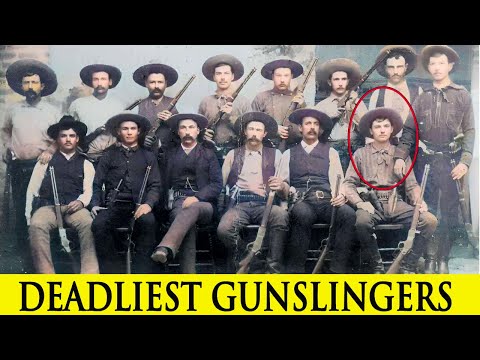
Take Doc Holliday, for instance. Born John Henry Holliday, he was a educated dentist with a promising future—until tuberculosis stole his health at just 15. Chasing dry air and new beginnings, he headed west and found violence, cards, and a place in history. In Tombstone, Arizona, he stood beside Wyatt Earp at the OK Corral, wounded in the hip yet still fighting. But Holliday wasn’t just a quick draw; he was intelligent, well-read, and connected—so much so that Colorado’s governor refused to extradite him for murder. He died young, penniless, but his legend lives on, tangled in fact and folklore.
Then there’s Johnny Ringo, the Shakespeare-quoting outlaw. Quiet, brooding, even elegant, Ringo could kill with his Colt but also knew his Hamlet. He drifted through Texas, New Mexico, and Tombstone, always searching—maybe for trouble, maybe for meaning. During the famous gunfight at the OK Corral, he wasn’t there, leaving one of the great what-ifs of the Old West. In 1882, he was found dead under a tree, a gunshot to the head. Officials called it suicide, but others whispered of murder. His story ends with a question, and that’s exactly how legends are born.
And who could forget Bass Reeves? Born into slavery in 1838, he escaped to Indian Territory during the Civil War, learning Native languages that would later give him an edge no other lawman had. In 1875, Judge Isaac Parker made him the first black deputy marshal west of the Mississippi. Over 30 years, Reeves arrested more than 3,000 criminals and killed 14 outlaws—all in self-defense. He couldn’t read or write, but his photographic memory allowed him to memorize entire warrants after hearing them once. He even arrested his own son when the boy was wanted for murder. Reeves lived by a code of justice, fearless and relentless.
These are just a few of the deadliest gunslingers who roamed the American frontier. Their stories are stranger than fiction, and their legacies still haunt the dusty trails of the Old West. But this is only the beginning—there are more legends to uncover, more myths to unravel, and more truths to face. Stay with us as we ride deeper into the untamed lives of the most dangerous gunslingers in history.
But the frontier had a way of producing men whose darkness ran far deeper than any Hollywood villain. Men like Buckskin Frank Leslie, who earned his nickname for the fringed jacket he wore while scouting for the U.S. Army in the 1870s. He could shoot with pinpoint accuracy and had a temper that flared as fast as his draw. When he rode into Tombstone around 1880, the town took notice quickly.
Frank wasn’t shy about using his gun, and he didn’t always kill in self-defense. The deaths of May Colleen and Billy Clayborne painted a clear picture: Buckskin Frank didn’t hesitate. He shot to kill and rarely missed. But the story takes a darker turn in 1889 when he shot and killed his own wife, Molly. That act landed him behind bars at Yuma Territorial Prison, sentenced to 25 years.
Yet here’s where things get strange—after only seven years, he was granted parole, thanks largely to a woman who would later become his wife. Whether she believed in his redemption or was simply charmed by the legend, her efforts opened the prison gates. By 1922, Buckskin Frank had all but vanished from public records. Some say he reformed. Others say the West just moved on without him.
Then there was Orin Porter Rockwell, a man who wasn’t your typical gunslinger. He wasn’t robbing banks or rustling cattle—his story was tied closely to the rise of the Mormon faith in 19th-century America. He served as a personal bodyguard for Joseph Smith and later Brigham Young, and when things got rough, Porter was the man they sent.
Joseph Smith reportedly prophesied that if Rockwell never cut his hair and stayed faithful, no enemy would ever take his life. Sounds like a legend, right? But Rockwell lived through countless gunfights, close calls, and ambushes. He even tried to break Joseph Smith out of Liberty Jail—a risky move that could have ended with him swinging from a noose. But that was Rockwell, loyal to the end.
He wasn’t a saint, though. The deaths of the Aken brothers still raised questions, and when he shot Lot Huntington, Brigham Young’s own nephew, folks couldn’t believe it. But in Rockwell’s mind, it was justice. Was he a hero, a villain, or something in between? Maybe all three. He was a force of nature, and in the lawless West, sometimes that was exactly what you needed.
Of course, not every legendary figure carried a gun for darkness. Annie Oakley—Little Sure Shot—was a woman who broke every rule the Wild West had for her gender. Born Phoebe Anne Mosey in 1860, she picked up a rifle as a young girl to put food on the table after her father passed. By fifteen, she outshot Frank E. Butler, one of the most respected marksmen around. That contest sparked a love story, and together they joined Buffalo Bill’s Wild West Show.
Annie could split a playing card edge-wise, shoot targets while looking in a mirror, and hit a dime tossed in the air. Even Sitting Bull, impressed by her talent, gave her the nickname that stuck forever. When World War I broke out, she offered to train women sharpshooters for the U.S. military—proving once again she was ahead of her time. She passed away in 1926, just eighteen days after Frank. Even in death, they were inseparable.
But for every Annie Oakley, there was a Bill Longley—a man remembered for something far more sinister than skill or charisma. Born in Texas in 1851, Longley’s path into lawlessness started young. By sixteen, he had already killed a man. He grew up in the bitter aftermath of the Civil War, and he didn’t just resist change—he hated it. He hunted Union sympathizers, terrorized freed slaves, and stood out even in lawless territory for how vicious and targeted his violence was.
His crimes eventually caught up with him. He was captured, tried, and sentenced to hang. But even his execution became the stuff of grim legend. On the day of his hanging, Longley joked and laughed as if death meant nothing. Then the rope broke, and he landed on his feet. The crowd gasped—some even thought it was divine intervention. But the law wasn’t swayed. The hangman reset the gallows, and Bill Longley was hanged a second time, this time successfully.
And then there’s Bat Masterson—gunslinger, lawman, gambler, and later a sports writer in New York City. Born in Canada in 1853, Bat made his way to the frontier as a young man, starting as a buffalo hunter. In 1874, he survived the Battle of Adobe Walls in Texas, one of the defining skirmishes between buffalo hunters and Native American warriors. Not long after, he was involved in a deadly saloon shootout, killing a soldier named Melvin A. King.
His real turning point came in Dodge City, Kansas, where he met Wyatt Earp. Earp saw something in Masterson and urged him to become a lawman. As sheriff of Ford County, Bat cleaned up the streets with a mix of charm, smarts, and a willingness to draw when needed. But law enforcement didn’t hold him forever. He drifted back to gambling halls and high-stakes card tables—until the surprise twist. In his later years, Bat swapped his revolver for a pen, becoming a sports writer covering boxing in New York City. He found a new kind of fame far from the frontier.
And then there was the Sundance Kid—fast draw, faster escape. Born in 1867, he left home at just fifteen, chasing opportunity or maybe just running from boredom. By 1887, a horse theft charge landed him in jail and earned him the nickname that stuck forever. Before long, he found his place among Butch Cassidy’s Wild Bunch—organized, calculated, and daring. With Sundance’s speed on the draw and unmatched marksmanship, they robbed banks and trains with clockwork precision.
By 1901, the heat was closing in. Sundance, Butch, and Sundance’s mysterious companion Etta Place packed up and headed south to Argentina. But their outlaw spirit didn’t retire—they picked up right where they left off, robbing banks and dodging capture. And then the trail goes cold. Did he die in a shootout in Bolivia? Or did he quietly slip away into another life under another name? We may never know.
No conversation about Wild West legends is complete without Jesse James—a name tangled up in the aftermath of slavery, civil war, and a country still trying to find its identity. Born in Missouri in 1847, Jesse came from a slave-owning family, a key piece of the puzzle that’s often left out. As a teenager, he joined a brutal Confederate guerrilla group led by Bloody Bill Anderson. These weren’t traditional soldiers—they were bushwhackers, known for savage ambushes and ruthless killings. Jesse took part in some of the war’s darkest moments, including the Centralia Massacre, where unarmed Union soldiers were slaughtered.
After the war, Jesse and his brother Frank formed one of the most notorious outlaw teams in American history. They robbed banks, trains, and stagecoaches with purpose and precision, making headlines across the country. But Jesse was more than a trigger-happy criminal—he was a master of public image. He styled himself as a Robin Hood, a hero of the poor fighting back against the rich and corrupt. And the public, weary from war and suspicious of big institutions, bought into it.
Then came Northfield, Minnesota—a botched robbery that left several gang members dead. Jesse and Frank barely escaped. It was a major blow, but not the end. Jesse returned to crime in 1879, but his gang was falling apart and the walls were closing in. In 1882, his story ended not in a blaze of glory but with a coward’s bullet. He was shot in the back by Robert Ford, a member of his own gang. Betrayed by someone he trusted, Jesse James became a legend—but behind the legend was a man shaped by war, soaked in violence, and undone by betrayal.
And then there’s Billy the Kid—the outlaw who died young but never faded. Born around 1859 in New York City, Billy didn’t grow up in the dusty deserts of the West. He was a city kid born into hardship. After his father’s death, things fell apart fast. By his early teens, Billy had fallen in with the wrong crowd, stealing food, clothes, maybe a horse or two. But things escalated quickly.
Billy claimed he killed twenty-one men—one for each year of his life. Historians think the real number is much lower, probably fewer than ten. Still, in a time when pulling the trigger was easier than trusting the law, that’s more than enough to make a name for yourself. His life of crime finally caught up with him in 1880 when Sheriff Pat Garrett—a man who had once known Billy personally—tracked him down and captured him.
In April 1881, Billy was tried and sentenced to hang for murder. But Billy had other plans. On April 28th, he escaped jail, killing two deputies in the process. It was bold, bloody, and pure Billy the Kid. He was back on the run, but not for long. Just a few months later, on the night of July 14th, 1881, Garrett ambushed Billy at Pete Maxwell’s ranch. One shot ended it all. Billy the Kid didn’t live long—he died at twenty-one—but in those short years, he carved out a legacy that still fascinates the world.
But if you want to talk about the deadliest gunman in Texas history, one name rises to the top: John Wesley Hardin. Born in Bonham, Texas in 1853, Hardin came of age during Reconstruction, a time of political unrest and racial tension that left scars across the South. At just fifteen years old, he killed his first man—an ex-slave. It was a shocking act that marked the beginning of a life soaked in blood and violence.
Hardin was infamous for his lightning-fast draw. He didn’t just rely on luck—he trained constantly, staying sharp, staying deadly. His reputation spread like wildfire. Townsfolk feared him. Sheriffs kept their distance. And anyone foolish enough to cross him often ended up buried six feet under. He claimed to have killed between twenty-seven and forty-two men, though historians believe the real number is likely much lower. Still, even a fraction of that count makes him one of the deadliest men to ever walk the frontier.
In 1877, his run finally ended. He was captured by Texas Rangers and sentenced to twenty-five years in prison for murder. You’d think that would be the end of the story, but not for Hardin. Behind bars, he reinvented himself. He studied law, grew a beard of respectability, and even wrote an autobiography, painting himself as a misunderstood anti-hero of the West. In 1894, he walked out of prison a free man.
For a brief moment, it seemed like he might leave the violence behind. But old habits and old enemies die hard. In 1895, during a heated feud, he was shot in the back of the head by John Selman in an El Paso saloon. Just like that, his story ended—not with a duel, but a betrayal. John Wesley Hardin lived fast, killed often, and died suddenly—a true outlaw whose legend still haunts the dusty trails of the American West.
And finally, there was Wyatt Earp—the lawman who tamed the West. Born in Monmouth, Illinois in 1848, Wyatt grew up far from the gunfights and gambling halls that would define his later years. He was a restless soul, always looking for something more. Over the years, he worked as a teamster, buffalo hunter, saloon keeper, and gambler. Every one of those jobs toughened him, preparing him for the lawless frontier towns he’d eventually help control.
His lawman career kicked off in Lamar, Missouri, where he served as a constable. But it was in Wichita and Dodge City, Kansas, that he really made a name for himself. Dodge City was no place for the faint of heart—full of cowboys, outlaws, and saloon troublemakers. But Earp thrived. Known for being tough, calm under pressure, and quick on the draw, he built a reputation as someone you didn’t want to cross.
In 1879, Wyatt and his brothers Virgil and Morgan moved to Tombstone, Arizona. It was a boomtown crawling with tension—lawmen on one side, outlaw cowboys on the other. Wyatt became a deputy U.S. marshal, and everything came to a head on October 26th, 1881, at the gunfight at the O.K. Corral. That legendary shootout lasted only thirty seconds, but it sealed Wyatt Earp’s place in American history. Three cowboys lay dead, and the town would never be the same.
But victory came at a cost. Morgan was murdered, and Wyatt found himself targeted by both enemies and the courts. Eventually, he left Tombstone behind, drifting west. He sought peace and fortune in San Francisco, Colorado mining towns, and even in Nome, Alaska, chasing gold and running saloons. In his final years, he settled in Los Angeles, where he quietly helped early Hollywood filmmakers bring Westerns to life, offering tips straight from his own adventures. He died in 1929 at the age of eighty—one of the last true legends of the Wild West.
These were the deadliest gunslingers in the history of the Old West—real people with stories stranger than fiction. Their names still echo across the canyons and saloons of American folklore, but behind the myths and movie portrayals were men and women far more complicated than just a quick draw and a mean stare.
Yet for all their fame, the question remains: what drove them? Was it survival, revenge, justice, or something darker? And in a land where the law was often just a man with a badge and a gun, who decides which of them were heroes and which were villains?
The line between hero and villain was never clear in the Old West—and perhaps that’s the point. Doc Holliday died with his boots off, sick and penniless, yet his loyalty to Wyatt Earp made him immortal. Bass Reeves wore a badge and arrested his own son, proving that justice sometimes cuts deeper than blood. And Bill Longley laughed on the gallows, even when the rope broke beneath him.
These gunslingers weren’t saints or demons—they were survivors in a world where the law was often just a man with a badge and a gun. Their stories remind us that the Wild West wasn’t a place of simple morality, but of complicated people making impossible choices.
So here’s the question that still haunts the dusty trails: if you had lived in that lawless time, would you have worn the badge, pulled the trigger, or ridden away?
Report this article
Select a reason for reporting:






