Texas, 1943. The train slowed at a crossing where mesquite trees cast shadows like prison bars across the tracks. Inside a POW car, Margaret Schultz pressed her face to the window, watching America pass by in fragments—oil rigs, cattle, an endless sky. She had expected brutality. But she found something far more dangerous: kindness.
What began with a cowboy’s smile on a farm outside Fort Clark would end with the War Department scrambling to contain a scandal that threatened to expose the home front’s most guarded secrets: German women prisoners and the lives they built behind a wall of silence.
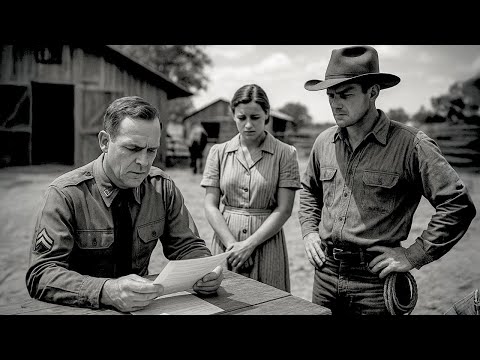
The heat over southwest Texas shimmered like liquid metal. June 1943. Margaret Schultz was twenty-three, a secretary from Hamburg captured in North Africa while working with the German Army’s administrative corps. She had never seen a landscape so empty, so impossibly wide. The train carrying German POWs had crossed into Texas from Louisiana on tracks that seemed to stretch forever. Most were men—soldiers of the Afrika Korps, U-boat crews, Luftwaffe fliers. But in three designated cars, separated by armed guards and military protocol that almost no one acknowledged publicly, were seventy-two German women.
Nurses, radio operators, administrative staff—women captured in war theaters where the German military had employed them in roles the American public preferred not to imagine enemy women filling. Their presence defied the official narrative, so they were moved quietly, their news documented sparingly, and housed in camps rarely mentioned by the press.
Margaret watched America through dust-streaked glass. Propaganda had prepared her for brutality, for a nation of criminals and mongrels, for cities ablaze with racial violence, for cruelty that rivaled the worst stories from the Eastern Front. Instead, she saw farmland, children waving from a truck, a woman hanging laundry in a yard so ordinary it could have been Bavaria—if Bavaria had ever been this flat, this bright, this horizontally endless.
The train stopped at Fort Clark, a cavalry base converted into a POW processing center. The doors opened and the heat poured in like something physical, something alive. Texas summer was an assault. The air tasted of creosote and distant rain that would never arrive.
“Get up, get up!” The guards were American, but the command was in German, barked with accents ranging from fluent to comical.
Margaret stepped down onto gravel that crunched like broken glass. Around her, the other women moved slowly, uncertainly, blinking in light that seemed to erase shadows entirely. They were not shackled. They realized this slowly. Their hands were free. The guards carried rifles, but they held them casually, almost casually. A soldier, barely twenty, offered a canteen to an older woman who looked on the verge of collapse. “Water, ma’am,” he said. The woman stared at him as if he’d offered poison. Then she drank.
Processing took three days. Medical exams, paperwork filled out in triplicate, photographs, fingerprints, the bureaucracy of war with carbon paper and filing cabinets. The women were housed temporarily in barracks that had once quartered cavalry troops. Wooden structures with screens on the windows and floors that creaked like ships at sea.
Margaret shared a bunk with Ilse Becker, a thirty-one-year-old nurse from Munich captured in Tunisia. Ilse’s hair was streaked with gray, her hands never still, as if constantly searching for work. “They’ll separate us,” Ilse said that first night, lying in the dark while cicadas sang outside like machinery. “They’ll send us to different camps, keep us scattered.”
“Why?” Margaret asked.
“Because we’re an embarrassment. German women in uniform—it complicates their story.”
She was right. On the third day, the women were divided into groups. Some went north to camps in Kansas, others to facilities in Oklahoma. Margaret and eighteen others were assigned to a farm labor program outside Brackettville, a small town barely on the maps, a place where the war felt as distant as the moon.
They were loaded into trucks with canvas covers that flapped in the wind. The drive took two hours on roads that turned from asphalt to gravel to dirt. The landscape opened into something primordial. Limestone hills, juniper scrub, draws where creeks ran clear over white rocks. The truck stopped at a gate. Beyond it were barns, horses, a farmhouse with a porch that wrapped around three sides, and standing in the yard, holding his hat in his hands, a man who would change everything.
His name was James Thornton. Thirty-seven years old, born in Brackettville to a family that had worked this land since before the Civil War. Lean and weathered as the landscape itself, with hands that knew rope and leather, and eyes that squinted against the sun until that squint became permanent.
He stood beside a lieutenant from Fort Clark who handled the introductions with military efficiency. “These prisoners will be working your farm under the POW labor program,” the lieutenant explained. “Standard agricultural protocols. You pay their wages to the War Department. They work during daylight hours. Guard rotation is weekly.”
James nodded slowly, studying the women as they climbed down from the truck. They wore work clothes—denim issued at Fort Clark, still creased from folding. They looked exhausted, sun-stunned, and disoriented. His eyes settled on Margaret. Later, he couldn’t say why. Perhaps something in the way she stood, spine straight despite the fatigue. Or the way she looked at the horses with recognition, as if seeing something familiar in a foreign world.
“Any of you ride?” he asked.
Silence. Then Margaret spoke, her English precise, her accent thick. “I ride. In Germany, my aunt had horses.”
Jim took out a cigarette, lit it, and studied her through the smoke. “Well,” he said, “we’ve got plenty of horses here. Plenty of work too. You’ll help with feeding, cleaning, riding if you’re able. Fair wages, fair treatment. That’s the deal.”
The guard corporal, a man named Williams from Alabama, laughed. “They might be the only POWs in Texas learning to cowboy.”
Jim didn’t smile. “Maybe they already know more than we think.”
The farm lay in a valley cut by the West Nueces River through limestone hills, 1,500 acres of dry land and pasture, where longhorn cattle and quarter horses were raised. The main house dated to the 1880s, built of stone and wood, with a well that had never gone dry even in drought years. The women were housed in a converted bunkhouse two hundred yards from the main residence. Two guards rotated shifts, more for protocol than security. Where would they run? The nearest town was twelve miles across terrain that could kill you with heat or snakes or simple desolation.
They worked at cleaning stalls, mending fences, hauling feed. The work was hard but not cruel, physical in a way that made exhaustion feel clean. Jim treated them like farmhands, not prisoners. He showed them how to approach the horses, how to read the cattle, how to move through the landscape without fighting it.
Margaret discovered she was good at it. Her body remembered rhythms from childhood summers at her uncle’s farm in Brandenburg—the smell of hay, the weight of a leather saddle, the particular intelligence in a horse’s eye. Here, under the Texas sky, those memories took on new shape. The propaganda faded slowly, not through speeches or revelations, but through breakfasts. Through Jim showing her how to tie a proper knot. Through afternoons when the work was done and they sat on the porch drinking sweet tea while the sun dropped like a stone into the western hills.
“We shouldn’t,” she said. “I know.” But knowing didn’t matter. She kissed him, and for a moment the entire war and the impossible situation dissolved into something simple and human and undeniable. When they pulled apart, Margaret was crying. “This is madness,” she said. “Impossible.” “Yes,” Jim touched her face, wiped her tears with his thumb. “Don’t make it less true.”
They became more careful after that. More careful and more reckless by turns, stealing moments in the barn, on the hills, in the hour after supper when the guards changed shifts and attention scattered. They didn’t discuss the future because there was no future to discuss. The war would end eventually. She would be repatriated. He would stay here in this valley, working cattle and horses until age or accident stopped him. But the present—this immediate, impossible present—was theirs.
Ilse noticed first. She had seen enough of life to recognize the signs, the way Margaret smiled at nothing, the distraction, the particular quality of attention that lovers radiate despite their best efforts. “You’re being reckless,” Ilse said one night after the others had slept. They spoke in whispers, in German, fast and urgent. “I know.” “Do you understand what will happen if they find out?” “To me? To him?” “I know.” “Then stop.” “I can’t.” Ilse was silent for a long moment. Finally she said, “Then be more careful.”
The other women talked. The guards talked. Word would reach Fort Clark. And Fort Clark would report to people who didn’t care about love or loneliness or any of the human reasons. They would care only about the scandal.
Had anyone said anything? Not yet. But they would. Margaret stared at the ceiling, at the shadows the moonlight threw through the window. When the war ends, I will be sent home. To Hamburg, if Hamburg still exists. To a country that will be destroyed and occupied and judged. I will spend the rest of my life in the ruins of the Third Reich. This—what I have with Jim—is all the happiness I will ever get. I will not give it up for fear.
“Then you’re braver than me,” Ilse said, “or more foolish. I can’t tell which.”
But Margaret was beginning to suspect the truth. Her cycle had always been irregular, unreliable. But its absence, combined with morning nausea and a tenderness in her breasts, was a sign she could not ignore. She told no one. Not Ilse. Certainly not Jim.
The farm was decorated simply for the holiday. Jim cut a juniper tree and set it up in the main house. The women were invited for Christmas dinner there, an awkward but sincere gesture. They sat around a table loaded with turkey, cornbread, beans, and pies. Prisoners and guards sharing a meal while the radio played carols and the war ground on in its fourth year. Margaret watched Jim across the table. Watched him joke with Anna about her fractured English. Watched him treat everyone with a basic human decency that felt revolutionary after years of Nazi rhetoric about Untermenschen and racial hierarchy. She loved him. The realization was simple and devastating. She loved him not despite the circumstances but because of who he was within them—a man who treated her with respect when he could have treated her with contempt, who saw her as a person when the world insisted she was only an enemy.
After dinner, while the others sang German carols they half-remembered, Margaret stood on the porch watching the stars. Jim joined her, keeping a careful distance. “You all right?” he asked. “Yes.” The lie was necessary. “Thank you for this. For all of it.” “It wasn’t much. Just dinner.” It was more than dinner. He knew what she meant. They stood in silence as the temperature dropped toward freezing and their breath rose in the air between them. Jim said slowly, “When this war is over, things will change. I don’t know how, but they will. Maybe there’s a future where this…” He gestured vaguely between them, an awkward, helpless motion. “Maybe there’s a way.”
Margaret wanted to believe him. Wanted to imagine a world where German POWs could marry Texas farmers, where the crimes of nations didn’t extend to individuals, where love was enough. But she carried growing evidence that love was never enough.
Her nausea worsened. Margaret began skipping breakfast, claiming a lingering cold had killed her appetite. Ilse watched her with growing concern but said nothing directly. The other women seemed oblivious, absorbed in their own adjustments to captivity that had stretched from weeks into months. By mid-January, Margaret was certain. She was pregnant. Twelve weeks, maybe fourteen. Soon it would be visible, undeniable. She had to tell Jim, had to decide what to do next.
But the words wouldn’t come. Every time she tried to speak, fear closed her throat.
Work continued on the farm. Winter meant lighter labor, feeding cattle, maintenance, hours spent indoors when the weather turned. Jim hired a local woman named Mrs. Rodriguez to help with cooking for the larger group. She was sixty, practical, and utterly uninterested in the political implications of German prisoners on a Texas farm. “You look pale,” Mrs. Rodriguez said to Margaret one morning. “You eating right?” “Yes, ma’am. Just tired.” “Tired?” Mrs. Rodriguez studied her with eyes that had seen through lies for six decades. “You taking care of yourself?” “Yes, ma’am.” But she wasn’t. She was terrified and exhausted and carrying a secret that would destroy everything the moment it surfaced.
February brought cold rains that turned the farm roads to mud. Work slowed to a near halt. The women spent days indoors, reading donated books from the Fort Clark library, playing cards, writing letters that might never arrive. Margaret finally told Jim on an afternoon when rain drummed on the barn roof and they were alone, checking a horse with a suspicious limp. “I’m pregnant.”
The words fell like stones into water. Jim stopped moving. The horse shifted impatiently. Outside, the rain kept falling. “How long?” His voice was careful, controlled. “Three months. Maybe more.” “God.” He sat down on a hay bale, put his head in his hands. “God.” “I’m sorry.” “Don’t.” He looked at her. “Don’t apologize. This isn’t…” He stopped, started again. “What do you want to do?” “I don’t know.”
They sat in silence while the rain enclosed them in a world reduced to barn walls and animal warmth and impossible choices. “They’ll find out,” Jim said finally. “Someone will notice, and they’ll report it. Fort Clark will investigate. The War Department will…” He couldn’t finish the sentence because there was no good ending to it. “They’ll take me away from here,” Margaret said. “To another camp, or back to Germany. They won’t let me keep the child.” “We could run.” She almost laughed. “Where? Mexico? How far would we get before the Army found us?” “I have money. Land I could sell. We could…” She put her hand on his. “You’d lose everything. Your farm, your life. And they’d take me anyway. And the child.” “Running solves nothing.” “Then what?” “I don’t know.”
The horse snorted in annoyance. The rain hammered above them. They sat amid the wreckage of what should have been joy—a child, a future—now turned to catastrophe by timing and nationality and war.
The first person to notice officially was the camp doctor, who visited Fort Clark monthly for prisoner medical exams. Dr. Emma Richardson was fifty-eight, a veteran of the First World War, unflappable and efficient. She had examined thousands of POWs over the past two years and treated the work with clinical detachment. When Margaret entered the exam room in late February, Dr. Richardson knew immediately. The signs were unmistakable to a trained eye—the swelling, the specific quality of fatigue, the way Margaret held herself. “How far along?” Dr. Richardson asked. “Sixteen weeks.” “And the father?” Silence. Dr. Richardson set aside her stethoscope. “Miss Schultz, I need to document this. It’s not about judgment. It’s protocol. If you were coerced or assaulted…” “I wasn’t.” “Then who?” “I won’t say.”
Dr. Richardson studied her for a long moment. She had seen enough of war to know that simple categories—victim, perpetrator, guilty, innocent—rarely captured the truth. Here was a German prisoner, pregnant by a man she refused to name. The implications were clear. “I have to report this,” Dr. Richardson said. “Do you understand that?” “Yes.” “The War Department will investigate. They’ll question everyone at the farm—the guards, the other prisoners. They’ll find out.” “I know.” “And what happens to you then? To the child?” Dr. Richardson paused. She had no good answers. “I’m sorry.”
The news reached the POW division of the War Department within forty-eight hours. A pregnant German prisoner represented multiple disasters: a violation of fraternization policies, potential rape allegations requiring investigation, a media nightmare if the press learned of it, and complex legal questions about citizenship and custody. Major Robert Kane, head of the POW operations office in San Antonio, took personal charge. He was forty-six, a career military man, closer to bureaucrat than soldier. His war was fought with memos and regulation manuals. He arrived at the Thornton farm on March 3 with two investigators, a stenographer, and a list of questions designed to establish timeline, responsibility, and damage control options.
The interrogations began with the guards. Hughes, the corporal who had spent most of his shifts reading, suddenly found his inattention transformed into dereliction of duty. He admitted, as he had to, that he had allowed prisoners to work without direct supervision, that James Thornton had run the operation with minimal oversight, that the women had enjoyed considerable freedom of movement. “Did you observe any inappropriate contact between Mr. Thornton and any of the female prisoners?” “No, sir.” “Did you suspect any such contact?” Hughes hesitated. The hesitation was answer enough.
The other women were questioned next. One by one, they sat in the farmhouse living room while the stenographer recorded every word and Major Kane assessed their credibility with cold precision. Anna claimed ignorance, as did Christine. But Ilse, when pressed, when threatened with obstruction charges and transfer to a maximum-security facility, finally broke. “They were close,” she admitted. “I warned her. I told her it was dangerous. But she wouldn’t listen.” “Close in what sense?” “They talked. They went riding together. I suspected more, but I stopped myself from knowing.” “Margaret is not a bad person. She was lonely. They both were.” “That’s not an excuse.” “No,” Ilse agreed, “but it’s the truth.”
James was interviewed last, after three days of preliminary interrogations had established the basic facts. He sat across from Major Kane in his own living room, knowing his life was over. “Did you engage in sexual relations with the prisoner Margaret Schultz?” “I did.” The stenographer’s pencil scratched. Major Kane showed no reaction. “How many times?” “I don’t know. More than once.” “Was there coercion?” “No.” “Did you offer her better treatment in exchange for sexual access?” “No. It wasn’t like that.” James paused. How to explain it? The accumulation of respect into affection, affection into love, the fact that he hadn’t planned any of it, had tried to resist it, had failed because he was human and lonely and she was human and present. “It wasn’t a transaction. It was…” He couldn’t finish. “Mr. Thornton, you realize you’ve violated multiple War Department regulations, potentially committed federal crimes related to prisoner exploitation, and created a situation that could result in significant legal and diplomatic complications.” “Yes.” “Did you know she was pregnant?” “Yes.” “And you said nothing, filed no report?” “I didn’t know what to do.” The admission tasted like failure. “I thought…I don’t know what I thought.”
Major Kane closed his notebook. “Charges will be filed. The exact ones are still being determined, but expect federal prosecution. The prisoner will be transferred to a secure facility pending repatriation after the war. The child…” He paused. “The child’s status is complicated. Most likely it will be placed in military custody at birth.” “No.” James stood. “You can’t…” “Sit down, Mr. Thornton. You’ve forfeited the right to make demands.”
They came for her on March 7, early, before the sun cleared the eastern hills. Two military policemen, Major Kane, and a female officer whose job was to make the transfer look humane. Margaret had known it was coming, had spent three days waiting, barely eating, unable to sleep. Ilse held her the night before while she cried—not from fear, exactly, but from grief at losing the brief happiness she had found.
James stood in the yard as they walked her to the waiting vehicle. The MPs wouldn’t let them speak. She looked at him once, a glance that carried everything, before she climbed into the back seat. The door closed. The engine turned over. James watched the dust trail until it vanished behind the first hill. Then he walked to the barn, sat on a hay bale, and wept for the first time since his wife’s funeral six years before.
Margaret was held at a special detention facility at Fort Clark, a small building that had once been officers’ quarters, hastily converted into something between a jail and a hospital. She was not mistreated. The food was adequate. Dr. Richardson handled her medical care, visiting weekly, saying nothing beyond clinical necessities. But she was isolated—no visitors, no news of James, of the investigation, of what would happen after the birth.
Time became abstract. Days bled into weeks. Her body changed, swelling with a life that was both love and catastrophe. She wrote letters that were never sent. To James, trying to explain. To her mother in Hamburg, describing the impossible situation. To the child, apologies written in advance for a life she could not provide.
Dr. Richardson was the only person who treated her as a human being rather than a problem to be managed. “The baby is healthy,” Dr. Richardson said during an April examination. “Strong heartbeat. Good position. You’re doing everything right, physically.” “And what happens after?” Margaret asked. “I don’t know. The War Department is still deciding.” “They’ll take the child.” Dr. Richardson set down her stethoscope. The professional detachment faded. “Yes. Probably.” “I’m sorry.”
Despite the War Department’s best efforts at containment, the story leaked. A reporter in San Antonio heard whispers, investigated, and published a story in late April. A German war prisoner, a Texas farmer, and a War Department scrambling for answers. The story spread like fire through wire services. Suddenly the carefully hidden secret of German women prisoners was front-page news. Photographs of Fort Clark appeared in newspapers. Editorials debated citizenship law, morality, the proper treatment of enemy aliens, and whether love could exist across battle lines.
Public reaction split along predictable lines. Some demanded James’s arrest, called him a traitor and worse. Others expressed sympathy for two people who had found connection amid chaos, however forbidden. Religious groups debated the moral status of the child. Legal scholars argued about citizenship, about whether birth on American soil to an enemy combatant conferred rights. And through it all, Margaret remained isolated at Fort Clark, reading about her own life in newspapers, watching her private catastrophe become public spectacle.
Federal prosecutors charged James Thornton with fraternization with an enemy prisoner, violation of War Department regulations, and—more seriously—sexual misconduct, a charge that could carry prison time. His lawyer, a San Antonio attorney named Harold Weiss, argued that the relationship was consensual, that no coercion occurred, that the regulations were ambiguous regarding civilian contractors, and that prosecution was punitive rather than just. Trial was set for July. Until then, James remained free on bail, working his farm alone, speaking to no one, watching spring turn to summer while the newspapers debated his morality and the war ground toward its inevitable end.
The war in Europe ended on May 8. The news came over the radio. Germany’s surrender, Hitler dead, the Third Reich collapsed. At Fort Clark, the German women prisoners received the news in silence. Some wept. Others looked relieved. Some maintained rigid beliefs that the reports were lies and propaganda, that Germany would rise again. Margaret felt only numbness. The war that had defined her adult life was over, and she was pregnant, seven months along, in a military detention facility in Texas, waiting for a future that held no good options.
Dr. Richardson visited that evening, carrying newspapers. “It’s over,” she said. “You’ll be repatriated eventually, after the baby is born.” “When?” “Months, probably. They’re still working out the logistics for millions of prisoners.” Margaret looked at photographs of destroyed German cities, of Allied soldiers in Berlin, of survivors from the concentration camps that made her sick to see. This was what she had supported. What she had facilitated, however indirectly, through her work in the Wehrmacht office, through her acceptance of lies. “I can’t go back,” she said. “You have no choice.” “And the child?” Dr. Richardson had no answer.
The question remained unresolved. Was the child American by birth, German by blood, a ward of the military, or eligible for adoption? The legal ambiguity was unprecedented. Margaret went into labor in the early hours of June 14, three weeks before her due date. Dr. Richardson was summoned immediately. They moved her to the Fort Clark hospital, a small facility that handled everything from routine exams to combat injuries. The labor lasted fourteen hours. There were no complications, just the ordinary pain of bringing a life into a world unprepared for it. Dr. Richardson stayed throughout, monitoring, encouraging, witnessing.
At 8:47 p.m., Margaret gave birth to a daughter, 3.2 kilograms, with dark hair and healthy lungs that announced her existence with angry cries. Dr. Richardson cleaned her, wrapped her, placed her in Margaret’s arms. For five minutes, they let her hold her daughter. Five minutes to memorize the face, the weight, the impossible perfect reality of this child who had been created from love and catastrophe. Then a nurse took the baby away. Margaret screamed, fought, had to be restrained as the infant disappeared into bureaucratic limbo.
Somewhere, forms were filed. Somewhere, decisions were made about the infant’s future by people who had never held her, never seen her mother’s face, never understood the full human cost of their regulations. The War Department, in consultation with State Department officials and military lawyers, made its decision. The child, born on American soil to a foreign enemy mother and an American father who were not legally married, would be placed in military custody pending permanent placement. James was notified. He immediately filed for custody, citing biological paternity and his desire to raise the child. His lawyer drafted motions, researched legal precedents. The case became another layer of complication in an already impossible situation.
Margaret, recovering in the Fort Clark hospital, knew none of this. She was told only that her daughter was healthy, was being cared for by appropriate providers, and that her repatriation would proceed once she received medical clearance. She stopped eating. Stopped speaking. Lay in her hospital bed staring at the ceiling tiles while her body healed and her spirit collapsed. Dr. Richardson tried to intervene, to talk, to reason, finally threatened forced feeding. Nothing worked. “She’s given up,” Dr. Richardson told Major Kane. “If you send her back to Germany in this condition, she’ll die. If not on the voyage, then shortly after.” “What do you suggest?” “Let her see the child. Let her say goodbye properly.” “That’s not in the protocol.” “Damn your protocol. She’s a human being. And so is that baby. Whatever rules you think apply, they don’t cover this.”
They permitted it on June 25. One hour, supervised. Margaret was brought to the building where her daughter was being cared for by military medical staff. The system had given the child a name. Baby Schultz. No first name, just a designation. She was eleven days old, formula-fed, healthy, and utterly unaware that her existence was a legal catastrophe. Margaret held her. Memorized her features. Whispered in German words the child would never remember. I’m sorry. I love you. I wanted to keep you. Please forgive me. James was not allowed to attend. His case was still pending. Allowing contact between him and the child before custody was determined would prejudice the proceedings. So he stayed on his farm, waiting for news, working land that felt empty despite the cattle and horses and summer heat.
After an hour, they took the baby away again. Margaret returned to detention. Something in her broke that could not be repaired, but at least she had held her daughter once more. At least the child would never have to grow up in the ruins of Germany, never have to explain her mother’s choices, never have to carry that particular burden—unless James won custody, unless the courts decided that paternity mattered more than nationality, unless the system somehow produced a just outcome.
James’s trial began on July 16 in the federal courthouse in San Antonio. The prosecution argued that he had exploited his position of authority, violated explicit regulations designed to protect prisoners, and committed acts that discredited the American military justice system. The defense countered that the relationship was consensual, that James had never used coercion, that the regulations were ambiguous regarding civilian contractors, and that the prosecution served no purpose but punitive moralism. The trial lasted three days. Witnesses testified. Documents were entered into evidence. Photographs of the farm, of Margaret, of routine operational memos about POW labor programs.
The judge, a sixty-two-year-old federal appointee named Marcus Hoffman, had served in the First World War. He understood military necessity and human weakness. He also understood that someone had to be held accountable—not because justice demanded it, but because the system required visible consequences. The verdict came on July 19. Guilty of fraternization violations and failure to maintain proper supervision of prisoners. Not guilty of sexual misconduct, given the clear evidence of a consensual relationship. The sentence: two years’ probation, a $1,000 fine, and permanent exclusion from POW labor programs.
James accepted the verdict without reaction. It was lighter than expected, harsher than deserved. What mattered more was the custody hearing for the child, scheduled for August. The hearing was held on August 8, three days after atomic bombs ended the war with Japan. The world was changing—wars ending, soldiers returning, prisoners being processed for repatriation. In that context, one baby seemed almost trivial. But James had hired the best lawyer he could afford. Harold Weiss argued biological paternity, James’s ability to provide for the child, the child’s right to know her father, and the practical reality that returning her to Germany—to chaos and occupation and potential starvation—was cruelty dressed as protocol.
The state argued that James’s criminal conviction demonstrated poor judgment, that the mother’s status as an enemy alien complicated custody, and that the child’s best interest would be served by placement with a stable American family through proper adoption channels. Judge Hoffman listened to six hours of arguments. Then he asked one question. “Mr. Thornton, if I grant you custody, what life can you offer this child?” James stood. “A farm. A home. A father who loves her. It’s not perfect, but it’s real.” “And the mother?” “She loves the child too. But she has to return to Germany. I can’t change that.” “Can you raise this child knowing her mother is alive somewhere, knowing you separated them?” “It’s already happened, Your Honor. The question is what happens next.”
Judge Hoffman called a recess. Three hours later, he returned with his ruling. Custody to James Thornton, provisional pending full adoption proceedings. The child would remain in Texas. Margaret would be repatriated as scheduled, but she would be permitted to correspond, to maintain contact if she wished, to have a relationship preserved across distance and politics and all the messiness that would define post-war Europe.
It was the best possible outcome, and it devastated everyone involved. Margaret was repatriated to Germany in September 1945, part of the first wave of prisoner returns. She arrived in Hamburg to find her mother alive, her sisters dead in the bombing of 1943. The city was rubble. The country was occupied and divided, its guilt undeniable. She worked in reconstruction for three years, then emigrated to Argentina in 1948, joining a wave of Germans seeking distance from the wreckage of Europe. She married a farmer there, had three more children, built a life. But she never forgot her daughter. Never stopped writing letters to Texas. Never stopped hoping that the distance might one day be bridged.
James raised his daughter. He named her Rebecca Anna Thornton, on the farm, riding horses, working cattle, learning the land. He told her about her mother when she was old enough to understand. Showed her the letters that arrived sporadically from Argentina, from a woman who loved her from five thousand miles away. In 1963, when Rebecca was eighteen, James paid for her passage to Argentina. She met her mother for the second time, the first she could remember. They spent three weeks together, two women bound by biology and separation, trying to compress a lifetime of absence into a few short summer days. It wasn’t enough. It would never be enough. But it was what they had.
Rebecca returned to Texas. Margaret stayed in Argentina. They wrote to each other regularly for the next forty years, until Margaret’s death in 2003 at the age of eighty-three. The farm still operates today. Rebecca’s grandchildren run it now. In the house, framed above the fireplace, hangs a photograph taken in 1963. A German woman and her daughter, standing together under the Argentine sun, smiling despite everything the world had tried to destroy.
And in a drawer in Brackettville, Texas, a bundle of letters tied with twine still carries the weight of all those impossible years—proof that some loves survive not by overcoming distance, but by refusing to let it win. What would you have done, if the world had forced you to choose between love and everything else?
Report this article
Select a reason for reporting:






