The morning of May 23, 1934, John Dillinger was hiding out in Calumet City, Illinois, just outside Chicago. He didn’t know it yet, but 800 miles away in Bienville Parish, Louisiana, a six-man posse had just turned a stolen Ford V8 into a colander, firing over 130 rounds into the car carrying Bonnie Parker and Clyde Barrow. Neither outlaw got a shot off. It wasn’t an arrest; it was an execution.
That evening, the story blared from every front page and radio in America. Dillinger didn’t need anyone to explain what it meant. He had already called Bonnie and Clyde “a couple of punks” in the papers, dismissing them as amateur thugs who robbed gas stations and panicked. But the professionals understood something the public didn’t: those 130 rounds didn’t check resumes. Being good at your job wouldn’t save you.
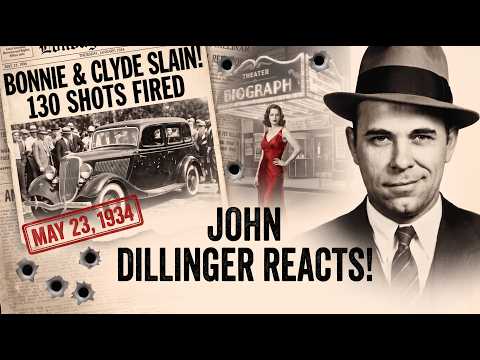
The same day Bonnie and Clyde died, a federal judge in St. Paul sentenced Dillinger’s girlfriend, Evelyn “Billie” Frechette, to two years for harboring him. His colleagues were shot to pieces, his woman was in jail, and the law was closing in. Most men would have run for the border. Dillinger? He kept a appointment.
He already had a plan in motion: plastic surgery. His lawyer, Louis Piquett, had set it up back in April after Dillinger shot his way out of the Bohemia Lodge ambush in Wisconsin. The surgeon was Dr. Wilhelm Loeser, a disgraced physician who’d done time in Leavenworth. The price: $5,000. The operating room: the living room of a guy named John Probasco on Chicago’s North Side.
On the evening of May 28—just five days after Bonnie and Clyde were ambushed—Loeser and anesthesiologist Harold Cassidy showed up to operate. Dillinger wanted the moles on his forehead removed, the corner of his left eye lifted, the dent in his nose filled, the scar on his upper lip erased, and his dimples taken out. He was deleting himself one feature at a time.
He chose to go fully under. That decision nearly killed him. Cassidy gave him too much ether. Dillinger swallowed his tongue, turned blue, and stopped breathing right there on the table. Loeser grabbed forceps, pulled the tongue out of his airway, and drove his elbows into Dillinger’s ribs until he started breathing again. The most wanted man in America came within a minute of dying in a bar owner’s living room.
After he recovered, Loeser burned Dillinger’s fingerprints off with a caustic soda mix. Friends said he looked like he had the mumps. But Dillinger didn’t hide. He healed up through June and went right back out into the city—a changed man, or so he thought. He kept a machine gun in an open case under the piano and a shotgun under the parlor table. Then he started dating a 26-year-old waitress named Polly Hamilton, who knew him as “Jimmy Lawrence.” He took her to restaurants and movie theaters while every cop in America carried his photograph.
His partner, Homer Van Meter, warned him about picking up women he knew nothing about. Van Meter had a point: Bonnie and Clyde died because someone inside their circle sold their location. It was in the papers. Dillinger read them. And yet he took his new girlfriend to the movies anyway.
Meanwhile, the government kept stacking the deck. On June 6, President Roosevelt authorized reward money for criminals. On June 18, Congress gave federal agents full arrest powers and the guns to go with them. On June 22—Dillinger’s 31st birthday—Attorney General Homer Cummings named him America’s first Public Enemy No. 1. Most men get a card. Dillinger got the federal government’s top spot and celebrated by taking Polly out on the town.
The new face had him feeling bulletproof. On June 30—38 days after Bonnie and Clyde died—he walked into the Merchants National Bank in South Bend, Indiana, with Van Meter and Baby Face Nelson and robbed it. A police officer got shot. The ambush hadn’t run him to Mexico or into a hole. He watched two outlaws get shot to pieces without a warning, then got a new face, a new girlfriend, and hit another bank inside of six weeks.
But the bet lasted only 60 days. Polly Hamilton lived with a woman named Anna Sage—a brothel owner in Gary, Indiana, facing deportation to Romania. Sage recognized “Jimmy Lawrence” and called the federal Division of Investigation, offering to hand him over for reward money and help with her immigration case. On the night of July 22, 1934, Sage went out to the movies with Dillinger and Polly at the Biograph Theater, wearing an orange skirt so the agents could pick them out of the crowd. The movie was Manhattan Melodrama, a Clark Gable gangster picture. When Dillinger walked out around 10:30, Melvin Purvis lit a cigar. Dillinger pulled a pistol and ran for the alley. They shot him down before he reached it.
Line it up next to May 23, and it’s the same job with different scenery. Somebody inside the circle traded him to the government. The lawmen studied his habits and picked the ground. And nobody gave him a usable warning before the shooting got ruled justified. The surgery he nearly died for made no difference at all because the woman standing next to him sold the agents—which meant they had to shoot.
While Dillinger lay in the alley, souvenir hunters dipped newspapers and handkerchiefs in his blood. Just two months earlier in Louisiana, crowds had swarmed the death car and tried to cut pieces off the bodies. About 15,000 people filed past Dillinger at the Cook County morgue over the next day and a half. The same treatment the punks got from the same public. Whatever gap Dillinger believed sat between a professional and a couple of amateurs in a stolen Ford, neither that ambush nor the crowd ever saw it.
But here’s what the papers never printed in those sixty days. While Dillinger was healing under Loeser’s knife and courting Polly Hamilton, the men who hunted him were learning from Louisiana. Melvin Purvis, the diminutive FBI agent running the Chicago office, had studied the Bienville Parish ambush the way a chess player studies a famous game. The lesson wasn’t subtle: don’t corner them in a car, don’t shout a warning, and don’t give them a chance to reach for a weapon. Pick the ground, wait for the moment, and end it clean.
Purvis had been embarrassed by Dillinger before. In April, at Little Bohemia Lodge in Wisconsin, his agents had surrounded the wrong building, opened fire on civilians, and let Dillinger slip out the back with Van Meter and Baby Face Nelson. The Bureau had taken a public beating. J. Edgar Hoover wanted blood, and Purvis knew that another failure would end his career.
So the Bureau went to work on the human element. They tracked down Anna Sage through an informant in Gary, and when she called, they didn’t just take her word—they wired her, coached her, and made sure the immigration paperwork stayed conspicuously unfinished until the night of July 22. Sage, known to history as “the Lady in Red,” was squeezing the government as hard as the government was squeezing her. It was a transaction, not a tip.
What Dillinger never understood—what Bonnie and Clyde never understood either—was that the machine hunting them wasn’t a posse of local constables anymore. The June 18 law giving federal agents arrest powers and guns had turned a loose collection of state pursuers into a professional apparatus with wiretaps, informants, and a budget. Dillinger’s answer to the Louisiana ambush had been cosmetic: a new face, a new name, a new girl. The government’s answer had been structural. He was playing checkers with his appearance while they were building a dragnet with paperwork.
Even the bank job in South Bend told the story if you read it right. Dillinger, Van Meter, and Baby Face Nelson walked out with cash, but a police officer got shot, and the local papers carried the description of a man with a fresh, puffy face. The surgery hadn’t made him invisible—it had made him memorable in a new way. Witnesses remembered the mumps-like swelling. The Bureau filed it away.
And Polly Hamilton? She was the detail that should have terrified him most. Van Meter had warned him plainly: Bonnie and Clyde died because somebody inside the circle sold them out. Dillinger heard it, nodded, and kept taking Polly to the pictures. Anna Sage didn’t need to crack a safe to find him. She just needed to live in the same apartment and wait for a man who couldn’t stop going to the movies.
By mid-July, the trap was set and the only variable left was the night. Purvis had his agents positioned, his signals arranged, his cigar ready. Dillinger had a loaded pistol in his pocket and a woman on each arm. The difference between them was sixty days of preparation—and the fact that one side had actually learned the lesson of Bienville Parish.
That is the part nobody prints on the wanted poster. Dillinger wasn’t outrun on July 22—he was out-prepared. Purvis didn’t need to be faster or braver, he just needed to be patient, and the Bureau had spent sixty days learning that patience from a Louisiana road.
“The ambush didn’t teach the outlaws anything,” one agent later remarked. “It taught us everything.” Dillinger had watched Bonnie and Clyde die and concluded the lesson was about faces. The government had watched them die and concluded the lesson was about process—informants, patience, and never giving a man a warning he could use.
So when the cigar glowed in the Chicago dark, it wasn’t a moment of luck. It was the end of a curriculum that started on May 23 and finished on July 22, with Dillinger as the final exam he never knew he was taking.
He had erased his moles, lifted his eye, filled his nose, and burned off his fingerprints—every feature the law could use. He never thought to erase the one thing that actually mattered: the habit of trusting someone who lived in the same apartment.
Two months, two ambushes, one lesson. The professionals and the punks ended up in the same alley after all—and the crowd dipped their handkerchiefs in both.
So here’s the question worth asking: if you knew someone in your circle was being squeezed by the government, would you spot it in time—or would you just keep buying the movie tickets?
Report this article
Select a reason for reporting:






