Imagine waking up on a Monday morning, walking to your local bank, and finding the doors locked. Not just your bank—every single bank in the United States of America. All of them closed, bolted shut. No withdrawals. No deposits. No transfers. Nothing.
Now imagine you have no idea when they’ll reopen—or whether your life savings will even be there when they do. That’s not some dystopian fantasy. On March 6, 1933, barely 36 hours after taking the oath of office, President Franklin Delano Roosevelt signed a proclamation that shut down the entire American banking system.
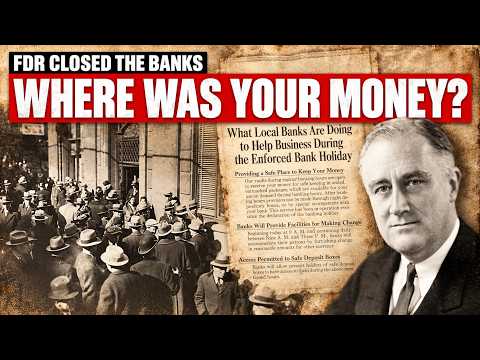
Every last institution, from the largest Wall Street powerhouses to the smallest rural savings banks, all of them went dark at the stroke of a pen. And here’s the part that should genuinely disturb you: there was no deposit insurance. There was no government guarantee on your money. If a bank failed, you lost everything.
And banks had been failing by the thousands. So when Roosevelt locked those doors, 125 million Americans were suddenly cut off from their own money, left staring at a locked vault with nothing but questions and a creeping terror that the entire financial system might never come back.
How did people survive? How do you buy groceries when every bank in the country is sealed shut? How do you pay your rent, your doctor, your employees? What happens to a modern economy when the most basic function of money—the ability to access it and spend it—simply vanishes overnight?
That’s the story we’re about to get into. Because the week that followed Roosevelt’s bank holiday wasn’t just a policy experiment. It was a stress test on the American social fabric—and what people did to get through it reveals something profound about the fragility of the system we all take for granted every single day.
But before we get to those survival stories, we need to understand just how catastrophic things had become for the banking system to reach this breaking point. Because Roosevelt didn’t shut down the banks on a whim. He did it because there was almost nothing left to save.
The collapse didn’t happen overnight. It had been building for years—a slow-motion avalanche that started long before the famous stock market crash of October 1929. Throughout the 1920s, the American banking system was already showing cracks. On average, more than 600 banks failed every single year between 1921 and 1929.
Most of these were small rural institutions—community banks in farming towns that had extended too much credit to agricultural borrowers during the post-war boom. When crop prices cratered in the mid-’20s, those loans went bad and the banks went under. But because these failures were happening in remote areas, far from the marble lobbies of New York and Chicago, most Americans in the cities barely noticed.
Wall Street considered these collapses to be natural pruning—weak banks clearing themselves out to make the system stronger. That was the prevailing wisdom: let the small ones fail, the strong will survive.
Then the stock market crashed and that comfortable theory collapsed alongside it. Black Tuesday, October 29, 1929, wiped out billions in wealth in a single afternoon. But the damage to the banks was even worse than the damage to the stock market—because many of those banks, especially the larger urban ones, had been making exactly the same mistake as the rural banks, just on a grander scale.
They had lent enormous sums to stock speculators. They had invested their depositors’ money directly into the market. And when the market evaporated, those loans and investments became worthless overnight. The banks were suddenly sitting on mountains of bad debt with nothing to show for it.
And here’s where the death spiral begins. Because banks operate on a principle that most people never think about until it’s too late: your bank does not keep your money in a vault. When you deposit $100, the bank doesn’t put a crisp bill in an envelope with your name on it. They lend most of it out—to other people, businesses, homeowners, farmers. They keep only a small fraction on hand, maybe 10 or 15%, to cover day-to-day withdrawals.
This system works beautifully as long as everyone doesn’t show up at the same time asking for their money back. But when confidence breaks, that’s exactly what happens.
And that’s what happened in the early 1930s. In 1930, a major wave of bank failures shattered whatever confidence remained. 1,350 banks collapsed that year. The failures accelerated in 1931 with over 2,200 banks going under. In 1932, another 1,450 closed their doors. And then in 1933, the worst year of all, approximately 4,000 banks suspended operations.
Now add all of those up. Between 1930 and 1933, more than 9,000 American banks failed—just evaporated—and they took with them an estimated $1.3 billion in depositors’ money. Adjusted for today’s values, that’s somewhere in the neighborhood of $27 to $28 billion.
But that number doesn’t capture the true devastation. Because in the 1930s, that lost money represented the entire life savings of millions of ordinary American families. School teachers, factory workers, shopkeepers, farmers—people who had done everything right, worked hard, saved diligently, and then watched helplessly as their bank simply ceased to exist.
And remember, there was no safety net. No Federal Deposit Insurance Corporation. No government guarantee. If your bank failed, that was it. Your money was gone. You might eventually receive some partial recovery through a liquidation process—maybe getting back 80 cents on the dollar if you were lucky—but that process could take years, and many people received nothing at all.
The cruelty of it was staggering. People who had trusted the system were punished for that trust.
Now, this created a vicious feedback loop that economists would later study for decades. The more banks that failed, the more terrified depositors at surviving banks became. And the more terrified those depositors became, the more frantically they rushed to pull their money out. And the more money people pulled out, the more banks ran out of cash and failed.
It was a textbook bank run—except it was happening simultaneously across the entire country, rolling from state to state like a plague.
By February 1933, the situation had become genuinely apocalyptic. On February 14, the governor of Michigan declared an 8-day bank holiday, shutting down every bank in the state. He did this because Michigan’s banks were hemorrhaging cash and there was simply nothing left to withdraw.
The Michigan holiday sent shock waves across the country because if it could happen there, it could happen anywhere. And it did. Within days, bank runs erupted in state after state. Maryland declared its own bank holiday on February 25. Other governors followed. By the time Roosevelt was inaugurated on March 4, 25 of the 48 states had either shut down their banks entirely or imposed severe restrictions on withdrawals.
On the final two business days before the inauguration, March 2 and 3, the Federal Reserve system lost $200 million in gold and another $150 million in currency. People were pulling cash and gold out of the system at a rate that threatened to drain it completely. The public had withdrawn a staggering $1.8 billion in gold and currency from banks in February and early March alone—with nearly two-thirds of that coming in the final week.
The entire monetary system of the United States was in free fall.
So when Franklin Roosevelt stood on the steps of the Capitol on March 4, 1933, and delivered those famous words about the only thing we have to fear being fear itself, he wasn’t speaking in metaphors. He was describing the literal mechanics of what was destroying the country.
Fear was the engine. Fear of losing your money drove you to withdraw it. Your withdrawal made the bank weaker. The weaker bank scared your neighbor. Your neighbor withdrew. And so on and so on until there was nothing left.
Roosevelt knew he had to do something dramatic. Something that would break the cycle entirely. Half measures wouldn’t work. Speeches alone wouldn’t work. The fear had become self-sustaining, feeding on itself, growing with every newspaper headline about another bank closing, another family ruined.
He needed to hit the reset button on the entire system. And so at 1:00 in the morning on Monday, March 6, barely a day and a half into his presidency, Roosevelt issued Proclamation 2039. It was sweeping in its language and absolute in its scope: “No banking institution in the United States would pay out, export, earmark, or permit the withdrawal or transfer of any funds by any manner or device whatsoever.”
Every bank, every branch, every transaction—frozen.
But the bank holiday was never meant to be a permanent shutdown—it was a pause, a desperate breath before the plunge. And in that pause, something unexpected happened: ordinary people discovered they could survive without banks, and that discovery terrified the men who ran them.
When the first banks reopened on March 13, 1933, the government had prepared for the worst. They expected long lines of panicked depositors demanding their cash. Instead, something remarkable unfolded. People didn’t just leave their money in the banks—they brought more of it back. The same citizens who had hidden cash under mattresses and buried jars in their backyards now stood in line to deposit their savings, trusting Roosevelt’s promise that the reopened banks were safe.
Within two weeks, more than half of the cash withdrawn during the crisis had returned to the system. The Dow Jones Industrial Average surged over 15% in a single day—its largest one-day gain in history. Raymond Moley, one of Roosevelt’s closest advisers, would later say that “capitalism was saved in eight days.”
By the time the process was complete, federal and state officials had reopened 12,756 banks. About 5,000 were permanently closed or placed under restrictions. 90% of the country’s banking resources were back online. The panic had broken.
But Roosevelt knew that reopening the banks wasn’t enough. The structural problems—the lack of deposit insurance, the reckless mingling of commercial banking and speculative investment, the absence of federal oversight—all needed to be addressed. So on June 16, 1933, he signed the Banking Act of 1933, better known as the Glass-Steagall Act.
The law did two revolutionary things. First, it created the Federal Deposit Insurance Corporation—the FDIC. For the first time in American history, individual bank deposits would be guaranteed by the federal government. If your bank failed, the government would make you whole. The incentive to run disappeared.
Second, Glass-Steagall erected a wall between commercial banking and investment banking. Banks that took deposits from ordinary citizens could no longer gamble those deposits on the stock market. Financial institutions had to choose: they could be a commercial bank or an investment house, but not both.
The results were immediate. Bank failures dropped from over 4,000 in 1933 to just 61 in 1934. Sixty-one from four thousand—in a single year. The era of chronic, devastating bank failures was over.
But here’s the most important takeaway from this entire story. Money—the thing we work for, save, invest, plan our lives around—is ultimately a system of collective belief. It works because we all agree that it works. The dollars in your bank account have value because everyone around you agrees they have value. The moment that agreement fractures, the entire edifice can shatter with terrifying speed.
In March 1933, that’s exactly what happened. The collective agreement that held the monetary system together simply broke down. And it took an unprecedented intervention—a president shutting down every bank in the country, then talking to 60 million people on the radio like they were sitting in his living room—to piece it back together.
It took clamshells and fish-skin parchment, newspaper scrip, and IOU notes passed between neighbors. It took churches accepting promises instead of cash, butchers extending credit to families they’d never met, and governors postponing executions because nobody could agree on what a holiday was anymore.
The scrip is gone now. The clamshells are in museums. The banks reopened. The deposits returned. And the system was rebuilt stronger than before. But the vulnerability never went away. It’s still there, buried beneath layers of regulation and insurance and digital infrastructure, waiting for the next moment when enough people all at once stop believing.
Because in 1933, millions of Americans thought their money was safe, too. And that should make you think very carefully about what the word “safe” actually means when someone tells you your money is safe in a bank.
So here’s my question for you: if every bank in your country closed tomorrow, how long could you survive on what you have in your pocket right now? And more importantly—what would you do when the cash runs out? Let me know in the comments below.
Report this article
Select a reason for reporting:






