Thomas Rivera had spent fifteen years cataloging Baltimore’s photographic history, but he had never seen anything like the Whitmore family portrait. It arrived in a box of glass plates from the Thornton Studio collection, immaculately preserved, a formal Victorian composition of four people—father, mother, two sons—posed with rigid solemnity. The mirror on the back wall was angled oddly, and when Thomas leaned closer, magnifying loop in hand, his breath caught. There was a fifth person in the reflection.
A little girl, no more than eight, stood pressed against the far corner, her white dress plain, her arms marked with bruises. She was not part of the family portrait. She existed only in the mirror’s reflection, terrified and alone.
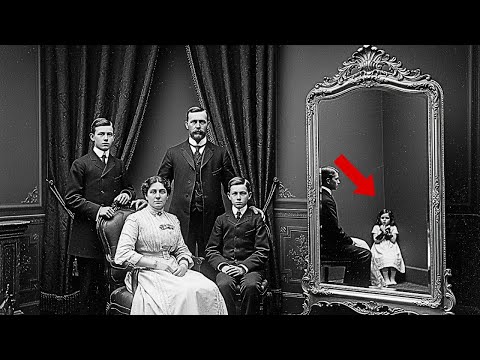
Thomas’s hands trembled as he flipped the photograph over. On the back, in faded ink: Thornton Studio, Baltimore, October 1907, the Whitmore family. Below that, in smaller handwriting: “Four in the portrait, five in the room.” Someone had known. Someone had documented the discrepancy.
He spent the next weeks digging through archives, census records, death certificates. The Whitmore family was prominent, their name in every society column. But the daughter, Alice, appeared only twice in public records—and then vanished. A death certificate from March 1908 listed her cause of death as “injury sustained in fall.” She was eight years old.
The photographer, Frederick Chen, had been an investigator for the Society for the Prevention of Cruelty to Children. His files revealed a pattern: mirrors positioned to capture what families tried to hide—bruises, fear, excluded children. He had been creating a visual archive of abuse, using reflections as evidence. The Whitmore portrait was his masterpiece: the official image the family wanted, and the truth they couldn’t erase.
Thomas found the case file. Frederick had reported Alice’s condition, but the investigation was closed after a doctor’s letter claimed she was “mentally deficient” and prone to self-injury. No one had even interviewed the child. Five months later, she was dead.
But there was one more document—a handwritten note from the investigator, Sarah Morrison: “I believe Alice Whitmore was murdered. We failed this child.”
Thomas sat back, the weight of a century pressing down on him. The mirror had captured more than a reflection. It had captured a crime—and a photographer’s desperate attempt to save a life that society had already forgotten.
He tracked down the last living link to the family: Eleanor Whitmore, Henry’s daughter, now seventy-eight and living in a retirement community in Towson. When he called, her response was immediate. “You found the photograph. I’ve been waiting for someone to find it.”
Her apartment was modest, crowded with photographs—including several of an elderly man Thomas recognized from the obituary. Henry Whitmore. Eleanor poured tea with practiced hands. “My father never spoke about his sister until he was dying,” she said. “He was seventy-five, in the hospital, and he finally told me about Alice.”
She described a quiet, gentle child, always trying to please a father who despised her. “He diagnosed her as mentally deficient, even though she was perfectly normal. Just terrified. Just traumatized.” Eleanor paused. “My father was twelve when the portrait was taken. He remembered the photographer—a Chinese man—kept looking at Alice. My father realized the man was trying to help.”
From an old envelope, she withdrew a letter, dated 1968, addressed to the Thornton Studio photographer. “After my father died, I found this among his papers. He wrote it, but never sent it.”
Thomas read Henry Whitmore’s words, his eyes wet. You saw what was happening to her. You tried to document it. You filed a report. They never even spoke to Alice. And five months later, my father beat her to death and called it an accident. The letter ended: Thank you for seeing my sister. Thank you for trying to make her visible.
“He didn’t know how to find the photographer,” Eleanor said. “But now you’ve found the photograph. Now someone knows. That’s what my father wanted—for Alice to be remembered.”
Thomas traced Frederick Chen’s later career. After leaving Thornton Studio in 1915, Frederick had opened his own business—Chen Photography, Documentation and Portraiture—specializing in what he called “evidential photography.” Between 1907 and 1935, his images had led to the removal of children from abusive homes in twenty-three cases.
In a 1920 interview, a reporter asked why he devoted himself to such difficult work. “Because I failed once,” Frederick said. “In 1907, I photographed a family and saw a child being abused. I documented it as best I could. The child died. I think of her every time I work on a case. This time, let my evidence be enough.”
He never married, had no children of his own. His 1940 obituary read: Frederick Chen, 58, respected photographer and child welfare advocate, died peacefully Tuesday. Those who worked with him remembered his insistence that every child deserves to be seen.
Every child deserves to be seen. Frederick had spent his life making invisible children visible—using mirrors, angles, light to capture what families tried to hide. He had seen Alice Whitmore isolated in the corner of his studio, and he had made sure that somewhere, in some way, she would be documented. Remembered. Seen.
Thomas spent six months preparing an exhibition. He titled it Reflections of Truth: Photography and Hidden Abuse in Victorian America. The centerpiece was the Whitmore portrait, displayed large enough that visitors could see both the posed family of four and the reflected image of Alice, isolated and terrified.
Beside it, he placed her brief biography: Alice Whitmore, 1899–1908. Daughter. Sister. Victim. This photograph is the only known image of Alice. She appears not in the family portrait itself, but in the mirror’s reflection—visible only because photographer Frederick Chen positioned the mirror to document her presence and suffering. Alice was invisible in life. Frederick Chen made sure she would be seen in death.
The exhibition also displayed Frederick’s reports, Sarah Morrison’s anguished notes, and Henry Whitmore’s unsent letter. It showed the twenty-three children Frederick’s evidence had rescued—proof that his techniques had saved lives, even when they’d failed to save Alice.
Eleanor Whitmore attended the opening with her children and grandchildren. Four generations stood before the photograph, acknowledging the child who had been erased from family memory. “She’s finally visible,” Eleanor said softly. “After more than a century of being hidden, dismissed, forgotten, she’s finally being seen.”
A young social worker approached, her eyes still wet. “This should be required viewing for everyone in my field,” she said. “It shows what happens when we accept convenient explanations instead of investigating thoroughly. When we value family reputation over children’s safety.” She looked at the mirror again. “That little girl in the corner—she’s every child we fail to see.”
Thomas gave dozens of talks in the months that followed. At each one, he projected the portrait and let the silence do its work. Then he would say, “Look closer. The mirror asks us to question what we’re shown, to seek out who’s been excluded. Check the reflections. That’s where the truth often hides.”
Among the visitors was a retired physician, Dr. Margaret Ellison, who lingered before the display case for nearly an hour. When Thomas introduced himself, she introduced herself in turn—and then said something that stopped him cold.
“I trained under a man who knew Harrison Stewart. He told me a story once, about a doctor who kept a ledger of his own.” She folded her hands. “Not medical records. A private accounting. Every family he helped, every child he signed away. He called it his insurance policy.”
Thomas felt the floor tilt beneath him. “Insurance against what?”
“Against the families who might turn on him. If one of them ever threatened to expose him, he could threaten back. He kept the ledger in a safe deposit box at the Mercantile Trust. I don’t know if it survived. But Stewart died in 1935, and his estate records were sealed for seventy-five years.”
Thomas did the arithmetic. Seventy-five years from 1935 was 2010. The seal had expired. The ledger could still exist.
He filed the request the next morning. The Maryland State Archives confirmed that the Stewart estate had been unsealed, its contents transferred to a private collection at the Baltimore Historical Society, cataloged but never examined. Box 14, Folder 3: Personal Papers, H. Stewart, M.D.
Three days later, Thomas sat in a reading room with white cotton gloves and a cardboard box that smelled of dust and old leather. Inside, wrapped in oilcloth, was a slim black notebook. The handwriting was small and precise, the ink still dark. Each entry was a date, a family name, a sum of money, and a phrase in Latin.
Thomas recognized enough of the Latin from old medical texts. Causa naturalis. Casus. Deficientia mentalis. Natural causes. Accident. Mental deficiency. Beside each phrase, a payment. Some entries listed two or three payments over several years—the same family, the same child, the same lie renewed.
He counted the entries. Forty-one. Forty-one families. Forty-one children.
Then he found it. Oct. 1907—Whitmore—$200. Mar. 1908—Whitmore—$500—casus. Two hundred dollars to diagnose Alice as deficient. Five hundred more to call her death an accident.
Thomas’s hands shook as he photographed the pages. This was the proof Sarah Morrison had begged for and never received. This was the ledger of a man who had monetized the suffering of children and called it medicine.
He thought of Frederick Chen, positioning his mirrors, filing his reports, testifying in courtroom after courtroom. Frederick had never known that the doctor’s word could be bought and sold. He had only known that his evidence had not been enough.
Thomas closed the notebook and sat very still in the quiet reading room. Outside, the afternoon light slanted through tall windows, and somewhere in the building, a door opened and closed. He had one more question now, and it was the hardest one of all.
If Harrison Stewart had kept a ledger to protect himself, then someone, somewhere, had known. Someone had paid him. And those families—or their descendants—might still be living in Baltimore, carrying the same name, the same reputation, the same convenient silence.
Thomas returned to the exhibition hall that evening and stood before the Whitmore portrait one last time. The mirror caught the gallery lights, and for a moment Alice seemed to be watching him from her corner, patient as always. “You were never invisible,” he whispered. “They just refused to look.”
He added the ledger to the exhibition the following week, displayed open to the Whitmore entry beneath a simple heading: The Price of Silence. Visitors lingered there longer than anywhere else, counting the entries, doing the arithmetic of a doctor’s greed.
Eleanor came to see it. She studied the page for a long moment, then touched the glass as if she could reach through it. “Five hundred dollars,” she said quietly. “That was the price of my aunt’s life. My father spent sixty years trying to make sure no one else’s life had a price.”
The exhibition traveled to three cities. Each time, someone came forward—a descendant, a researcher, a survivor—and the archive of hidden children grew a little larger.
Thomas still keeps a copy of the photograph above his desk. Four in the portrait, five in the room. He looks at it every morning, and every morning he asks himself the same question.
If a mirror could speak the truth a family spent a lifetime hiding—would you dare to look closely enough to see it?
Report this article
Select a reason for reporting:






