Dr. Jennifer Cole had examined thousands of 19th-century photographs, but the tintype that arrived on that humid September morning felt different. As she peeled back the archival tissue, a young African-American girl stared back—perhaps nine or ten, dressed in her Sunday best, her braided hair tied with a single ribbon. The girl’s eyes held a spark that defied the rigid solemnity of most post-war portraits. It was a look of quiet rebellion, frozen in silver and copper.
Then Jennifer noticed the book in the girl’s lap. At first glance, it seemed a simple prop. But under magnification, faint embossed letters emerged from the worn leather cover: “To my dearest friend, Clara, may these words open all the doors they tried to close. With eternal affection, Em, 1884.” The message sent a chill down her spine. In post-Reconstruction Georgia, a white girl giving a book to a black girl wasn’t just unusual—it was dangerous.
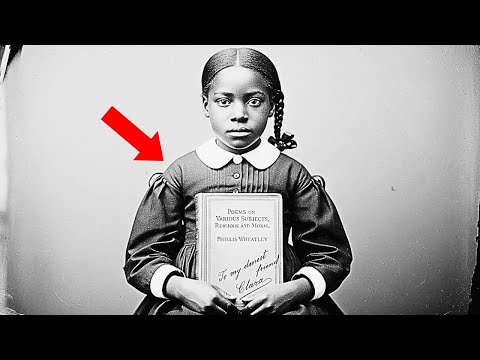
Jennifer called Dr. Raymond Foster, a historian at the University of Georgia. When she read him the inscription, his response was immediate: “You’re looking at evidence of something that was considered criminal at the time.” Interracial friendships were increasingly forbidden as Jim Crow laws tightened their grip. And if “Em” had been teaching Clara to read, the act was even more threatening—educated black people were seen as a danger to the social order.
Jennifer turned back to the photograph. Clara’s chin was lifted, her posture straight. She wasn’t holding a book; she was holding a weapon. The book, Jennifer would soon discover, was a copy of Phillis Wheatley’s poems—a volume that proclaimed black intellectual achievement. Someone had paid $1.50—a significant sum in 1884—to have this portrait taken. It was no accident. It was a deliberate act of documentation.
Their investigation led them to Samuel Watkins, a controversial Athens photographer who served both white and black clients. His logbook confirmed the date: August 12, 1884. Portrait of a young girl, Clara. No surname. Commissioned by family. Payment received. But who was “Em”? The initials matched Emma Margaret Ashford, daughter of Charles Ashford, a white educator who had once taught at a freedmen’s school. Emma would have been ten years old in 1884—the same age as Clara.
Then came the breakthrough. Dorothy Washington, an elderly church historian, recalled her grandmother’s stories about a girl named Clara who worked as a helper at the Ashford School. “Clara could read better than most adults,” Dorothy said. “The church people knew about it, and they were proud—but also scared for her.” Reading was power, and power was dangerous for a black child in those days.
Jennifer and Raymond had found their Clara. But the story was far from over. A fragment of a diary, hidden for over a century, would soon reveal the heartbreak behind the portrait—and the courage that had kept it hidden.
Dorothy Washington’s hands trembled as she unfolded the oilcloth bundle. Inside was a single page of diary paper, its edges frayed but the handwriting still legible—careful, educated strokes that belonged to a young white girl. “Mother discovered my friendship with Clara today,” Jennifer read aloud. “She has forbidden me from speaking with Clara except when absolutely necessary for school business.”
The entry was dated September 1884, one month after the portrait was taken. Emma wrote of Clara’s intelligence, her kindness, the way she read poetry with such feeling it brought tears to her eyes. “I gave Clara the Wheatley poems last month and we had her portrait taken holding it,” the diary continued. “If we are to be separated by society’s cruel rules, at least there will be this—a photograph showing Clara as she truly is, not as a servant, but as a scholar.”
Raymond’s voice was tight with emotion. “We have documentation of an interracial friendship that violated every social norm of Jim Crow Georgia—written in the words of one of the participants.” Most such evidence had been destroyed or lost. But Emma had written it down, and somehow it had survived.
They divided the research. Raymond traced Emma’s life after 1884; Jennifer searched for Clara. The work was painstaking, complicated by the different ways white and black lives were documented in the Jim Crow South. Emma married James Crawford, a businessman from Atlanta, in 1890. Census records showed three children, occasional mentions in society pages, a conventional life confined within acceptable boundaries.
Jennifer’s search was harder. African-American women rarely appeared in official records unless they intersected with legal or economic systems. But one name stood out: Clara Johnson, listed in the 1900 census as a 26-year-old school teacher living with her mother. The age fit. Church archives confirmed she had taught at a small school for black children in the basement of the same church where the photograph was found—from 1892 until 1918.
An oral history interview from 1976 struck Jennifer like a physical blow. An elderly man named Robert Pierce recalled his teacher, Miss Clara. “She made us love books. She said books were freedom—that they couldn’t take away what we knew, what we learned. She had this old book of poems she’d read to us sometimes. Said it had been given to her by someone special. She treated that book like it was made of gold.”
The Wheatley poems. Clara had kept the book Emma gave her, had treasured it for decades, and had used it to teach her own students. The gift had continued to create ripples, touching lives far beyond that moment in 1884 when two young girls had defied society’s barriers.
Then came the call from Patricia Hendrix, whose grandmother had been one of Clara’s students. “My grandmother always said Miss Clara loved someone she couldn’t be with, someone from a different world,” Patricia explained. “There’s a box of letters I found when my grandmother passed. I never read them carefully. They seemed private.”
Jennifer and Raymond visited Patricia’s home the next day. The box contained approximately thirty letters, all written on fine stationery and dated between 1884 and 1889. They were from Emma to Clara—continuing their friendship in the only way that remained possible. Emma wrote about her reading, her frustrations, and repeatedly expressed her longing to see Clara again. The letters were addressed simply to Clara, signed only with Emma’s initials. Precautions against discovery.
One letter from 1885 was particularly poignant. “I received word through Sarah that you are reading the Wheatley poems to the younger children at your church. My heart soars knowing that you are becoming the teacher I always knew you could be. Society says we cannot be friends, but they cannot stop me from caring about you or being proud of your accomplishments.”
But it was a letter from 1889 that silenced the room. “I am to be married in the spring,” Emma had written. “James has asked that I sever all ties that might compromise our standing. I have agreed. Forgive me, Clara. I am not brave enough to choose differently.” That was the last letter in the box. No farewell followed, no explanation beyond the quiet admission of surrender.
Jennifer sat with the fragile pages in her lap, the weight of a century pressing down on her. Emma had chosen safety. Clara had been left without a word. And yet Clara had kept every letter—had kept the book, the photograph, the memory of a friend who had abandoned her.
Raymond broke the silence. “There’s something I haven’t told you yet.” He pulled a photocopy from his satchel—a diary entry from Emma’s adult years, discovered in a collection at the Atlanta History Center. Emma had kept diaries intermittently throughout her life. In 1920, she had returned to Athens for the first time in decades.
“I walked past the church where I knew Clara taught,” Emma had written. “I wanted to see her, to apologize for my long silence. But I stood outside and could not find the courage to go in. A group of children came out, laughing, carrying books. One little girl was reading aloud from a book of poetry. I recognized it even from a distance—the Wheatley poems I gave Clara in 1884. She kept it. After everything, after my betrayal, she kept the book and continued to share it with others.”
Emma had walked away without entering the church. “I am a coward today, just as I was in 1889,” she confessed. “But at least I know this: Clara became exactly what I always believed she could be.”
Jennifer read the passage twice, her throat tight. The story had seemed romantic in its defiance—two girls against an unjust world. But reality was messier. Emma had failed their friendship. Clara had carried on alone, building a life dedicated to education while holding onto the memory of a friend who had left her behind.
“Did they ever reconcile?” Jennifer asked.
Raymond shook his head. “I found no evidence of further contact. Emma died in 1945. Clara in 1928.”
One question remained: why had Clara hidden the photograph and letters inside the church wall? The answer came from Dorothy Washington, who recalled her grandmother’s account of the 1915 renovation. Clara had asked the construction workers to seal her precious items inside the cavity. “She said she wanted them protected,” Dorothy explained. “That they were too important to risk losing.”
Jennifer understood then. The photograph wasn’t just documentation of a friendship. It was proof of Clara’s worth—evidence that someone had once seen her not as a servant, but as a scholar. Clara had hidden it to keep it safe, and she had drawn on that validation throughout her life, passing it on to her students.
The Atlanta Historical Preservation Society mounted an exhibition featuring the tintype, the diary fragment, and Emma’s letters—donated by Patricia Hendrix so the story could finally breathe in the open. Visitors stood before Clara’s enlarged portrait, many of them blinking back tears. “She wasn’t just holding a book,” Jennifer told the crowd on opening day. “She was holding proof that she mattered.”
A group of schoolchildren clustered around the display—a mixed-race class, standing shoulder to shoulder without a thought. Their teacher explained that friendship like Clara and Emma’s had once been forbidden. One boy squinted at the photograph and shrugged. “That’s stupid,” he announced. The others nodded.
Jennifer smiled and stepped back. Perhaps that was the portrait’s final purpose—not only to document the past, but to remind the living how fragile progress can be.
Clara’s dignified face, the Wheatley poems cradled against her dress, would keep teaching long after everyone in that room was gone. Worth. Courage. The stubborn, quiet power of a book in the right hands.
And somewhere in the silence of the archive, two girls of 1884 were still speaking—one through ink, one through silver and copper.
If you had found Clara’s portrait in that church wall, would you have recognized the rebellion in her hands—or only the sweetness of a child dressed for Sunday?
Report this article
Select a reason for reporting:






