The war cry split the night air, a sound so feral it seemed to claw at the very stars. Fanny Kelly stood frozen, her heart hammering against her ribs as the Sioux warriors danced around the blazing torches, their bodies painted for war, their eyes gleaming with a terrifying fervor. She had been forced to join this grotesque festivity, a staff in her hand from which dangled the bloody scalps of white soldiers—men who might have been her rescuers. The flickering light cast monstrous shadows on their faces as they stamped and shrieked, and Fanny knew in that moment that her life hung by the thinnest of threads.
Just days earlier, she had been a captive in a moving village, a sea of women, children, and dogs dragging the Sioux Nation’s belongings across the desolate plains. Now, she was a trophy in their victory dance, a symbol of their triumph over General Sully’s army. But the real horror was yet to come.
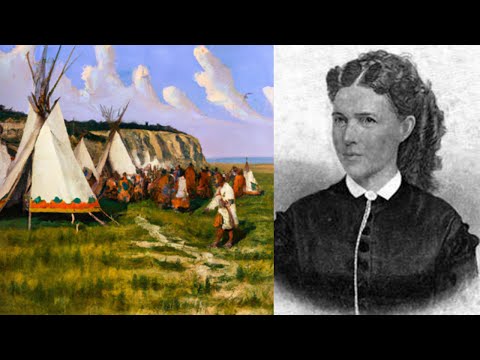
The battle had been fierce. General Sully’s troops, determined to crush the Sioux, had pursued them relentlessly. Fanny had heard the distant boom of cannons—the “big guns,” the Indians called them—and her heart had leaped with hope. “The soldiers had surely come for me,” she later wrote, “and would overtake us.” But the Indians returned from the fight not defeated, but enraged. They bore trophies: blood-soaked uniforms torn from fallen soldiers, and the news that they had killed many white men. Among the dead was Captain Fielner, the topographical engineer whose scalping had sparked a cycle of vengeance.
Fanny’s hope turned to ashes. The Indians, desperate and starving, now saw her not as a guest but as a burden—and a target for their fury. “Their feelings were revengeful toward me,” she recalled. The chiefs convened a council, and Fanny was summoned. “Are you ready to die?” the messenger asked. “To be burned at the stake?” Her blood ran cold. She had heard of the horrific tortures inflicted on captives, and now she was to be the next victim.
The council fire crackled as the pipe was passed, each chief smoking in solemn silence. The old Chief Ottawa, his body a map of battle scars, rose to speak. “The pale faces are eternal persecutors,” he declared, his voice heavy with decades of grievance. “They pursue and harass us without intermission, forcing us to abandon our best hunting grounds.” He pointed to the stake being prepared. “Is it just that we should suffer these wrongs without complaining? Shall we allow ourselves to be slaughtered like timid animals without seeking to avenge ourselves?” Murmurs of agreement rippled through the circle. Fanny’s fate seemed sealed.
But then another voice cut through the tension. Another old chief, Ottawa, stood. “It is the undoubted right of the weak and oppressed,” he said, “and yet it ought to be proportioned to the injury received. Why should we put this young innocent woman to death? Has she not always been kind to us? Smiled upon us and sang for us? Do not all our children love her as a tender sister? If they are of her nation, why should we punish the innocent for the guilty?” He looked to the heavens, and Fanny, trembling, offered her own silent prayer.
The chiefs deliberated, and Fanny waited, her life balanced on the edge of a knife. The decision, when it came, was mercy—but a fragile one. Her life was spared, yet the horrors of starvation and constant flight were just beginning. The Badlands loomed ahead, a barren wasteland of jagged rock and choking dust, where the Sioux hoped to lose Sully’s army. For Fanny, it was a march into the heart of despair, with death always a step behind.
The days that followed blurred into a single, endless nightmare of dust and hunger. The Badlands stretched before them like the ruins of some ancient, cursed world—great boulders of blasted rock scattered across hard, dry sand, and everywhere that choking wind that filled the air with blinding grit. Fanny wrapped her blistered face as best she could, but the sand found every crevice, stinging her eyes and coating her throat with each breath.
They pressed northward with General Sully’s army always at their heels. The warriors rode in tight, watchful clusters, scanning the horizon for the telltale dust clouds that signaled pursuit. There was no time to hunt, no time to rest. “We were driven so far northward,” Fanny wrote, “that they were obliged to leave all their earthly effects behind them and swim the Yellowstone River for life.”
The ponies were the first to break. Starved of food and water, their ribs jutted through their hides like barrel staves, and it took hard blows and desperate shouts just to keep them moving. When the order came to cross the Yellowstone, Fanny’s heart seized. The river ran swift and cold between steep banks, and she could not swim. She clung to her horse’s mane as the animal plunged into the current, the icy water closing over her chest, and prayed with every fiber of her being.
They made the far bank half-drowned and shivering, but alive. Behind them, the Sioux abandoned everything that could not be carried—lodges still standing, blankets, provisions, tools. It was a terrible sacrifice, but it bought them distance. General Sully’s troops stopped to burn the abandoned camp, and that single day of destruction was all the Sioux needed to slip beyond his reach.
When the pursuit finally ended, the warriors turned homeward, and Fanny braced herself for what she knew would follow: the mourning. She had seen it before, but never on such a scale. The women wailed and tore at their hair, blackened their faces with ash, and gashed their own arms and legs with knives until the blood ran freely. “Their cries are terribly wild and distressing,” Fanny recorded, “and the near relations of the deceased indulge in frantic expressions of grief that cannot be described.”
Hunger stalked them all. The flight had scattered every store of food, and the barren country yielded nothing—no buffalo, no elk, not even a rabbit. Dogs and horses began to die, and their bodies were eaten immediately. Fanny survived on rose leaves and blossoms gathered along the way, chewing grass for whatever moisture it might hold. “Many days in succession I tasted no food,” she wrote, “save what I could gather on my way.”
And still the Indians blamed her. The loss of their young men, the humiliation of the flight, the gnawing emptiness in their bellies—all of it curdled into a bitter hatred directed at the pale woman in their midst. They threatened her with death almost hourly, and Fanny never knew when the mercy shown at the council fire might be withdrawn.
One evening, as she sat apart from the others, an Indian approached and dropped something into her lap. It was a letter—crumpled, stained, and addressed in a neat, careful hand. She recognized the paper at once. It had been taken from the pocket of a dead soldier.
Her fingers trembled as she unfolded it. The letter was from the soldier to his family, a tender message of love and hope, written in the cheerful confidence that he would soon see them again. But the warrior who had taken it from the corpse told her something else: the letter had been found on a man who fell at the Little Cheyenne, and it carried news that chilled her blood. Captain Fielner, the topographical engineer, was dead. And General Sully, in his fury, had ordered the heads of the fallen warriors cut off and impaled on poles as a warning to every Sioux camp.
Fanny stared at the letter, her vision swimming. “The soldier had written a friendly and kind letter to his people,” she wrote, “but ere it was mailed he was numbered with the dead.” The words blurred before her eyes, and she understood with terrible clarity that the cycle of vengeance would only deepen. Every death on one side demanded a death on the other, and she—a white woman, helpless and alone—stood squarely in the middle of it.
That night, as the camp settled into an uneasy silence broken only by the whimpering of hungry children, Fanny lay on the cold, damp ground and stared up at the stars. Her body ached with fatigue and emptiness, her face was raw from sun and wind, and her heart was a battleground of hope and despair. Yet even here, in this desolate place, she found a strange and stubborn consolation. “It was a blessed consolation,” she wrote, “that no earthly foe could interrupt my communion with the Heavenly World.”
She closed her eyes and let the words of an old hymn rise in her mind, a whispered promise in the darkness: He walks with thee, that angel kind, and gently whispers, be resigned. Bear up, bear on, the end shall tell, the dear Lord ordereth all things well.
Morning would bring another march, another day of hunger and fear. But as sleep finally claimed her, Fanny Kelly held fast to the one thing her captors could never take: the unshakable belief that she would, somehow, survive.
The days of flight dragged on, and the Badlands gave way at last to broken country where a little game could be found—a few rabbits, a stray antelope—and the Sioux began to recover their strength. Fanny watched the warriors ride out again, not in triumph this time but in the quiet, patient way of men who knew the white soldiers would not follow them into such desolation. General Sully’s column, burdened with wagons and weary horses, had turned back at last.
“So all my fond hopes were blasted,” Fanny wrote, “for the Indians told me that the Army was going in another direction.” The words tasted of ash. She had heard the big guns, seen the smoke of battle rolling over the hills, and believed with all her heart that rescue was at hand. Instead, the soldiers had gone, and she remained a captive in a starving village that blamed her for every soldier’s bullet.
Yet the mercy shown at the council fire held. Chief Ottawa’s voice had not been forgotten, and though the women still blackened their faces and wailed for their dead, no hand was raised against her. She gathered her rose leaves and blossoms, chewed her grass, and walked on beside the stumbling ponies and the burdened dogs. “Fear, fatigue, and long-continued abstinence were wearing heavily on my already shattered frame,” she admitted, “but life always became sweet to me when I felt that I was about to part with it.”
She did not know how many weeks would pass before deliverance came, nor what further trials lay between her and the flag of liberty. But she had learned the one lesson the wilderness teaches to all who would survive it: to bear up, to bear on, and to trust that the end would tell. And so Fanny Kelly walked on into the unknown, a woman alone among enemies, clinging to a hope no earthly foe could take from her.
What would you have done in Fanny’s place—would you have found the same stubborn faith to endure, or would the endless hope deferred have broken you at last?
Report this article
Select a reason for reporting:






