In the dimly lit archives of Harvard University’s Widener Library, Dr. Rebecca Torres lifted a fragile photograph from a Manila envelope marked Boston Railway Station Collection 1900-1905. The image showed a woman in a dark, worn dress embracing a young boy on a train platform. The woman’s face was turned downward, her expression hidden, but her posture conveyed unmistakable sorrow. The boy stared directly at the camera with hollow, tired eyes that seemed far too old for his small frame. Rebecca had seen hundreds of similar photographs, but something about this one held her attention. She couldn’t quite identify what it was.
Three weeks later, an email from the digitization team changed everything. As the high-resolution scan loaded on her screen, Rebecca leaned forward, adjusting her glasses. The clarity was remarkable—she could see individual threads in the woman’s dress, the grain of the wooden platform, even the texture of the boy’s worn boots. But it was something else that made her breath catch in her throat. In the boy’s small hand, pressed against the folds of his mother’s dress and nearly invisible in the original photograph, was a small metallic disk. She zoomed in further, her heart beginning to race. It was a medal of some kind.
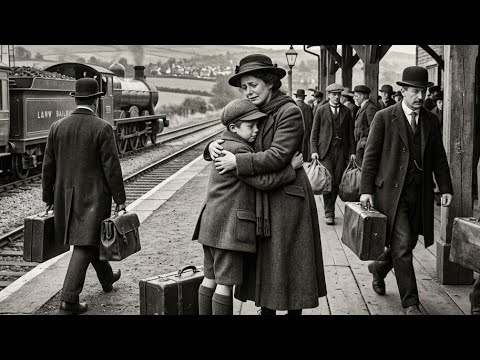
Rebecca immediately contacted her colleague, Dr. James Mitchell, a military historian. Within an hour, he was studying the enlarged image with intense concentration. “That’s a military medal,” he finally said, his voice quiet but certain. “The shape, the ribbon attachment point—I think that’s from the Spanish-American War era, 1898, maybe 1899.” Rebecca felt a chill run down her spine. The photograph was dated 1900, just two years after the conflict. But why would a young boy be clutching a military medal in such a clandestine way? And why did the mother appear so devastated?
James shook his head slowly, frustrated by the limitations of the image quality. “Not with absolute certainty, but the size and shape are consistent with campaign medals issued to soldiers who served in Cuba or the Philippines. We need to find out who these people were.” He paused, running a hand through his graying hair. “Rebecca, if this boy was holding his father’s medal and his mother is clearly in mourning, we might be looking at a widow and an orphan.”
Rebecca’s mind raced through possibilities. Thousands of men had served in the Spanish-American War, and many had died—not just from combat, but from disease. The war had been brief but brutal, leaving countless families shattered. “The photograph was taken at a Boston railway station,” Rebecca said, opening the original archive notes. “There’s a partial notation here: ‘Mother and child, platform seven, early morning departure.’ That’s all we have. No names, no destination, nothing else.”
James pulled up a chair beside her, his expression determined. “Then we start with the station itself. Boston in 1900 had several major railway terminals. We need to identify which one, check passenger manifests if they still exist, cross-reference with military discharge records and casualty lists from the war.” Rebecca nodded, feeling the familiar rush of a historical mystery beginning to unfold. But this wasn’t just an academic puzzle. This was about real people, real grief, and a secret hidden in plain sight for over a century.
For the next two weeks, Rebecca and James worked tirelessly. Rebecca focused on identifying the railway station and searching for immigration records, while James dove deep into military archives, searching for Irish immigrant soldiers who had served in the Spanish-American War and died or gone missing shortly afterward. The work was painstaking and often frustrating. Many records from that era had been lost to fires, floods, or simple neglect.
Rebecca started with the photograph itself, examining every visible detail. The architectural elements—the iron support beams, the distinctive roof line, the platform numbering system—eventually led her to identify the location as South Station, which had opened in Boston in 1899. She requested access to South Station’s historical archives, now held by the Massachusetts Historical Society. After days of searching through fragile ledgers, she found a notation dated September 14th, 1900: Platform 7, morning departures to Providence, Hartford, New York. But there were no passenger names listed for that specific date.
Meanwhile, James was making slow but steady progress through military records. He obtained access to the National Archives collection of Spanish-American War service records, focusing on soldiers of Irish descent who had enlisted for Massachusetts. One afternoon, he called Rebecca from the National Archives reading room in Washington. His voice carried a mixture of excitement and sadness. “I found something. There were 47 Irish-born soldiers from the Boston area who died during or immediately after the Spanish-American War. But here’s what’s strange: 12 of them have notations in their files marked ‘status disputed’ or ‘record incomplete.'”
Rebecca’s pulse quickened. “Disputed how?” “Various reasons. Some were listed as deserters, others as missing in action, a few with contradictory death reports. The paperwork is a mess, Rebecca, and given the anti-immigrant sentiment of the time, I suspect some of these men were simply forgotten—or worse, deliberately misrecorded.” Rebecca thought of the medal hidden in the boy’s hand, the mother’s grief-stricken posture. If a soldier was wrongly listed as a deserter, his family wouldn’t receive his pension or benefits. They’d be left with nothing but shame.
“Exactly,” James replied. “And if this boy’s father was one of those men, that medal might have been the only proof the family had of his actual service and sacrifice. I’m sending you the list of names. Let’s see if we can match any of them to immigration records or Boston city directories from 1898 to 1900.”
Rebecca received James’s list and immediately began cross-referencing the names with Boston immigration records, city directories, and church registries. The process was meticulous and exhausting. On the fourth day of her search, while examining records at the Archdiocese of Boston’s historical archives, she found something promising. In a parish registry from St. Augustine’s Church in South Boston, an area heavily populated by Irish immigrants, she discovered a baptismal record from 1892 for a boy named Thomas, son of Patrick and Mary, immigrants from County Cork. The surname caught her attention immediately. She checked it against James’s list of disputed military records. There it was: Patrick, enlisted August 1898, Company K, 2nd Massachusetts Volunteer Infantry, deployed to Cuba. Status: deserted October 1898.
Rebecca’s hands trembled as she photographed the registry page with her phone. A deserter. That single word would have destroyed this family’s reputation, cut off any military benefits, and branded Patrick as a coward in the eyes of his community. But the medal in the photograph suggested a very different story. She called James immediately. “I think I found them. Patrick, Mary, and their son Thomas. The father was listed as a deserter, but if he actually died in combat and someone made an error—or worse, deliberately falsified the record—this family would have been devastated.”
James’s response was thoughtful. “We need to find Patrick’s complete military file. If there’s documentation about how he supposedly deserted, there might also be evidence that contradicts it. Sometimes these files contain letters, witness statements, or transfer orders that tell a different story than the official designation.” Over the next week, James worked with archivists at the National Archives to locate Patrick’s full military record. What he discovered was deeply troubling. The desertion charge was based on a single report filed by a Lieutenant named Howard Sterling, who claimed that Patrick had abandoned his post during a skirmish near Santiago de Cuba in October 1898. There was no investigation, no corroborating testimony, no follow-up.
But buried deeper in the file, James found something else. A handwritten note from a different officer, Captain William Harrison, dated November 1898. It read: “Regarding the man Patrick reported as deserted by Lieutenant Sterling, witness the soldier fall during enemy engagement Oct 4. Body not recovered due to terrain. Recommend status review.” James sat back in his chair, anger rising in his chest. Patrick hadn’t deserted. He had died in combat. But Lieutenant Sterling’s report had been accepted as official. Captain Harrison’s contradicting account had been ignored or overlooked. The bureaucratic indifference—or perhaps prejudice—had condemned an immigrant soldier’s memory and destroyed his family’s future.
“Rebecca,” James said when he called her that evening, his voice heavy with emotion. “Patrick died a hero, and his family spent the rest of their lives carrying the shame of a lie.” With Patrick’s identity confirmed and the truth about his death emerging, Rebecca shifted her focus to understanding what had happened to Mary and Thomas after 1900. She knew that the photograph captured a moment of departure, but where had they been going—and why?
She returned to South Boston, walking the narrow streets that Mary would have known, trying to imagine the widow’s life in those desperate years. At the Boston Public Library, Rebecca discovered city directory listings that painted a heartbreaking picture. In 1899, Mary was listed as living at a tenement address on East Fourth Street, occupation: laundress. By 1900, she had moved to a smaller, cheaper lodging on West Broadway. By 1901, her name no longer appeared in the Boston directories at all. Rebecca also found records at the Massachusetts State Archives showing that Mary had applied for a military widow’s pension in early 1899. The application had been denied because Patrick’s status was listed as deserter. Mary had appealed twice, each time submitting handwritten letters pleading for someone to investigate the circumstances of her husband’s death. Both appeals were rejected with formal letters.
The weight of this injustice pressed heavily on Rebecca as she read Mary’s words, written in careful but imperfect English: “My husband Patrick was good man. He love his country. He go to war proud. Please, I need help for my boy. Please look again. He not run away. He die fighting.” No one had listened.
Rebecca found more fragments in unexpected places. A notation in the records of the Saint Vincent de Paul Society showed that Mary had requested assistance in August 1900 to pay for her son’s railway ticket to Providence, Rhode Island. She was sending the boy to live with her sister’s family because she could no longer afford to feed him. The photograph suddenly made complete sense. It was a mother’s goodbye, a moment of unbearable separation forced by poverty and injustice.
But the medal—why had Thomas been holding it in that moment? Rebecca found a possible answer in a small diary entry from a Providence City Mission volunteer, dated September 1900. It mentioned a boy named Thomas arriving from Boston to stay with his aunt’s family. “The child carries with him a military medal, which he says his mother gave him before the train. She told him it belonged to his father, who was a soldier and a brave man, and that he must never forget this truth, no matter what anyone else says.”
Rebecca sat alone in the reading room, tears blurring her vision. Mary had given Thomas the medal—the only physical proof of Patrick’s service and honor—as a final gift, a piece of truth to carry with him when everything else had been taken away. It was an act of profound love and defiance.
James, meanwhile, had become increasingly troubled by Lieutenant Howard Sterling. He discovered that Sterling came from a wealthy Boston family with deep political connections. His service record showed a pattern of friction with enlisted men, particularly those from immigrant backgrounds. Then James found a letter in Sterling’s post-war correspondence, dated 1899. “The immigrant rabble proved as unreliable as expected. One Irish fool got himself killed trying to play hero. I marked him down as a deserter, saved the government a pension, and taught the others a lesson about their place.”
James felt sick reading those words. Patrick hadn’t just been failed by bureaucracy—he’d been deliberately dishonored by a bigoted officer. The desertion report wasn’t an error; it was an act of malice. He immediately shared his findings with Rebecca. “We have to set this right,” she said fiercely. “We have to tell Patrick’s story and clear his name, even if it’s more than a century late.”
Tracing Thomas’s life after 1900 proved challenging. Rebecca discovered that Thomas had lived with his aunt’s family in Providence, attending school intermittently. By 1906, at age 14, he appeared in city records as an apprentice at a textile mill. But what happened to Mary? It took days of searching before Rebecca found the heartbreaking answer in Boston City Hospital records. Mary had died in February 1902 at age 31, of pneumonia and exhaustion. She had worked herself to death in the two years after sending her son away.
Yet through all of this, Rebecca noticed something remarkable in the orphanage records where Thomas lived from 1902 to 1906. Multiple mentions of a military medal that Thomas kept with him, carefully hidden in his few possessions. One small military medal, brass, worn ribbon, property of the boy. He had kept it through everything—the separation from his mother, her death, his time in the orphanage. Thomas had kept his father’s medal just as Mary had wanted.
Thomas’s adult life revealed a man shaped profoundly by his childhood losses. He served honorably in World War I, was wounded twice, and returned to Providence, where he married and had three children. In a journal he kept during the 1930s, one entry stood out—dated September 14th, 1940, exactly 40 years after the photograph. “Today I thought of the day mother sent me away. She put father’s medal in my hand and told me to remember that he was brave and good, no matter what the government said. I carry that medal still. My children know the story. They will pass it to their children. The truth will not die with me.”
Rebecca traced Thomas’s family line forward and made contact with his granddaughter, Sarah, who lived in Cranston, Rhode Island. She was 71 years old, retired from a career as a public school teacher, and initially skeptical. “My grandfather didn’t talk much about his childhood. But he did tell us about his father, the soldier who died in Cuba, and he always insisted the official records were wrong. He kept the medal in a wooden box. I remember seeing it as a child.”
With Sarah’s permission, Rebecca and James drove to Cranston on a cold November morning in 2018. Sarah welcomed them into her modest home and listened in silence as they explained everything they had discovered. When Rebecca finished, Sarah stood without a word and left the room. She returned moments later carrying a small wooden box, its surface worn smooth by generations of handling. “My grandfather gave this to my father before he died. My father gave it to me. I’ve been waiting my whole life to know what to do with it.”
She opened the box. Inside, resting on faded velvet, was the medal from the photograph. Even after 120 years, it retained a faint gleam. The engraving was still visible—a campaign medal for service in Cuba. On the back, someone had carefully scratched a name: Patrick. “He was a brave man,” Sarah said, touching the medal gently. “My grandfather told me that again and again. He said his mother made him promise never to forget it, and he never did.”
Rebecca and James worked with military historians, legal advocates, and the Department of Defense’s Board for Correction of Military Records to build a comprehensive case for Patrick’s posthumous exoneration. They submitted every piece of evidence: Captain Harrison’s witness statement, Sterling’s prejudicial correspondence, Mary’s pension appeals, and the medal itself. In June 2019, nearly 121 years after Patrick’s death in Cuba, the Department of Defense issued a formal correction to his military record. His status was changed from ‘deserted’ to ‘killed in action.’
Rebecca organized a small ceremony at the Massachusetts State House in August 2019. A military officer presented Sarah with her great-great-grandfather’s corrected service record and a certificate of honorable service. “Patrick served his country with courage and died with honor. The error in his record was a grave injustice to him and his family. Today, we set that record straight.” Sarah accepted the documents with trembling hands, tears streaming down her face. Beside her stood her children and grandchildren—Patrick’s descendants, carrying forward the line he had died protecting.
Rebecca spoke briefly at the ceremony, holding up a large print of the 1900 photograph. “This photograph captured one of the most painful moments in this family’s history. A mother saying goodbye to her son, both of them carrying the weight of an injustice they couldn’t fight. But hidden in that moment was also an act of profound resistance. A medal passed from hand to hand, a truth preserved against all odds.” She looked at Sarah. “Your great-great-grandmother Mary wanted her son to remember that his father was brave and good. She gave him the only proof she had, and he kept that promise. Today, finally, the world knows the truth she protected.”
After the ceremony, Sarah approached Rebecca and James privately. “I have something to tell you. My grandfather kept a journal. I found an entry from September 1940 where he wrote about the day his mother gave him the medal. He wrote, ‘The truth will not die with me.’ I used to think that was just his way of coping with grief. Now I understand it was a mission—and you helped him complete it.”
The photograph that had hung forgotten in an archive for 118 years now held a place of honor in Harvard’s collection, accompanied by the full story of the family it depicted. The medal returned to Sarah’s family, where it would continue to be passed down—no longer a symbol of hidden truth, but of justice finally served. Rebecca often thought about Mary standing on that platform in 1900, pressing the medal into her son’s hand, whispering words of truth and love she knew he would need to survive. Mary had died believing her husband was remembered only as a deserter, never knowing that her final gift to her son would one day restore everything that had been taken from them. But Thomas had known. He had carried that medal for 64 years, protecting his father’s honor with the same courage Patrick had shown in Cuba. And now, five generations later, the truth had finally caught up with the lie. The photograph remained as it had always been—a mother comforting her son, frozen in a moment of grief. But now when people looked at it, they could see what had been hidden for so long. A small hand clutching a medal, holding tight to love, memory, and an unshakeable belief that the truth, no matter how long buried, would someday come to light.
What would you do if you discovered a hidden truth in your own family’s history—would you have the courage to pursue it, no matter how much time had passed?
Report this article
Select a reason for reporting:






