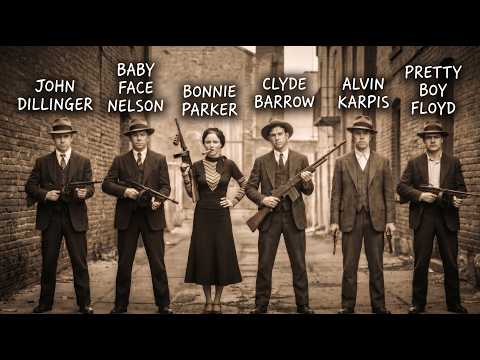
When John Dillinger and Babyface Nelson’s faces were plastered on every post office wall in America, survival as Public Enemy Number One became a gruesome game of self-destruction. The 1930s Public Enemy era wasn’t a game of hide and seek—it was a brutal test of human endurance where staying alive required back-alley mutilations and field medicine that defied belief. The stakes became life or death after the bloody 1933 Kansas City Massacre, a shootout that shocked the nation and gave J. Edgar Hoover the ultimate federal mandate to hunt down the underworld. From that moment on, if you were running, your body was the front line.
Months before FBI Agent Melvin Purvis would close the dragnet outside Chicago’s Biograph Theater on July 22, 1934, John Dillinger understood that escaping the law meant changing the one thing they used to track you: your identity. He paid a disgraced former physician named Dr. Wilhelm Loeser $5,000 to physically redesign his face inside a hidden safe house. Loeser sanded off three of Dillinger’s moles and aggressively tightened the skin under his cheekbone—a procedure that required cutting. Then he attempted to fill the cleft in Dillinger’s chin with hot paraffin wax. During the surgery, Loeser accidentally gave Dillinger an overdose of ether, causing his skin to turn blue and nearly killing him on the operating table before they could get his tongue, which had fallen back into his throat, out.
The very next morning, Dillinger hadn’t had enough. He had Loeser pour raw acid on his fingertips and scrape them, attempting to permanently erase his fingerprints. Though the process caused immense pain and deeply scarred the tissue, it failed to destroy the deep-set dermal ridges. When the FBI later took his prints after he was dead, the outer ridge patterns were still easily readable.
Dillinger’s inner circle understood this grisly survival math all too well, especially after their narrow escape from the bloody FBI ambush at the Little Bohemia Lodge. John “Red” Hamilton, Dillinger’s unluckiest lieutenant, was shot in the back during a chaotic getaway. Safe houses refused to take a bleeding high-profile fugitive, so Hamilton spent his final days trapped in a back room, slowly rotting from gangrene while his crew watched him slip away. When Hamilton finally died, Dillinger faced a brutal logistical reality: leaving the body intact meant giving Hoover’s men a definite tracking lead.
Dillinger and his associates drove the corpse to a gravel pit. They used a hacksaw to chop off Hamilton’s right hand—the one missing two fingers from a childhood accident that earned him the nickname “Three Finger Jack”—to throw off federal investigators. Then they poured ten cans of raw, flesh-eating lye over his face and chest before burying the rapidly dissolving remains. Survival didn’t stop at your own skin. It meant erasing your friends, too.
Further south, Ma Barker’s boys and the rest of the Barker-Karpis gang were taking the exact same physical gamble. Alvin “Creepy” Karpis paid a notorious underworld surgeon named Dr. Joseph Moran to permanently remove his fingerprints. Unlike Loeser’s acid method, Moran used a scalpel to physically slice the skin on the ridges of Karpis’s fingertips. The agony was immense, and the botched healing process left Karpis with smooth, sensitive scar tissue that made everyday tasks painful. While contemporary outlaws like Machine Gun Kelly relied on clever disguises and devastating firepower, the Karpis crew relied on raw mutilation. Moran’s medical failures eventually drove the gang to absolute paranoia. Believing the doctor knew too much and was becoming a liability, they executed him and dumped his body into Lake Michigan.
But fixing a face or a finger was nothing compared to the daily physical trauma endured by Bonnie Parker and Clyde Barrow. For them, survival meant keeping a broken squad moving at all costs. In June 1933, Clyde rolled their stolen Ford V8 into a river basin in the Texas Panhandle. The car battery cracked open, pinning Bonnie underneath and bathing her right leg in raw acid. The chemical burn was so severe that it ate down to the muscle, causing her leg to permanently curl inward and turning her toes into a claw. She could never walk on her own again. To keep her alive and escape police search parties, Clyde carried her in his arms for eleven straight months to motels and across state lines. When they had to stand in public to blend in, Bonnie would use sheer willpower to lean hard against car doors or fences so locals wouldn’t realize she was a crippled fugitive.
Clyde’s own survival required extreme measures long before the crash. To escape the brutal, lethal fieldwork conditions at Eastham Prison Farm, he used an axe to chop off two of his toes on his left foot. It worked to get him off the fields, but it left him with a permanent limp. For the rest of his life, Clyde drove getaway cars strictly in his socks because wearing shoes hurt too much, and he couldn’t react well to police ambushes when he was in the car.
While Dillinger was altering his face and Clyde was driving in his socks, Pretty Boy Floyd was running his own desperate escape across the Midwest, pushing his body to the absolute limit. But even Floyd’s endurance couldn’t match the Barrow gang’s survival instinct, which reached a terrifying peak during a police siege at a Missouri tourist court. Clyde’s older brother, Buck Barrow, took a bullet directly through the noggin. The round entered his left temple and exploded out the right side of his head. By all medical logic, he should have died right there. But instead, his wife, Blanche, bandaged his open head and loaded him into the car. They kept driving.
Five days later, while hiding out in an Iowa park, a posse cornered them again. Buck was completely incapacitated from severe blood loss and infection, but the rest of the crew actively traded gunfire with the police to buy time. When doctors finally captured Buck, they noted they had never seen a human being survive that long with that level of catastrophic brain trauma. He kept himself alive for nearly a week before finally succumbing to his wounds and a severe case of pneumonia in a hospital bed.
And then there’s Lester Gillis—the papers called him Baby Face Nelson. He took the concept of fighting to survive to its absolute limit during a furious road chase outside Barrington, Illinois, on November 27, 1934. Nelson went toe-to-toe with FBI inspectors Herman Hollis and Samuel Cowley. Nelson was shot repeatedly by a devastating blast of federal buckshot and rifle rounds but refused to stop firing his weapon. He killed both federal agents in a hail of gunfire, but his own lower body was completely shredded. The subsequent coroner reported nine separate entry wounds across his torso—a total of seventeen counting the one that went through his pancreas and liver. Yet Nelson didn’t fall. Somehow, he climbed back into the car they had just stolen from the two people he killed. Then John Paul Chase and Helen drove him all the way to his safe house in Will o’ the Met, Illinois. Every single drop of his remaining life force went to getting his family to safety before he finally bled out on a bedroom floor hours later.
Even after his death, his crew’s survival protocols remained cold and calculated to delay the Bureau from identifying his body and tracking the rest of the safe house network. Helen stripped his corpse and dumped him in a ditch, taking his clothes to burn the evidence.
That’s the raw, terrifying reality of the 1930s underground. They didn’t just run from the law—they mutilated and tortured their own broken bodies to keep moving, because stopping meant a date with the electric chair. The history books remember the fast cars and the Tommy guns, but the real story was written in blood and acid at the absolute limit of what a human body could endure to stay free for one more day.
But the mutilations were only half the equation. The other half was the medicine—or what passed for it—that kept these broken bodies upright long enough to run another day. There were no sterile operating rooms in the underworld, no trained nurses standing by with morphine and clean gauze. There were kitchen tables, whiskey bottles, and men with steady hands and no licenses.
Baby Face Nelson’s final ride proved just how thin that margin was. After the Barrington shootout, John Paul Chase and Helen pulled him from the car and laid him on the floor of the safe house. He was conscious enough to give instructions, and his first order was not for a doctor. It was to burn the car, wipe the plates, and get Helen out of the state before dawn. He knew that every hour his body lingered was an hour the Bureau could use to close the net around everyone he loved.
When he finally stopped breathing, the crew didn’t have time to grieve. They had a corpse with nine holes in it and a neighborhood full of people who might have heard the gunfire. Helen did what had to be done—she stripped him, wrapped the body, and helped drag it to a drainage ditch on the edge of town. Then she set his clothes alight in a metal drum behind the house. The smell of burning wool and blood hung in the air for hours.
It was the same cold arithmetic that had played out in a gravel pit in Ohio and a lake in Michigan. Dead men were liabilities. Dead men with intact faces and readable fingerprints were indictments waiting to happen. The Bureau’s Identification Division, run out of Washington, was building the largest fingerprint file the world had ever seen. Every arrest, every prison intake, every coroner’s report fed the machine. J. Edgar Hoover understood that the body itself was evidence, and evidence could be catalogued, cross-referenced, and used to hang a whole network.
So the outlaws fought back with the only weapon they had—their own flesh. They burned it, cut it, scarred it, and buried it in lye. They amputated fingers and hands from their own dead. They drove getaway cars in their socks and carried their wounded wives across state lines in their arms.
But there was one more name on Hoover’s list that the history books often skim over, and his story pushed the boundary of self-mutilation even further than Dillinger’s acid or Karpis’s scalpel. His name was Charles Arthur Floyd—Pretty Boy Floyd to the papers—and by the fall of 1934, he was the last of the big names still running. The Kansas City Massacre had put him at the top of the Bureau’s most-wanted list, and he knew that his face, like Dillinger’s, was on every wall from Oklahoma to Ohio.
Floyd had watched what happened to the others. He had heard about Loeser’s botched ether overdose and Moran’s butchered fingertips. He decided that if he was going to go under the knife, he would do it his own way. In a rented room outside of Tulsa, he had a local back-alley dentist pull every tooth in his upper jaw and replace them with a cheap set of dentures that changed the shape of his mouth entirely. The dentist, a man with gambling debts and a taste for corn liquor, asked no questions and took his payment in cash.
The swelling was so severe that Floyd couldn’t eat solid food for nearly two weeks. He lived on whiskey and milk, sitting in the dark with a cold compress pressed to his jaw, while his associates kept watch at the window. When the swelling finally went down, his own mother wouldn’t have recognized the hollow-cheeked stranger staring back at him from the mirror.
But changing a face was one thing. Changing a walk, a voice, a habit—that was something else entirely. And Floyd knew that the Bureau wasn’t just looking for a face. They were looking for a pattern.
Floyd’s gamble bought him weeks, not months. On October 22, 1934, agents and local police finally cornered him in an East Liverpool, Ohio, cornfield. He ran for the treeline, and a single round caught him in the back. He lived long enough to be carried to a porch, where he reportedly said, “I’m Charles Arthur Floyd”—and died before the ambulance arrived. The dentures, the hollow cheeks, the months of pain—none of it mattered once the fingerprints went to Washington.
That was the brutal lesson of the whole era. Dillinger’s acid-scarred fingertips, Karpis’s sliced ridges, Hamilton’s severed hand—the Bureau’s Identification Division catalogued them all. Hoover’s machine didn’t need a face; it needed a pattern, and patterns outlive flesh.
So the outlaws mutilated themselves for nothing. They chopped, burned, and buried their friends, and the file cabinets in Washington grew anyway. The history books remember the Tommy guns and the fast Fords, but the real story is written in blood, lye, and scar tissue—a desperate arithmetic that never once balanced.
If your own body was the last piece of evidence the law could use against you, how far would you go to erase it?
Report this article
Select a reason for reporting:






