In the harrowing skies over Europe, where every mile per hour and every gallon of fuel could mean the difference between life and death, a surprising discovery emerged from the heart of World War II aviation. The B-17 Flying Fortress, an icon of American air power, was at the center of a controversial decision: to paint or not to paint. As production rates soared to 17 bombers per day in early 1944, the U.S. Army Air Forces faced a critical choice—one that would unexpectedly alter the bombers’ performance in ways no one anticipated.
The stakes were immense. Crews flying unpainted B-17s felt dangerously exposed, convinced that their shiny, silver airframes would become prime targets for German fighters. Yet, in a twist of engineering irony, the decision to strip away camouflage paint had already been made before the tests to evaluate its effects were even conducted. What followed was a revelation that defied intuition and challenged everything engineers thought they knew about aerodynamics.
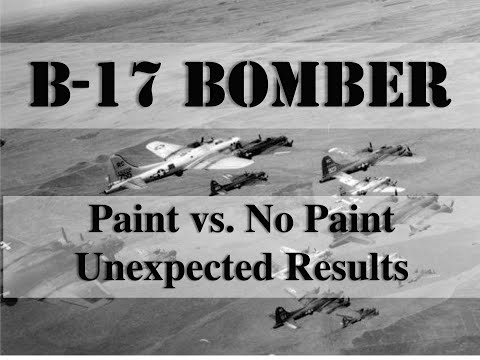
At the heart of the matter lay the B-17’s stress skin semi-monocoque construction—a design where the aluminum skins bore the brunt of the loads, transferring stress through thousands of rivets to interior stringers and frames. The exterior skins, mostly thin 24ST clad aluminum, were chosen for their corrosion resistance and shiny finish. But when painted, something remarkable happened. The paint, a two-coat system of chromated primer and lacquer, added 75 pounds to the aircraft. Yet, as flight tests at 24,900 feet would soon show, that extra weight came with an unexpected benefit.
At the same engine power, the painted B-17 flew two to four and a half miles per hour faster than its unpainted counterpart. The trend held consistent even at lower altitudes. The study concluded that paint was wicking into lap joints, seams, and rivet head gaps, smoothing the surface and reducing drag. In combat formation, where indicated airspeeds of 150 to 155 mph translated to true airspeeds of 222 to 229 mph at altitude, the implications were staggering.
Extrapolating the data, an unpainted B-17 would need 3 percent more engine power to keep pace with a painted one. That translated to roughly 80 extra gallons of fuel per mission—490 pounds of additional weight. With a combat-ready fuel load of about 2,700 gallons, the painted bomber enjoyed a 90-mile range advantage at formation speeds. The 75 pounds of paint more than offset the 490 pounds of extra fuel the unpainted B-17 required to match performance.
But why did this phenomenon not apply to the B-29 Superfortress? The answer lay in its design: flush fasteners and skin butt joints created aerodynamically clean surfaces, rendering paint’s drag-reducing effect negligible. For the B-17, however, the discovery was a game-changer—one that would reshape maintenance and operational strategies across the Eighth and Fifteenth Air Forces.
As the unpainted bombers rolled off assembly lines and into the fray, crews and engineers alike grappled with the paradox: stripping paint to save weight and cost had inadvertently made the aircraft less efficient. The story of the B-17’s paint dilemma is a testament to the complexities of aviation engineering, where even the smallest details can yield unexpected consequences.
Yet the story did not end with the flight test report. The data, compelling as it was, arrived too late to reverse the decision. By March 1944, bare-metal B-17s were already pouring into England by the hundreds, and the logistics of repainting them in theater—stripping, priming, and lacquering each airframe—would have consumed precious hangar time and manpower the Eighth Air Force could ill afford.
Instead, the report circulated quietly through Materiel Command, filed away as an engineering curiosity rather than an operational directive. No order went out to repaint the fleet. Crews continued to fly their silver Fortresses into the flak-filled skies, unaware that the finish they cursed might have been costing them fuel and range with every mission.
Still, the findings left a nagging question that nagged at the engineers who studied them. If paint could smooth a riveted airframe by filling lap joints and seams, what else might be gained—or lost—by the surface treatment of a bomber? The answer, it turned out, lay not in the paint itself but in the way the B-17 was built.
The Flying Fortress was a product of 1930s manufacturing, when thousands of protruding rivet heads and overlapping skin panels were simply the cost of building a large aircraft quickly. Each lap joint created a tiny step, each rivet a miniature obstacle to the airflow. Paint, brushed or sprayed into those crevices, effectively faired the surface—a crude but effective aerodynamic fix.
The B-29, by contrast, was designed from the outset with flush rivets and butt-jointed skins, its surfaces already as smooth as painted aluminum could hope to be. For the Superfortress, paint offered no aerodynamic benefit whatsoever—only weight. That was why the B-29’s bare-metal crown panels, dull and unclad, could be flown without penalty.
For the B-17, the lesson was bittersweet. The bomber that had carried the daylight bombing campaign on its shoulders was, in a sense, too old-fashioned to benefit from the very paint that had once been standard. The engineers who pored over the test curves could only speculate about what might have been: a fleet of painted Fortresses, each carrying 90 extra miles of range and 490 fewer pounds of fuel, flying deeper into Germany and back with a margin of safety that bare metal could not provide.
Yet the war did not wait for such reflections. The bombers kept rolling off the lines, silver and unadorned, and the crews kept flying them—paint or no paint—into the teeth of the Luftwaffe. The paradox of the B-17’s finish would remain an obscure footnote, a reminder that in the rush of wartime production, even the most carefully reasoned decision could carry consequences no one had foreseen.
Among the crews, however, the debate over paint took on a life of its own. Veteran bombardiers swore the olive-drab Fortresses drew less attention from German fighters, while pilots who flew the bare-metal ships insisted the silver finish made them harder to spot against an overcast sky. Neither side had data to back their claims—only the gut instinct of men who had watched friends die in burning aircraft.
What the crews could not see was the quiet arithmetic being tallied in the maintenance sheds. A painted B-17 required periodic touch-ups after every mission, and each coat of primer and lacquer added hours of ground time. The unpainted ships, by contrast, needed only a wipe-down and an occasional polish. In a war of attrition, the savings in manpower alone justified the bare-metal decision.
But there was another factor the flight test report never addressed: the psychological weight of the aircraft’s appearance. A shiny, unpainted Fortress looked new, aggressive, almost insolent—a deliberate challenge to the Luftwaffe. Some squadron commanders believed that alone was worth a few gallons of fuel.
As spring turned to summer in 1944, the Eighth Air Force’s strength swelled to unprecedented levels. Mission after mission, the formations darkened the sky over occupied Europe, and the question of paint faded into the background noise of war. The engineers’ report gathered dust while the bombers flew.
Yet in one corner of the Materiel Command offices, a young aerodynamicist named Lieutenant Harold Vance refused to let the matter rest. He had studied the flight test curves for weeks, and something about them troubled him. The drag reduction from paint was real enough—but the test data had been gathered on a single aircraft, under tightly controlled conditions that bore little resemblance to the violent, turbulent air of a combat formation.
What if the benefit vanished entirely when dozens of Fortresses flew together, their prop wash churning the sky into chaos? The formation itself created drag and turbulence that no amount of paint could smooth away. Vance began drafting a memorandum, arguing that the whole paint question was, in operational terms, a rounding error.
His superiors read the memo, nodded, and filed it alongside the original report. There was no time, no fuel, and no appetite for reopening a settled decision. The war had moved on.
But Vance’s observation would echo decades later, when historians and aviation enthusiasts revisited the B-17’s paint paradox. The numbers were elegant, the logic sound—yet they had been overtaken by the messy reality of combat, where no single variable could be isolated from the chaos of the sky.
And still the Fortresses flew, silver and unadorned, their rivets catching the sun as they climbed toward the assembly point. Whatever the engineers concluded, the crews had their own verdict: a bomber that flew was a good bomber, and paint had never once kept a man alive.
Lieutenant Vance’s memorandum might have ended there, buried under the weight of more urgent business, had it not crossed the desk of a group commander in the 91st Bomb Group. He read it twice, then passed it to his operations officer with a single handwritten note: “Worth a try. Let’s weigh a few ships and see.”
What followed was not a formal test but a grease-stained, improvised experiment. Crew chiefs weighed painted and unpainted Fortresses on borrowed scales, logged fuel consumption from mission reports, and compared the numbers against the engineers’ curves. The results were muddier than anyone expected—some unpainted ships burned more fuel, others less, and the spread between individual aircraft swamped the predicted 3 percent difference.
The paint paradox, it turned out, was real but small—a whisper lost in the roar of combat. Formation flying, engine wear, and the sheer variance between airframes mattered far more than the finish ever could.
So the silver Fortresses kept flying, and the painted ones flew beside them, and no one ever settled the argument. The war ended, the bombers were scrapped or mothballed, and the flight test report became a footnote for hobbyists to argue over on internet forums.
But the question lingers, as good questions do: if you had been a B-17 crewman in 1944, would you have wanted your Fortress painted—or trusted the bare metal? Tell us in the comments below.
Report this article
Select a reason for reporting:






