The night was alive with the unnatural cries of owls, their calls echoing through the dense Kentucky woods in a pattern too deliberate to be mere chance. Inside the double cabin, the Widow Scraggs felt a chill that had nothing to do with the April cold. Her son, restless and alert, had been pacing for an hour, his eyes fixed on the door. The horses in the pound nearby snorted and galloped, their terror palpable. Something was out there.
Then came the knock—a demand for admission in a voice that mimicked settlers but carried an edge that the old widow recognized instantly. “Indians!” she hissed, springing from her bed. “Don’t open the door!” Her sons grabbed their rifles, always charged, always ready. The night of April 11, 1787, was about to become a fight for survival.
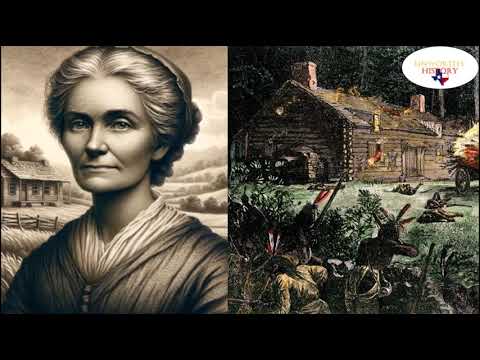
The Indians, realizing their ruse was discovered, began to thunder against the door with brutal force. A single shot from a loophole forced them to shift their attack. But fortune favored the attackers: they found the door to the other cabin, where the three daughters slept. The brothers’ rifles couldn’t cover that angle. With rails torn from the yard fence, the door was smashed open, and the girls were at the mercy of the raiders.
One daughter was seized immediately, but the eldest fought like a wildcat. She had been at the loom, a knife in hand, and she drove it into the heart of one Indian before she was tomahawked. The little girl, overlooked in the chaos, ran into the yard, her screams piercing the night: “They’re killing my sisters!” The brothers, mad with rage, prepared to charge out, but their mother blocked the door. “The child must be abandoned to its fate,” she declared, her voice steady despite the horror. “If you go, you’ll all die for nothing.”
Just then, the child’s scream was cut short by a faint moan, and silence fell. Then the crackling of flames—the Indians had set fire to the cabin. The blaze spread quickly, forcing the survivors to flee or burn. The door was thrown open, and the family scattered into the yard, lit by the blazing roof as bright as day. The old lady, supported by her eldest son, made for the fence but was shot down, several balls tearing into her breast. She fell dead. Her son, unhurt, escaped by sheer agility.
The other group—the widowed daughter with her infant, and the younger brother—also reached the fence, but Indians rushed them with tomahawks. The young man fought fiercely, firing until he had to use his rifle as a club, drawing all attention to himself so his sister could escape. He fell under the tomahawks, scalped and mangled. Of the eight family members, only three escaped; four were killed, and one—the second daughter—was carried off as a prisoner.
By daylight, thirty men had assembled under Colonel Edwards. A light snow had fallen, and the trail was easy to follow. But a hound, brought along, bayed loudly and alerted the Indians. The pursuers found the prisoner, her head split by a tomahawk, still warm and bleeding on the snow. She waved weakly at her brother, tried to speak, and died within minutes.
The pursuit continued, and soon they spotted two Indians on a narrow ridge, running from tree to tree and yelling to seem more numerous. The whites dismounted and flanked them. In the firefight, one Indian was killed and the other wounded, but the rest had escaped. The rear guard had sacrificed themselves to delay the pursuit—a act of devotion that even the settlers found remarkable.
The trail was lost when it entered a running stream, and the next morning the snow had melted, erasing all traces. The Widow Scraggs and her family had paid a terrible price on the frontier, their story one of many that would otherwise be forgotten.
The men stood in silence at the edge of the stream, staring into the dark water as if it might give up the secret of the trail. Colonel Edwards finally broke the quiet. “They’re gone,” he said, his voice flat. “We’ll not catch them now.” The party turned back, carrying the body of the second daughter wrapped in a blanket, and the mood was grim. They had saved no one, and the enemy had vanished into the mountains.
When they returned to the Scraggs place, the cabin was a smoking ruin. The eldest son, who had escaped the massacre, stood among the charred timbers with his surviving sister and her infant. He had buried his mother and brother in a single grave that morning, marking it with rough stones. “I’ll rebuild,” he told the colonel, though his voice cracked. “I’ll not let them drive me off.”
The story spread quickly through Bourbon County, and then through the settlements. It was the kind of tale that frontiersmen told their children—a warning and a lesson. The Widow Scraggs had been right to keep her sons from charging into the yard; had they gone, all would have died. Yet the memory of the little girl, running in circles and crying out, haunted the survivors for years.
What became of the eldest son is not recorded in Pratz’s book. Some said he moved further west, into the Illinois country, where the fighting was even fiercer. Others claimed he stayed in Kentucky, married, and raised a family of his own, never speaking of that night. The surviving daughter and her infant disappeared from the records entirely.
But there is one detail that Pratz adds, almost as an afterthought. Among the Indians who attacked the cabin was a young warrior who had been wounded by the eldest daughter’s knife—the same knife she had used at the loom. He survived, and years later, when peace had been made, he told a trader that he had never seen a woman fight so fiercely. “She was brave,” he said. “We sang for her that night.” The trader asked what he meant, but the warrior would not explain.
It was a small thing, but it hinted at something the settlers rarely acknowledged: that their enemies were not simply savages, but men with their own codes of honor and their own ways of mourning. The widow’s daughter had killed one of their own, and they had honored her courage in the only way they knew.
Colonel Edwards, for his part, never forgot the pursuit. He had led men against the Indians many times, but the sight of the second daughter waving her hand as she lay dying on the snow stayed with him. He wrote a letter to the governor of Virginia, recommending that a fort be built in Bourbon County to protect the settlers. The fort was never built, but the letter survives in the state archives, a yellowed page that mentions “the late melancholy affair at the widow Scraggs’s.”
The frontier moved on. By the time Pratz’s book was published in 1838, Kentucky was a settled state, and the Indians had been driven west of the Mississippi. The cabin site was plowed into farmland, and the grave with its rough stones was lost. But the story remained, passed down in families and printed in books, a reminder of the price that had been paid.
Yet the story did not end with the grave by the ruined cabin, nor with the yellowed letter in the archives. There was another thread, one that Pratz himself admitted he could not fully unravel. It concerned the infant—the widowed daughter’s child, who had been carried in its mother’s arms as she fled through the fence and into the darkness.
The young woman had escaped, but not without cost. In the confusion of the flight, she had stumbled and fallen hard against a stump, and the child had been torn from her grasp. She searched frantically in the dark, but the blaze of the burning cabin and the shouts of the Indians drove her on. She reached the woods and hid until dawn, and when she crept back to the clearing, she found no sign of the baby. She assumed it had perished in the fire or been carried off by the raiders, and she mourned it as dead.
But the child had not died. A hunter named Caleb Rusk, passing through the country a week later, heard a thin, persistent wailing from the edge of a canebrake. He followed the sound and found the infant, wrapped in a torn blanket, lying in a hollow beneath a fallen log. “It was a miracle,” Rusk later told his neighbors. “The child was weak but alive, and not a scratch on it.” He carried the baby to a settler’s cabin, where a woman with milk of her own took it in.
Pratz records this detail with characteristic brevity, but he adds that the child was a girl, and that she was raised by the Rusk family under the name of Mary. Whether her mother ever learned the truth is not stated. The widowed daughter, according to one account, died of a fever two years later, still believing her child was lost. If she had known, she might have found some small comfort.
Mary Rusk grew up on the Kentucky frontier, and by all accounts she was a quiet, hardworking woman who never spoke of the massacre. She married a farmer named Elias Thorn and bore him six children. Among her descendants, the story was whispered but never confirmed—until a grandson, digging through old papers, found a letter from Caleb Rusk to a cousin, describing the night he found the baby in the canebrake.
“I have often wondered,” Rusk wrote, “what became of that poor little creature, and whether she ever knew the fate of her people.” The letter was dated 1795, and it was the only proof that the infant had survived.
This discovery, made in the 1840s, caused a brief stir among the scattered families of Bourbon County. Some claimed to remember Mary Thorn and said she had always seemed different—quieter, more watchful, as if she carried a weight she could not name. Others dismissed the story as sentimental invention. But Pratz, who corresponded with the Thorn family, believed it to be true.
He noted that Mary Thorn had died in 1821, at the age of thirty-four, and that her gravestone in the Thorn family plot bore only her name and the dates of her birth and death. No mention of the Scraggs, no hint of the massacre. “She was one of us,” her son reportedly said, “and that is all that needs to be written.”
And yet the story persisted, passed down through the Thorns and the Rusks, until it reached Pratz’s ears. He included it in his book as a kind of epilogue, a faint glimmer of mercy in a tale of almost unrelieved horror. The child who had been abandoned to its fate had, by chance, been saved.
There is one more thing. Among the papers of Colonel Edwards, found after his death, was a list of the men who had ridden with him on the morning after the attack. Beside one name—a young private named Samuel Garth—was a note in the colonel’s hand: “He carried the child from the canebrake and gave her to Rusk. He would not take credit, but it was his doing.”
So the little girl who ran in circles in the yard, crying out that her sisters were killed, had not been the only child to survive that night. The infant, too, had lived—not through the courage of her family, but through the kindness of strangers. It was a small thing, Pratz concluded, but it was something.
The frontier was a hard place, and its stories were usually written in blood. But now and then, in the margins, there was room for a gentler hand.
Years later, when the last of the old settlers had passed, a grandson of Mary Thorn visited the site of the Scraggs cabin. The land was a peaceful farm now, the grave long lost. He stood in the field and tried to imagine the night of fire and terror. “She never knew,” he whispered to himself. “She never knew she was the baby in the canebrake.”
He thought of the little girl in the yard, the brave sister at the loom, the mother who made the hardest choice. Their stories had faded, but their blood ran in his veins. He turned away, the wind cold on his face, and wondered if any of it mattered anymore.
But the past never really lets go. The frontier moved on, yet its ghosts linger in the soil and in the stories we tell. What do you think—should such tales be remembered, or is it better to let them fade?
Report this article
Select a reason for reporting:






