October 15, 1944. A dusty transport truck rolled through the gates of a prison camp in Florence, Arizona, carrying cargo the desert had never seen: twenty-three German women, silent and hollow-eyed, their oversized military uniforms hanging off bodies thinned by months of chaos in North Africa. They had been captured near Tunis when Rommel’s forces collapsed, and now they were prisoners in a land their propaganda had taught them to hate.
Lieutenant Rachel Colman stood at the camp entrance, watching the truck approach with a knot of anxiety and curiosity. She was one of the first officers assigned to oversee a facility for female POWs—a role that felt both experimental and unprecedented. The Army didn’t quite know what to do with German women prisoners, so they had created this small compound within the larger male prison, housing fewer than thirty women in barracks hastily converted from storage sheds.
Rachel had received only basic instructions—Geneva Convention protocols and a terse memo about maintaining discipline while ensuring humane treatment.
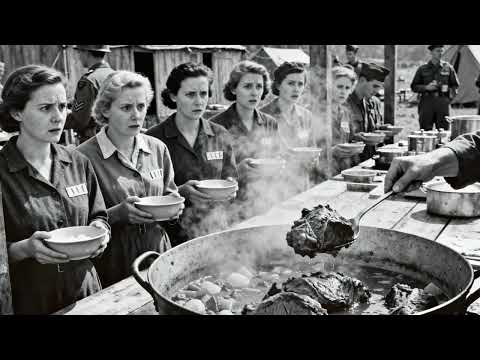
As the women climbed down from the truck, Rachel noticed their eyes. They held the same faraway look she had seen in photographs from the Great Depression—the unmistakable mark of long hunger.
Among them was Johanna Brenner, a twenty-six-year-old nurse from Berlin who had joined the medical corps believing she was serving a noble cause. She carried a small cloth bag containing everything she had left in the world: a spare pair of underclothes, a wooden comb missing several teeth, and a photograph of her younger sister that had somehow survived the Atlantic crossing.
Beside Johanna stood Katharina Weber—Kat to everyone—a twenty-two-year-old radio operator from Munich whose sharp mind and skill with codes had made her essential to the communications unit. Her blonde hair, once neatly braided, now hung limp and tangled around her thin face. She had been living on severely limited rations for the past three months since supply lines to their unit were cut during the Allied advance. The constant feeling in her stomach had become so familiar she barely noticed it anymore.
Frieda Schultz, the eldest at thirty-five, moved with the careful economy of someone conserving every ounce of energy. She had been an administrative officer, managing personnel records and supply requisitions with German precision until the day everything collapsed. Young Anneliese Krauss, barely nineteen and looking younger with her round face and wide, frightened eyes, stood close to Johanna like a shadow. She had grown up on a small farm in rural Bavaria and joined the auxiliary corps because the recruiter promised regular meals and a chance to serve the Fatherland.
Lieutenant Colman began the intake process with crisp efficiency, her voice firm but not harsh as she explained the camp rules through an interpreter. The women would be assigned to barracks, issued clean clothing, and expected to maintain military discipline despite their status as prisoners.
As Rachel spoke, she watched the women’s faces for any sign of defiance or hostility, but found only exhaustion and a weariness that seemed deeper than mere fear of capture.
Sergeant Marcus Sullivan observed the intake from his position near the mess hall. A tall, sun-weathered Texan with hands that bore the calluses of ranch work, Mark had been assigned to oversee kitchen operations that would now include feeding these unexpected prisoners. He had grown up on his family’s cattle ranch outside San Antonio, where Sunday dinners meant a table laden with enough food to feed the entire extended family.
The sight of these starving women stirred something in him that transcended national boundaries and military allegiances.
Corporal Betty Walsh, a first-generation Irish-American from Massachusetts, stood ready to escort the women to their barracks. Her own mother had arrived in America hungry, fleeing the poverty of County Cork with nothing but hope and determination. Betty had recognized that particular kind of hunger in the eyes of these German women—the kind that went beyond missing a few meals, the kind that spoke of weeks or months of deprivation.
Despite her duties as a guard, despite the fact that these women represented the enemy her brothers were fighting overseas, Betty felt an unexpected wave of sympathy.
The processing took nearly two hours. Each woman was documented, photographed, and assigned a prisoner number. Johanna became Prisoner 2741. Kat became 2742. They were issued clean prison uniforms—coarse gray cotton dresses that were at least an improvement over their tattered military clothing. They were taken to their barracks, a long wooden building with rows of bunks and thin mattresses that nevertheless seemed luxurious compared to the crowded holding facilities in North Africa.
As evening settled over the desert compound, the women sat on their bunks in silence. They had been told dinner would be served at six o’clock, but none dared to hope for much. In the camps where they had been held previously, meals had consisted of thin soup and a small piece of bread—barely enough to keep them alive.
Johanna sat with her hands folded in her lap, trying to still the trembling that had nothing to do with the cooling desert evening. Beside her, young Anneliese was crying silently, trying to muffle the sound in her thin pillow.
When Corporal Walsh appeared at the barracks door and announced that it was time for dinner, the women rose with mechanical obedience. They filed out in an uneven line and followed her across the compound toward the mess hall, eyes downcast, expectations tempered by months of disappointment and deprivation.
None of them could have imagined what awaited them.
The smell hit them first as they approached the building—a rich, savory aroma that seemed impossible, like a cruel trick played by their starving minds. It was the smell of roasting meat, of potatoes and gravy, of food prepared in abundance rather than scarcity.
Johanna’s steps faltered. She saw Kat’s eyes widen in confusion and disbelief. Surely, they thought, this could not be for them.
The mess hall doors swung open, and the German women stepped into a space that defied everything they thought they knew about how prisoners were treated. Long tables stretched across the room, already set with trays and metal utensils, but it was the serving line that stopped them in their tracks.
Behind the counter stood Private Helen O’Brien, a sturdy woman with flour dusting her apron and a smile that seemed out of place in a prison camp. Beside her, Sergeant Sullivan supervised the steaming trays of food with the air of a man who took genuine pride in his work.
Johanna found herself at the front of the line, her hands trembling as she picked up her tray. Helen O’Brien looked at her with kind eyes and began filling the metal surface. First, a thick slice of roast beef—meat so tender it fell apart under the serving spoon. Then came mashed potatoes, smooth and buttered, followed by carrots glazed with something sweet, green beans, and a thick ladle of brown gravy that pooled around everything in rich, glistening abundance. Finally, a thick slice of white bread with a pat of butter.
Johanna stared at the tray in her hands as if it might disappear at any moment. This was more food than she had seen on a single plate in over a year, more meat than her entire unit had shared in a week during those desperate months in North Africa.
She looked up at Helen with confusion that bordered on suspicion. Was this some kind of test? A psychological trick to soften them up before interrogation?
Helen simply smiled and said something in English that the interpreter repeated: “Sunday pot roast. It’s a tradition here.”
Behind Johanna, Kat received her portion with the same stunned disbelief. Little Anneliese gasped when the meat was placed on her tray, her eyes filling with tears. Frieda, pragmatic as always, maintained her composure, but her hands shook as she carried her loaded tray to the table.
One by one, the twenty-three German women received portions that seemed impossibly generous, contradicting everything their propaganda had taught them about American cruelty and deprivation. They sat in silence, none of them quite believing what they saw before them.
Johanna looked around the table at her companions, seeing her own confusion reflected in their faces. “This must be a special occasion,” she thought. Perhaps it was a holiday they didn’t know about. Perhaps tomorrow they would return to the meager rations they had expected.
She picked up her fork with exaggerated care, as if any sudden movement might shatter the illusion. The first bite of roast beef nearly undid her completely. The meat was tender and flavorful, seasoned with herbs she couldn’t identify. The potatoes were creamy and rich. The gravy tasted like salvation itself.
Johanna had to force herself to chew slowly, to not devour everything in desperate gulps. Around her, the other women ate with the same controlled restraint, their bodies craving the food while their minds struggled to process the unexpected kindness.
This was not how enemies were supposed to be treated. This was not how war was supposed to work.
That night in Barracks C, the women lay awake in the darkness, their stomachs full for the first time in months. The sensation was almost uncomfortable after so long with hunger. Johanna stared at the ceiling, her mind refusing to settle. She kept returning to the image of that plate, its sheer abundance, trying to reconcile what she had experienced with everything she had been told about America.
In Berlin, before she had been sent to North Africa, ration cards had governed every aspect of life. Her family’s weekly meat allocation had barely been enough for one modest meal. Bread had been stretched with sawdust and other fillers to make the flour last. Her mother had become creative with turnips and potatoes, making meals that at least filled their stomachs if not their nutritional needs.
Johanna remembered the constant hunger that had become normal, the way her younger sister’s cheeks had hollowed, the way everyone had learned to move slowly to conserve energy.
Beside her, Kat whispered in the darkness: “Did that really happen? Or are we all dreaming the same dream?”
Her voice trembled with uncertainty, exactly as Johanna felt. Several other women murmured agreement, their voices soft in the night air. They had learned to be cautious with hope, to distrust anything that seemed too good to be true.
Frieda’s practical voice cut through the whispers: “It happened. The question is why.”
She paused, and Johanna could almost hear her analytical mind working through the possibilities. “Maybe they’re fattening us up before sending us somewhere worse. Maybe it’s propaganda, something they can photograph and show the world. Maybe it’s just for today.”
Her words echoed the suspicions they all harbored, the defensive skepticism that had grown from too many disappointments.
Little Anneliese spoke up, her voice small and filled with hope: “My grandmother used to make roast like that. Before the war. Sundays after church.”
The longing in her voice was palpable. “I thought I would never taste anything like that again.”
She fell silent, perhaps realizing that speaking of such memories only made the ache worse rather than better.
Johanna thought of her own grandmother’s Sunday dinners, the gatherings that had ended when the war began. She remembered how her grandmother had tried to maintain the traditions even as rations shrank, setting the table with her fine china even when there was little to put on it. The old woman had died during the winter of 1943, her health failing as malnutrition turned a simple cold into pneumonia. Johanna had been in North Africa by then, unable to return for the funeral, learning of her grandmother’s death through a letter that had taken three months to reach her.
The memory of that meal, that delicious roast, mingled with thoughts of her grandmother’s cooking, creating a confusing mixture of emotions. Gratitude mixed with guilt, relief mixed with suspicion, hope mixed with the caution of survival.
Tomorrow would bring answers, Johanna told herself. Tomorrow they would discover whether this abundance was real or merely another cruelty of war, a moment of plenty designed to make the inevitable return to hunger all the more painful.
Morning came with the desert sun slanting through the barracks windows. The women rose stiffly, their bodies still adjusting to a full night’s sleep. Johanna helped young Anneliese tidy her bunk with military precision, a habit that offered comfort in its familiarity. They dressed in their gray prison uniforms and waited to see what the day would bring.
Corporal Walsh arrived to escort them to breakfast. The walk across the compound was different in daylight. Johanna could see the larger facility beyond their separate enclosure, rows of barracks housing German male prisoners working in the fields and workshops. She wondered if they received the same treatment, the same impossible abundance of food.
The smell of coffee greeted them first—real coffee, not the bitter grain substitute that had become common in Germany. Then came the aroma of bacon, eggs, and toast. Johanna felt Kat grip her arm tightly as they entered, and saw the serving line laden with food once again.
This was not a special occasion. This was not a one-time display. This was breakfast.
Helen O’Brien stood at her post again, her cheerful demeanor unchanged. She served each woman two eggs, three strips of bacon, two slices of buttered toast with jam, and a portion of fried potatoes. The interpreter, a middle-aged man named Private Cooper who had learned German from his immigrant grandparents, explained that coffee and milk were available at the end of the line.
Johanna took her tray with trembling hands, no longer able to maintain the mask of composure she had worn the night before. At the tables, Lieutenant Colman sat eating her own breakfast, having deliberately chosen to eat among the prisoners rather than in the separate officers’ mess. It was a calculated decision, she hoped it would help build a sense of familiarity with these women.
She watched them eat with more confidence than the night before, their initial shock giving way to cautious acceptance. Through Private Cooper, Rachel addressed the nearest table. “The Geneva Convention requires that we provide you with the same food rations our own soldiers receive. This is a standard breakfast. Nothing special.”
Frieda looked up from her plate, her analytical mind absorbing this information. “Your soldiers eat like this every day?” The question carried such astonishment that Rachel almost smiled. She nodded simply, taking a bite of her own toast. “Every day. Sometimes better on Sundays and holidays.”
The translation rippled through the mess hall, and silence fell as the German women absorbed this revelation. If this was normal, if this was the baseline of American military provisioning, then everything they had been told about America’s suffering under British blockade, about American soldiers starving in their own country, had been lies.
After breakfast, Lieutenant Colman announced the work assignments. Under the Geneva Convention, enlisted prisoners could be assigned to non-military labor. The women would be divided into groups for various tasks—laundry, maintenance, administrative work, and kitchen duty. Johanna, with her medical background, would assist in the camp’s small infirmary. Kat, with her organizational skills, would help with supply inventory. Young Anneliese and several others were assigned to the kitchen under Sergeant Sullivan’s supervision.
Anneliese followed Sullivan into the kitchen with trepidation, unsure what to expect from this tall American with the weathered face and watchful eyes. The kitchen was larger than she had imagined, with industrial stoves, enormous refrigerators, and pantries stocked with more food than she had seen in years.
Sullivan gestured to the supplies and began, through Private Cooper’s translation, to explain the day’s tasks. They would prepare lunch for the entire camp and help with dinner preparations. He noticed how Anneliese’s eyes kept drifting to the pantries, to the sacks of flour and sugar, the crates of vegetables, the sides of meat hanging in the cold storage.
He understood that look. It was the same one he had seen on his younger cousins’ faces during the worst years of the Depression, when they had come to stay at the ranch because their families couldn’t feed them in the city. It was the look of someone trying to believe that abundance was real and not just a temporary illusion.
He handed Anneliese a sack of potatoes and a peeler, demonstrating the task with patient gestures that needed no translation. She began to work with meticulous care, her farm-girl hands finding comfort in the familiar task. Two other German women joined them, and soon the kitchen settled into a quiet rhythm.
Sullivan worked alongside them, not as a supervisor but as a fellow laborer, peeling vegetables and preparing ingredients with the practiced efficiency of a man who had grown up doing hard work. Private Helen O’Brien bustled in, greeting the new kitchen helpers with a warm smile that transcended language barriers. She began teaching them American ways of preparing certain dishes, explaining how to season the roast that would be Sunday dinner tomorrow, how to make the thick gravy that had amazed them.
Anneliese watched Helen with fascination as she added what seemed like outrageous amounts of butter and cream to the mashed potatoes, ingredients that had been luxuries even before the war in her small Bavarian village.
In a quiet moment, Sullivan pulled out photographs from his wallet, showing them to the German women with gestures and Private Cooper’s halting translations. His family’s ranch, his parents, his three younger sisters who looked not so different from these prisoners in age and appearance. Anneliese understood what he was trying to communicate without words. They were not so different, Americans and Germans. They came from farms and cities. They had families they missed. They knew the value of hard work and the comfort of a shared meal.
By midday, the kitchen had undergone a subtle transformation. The work continued, but the atmosphere had shifted from wary coexistence to something approaching cooperation. Anneliese found herself almost smiling as she worked, her hands busy, her stomach full, her mind beginning to question everything she had believed about her enemies.
Three weeks into their captivity, the German women were told they could write letters home. Lieutenant Colman explained, through Private Cooper, that all correspondence would be censored according to military regulations, but they were permitted to reassure their families of their safety and well-being.
The announcement brought a mixture of relief and anxiety. What could they possibly write that would be believed? Johanna sat on her bunk that evening, a sheet of paper and pencil in hand, staring at the blank page. How could she explain to her younger sister what she was experiencing? How could she describe meals that contained more meat than her entire family had seen in months? Would Liesl think she had gone mad? Or worse, that she had betrayed her country by accepting such treatment?
The words seemed impossible to form. She began cautiously, maintaining a tone of calm, objective reporting.
My dear Liesl, I write to tell you that I am well. I am held in a prison in America, in a place called Arizona. The conditions here are adequate, and we are treated according to international law.
She paused, chewing on the pencil. How much more could she say without sounding as though she were being coerced or brainwashed? Around her, other women struggled with the same dilemma.
Kat wrote to her mother in Munich, trying to find words that would pass censorship while still conveying the truth. “We receive regular meals. The Americans provide adequate food.” Even this simple statement seemed inadequate to describe the reality of seeing a plate piled with roast beef, of the disbelief of eating eggs and bacon every morning, of the strange guilt that accompanied being fed better as a prisoner than she had been as a soldier.
Frieda, ever practical, treated her letter as an official report. She detailed the facts, the temperature, the daily routine, the work assignments, but even she couldn’t resist adding a line that might raise eyebrows in the censorship office. “The food supplies here exceed what we received in military service. The Americans appear to have no shortage of provisions.”
She wondered if that sentence would be flagged, if it would be considered propaganda or intelligence that should not be shared. Little Anneliese wrote to her parents on their Bavarian farm, her handwriting small and childish: “Please do not worry about me. I am working in the kitchen, which reminds me of home. The Americans are not what we were told. They share their food with us, even though we are their enemies. I do not understand why, but I am grateful.”
Tears fell on the paper as she wrote, smudging the ink slightly. She thought of her mother, who struggled to feed the family on dwindling rations, of her father working their small farm without sons to help him.
That night, Lieutenant Colman reviewed the letters before sending them to military intelligence for final approval. She read the hesitant words, the careful phrasing, the evident struggle these women faced in describing their treatment. One phrase in Johanna’s letter caught her attention: “I no longer know what to believe about anything.” Rachel understood that sentiment. This war had made certainties uncertain for everyone involved.
November brought a relative cooling to the Arizona desert, a relief from the blazing heat of October. The women settled into routines that were no longer strange to them. They rose each morning at six, dressed in their gray uniforms, and reported to their various work assignments. The initial suspicion that the food abundance was temporary had faded, as week after week brought the same generous portions, but trust remained a more complicated matter.
Relief came suddenly one Tuesday afternoon. Young Anneliese was working in the kitchen when she slipped on a wet patch of floor, falling hard and twisting her ankle. She cried out in pain, and Sergeant Sullivan rushed to her side, calling for help. Within minutes, Johanna arrived from the infirmary, her medical bag in hand, her training taking over despite her own fatigue.
She knelt beside Anneliese, examining the swelling ankle gently, murmuring reassuring words in German. Sullivan watched the scene with careful attention, then made a decision that would have violated protocol. He left the kitchen and returned moments later with a bucket of ice, a commodity that required Lieutenant Colman’s authorization. He set it beside Johanna without a word.
Their eyes met in a moment of understanding that transcended language and nationality. She nodded her thanks and began applying the ice to Anneliese’s injury, her hands working with the confidence of medical training.
Corporal Walsh arrived to check on the situation, finding Sullivan helping Johanna wrap Anneliese’s ankle with a flexible bandage. She expected to feel alarmed at this breach of the invisible barriers that were supposed to separate guards from prisoners. But she felt something different entirely. She saw two people working together to help a third. Their uniforms and nationalities had become irrelevant in the face of human need.
She made a note in her daily report, but she phrased it in ways that would not alarm Captain Hayes.
That evening at dinner, news of the incident spread through the compound. The German women saw how their American captors responded to one of their own with immediate attention and practical assistance. The American staff saw their sergeant and the German nurse working together with seamless cooperation. Something, however subtle, had shifted in the camp’s atmosphere. The careful distance that everyone had maintained began to seem less necessary, less natural.
Johanna found herself sitting near Lieutenant Colman during the meal, and Rachel seized the opportunity to speak through Private Cooper. “You have medical training. We could use your help in the infirmary on a regular basis. Would you be interested?”
The question was phrased as an offer, not an order, and that distinction mattered more than Rachel realized. Johanna considered the proposal, weighing her response carefully. She felt that accepting would be an act of cooperation, an acknowledgment of her situation rather than mere endurance of it. But refusing seemed like a kind of false pride, a preservation of the illusion of resistance when the reality was far more complicated.
“Yes,” Johanna said finally, in her careful English. “I will help.” With those simple words, she crossed an invisible line from prisoner to something else entirely, something harder to define but that felt closer to participation than to captivity.
Around them, other conversations began, tentative exchanges that slowly bridged the chasm of war.
In late November, word came of an approaching American holiday called Thanksgiving. Lieutenant Colman gathered the women to explain the tradition through Corporal Cooper’s translation. She told them of a day of gratitude, when Americans gathered with family to share a bountiful meal and give thanks for their blessings. This year, the holiday fell on November 23rd, and Captain Hayes had authorized a special celebration that would include the prisoners.
The German women listened with polite confusion. A holiday centered entirely on food and gratitude seemed strange in the midst of war and captivity. Frieda raised the question that was on many minds: “Why do you celebrate with us? We are your enemies.”
Rachel considered the question carefully before answering. “The holiday has nothing to do with politics or war. It is about our shared humanity and the things we have to be grateful for, even in difficult times.”
The days leading up to Thanksgiving saw a transformation in the compound. Sergeant Sullivan threw himself into the preparations with an enthusiasm that surprised even his own staff. He requested additional supplies, planned a detailed menu, and enlisted everyone available to help with the preparations.
Anneliese, recovered from her ankle injury, found herself at the heart of the kitchen activity, learning to prepare dishes she had never heard of: sweet potato casserole, cranberry sauce, cornbread stuffing, pumpkin pie. Helen O’Brien became an unofficial cultural ambassador, explaining the significance of each dish with animated gestures and patient repetition.
The turkey, a bird so large that Anneliese initially mistook it for some exotic American animal, became the centerpiece of the preparations. Sullivan explained how to prepare it, showing the women how to season and stuff it. Kat, assigned to help with inventory, marveled at the quantities of ingredients required. Butter measured in pounds rather than ounces. Sugar by the cupful. Cream without restriction or ration card.
Johanna watched the preparations from the infirmary, where she was treating a minor wound for one of the guards. Corporal Walsh had injured her hand on a piece of equipment and had come to Johanna rather than waiting for the regular medic. It was a simple gesture of trust, but Johanna recognized its significance.
As she cleaned and bandaged the wound, Betty spoke in simple, slow English that Johanna mostly understood. “Tomorrow will be a good day. You’ll see. It’s about being together, about being grateful we’re alive.”
Thanksgiving morning dawned clear and unseasonably warm. The mess hall had been transformed. Tables were arranged in a large square so that everyone could see each other. Someone had found white tablecloths and autumn decorations, corn stalks and gourds that added unexpected festivity to the utilitarian space.
When the prisoners arrived for the meal, they found the American staff already seated, waiting for them not as guards but as companions at the table. Captain Hayes stood to address the gathering, Private Cooper translating his words. “Today, we set aside our roles as captor and captive. Today, we are simply people sharing a meal, acknowledging that even in wartime, we have things to be grateful for. We are grateful for peace, even though we are at war. We are grateful for our full plates when others go hungry, and we are grateful that we can share this with all of you.”
The words hung in the air, met with uncertain silence from the German women who did not know how to respond to such unexpected sentiment.
The Thanksgiving dinner began with the turkey, golden and glistening, carved by Sergeant Sullivan with careful precision. The German women watched in continued amazement as dishes were passed around the tables, each one piled with food that seemed to defy the reality of wartime rationing. Sweet potatoes topped with melted marshmallows—a combination that seemed strange to the German women until they tasted the surprising harmony of flavors. Green bean casserole. Mashed potatoes swimming in butter. Cranberry sauce, jellied and whole. Cornbread stuffing fragrant with sage and herbs.
As the meal progressed, something remarkable began to happen. The formal distance that had characterized most interactions between guards and prisoners softened, then dissolved entirely. Corporal Walsh found herself seated between Johanna and Kat, attempting to explain the origins of Thanksgiving through a combination of simple English, hand gestures, and Private Cooper’s help. She recounted the story of the Pilgrims and the Native Americans who shared a harvest feast, the irony of their current situation—enemies breaking bread together—echoing that distant historical moment.
Sergeant Sullivan moved among the tables, ensuring everyone had enough food. His natural hospitality overshadowed any awareness of rank or nationality. He noticed that Frieda had barely touched her sweet potatoes and encouraged her with gestures to try them. She did so reluctantly, her eyebrows rising in surprise at the unexpected sweetness. Sullivan smiled, and for the first time since her capture, Frieda found herself almost smiling back at an American soldier.
Helen O’Brien began teaching the German women the English names for the foods they were eating, turning the meal into an impromptu language lesson. She would say, pointing to the meat: “Turkey.” The women repeated the word in unison, their accents heavy but their attempts earnest. “Turkey.” Then “stuffing, gravy, cranberry.” Each word was a small bridge built across the linguistic divide.
Anneliese proved particularly adept, her young mind absorbing the vocabulary with enthusiasm. Kat found herself explaining German holiday traditions to Corporal Thomas Wilson, who sat across from her with genuine curiosity. She described Christmas markets, stollen bread, and the celebration of St. Nicholas Day. Wilson listened with interest, asking questions that showed genuine engagement rather than mere politeness. He told her about Christmas on his family’s farm in Iowa, how the similarities between their rural traditions created unexpected common ground.
Lieutenant Colman watched the scene with mixed emotions. This was exactly what she had hoped for when she had pressed Captain Hayes to approve the celebration. Yet she also felt the weight of what it represented. These women were still prisoners. America was still at war with their country. The familiarity that was developing between captors and captives might complicate the clear lines that were supposed to exist.
But as she watched Johanna laugh at something Betty Walsh said, as she saw young Anneliese’s face light up when she successfully pronounced the word “pumpkin pie,” Rachel could not bring herself to regret her decision.
As dessert was served, pumpkin pie with fresh whipped cream, the conversation around the tables evolved into something that resembled friendship more than the wary politeness that had characterized the previous weeks. The women were learning that Americans could be generous without ulterior motives, that kindness did not require agreement on politics or war, that shared humanity could exist even between enemies.
The days following Thanksgiving brought an unexpected weight to the barracks. The German women had experienced something beautiful and confusing, and now they struggled to reconcile their gratitude with the guilt that accompanied it.
Johanna lay awake at night thinking of her sister in Berlin, of her family living on meager rations while she ate turkey and pie. The sensation of being full had become complicated by the knowledge of those who still went hungry. Kat voiced what many were feeling during a quiet evening in the barracks. “How can we accept their kindness when our people are starving? When our soldiers are dying?” Her voice carried a note of anguish that echoed through the room.
Several women nodded in agreement, their faces reflecting the same internal conflict. They had not asked to be captured. They had not asked for this generosity, and yet they received it daily. And with each meal, the guilt grew heavier.
Frieda, practical as always, offered a different perspective. “Would our families be honored if we refused to eat? Would it help Germany if we starved ourselves on principle?” She paused, letting her words sink in. “We are alive. We are being treated with dignity. Perhaps that is something to be grateful for, even if it feels wrong.”
Her logic was sound, but logic did little to ease the emotional weight that pressed upon them. Little Anneliese stopped writing letters home altogether. She could not bear the thought of her mother reading about the meals she was eating while the family subsisted on turnips and dark bread. The contrast between her reality and theirs felt like a betrayal, even though she had no control over either situation.
She threw herself into her kitchen work with renewed vigor, as if her physical exhaustion might somehow atone for the comfort she received.
Lieutenant Colman noticed the shift in mood and discussed her concerns with Sergeant Sullivan. They stood outside the mess hall one evening, considering the psychological complexities of their situation. Rachel observed: “They feel guilty for being fed well.” “It’s driving them inward again, creating distance between them and the staff.”
Sullivan nodded slowly, his weathered face thoughtful. “I don’t blame them. If I were captured and fed better by the enemy than my own folks back home, I’d feel pretty torn up about it too.”
The tension reached a peak one evening when Margarete Fischer, a prisoner who had remained largely silent since their arrival, refused to eat her dinner. She sat at the table with her arms crossed, tears streaming down her face.
She said in halting English: “I cannot. My husband, my children, they have nothing, nothing. And I sit here with meat and butter like a queen. It is not right. It is not right.”
Her voice rose with each word until she was nearly shouting. Johanna moved to sit beside Margarete, placing a gentle hand on her shoulder. She spoke in German, her voice calm but firm. “Your suffering will not feed your children. Your hunger will not end the war. We are prisoners, yes, but we are also human beings who need to survive. When this is over, when we can return home, they will need us to be strong enough to help rebuild.”
The words were as much for herself as for Margarete, an attempt to reconcile the impossible situation in which they found themselves.
March 1945 arrived, and wildflowers bloomed in the Arizona desert, transforming the landscape into unexpected beauty. The war in Europe was clearly entering its final phase, though news remained sporadic and censored. The German women could sense the approaching end through subtle changes in their captors’ behavior, the increased activity of radio communications, the tension that accompanied each new dispatch from the front.
In the months following Thanksgiving, the dynamics of the camp had evolved into something none of them could have anticipated. Johanna worked daily in the infirmary alongside the regular medic, treating minor injuries and illnesses for both prisoners and staff with equal care. Her English had improved dramatically through constant practice, and she found herself serving as an unofficial translator and mediator between the two groups. The role gave her a sense of purpose beyond mere survival.
Kat discovered an unexpected talent for administration. She helped organize the supply inventories, managed work schedules, and even assisted with some of the paperwork that kept the camp running. Lieutenant Colman had come to rely on her efficiency and accuracy, a trust that would have seemed impossible six months earlier. Kat found satisfaction in the work, in being useful rather than merely existing in captivity.
Young Anneliese blossomed under Sergeant Sullivan’s patient mentorship in the kitchen. She learned to prepare dozens of American dishes and even began teaching Helen O’Brien some traditional Bavarian recipes, adapting them to available ingredients. The kitchen became a space of genuine collaboration, where nationality mattered less than the shared goal of preparing good meals. Sullivan had started calling her Annie, an Americanized version of her name that she found herself accepting without objection.
The Sunday pot roast tradition continued uninterrupted through the winter, becoming a ritual that marked the passage of time and provided a sense of continuity. But it was no longer just about the food. The Sunday meals had evolved into extended gatherings where guards and prisoners sat together over coffee, sharing stories and photographs, teaching each other songs and phrases in their respective languages. The boundaries between captor and captive had blurred into something more complex and more human.
Spring brought new challenges. As Allied forces advanced deeper into Germany, reports began to filter back about the conditions they were discovering. Stories of concentration camps, of systematic atrocities, of horrors that defied comprehension reached even the isolated desert compound. Lieutenant Colman made the difficult decision to share some of this information with the prisoners, knowing it would shatter whatever remaining illusions they held about their country’s conduct during the war.
On the evening she gathered the women to tell them, Rachel saw the reactions she had expected: disbelief, denial, horror, shame. Some of the women wept openly. Others sat in stunned silence. Frieda’s face went pale as she listened to the translated accounts from places like Dachau and Buchenwald. She whispered: “We didn’t know. How could we not have known?”
But even as she said it, a part of her recognized the willful blindness that had allowed such things to happen. They had all seen hints, heard whispers, chosen not to look too closely at uncomfortable truths.
Johanna felt something break inside her as she listened. The neat categories she had used to organize her world, the certainty she had held about serving a just cause, all of it crumbled. That night, she finally understood, fully and completely, why the Americans had shown them such unexpected kindness. It was not weakness. It was not naivety. It was a deliberate choice to treat enemies with humanity, to prove that decency could exist even in the midst of war.
May 8, 1945. Victory in Europe Day. The announcement came over the radio in the mess hall, and the American staff erupted in celebration. The war in Europe was over. Germany had surrendered unconditionally.
For the German prisoners, the news brought a complex mixture of relief that the killing had stopped and despair at what the surrender meant for their defeated homeland. They sat in silence as their captors celebrated, feeling the weight of national shame settle over them like a heavy blanket.
Lieutenant Colman gave her staff a day to celebrate before calling a meeting to discuss the next steps. The question of repatriation loomed large and pressing. These women were prisoners of war, and with the war over, they would need to be returned to Germany. But what Germany would they be returning to? The reports painted a picture of devastation, cities reduced to rubble, infrastructure destroyed, acute shortages of food and supplies, a population displaced and traumatized by total defeat.
Three days after VE Day, Rachel gathered the prisoners to explain their options. Through Private Cooper’s careful translation, she explained the procedures ahead. They would remain in custody until transportation could be arranged, which might take several weeks or months given the logistical challenges of moving thousands of prisoners across the Atlantic. They would be repatriated to Germany and released to make their own way in what remained of their country.
She paused before adding the final, unprecedented option that Captain Hayes had authorized after lengthy discussions with higher command. Rachel continued in a careful, measured voice: “There is another possibility. Given your excellent behavior during captivity and the skills many of you have demonstrated, the United States government is prepared to offer a limited number of you the opportunity to apply for permission to remain in America as immigrants. This is highly unusual, perhaps unprecedented, but these are extraordinary circumstances.”
A stunned silence followed the translation of her words. The German women exchanged glances, their expressions ranging from confusion to hope to fear.
Johanna felt her heart racing. Stay in America, build a new life in the country that had been her enemy, leave behind everything and everyone she had known? But what was there to return to? Her grandmother was dead, her sister struggling to survive in ruined Berlin, her city in ruins. Here, she had purpose, work she valued, relationships with people who had treated her with respect and dignity. The choice seemed impossible, yet it was inescapable.
Kat’s analytical mind immediately began calculating the possibilities and risks. She had no close relatives left in Munich. Her parents had died in an air raid in 1943. Her brother had been killed on the Eastern Front. What awaited her in Germany but rubble and memories? Yet how could she choose to stay in the land of her captors, to abandon her country in its darkest hour? Practicality warred with her sense of duty and identity.
Frieda spoke first, her voice steady despite the emotion her words concealed: “How long do we have to decide?”
Rachel recognized the weight of the question. She answered: “Two weeks. Two weeks to decide the rest of your lives.”
The women left the mess hall in silence, each carrying the burden of an impossible choice.
The two weeks that followed VE Day passed like an eternity. The compound existed in a strange limbo, no longer quite a prison but not yet anything else. The American staff continued their duties with the same professionalism, but the atmosphere had changed. Everyone understood that the end was approaching, that this strange community they had built together would soon dissolve.
Johanna spent hours walking the perimeter of the compound, wrestling with her decision. She thought of her sister Liesl, alone in devastated Berlin, waiting for news of her return. How could she abandon her only remaining family? But the letters she had received, smuggled through Red Cross channels, painted a grim picture. Liesl encouraged her to stay if she had the chance. Her sister wrote in a shaky hand: “There is nothing left for you here but hunger and rubble. If you have the opportunity for a better life, take it. I will survive. I am stronger than you think.”
Young Anneliese made her decision quickly and with surprising certainty. She would stay. Her family’s farm lay in the path of the Soviet advance, and news had reached her through official channels that her parents and younger siblings had fled westward, their current whereabouts unknown. Sergeant Sullivan had offered to help her find work, even suggested she continue her training to become a cook. Building something new seemed better than returning to search for the remnants of what had been lost.
Kat struggled with the choice most visibly. She sat with Johanna one evening, her hands wrapped around a coffee cup, her face pale with exhaustion from sleepless nights. She said quietly: “If I stay, I am a traitor. If I return, I return to nothing. Either way, I lose.”
Johanna had no answer for her, no wisdom that could make the choice easier. She simply sat with her friend, offering the comfort of shared bewilderment.
Frieda announced her decision to return to Germany. She was the eldest among them, the most rooted in her German identity despite everything that identity now meant. She told the others: “I need to see what remains. I need to face what we have become, what we allowed to happen. Running away to America feels like running away from justice.”
Her words carried no judgment of those who chose differently, only a statement of her own moral compass and sense of duty.
Lieutenant Colman watched the women struggle with their decisions, feeling the weight of responsibility she carried. She had helped create the conditions that made staying possible, had fostered the relationships that made leaving painful. In her quiet moments, she wondered if offering this choice had been kindness or cruelty. Captain Hayes reassured her that they were simply giving the women options, that circumstances had forced their hand, but Rachel could not shake the feeling that they had changed these women’s lives in ways that went far beyond traditional prisoner treatment.
By the end of the two weeks, the numbers were clear. Of the twenty-three German prisoners, seven chose to apply for permission to remain in America, while sixteen would return to Germany. The applications would require approval from multiple government agencies, a process that would take additional months, but the initial choices had been made.
In August 1945, the official orders for repatriation came through. The transport ships were ready, the paperwork complete, the logistical arrangements finally in place. The sixteen women who had chosen to return to Germany prepared to depart with mixed emotions. They packed their meager belongings, exchanged addresses with those staying behind, and tried to ignore the anxiety that gnawed at them about facing an unknown future in a devastated homeland.
The morning of departure dawned clear and hot. The entire compound gathered outside the barracks where the transport trucks waited. Frieda stood at the head of the group returning to Germany, her posture straight as a soldier despite the tears she was fighting to contain. She had spent the previous night writing detailed instructions for those staying behind, practical advice on navigating American bureaucracy and cultural expectations, as if organizing information could somehow maintain the connection across the distance that would soon separate them.
Johanna had made her final decision to stay just three days earlier, after receiving a second letter from her sister explicitly releasing her from any obligation to return. She stood now with the small group remaining in America, feeling at once liberated and guilty, hopeful and terrified.
Beside her stood Anneliese and Kat and four others who had chosen to build new lives in this strange land that had fed them when they were hungry, that had shown them kindness when they expected cruelty.
Sergeant Sullivan approached with a large basket, his weathered face showing unusual emotion. He handed it to Frieda on behalf of the group, and she looked inside to find it filled with food for their journey: sandwiches, fruit, cookies, and several canteens of water. He said simply, through Private Cooper’s translation: “For the journey, so you don’t go hungry.”
Frieda, for all her composure, broke down at this gesture, tears finally spilling down her cheeks as she accepted the basket and thanked him in her careful English.
Lieutenant Colman addressed both groups, her voice steady despite her own emotion: “To those returning to Germany, you carry with you our hope that you will help rebuild your country into something better than what it was. To those staying, you carry the responsibility of proving that enemies can become friends, that redemption is possible even after terrible wars.”
She paused, searching for the right words. “You have all shown courage and dignity in the most difficult of circumstances. You have taught us all a lesson in humanity that we will never forget.”
The farewells were long and emotional. Frieda embraced Johanna tightly, whispering in her ear: “Live well. Make this choice mean something.” Johanna nodded, unable to speak around the lump in her throat.
Anneliese clung to several of the departing women who had become like older sisters to her, promising to write, to remember, to honor their shared experience. Even Kat, usually so reserved, wept openly as she said goodbye to friends she might never see again.
Corporal Betty Walsh helped the departing women board the trucks, her own eyes red from crying. She had grown close to several of them, had felt the pain of their departure keenly. As the trucks pulled away, everyone stood watching until they disappeared from view, carrying sixteen women back toward an uncertain future in a broken homeland.
The remaining women walked slowly back toward the compound that would be their home for the foreseeable future, feeling the weight of their choice settle more heavily now that it was irrevocable.
Twenty years later, in the autumn of 1965, Johanna Brenner Henderson stood in the kitchen of her small Tucson home, preparing Sunday pot roast. Her hands moved with practiced ease, seasoning the meat with the same care Sergeant Sullivan had taught her two decades earlier. Her husband David set the table while their two teenage children argued good-naturedly about whose turn it was to help with the gravy.
The doorbell rang, and Johanna hurried to answer it, finding Anneliese Sullivan on the doorstep. Annie, as everyone called her now, had married Sergeant Marcus Sullivan in 1947. She now ran her own catering business in Phoenix, her innovative Bavarian-American cuisine having found an enthusiastic following.
Behind Annie stood Kat Weber Chen, who had built a successful career as a translator with the State Department. The three women embraced with the easy affection of family.
The dinner table that evening was laden as always, with platters of savory, tender meat, mashed potatoes swimming in butter, carefully prepared vegetables, and fresh bread still warm from the oven. But it held something more valuable than food. It held connection and memory, proof that enemies could become friends, that prisoners could become citizens.
As they ate, the conversation turned to the letters they received from Germany. Frieda wrote regularly, maintaining the same precision and organization that had characterized her during captivity. She had helped rebuild the administrative infrastructure of Hamburg, had married a widower with three children, and had found purpose in reconstruction. Other women who had returned wrote as well over the years, their stories weaving together into a tapestry of resilience and determination.
Liesl, Johanna’s sister, had visited America twice, marveling at her sister’s life while maintaining her own fierce pride in having survived and rebuilt in Berlin. The two women had reconciled with the distance between them, understanding that love sometimes meant accepting different paths rather than walking the same road together.
After dinner, as was their tradition, the three women raised their coffee cups in a quiet toast—not to nations or politics or ideologies, but to a Sunday in October 1944 when they had first encountered pot roast and abundance, when they had first glimpsed the possibility that the world might be more complicated and more hopeful than they had been taught.
They toasted Lieutenant Colman, Sergeant Sullivan, Corporal Walsh, and all the Americans who had shown them that kindness was not weakness. The pot roast tradition continued, passed down to children who barely understood its significance, who grew up knowing only that Sunday dinners were important, that gathering around a full table was how you built family and community.
The story of the German women who couldn’t believe all that meat became a quiet legend, a reminder that even in the darkest moments of war, humanity could prevail if people chose to see each other as people rather than enemies. The plates were always full, the doors always open, and the memory of hunger transformed into gratitude for abundance and second chances.
Report this article
Select a reason for reporting:






