Before the guests stirred, the hill was already alive. In the pitch black below, servants knelt to light the first fire, while the butler, somewhere down the service stairs, carried the small wire traps he had set for the mice the night before and released each mouse onto the cold grass. In the grand rooms, nothing moved—and that was the point. The magic celebrities came for was handmade in the dark by people told not to be noticed, and it had been running for years before any of them arrived.
Who were they, then? The hundreds who fed a house that was never finished? And why were their names almost never recorded? I make these films because the people who kept the great houses running are rarely in the story. If this is the story you want told, subscribe and follow me, because tonight we go down the back stairs.
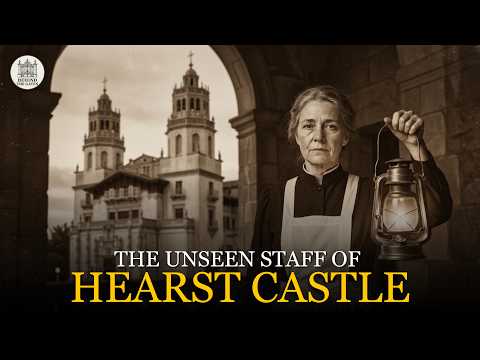
The house wakes before its master. The first task on the enchanted hill happened in darkness, and no guest was ever meant to see it. Long before the movie stars came down to breakfast, before the tennis courts were swept and the pools polished and the long table set, the estate was already pulsing like a giant animal—from the inside, quietly, by the work of people moving through it like a nervous system no one cared about.
Somewhere in the lower rooms, a fire was being lit. It was the first act of the day on the hill, and it set the pattern for everything that followed. The warmth a guest woke up to was made by someone kneeling in the cold, striking a match, coaxing the flame, so the room would feel as if it had always been warm. The genius of the place lay in making that person invisible.
One small, strange detail preserved in the record tells you almost everything about how this house worked. According to contemporary accounts, the butler set small wire traps for mice at night, baited with food scraps, and in the morning he carried each trapped mouse outside and released it on the grass unharmed. The traps were the kind that catch an animal without hurting it. This habit was remembered as a kindness of the master who couldn’t bear to see a creature harmed before his eyes. But look at what it actually was. One worker spent part of his night and part of his morning caring for mice so that the sleeping guests would never see a single one.
Multiply that one task by a thousand others, and you have the reality of daily life in the castle. Clothes that appeared pressed, rooms warmed before anyone entered, meals that arrived as if the kitchen were a rumor, flowers cut and arranged, fires lit, floors polished, beds made, baths hot. Every one of those small luxuries was work done early, quietly, by hands the guests were gently encouraged to forget.
And the encouragement was real, baked into the habits of the house. According to one contemporary account, a guest who asked for breakfast in bed was told that Mr. Hearst did not approve, and that he should come down to the main rooms like everyone else. The house’s comfort was absolute, but it was administered on the owner’s terms—and the staff were the ones who enforced them, quietly.
Imagine what that comfort actually required, measured in rooms and acres. The completed estate held roughly 165 rooms across all its buildings. The main house alone, Casa Grande, had about 115 rooms, including 42 bedrooms, 61 bathrooms, and 19 sitting rooms. The gardens, terraces, and walkways stretched over about 127 acres. Every room had to be cleaned, heated, and prepared. Every terrace swept. Every bathroom stocked. And at the heart of all that maintained space, the long dining table seated about 22 people on a full evening.
That is the ratio the entire film turns on, and it’s worth fixing in your mind before we go further. 165 rooms and 127 acres, maintained and heated and fed and cleaned to serve about 22 guests in the wilderness. The math of the place was not the math of a house, but of a small town that existed to serve a single dinner party—and ran every day whether the party happened or not, because a house like this does not stop.
Even left alone for a week, the fires still need tending. Dust still settles, the garden grows, the animals eat. The machine had no off-season. It was a small town in disguise, with its own water and power, growing most of its food and raising its own herds, carrying its messages over its own wires, housing its workers in its own quarters and governing them by its own rules.
A visitor saw a palace. But what stood on that hilltop was a settlement of more than a hundred workers, organized into departments, each with its own head, its own hours, its own place in a precise system. Everything was arranged so that the settlement itself seemed to vanish the moment a guest looked up from his drink.
Picture the daily provisioning behind that ease, because the ease had a tangible weight. A 165-room house meant lighting and extinguishing fires room by room through the cold winter months. 61 bathrooms meant heating and moving water, cleaning drains, changing linens. 42 bedrooms meant stripping beds, making them, turning them, taking clothes, washing, ironing, and returning them so that a guest’s shirt seemed to have been cleaned by itself overnight.
The kitchens prepared full formal dinners for a crowded table and fed the staff too, which meant receiving shipments, butchering meat and game, baking bread—a hotel kitchen operation running in a place with no hotel for miles. None of this was incidental. It was repeated daily, most of it in the dark, to give the daylight hours their air of ease.
The magic wasn’t a single trick. It was a chain of a thousand small acts of precision performed to become invisible, by people who had learned to move through the house as if they were not in it. And these people did not live nearby. They were brought to a remote hilltop over a steep five-mile road, to a place that a generation earlier had been only brush and farmland and a boy’s memory of a tent.
They lived where they worked, in quarters built into the estate’s plan, because there was nowhere else within reach. The reason the house needed so many hands, gathered from far away and housed on the hill, comes down to the man who decided to stop camping.
The man who was tired of camping. He owned a quarter of a million acres and one of the largest fortunes in America, and all he wanted was to stop sleeping in a tent. William Randolph Hearst had camped on this hilltop as a boy with his mother, in the days when the family owned the land and used it the way farming families do—riding horses and pitching tents on the summit for the view of the coast. And when he was fifty-six, with the hill and the money in hand, he told his architect that he was, in his words, “tired of camping.” He wanted to build something. That sentence was the seed of everything that followed—the towers, the pools, the zoo, the vast invisible staff—all of it growing from a rich man’s wish for a sturdier roof over the place of his childhood.
The money that made it possible came from two generations, and its scale is why the workforce reached the size it did. The foundation was mining. Hearst’s father, George Hearst, was one of the great mineral prospectors of the American West, a man who read the ground the way others read ledgers, with massive stakes in the Comstock silver mines of Nevada, the Homestake gold of South Dakota, and the Anaconda copper of Montana.
When George died in 1891, his widow Phoebe inherited a vast fortune. When Phoebe died in 1919, in the great influenza pandemic, the whole of it passed to their only son—along with the sprawling, empty ranch on the coast that would become the hill.
The son had already turned mining money into something larger: a media empire that dwarfed most private fortunes of the age. He started with a single newspaper his father handed him over a gambling debt in 1887, and built from it the largest chain of papers in the country. At its height in the mid-1930s, the Hearst organization ran roughly 28 major daily newspapers in cities across America, alongside a stable of magazines, a wire service, a newsreel division, radio stations, and its own film production company. It was said that nearly one in four Americans read a Hearst paper. In the end, this whole edifice was built on the reading habits of an entire nation.
There is a beautiful symmetry in where that first money came from. George Hearst made his fortune from beneath the ground—silver and gold and copper dug by other men under his direction, in the hard and dangerous labor of the Western mines. From that he rose to the United States Senate, a self-made baron of his era. And the wealth he built on the backs of miners would be spent, a generation later, building a palace on the backs of another workforce entirely unseen.
Hearst’s money began with work no one saw, deep in the earth, and ended with work no one was meant to see, behind the doors of a hilltop house. The disregard of labor was, in a sense, baked into the Hearst fortune from the start.
The land itself grew the way the empire did, by accumulation that never stopped. The family’s holdings began at roughly 40,000 acres, purchased in 1865, when California had barely been a state for a generation. By the time Hearst inherited it, it had swollen to nearly 250,000 acres, with about 14 miles of Pacific coastline. A rider could cross most of it in a day without once leaving Hearst land. And near its middle stood the hill he had loved as a child, still empty, still bare, waiting for the appetite about to be unleashed upon it.
That appetite is the key to the whole story, because it explains why the staff never got a rest. Hearst did not want a house. He wanted a house that would never end. He hired the architect Julia Morgan, one of the finest builders in the country—the first woman admitted to study architecture at the great Paris school, the first licensed to practice in California. And the two of them began a project that was never designed to be finished.
He revised constantly, reworking what he had just built, changing his mind about completed rooms and unbuilt wings. A finished house was a small death to him, because finishing meant the fun of building was over. So the building never stopped—and a project that never stops needs a workforce that never stops.
His passion was not only for construction. For decades Hearst was one of the world’s largest buyers of art and antiquities, collecting at a scale that far exceeded what any single house could hold. He bought entire ceilings and entire rooms and entire religious houses, and much of it sat in warehouses on the far coast, crated, waiting for a completion that never came. Some of it would never be revealed in his lifetime. Collecting and building were one hunger with two faces—a need to acquire and arrange and possess, a need that could be fed but never filled.
A man like that treats a house as a permanent campaign of acquisition. And a campaign needs an army, and an army needs shelter and food and wages, whether or not a battle is fought that week. He was a strange master to work for—generous and exacting at once, shy in his manner, and drowned in his desires. Those who watched him closely noted a tenderness oddly at odds with his power.
One contemporary wrote that anyone suffering before his eyes, human or animal, stirred his sympathy so much that he seemed almost womanish, even ridiculous. He would order a car to slow for a deer in the road—yet that same tenderness never reached the people he did not see, the ones whose names never made the ledgers. The maid who lived two corridors away, or the builder in the camp. His concern extended exactly as far as his eyes did, and the whole house was designed to keep the workers out of his sight.
To build his paradise on a bare mountain, he first had to build the machine that would carry it there—brick by brick, crate by crate, fully grown tree by fully grown tree. That machine, not the marble, is the real subject of this film.
The machine began, as everything on the hill began, with a road and a camp and a crew of men in the wind. When work started in 1919 there was no house to speak of, because there was no house yet. What existed first was a construction camp, and the hill’s first residents wore work boots instead of dinner jackets.
Every luxury that followed—the pressed clothes, the lit fires, the long table under ancient banners—rested on that camp. And when the money faltered in 1937, the camp emptied first. The hands that built the magic were the first price the crash collected.
Today hundreds of thousands walk those halls and admire the marble, never thinking of the twenty gardeners or the men who washed salt from the sand. The house was designed to make work invisible—and time finished the job.
So tell me below: if you had worked on that hill, which hidden department would you have chosen—the kitchens, the gardens, the construction camp, or the zoo? And which one had never crossed your mind before tonight?
Report this article
Select a reason for reporting:






