The photograph seemed ordinary at first—a wealthy family posed beneath a sprawling oak, frozen in the summer of 1871. But historians would soon discover that the most important detail wasn’t the opulent house or the stern faces of the adults. It was the girl standing in the background, her wrist wrapped in a faded ribbon that, when enlarged over 150 years later, revealed a message no one expected to find.
The image had been hidden away in a cedar box for decades, discovered in 2023 during the restoration of an abandoned farmhouse outside Lexington, Kentucky. Workers removing warped floorboards from an upstairs room found it tucked beneath the joists. At first glance, it was just another family portrait—a house, a garden, a summer noon suspended in time. But when the photograph was digitized at ultra-high resolution, researchers noticed something strange.
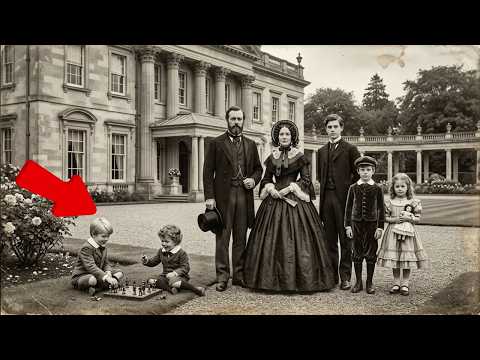
There was a girl standing behind the family. She looked about nine years old. Her dress was plain. Her hair was pulled back tightly. And around her left wrist was a narrow piece of cloth. At normal size, it looked like nothing more than a ribbon. But when magnified, the ribbon revealed dark marks arranged in a deliberate pattern. Three, then two, then three again. And beneath that, almost hidden under the girl’s fingers, was what appeared to be a single letter.
Suddenly, the photograph transformed into something else entirely. Not a family keepsake, but evidence.
The researchers began with the obvious question: who was the girl? The image bore no writing on the front. No photographer’s name. No date in the frame. Only a faint pencil inscription on the back offered a starting point. Star, September, Bellwood. That was all.
But the house in the photograph provided another clue. Its wide porch, tall windows, and distinctive iron railing matched the architecture of a property known locally as Bellwood Farm. And Bellwood Farm had belonged to the same family for nearly 80 years—the Whitmores. In 1871, the estate was owned by Charles Whitmore, a wealthy landowner whose name appeared repeatedly in the county records. His wife, Eleanor, stood beside him in the photo. Their children—Thomas, Clara, and young James—were arranged in the foreground. Everything about the image suggested prosperity: the clothes, the furniture, the manicured garden, even the expressions on their faces.
But the girl in the back was different. She wasn’t posing. She wasn’t smiling. And unlike the Whitmore children, she wasn’t looking at the camera. She was looking directly at the boy standing beside her—James Whitmore, the youngest of the family. He was six years old; she appeared to be nine. Between them sat a small wooden box.
The box became the second mystery. Researchers enhanced the area around it. The object was no more than four inches wide. Its lid appeared to be open. Inside was something pale. At first, experts thought it might be a flower. Then one researcher noticed a straight edge. It was paper—a folded piece of paper. Someone had placed a note inside the box. And the girl seemed to be holding it open while James reached toward it. Why?
That question led the researchers back to the records. They searched property deeds, family correspondence, local newspapers, school registers, and church logs. Finally, they found a handwritten household ledger belonging to Eleanor Whitmore. The ledger contained hundreds of ordinary entries—purchases of food, seeds, clothing, repairs, servants’ wages, medical expenses. But one entry from September 1871 was different. It consisted of just four words: “Star, Mara must leave tomorrow.”
No explanation followed. No surname. No destination. Just the sentence. “Mara.” The girl in the photograph, at least according to this theory.
But another document surfaced—a school attendance record from a small mission school outside Lexington. A name appeared on one page: “Star, Marabel, Star, age nine.” Beside her name was a handwritten note: “Star, absent after September.” That changed the course of the investigation. Mara had been attending school, and then she vanished. The photograph was taken at roughly the same time. But why? And why had Eleanor written that Mara must leave?
The researchers turned back to the photograph, to the ribbon, to the box. They enlarged the image again, isolating the girl’s wrist. The ribbon wasn’t decorative. The marks weren’t random. They looked as if they had been drawn with dark pencil or charcoal. Three marks. Two marks. Three marks. And beneath them, the faint outline of a star—Mara’s star.
Could the girl have written her own name on the ribbon? Perhaps. But there was another problem. The marks weren’t letters. They were more like a simple counting system. Three, two, three. One researcher, familiar with 19th-century household records, suggested something unexpected. The pattern might represent days—three days, three days. But days until what?
The answer came from a different source entirely: a newspaper. In October 1871, a local paper reported that several families in the neighboring county had relocated workers after a dispute over a private work arrangement. The article didn’t mention Mara, but one of the families named in the report was the Whitmores. There was no accusation, no scandal—just a brief statement that several workers had been transferred from the property. Only one was listed by name: “Bell.”
The mystery deepened. Mara hadn’t simply disappeared. She had been moved. But to where?
The researchers followed the trail south. An employment register from a neighboring county listed a “Mara Bell” as a domestic servant in another household. The age didn’t match—twenty years old, far too old to be the nine-year-old girl. At first, the researchers dismissed it. Then they noticed the birthplace: the same rural district, the same surname. And one more detail. The woman’s mother was listed as “Sarah Bell.”
Sarah Bell’s name appeared in an earlier household ledger from Bellwood Farm. She had worked there, and according to the record, she had a daughter named Mara. The woman in the later document wasn’t necessarily the same person—but the link was strong enough to pursue.
The next piece of evidence came from a church archive. A handwritten membership list from 1884 contained the name “Marabel, teaching assistant.” She was twenty-two years old. If this was the same Mara, she had survived. More importantly, she had learned to read and write.
That brought the researchers back to the photograph. Because the strange marks on the ribbon might not have been random at all. Perhaps they were Mara’s first attempt to leave a message. But what message?
The wooden box still held the answer. The original image was scanned again using different contrast levels. The object inside the box became clearer. It wasn’t a flower, and it wasn’t paper. It was a small envelope. And inside the envelope was a shape that looked remarkably like a child’s drawing—a house, a tree, and three small figures. The drawing was crude, but one of the figures stood apart from the other two.
The researchers compared the drawing to known examples of 19th-century children’s writing and sketches. There was no way to prove who had made it. But a faint inscription at the bottom contained two discernible letters: Star and B. Star Marabel. Or at least, someone wanted the researchers to believe so.
Then came the most surprising discovery of all: a second photograph. It had been preserved in a different archive, roughly 400 miles away. The image showed a small school building. It was taken around 1887. Several students stood outside. Near the edge was a young woman holding a book. Her name was written on the back: Star, Miss Marabel.
The researchers compared her face to the girl in the 1871 photograph. They couldn’t confirm an exact match. The image quality was poor, but there were similarities—the shape of the eyes, the narrow chin, the distinctive curve of the eyebrows. And most importantly, the same habit of keeping her left hand close to her body. It wasn’t proof, but it was enough to reopen the story.
If Mara had become a teacher, what had happened between 1871 and 1884? Why had she been forced to leave Bellwood? And why had the Whitmore children kept asking about her?
The answer finally emerged in a letter dated October 1871. It was folded inside a Bible donated to a local church. The letter was written by Eleanor Whitmore, but unlike the earlier letter, this one had never been sent. Perhaps that was why it survived. Eleanor wrote about Mara. She explained that Mara’s mother had been employed by the family years earlier. Mara had grown up among the Whitmore children. James had been especially attached to her. They played together. They explored the garden. They exchanged small objects—and apparently invented games involving pieces of ribbon and scraps of paper.
But in 1871, the family received news that Sarah Bell had accepted work elsewhere. Mara was expected to leave with her. James didn’t understand. He thought Mara was only going away for a few days. So he gave her the small wooden box. Inside it, he placed the things he considered important: a glass marble, a small brass button, a drawing, and a piece of paper. The paper contained just one sentence: “Star, come back when you’re grown.”
It wasn’t meant to become historical evidence. It was a child’s promise. But it explained the photograph. The two children weren’t simply standing beside a box. They were preparing for separation. Perhaps the ribbon around Mara’s wrist was something James had given her. Perhaps the marks were a private code between the two children. Perhaps the photograph had been taken because they knew it was their last day together.
Suddenly, the formal family portrait looked entirely different. The adults appeared stiff and posed. But behind them, two children were trying to hold onto something they knew they were about to lose.
The researchers wanted to know if James ever saw Mara again. They combed through his school records, university transcripts, business correspondence, marriage documents, and finally his personal diaries. James Whitmore became a lawyer, but his diaries contained surprisingly little about his childhood—until 1891.
That year, he traveled through central Kentucky. One entry contained just a single sentence: “The carriage stopped near the old school. I asked for Mara.”
The trail led to a school building from the 1887 photograph, long since demolished, but its records survived. One page listed Mara Bell as a teacher. Another document revealed she had later opened a small school for children with limited access to formal education. She stayed there for over 30 years. And she never changed her name. Mara Bell. The same name written on the back of the school photograph. The same initials that may have been hidden on the ribbon.
But one piece was still missing. Did James actually find her?
The answer came from an unexpected source. A collection of letters donated by a Kentucky family in 1978 contained correspondence between two former students. One letter described an elderly teacher who kept a small wooden box in a locked drawer. The box, according to the letter, contained a glass marble, an old brass button, a child’s drawing, and a faded ribbon.
The researchers froze when they read that sentence. The objects matched the contents of the box in the 1871 photograph. But there was more. The letter said the teacher sometimes told her students that the box had belonged to a boy who promised her he would come back. The boy’s identity was never recorded—until the researchers found one final clue.
Mara’s estate inventory, prepared after her death in 1939, listed a personal item under miscellaneous possessions. It was described simply as “small wooden keepsake box, no value.” No explanations. Just the box. The same box—or at least one strikingly similar.
By then, the photograph had become more than an image. It was proof of a relationship rarely acknowledged by official records: a friendship between two children separated by the social rules of their era.
But the historians wanted to know if James had kept his promise. The answer was found in a newspaper from 1892. A short notice announced a donation to the Marabel School. The donor was anonymous. The amount was unusually large. The researchers traced the payment through bank records. The account belonged to James Whitmore.
He had found her.
But there was something even more interesting. He hadn’t donated under his full name. He signed it with a single letter: J.
And according to a letter Mara wrote years later, an anonymous visitor came to the school. She wrote: “He had grown very tall, but I knew him at once.” That may be the closest surviving description of their reunion. No photograph was found. No detailed account. No dramatic encounter recorded in diaries. Just a few lines. A man, a teacher, a childhood promise, and a wooden box that endured for over 60 years.
Perhaps the most powerful discovery came when the researchers returned to the original 1871 photograph. They enlarged James’s face, then Mara’s, then the space between them. Something became clear. James wasn’t looking at the camera. He was looking at Mara. And Mara wasn’t looking at the photographer either. She was looking at him.
The adults had posed for a picture for history. The children had forgotten to pose. And that small difference changed the entire image.
For decades, historians had treated old photographs as records of wealth, clothing, architecture, and social status. But sometimes the most important story isn’t about the people who were meant to be remembered. It’s about the person standing just outside the frame. The girl with the ribbon. The boy with the box. The children who didn’t realize that their last afternoon together would eventually become the center of a historical investigation.
The ribbon itself has now faded almost completely. The wooden box is fragile. The photograph is damaged at the edges. And some questions may never be answered. We may never know exactly what each mark on that ribbon meant. We may never know if James and Mara truly understood they were saying goodbye. We may never know what was said during their reunion years later.
But one thing is certain: the photograph preserved something that official records nearly erased. A friendship. A promise. And a quiet child’s determination to remember another child.
When the historians enlarged the little girl’s hand, they expected to find an object. Instead, they found a message—not written for historians, not for museums, not for history at all. It was written for one person. A boy named James. And perhaps that is why the photograph feels so moving today.
The adults in the picture thought they were immortalizing their family forever. They didn’t realize that the world, more than a century later, would look past their expensive clothes, their grand house, and their carefully arranged poses—to stop at the smallest figure in the background. A nine-year-old girl. A faded ribbon. A wooden box. And a promise that took twenty years to keep.
History often remembers the powerful because they left documents behind. But the truth sometimes survives in much smaller places—in a child’s handwriting, an old photograph, a forgotten box, or a faded ribbon wrapped around a little girl’s wrist. And sometimes, that is enough.
What do you think happened during that reunion between James and Mara after all those years? Share your thoughts in the comments below.
Report this article
Select a reason for reporting:






