At Huis Doorn, the old German emperor lived among uniforms, portraits, and relics that no longer ruled anything. Wilhelm II, who had once commanded an empire, spent his final decades in a Dutch manor house, surrounded by the ceremonial furniture of a throne that had collapsed in 1918. Then Hermine Reuss arrived. She was much younger, fiercely ambitious, and drawn not to the aging man alone but to the title, the aura, and the possibility that the story might not be over.
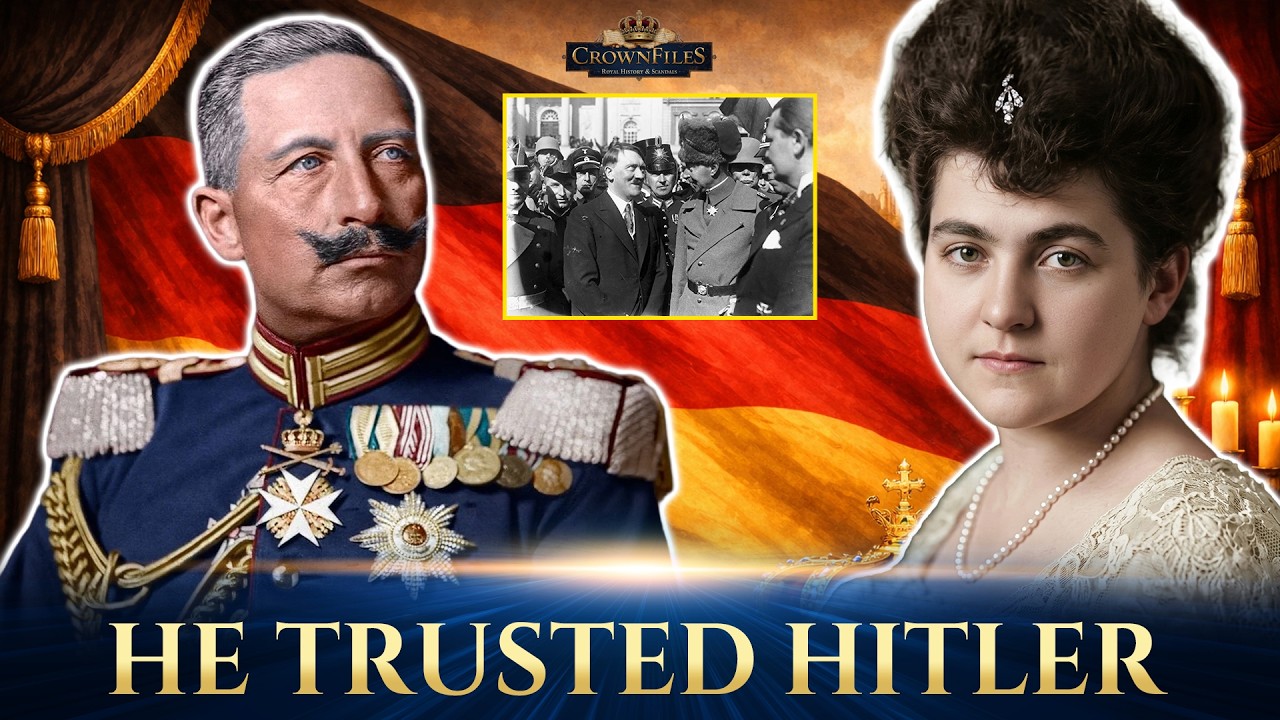
Their marriage in 1922 looked like a late-life romance between a fallen monarch and a loyal aristocratic widow. It was something more dangerous. Together, they came to believe that a rising dictator might reopen the gates of a vanished world. Wilhelm had been born into splendor but not into peace.
He carried a damaged left arm from childhood, a visible imperfection in a court that worshipped strength and military grace. His mother, ambitious and demanding, tried to shape him into a refined, liberal, English prince, while the Prussian court around him expected hardness, command, and masculine certainty. Pulled between two worlds and judged by both, Wilhelm never learned to feel secure in power. He learned to perform it.
The throne became emotional armor, a way to silence shame and self-doubt through the theater of authority. Hermine understood that kind of wound in quieter form. Born into the nobility, she lost her mother young and grew up in a household shadowed by her brother’s severe disability. In that world, rank was not decoration.
It was security, identity, survival. Losing position was not merely embarrassing; it was existential. That may explain why she later seemed so drawn to titles and ceremony. Officially, she was never an empress, but years later she still liked to be addressed as one.
It was compensation, an attempt to inhabit a certainty that real life had denied her. Both of them had learned to survive through performance. As emperor after 1888, Wilhelm staged himself as Germany itself. The uniforms, the bombast, the insistence on imperial dignity formed a facade behind which uncertainty could hide.
The more insecure the man, the more convincing the costume had to become. Hermine mastered a different kind of facade. Widowed from her first marriage, she carried herself with the disciplined poise of noble life, even when private reality was far less secure. When she arrived at Doorn, she became more than a companion.
She organized the estate, founded a relief fund for poor German families, and staged charitable bazaars that made her appear dignified and useful. But there was calculation in the dignity. She behaved not like the wife of a retired old man but like a woman rehearsing for a return. Together, Wilhelm and Hermine built a court in exile, something that was neither fully real nor fully imaginary.
Titles survived. Rituals survived. Visitors came and went. The house became a museum of interrupted power, and inside that carefully maintained illusion, it became easier to believe that history had not ended, only paused.
What Wilhelm found in Hermine was admiration without irony. She accepted the rituals, the titles, the old imperial habits that told him he was still someone history might yet recall. For a man built on image, that devotion was deeply seductive. What Hermine found in Wilhelm was proximity to vanished majesty.
She needed the empire to matter so that she could matter inside it. The marriage was intimate and transactional at the same time, built on a shared refusal to accept finality. Wilhelm needed the illusion of continuity. Hermine needed the possibility of elevation.
Together, they reinterpreted defeat as interruption. Once a couple lives inside that kind of fantasy, reality itself starts to look like betrayal. Every political rumor becomes a sign. Every visitor becomes a potential messenger.
Every change in Berlin can be read not for what it is but for what the heart desperately wants it to mean. At Doorn, Hermine did not merely keep house. She sustained the emotional climate of restoration, maintained appearances, and stayed in contact with circles that still talked about return. According to official accounts from Huis Doorn, she, along with Wilhelm’s house ministers, maintained contact with influential figures in Germany, including Hermann Göring and even Adolf Hitler, all in connection with the dream of a possible comeback.
The marriage did not merely preserve nostalgia. It activated it. The climax arrived not with a wedding but with a national hallucination. By 1933, Germany was collapsing into crisis, and Hitler was moving toward power.
For monarchists, conservatives, and all those who still dreamed of an older Germany, this was the moment when fantasy became dangerously seductive. Hitler understood symbolism better than almost anyone. He knew he did not need to restore the monarchy to calm the old elite. He only needed to look as though he respected the world that had come before him.
That is why the Day of Potsdam mattered so much. Publicly, it staged a symbolic alliance between National Socialism and old Prussian conservatism. Tradition was not being destroyed, the visual message seemed to say; it was being absorbed, honored, continued. To the wider world, it looked like a transfer of legitimacy.
To people like Wilhelm and Hermine, it felt like the first crack of light after years of exile. At Doorn, hope became feverish. Restoration no longer seemed a dream whispered over dinner. It began to feel negotiable.
For Wilhelm, the seduction was complex. Germany once again appeared to be marching, saluting, invoking greatness, dressing power in ceremony. It must have felt horribly familiar, recognizable. And for a man who had never emotionally accepted his own fall, recognition itself was enough to awaken hope.
But here lies the cruelty at the center of the story. Hitler never needed Wilhelm as a sovereign. He needed him only as a shadow. Sources from Cambridge’s major biography of Wilhelm II make clear that the ex-Kaiser’s hopes of being restored by Hitler were ultimately frustrated and that shortly after the symbolic theater of Potsdam, those hopes were dashed.
At almost the same moment, Hitler was not reviving the old order. He was dismantling every rival center of power. Within days of Potsdam came the Enabling Act. Within months, non-Nazi parties, organizations, and unions ceased to exist.
This was not restoration. It was absorption. Wilhelm and Hermine had already stepped too far into the illusion. They allowed themselves to believe that a dictator might serve their private resurrection.
In doing so, they misread the nature of power itself. Monarchs think in inheritance. Revolutionaries think in conquest. Hitler did not intend to hand back a crown.
He intended to devour every symbol that made crowns meaningful. The great turning point in their story was not that Hitler opened the door. It was that they mistook a stage set for a doorway. Once Hitler had secured real power, the dream was finished, whether Wilhelm and Hermine were ready to admit it or not.
Legally, politically, and symbolically, there was no meaningful path back for the old Kaiser. The performance of continuity had served its purpose. Hitler had borrowed the prestige of old Prussia and the visual language of authority, but only to strengthen a new dictatorship in which no rival legitimacy could survive. Wilhelm and Hermine had not attached themselves to a bridge back to the past.
They had attached themselves to the force that would erase the past more completely than the republic ever had. At Huis Doorn, the fantasy could still be maintained for a while. The uniforms remained. The rituals remained.
But behind the curtains, history had already moved on without them. The new Germany had no use for an emperor except as decor. No use for an empress except as a relic. No summons came.
No restoration decree arrived. No carriage waited at the gates. Just time passing inside a house filled with the remains of a world that would never return. Then came the final humiliation: death without restoration.
Wilhelm stayed at Doorn until 1941. In his last will, he made clear that he wanted no Nazis present at his funeral. Whatever illusions had once survived, he no longer wished to be symbolically absorbed into the movement that had used his memory while destroying any chance of true return. Hermine outlived him but not the dream.
By 1947, she died in impoverished conditions while under internment in the Soviet occupation zone, still clinging to the hope of restoration until her very end. The story did not end with a crown regained, or even with a dramatic public disgrace. It ended with the total failure of a shared delusion. Wilhelm and Hermine gambled their dignity on the belief that power might welcome them back.
Instead, power stripped them of the last illusion they had left, that history still owed them a second act. They were not remembered as the couple who restored a dynasty. They were remembered as two people who loved the image of lost power so intensely that they mistook its echo for its return.






