The road south out of the North Korean mountains was a single lane of frozen ruts, and the young soldier riding in the back of the deuce-and-a-half had stopped feeling his feet somewhere above the Chongchon River. He had thrown away things on this road, and the men around him had thrown away their entrenching tools, their spare ammunition, in some cases their rifles. The trucks moved bumper-to-bumper in the dark with their lights off, and every few minutes the column stopped for no reason anyone could see, and the men sat there in the cold listening for the one sound that emptied the stomach faster than artillery. A bugle.
Somewhere up in the black hills, a Chinese bugle, and then another answering it, and the men would tumble off the trucks into the ditches because they had learned in the last week that the bugles meant the enemy was already behind them. This was the United States Eighth Army at the end of 1950. The same army that had broken out of the Pusan Perimeter in September. The same army that had marched north in triumph and stood within sight of the Yalu River and the border of China, and believed it would be home by Christmas.
Now it was running—farther and faster than any American army had ever run. The men had a name for it. They called it the big bug out. And the worst part, the part that the official histories would spend years trying to explain, was that nobody was entirely sure who was chasing them, or how many, or whether anyone in Tokyo had the first idea how to make it stop.
The question at the center of the story is one that everyone who has ever worked inside a large institution has asked at least once: when a great organization breaks down, when it loses its nerve and starts to come apart, can one person actually fix it? The United States Army in December of 1950 bet that the answer was yes. It bet the survival of an entire field army, and arguably the outcome of the war, on a single man. The strange thing—the thing serious historians still argue about—is whether that bet was the smartest decision of the war or simply the luckiest.
To understand why the army made that bet, you have to understand how far the Eighth Army had fallen and how quickly. In the late autumn of 1950, the war looked won. After the landing at Inchon on September 15th, the North Korean Army had collapsed. United Nations forces recaptured Seoul, crossed the 38th parallel, took Pyongyang, and pushed north toward the Manchurian border.
General Douglas MacArthur, commanding from his headquarters in the Dai Ichi building in Tokyo, had promised the troops they would be home for the holidays. On November 24th, 1950, he launched what he called the Home by Christmas Offensive, a final drive to the Yalu to finish the thing off. The next day, the mountains came alive. The Chinese had been there the whole time.
Beginning on October 19, 1950, more than 300,000 soldiers of the Chinese People’s Volunteer Army had crossed the Yalu by night, marching in the dark, hiding by day under camouflage in the hills, maintaining a discipline of concealment so total that American aerial reconnaissance had almost entirely missed them. They had fought a short, sharp series of warning attacks in early November and then vanished. The disappearance lulled the high command into believing the intervention was a token gesture. The warning had been there to read if anyone in Tokyo had wanted to read it.
On the night of November 1st and into November 2nd, 1950, at a town called Unsan, the Chinese fell on the Eighth Cavalry Regiment of the First Cavalry Division, one of the proudest regiments in the United States Army, and they tore it apart. The Third Battalion of the Eighth Cavalry was nearly annihilated, surrounded and overrun in the dark by an enemy that came in waves through the hills blowing bugles and whistles, infiltrating between the American positions before anyone understood what was happening. The regiment lost something on the order of 600 men. That was not a token.
It was a sample—the Chinese army showing in miniature exactly how it intended to fight and exactly what it would do to a road-bound American force that did not hold the high ground. The lesson was written in blood at Unsan three weeks earlier, and it was filed and forgotten. On November 25th, 1950, the Chinese 13th Army Group struck the Eighth Army along the Chongchon River, aiming their first blow exactly where it would do the most damage: against the weak and overextended South Korean Corps holding the army’s right flank. That flank dissolved, and once it was gone, the whole position was unhinged.
At a place called Kunu-ri on the night of November 30, 1950, the United States Second Infantry Division was ordered to withdraw down a road the Chinese had already cut behind it. The Chinese had set up a gauntlet, a corridor of machine gun and mortar positions on the high ground on both sides of the only escape route, and the division had to run it. The Second Infantry Division lost roughly 4,037 men in that fight, close to a third of its entire strength. It lost 46 artillery pieces, nearly half its crew-served weapons, and about 30 percent of its vehicles.
The 503rd Field Artillery Battalion lost every gun it had. The Turkish Brigade fighting alongside took some 936 casualties and lost around 90 percent of its equipment. The first count of Eighth Army losses in that single battle ran past 11,000 men. The military historian S.
L. A. Marshall would later write a whole book about that retreat, called The River and The Gauntlet. The casualties, terrible as they were, were not the real story.
Armies take casualties and keep fighting. What happened here was something worse, something that does not show up cleanly in a casualty table. The army lost its nerve. The official United States Army history, written later by Roy Appleman and Billy Mossman in the volume titled Ebb and Flow, documents the phenomenon the soldiers themselves named bug out fever—the tendency to withdraw without fighting, to abandon a position at the first sign of envelopment, to look over the shoulder for the road south before the battle had even properly begun.
The Second Infantry Division, the same division gutted at Kunu-ri, even had a bitter little song about bugging out. T. R. Fehrenbach, in his classic study This Kind of War, put his finger on the deeper sickness.
An army in the field, in contact with the enemy, can remain idle only at its peril, he wrote. This army had become something close to idle—an army that thought first about leaving. By early December, General Walton Walker had given up Pyongyang and ordered a general withdrawal. How far did the Eighth Army retreat?
Some accounts put it at around 120 miles. The official Eighth Army history puts the full withdrawal at 275 miles and states flatly that it qualifies as the longest retreat in United States military history. Whichever end of the range you take, the verdict is the same: no American army had ever fallen back so far, so fast, with so little fight left in it. The line that had stood near the Manchurian border in November was, by the end of December, sliding back toward the 38th parallel and beyond.
Then it got worse, because the man holding the disintegrating army together died. On December 23, 1950, Lieutenant General Walton Walker climbed into his command jeep and headed north up an icy road in the Uijeongbu area, above Seoul, on his way to visit front-line units. Walker was a fighter. He had commanded the 20th Corps under Patton in Europe, the formation Patton nicknamed the Ghost Corps for how fast it moved.
It was Walker who had held the Pusan Perimeter in the desperate summer of 1950, with an order that there would be no Dunkirk and no Bataan—his men would stand or die. Whatever you think of how the retreat had been handled, he had not quit. On that road, a South Korean weapons carrier swung out of its lane into his path, and the two vehicles collided. Walker was killed instantly.
He was posthumously promoted to full four-star general on January 2, 1951, and buried at Arlington. Five years earlier, his old chief Patton had also survived the entire war only to die in a vehicle accident. Now Walker had done the same. Consider the situation in the last week of December 1950.
The Eighth Army was beaten, demoralized, and in the longest retreat in its history. The Chinese had committed hundreds of thousands of men and showed no sign of stopping. The army had lost confidence in itself and in its leadership. And now the field commander was dead.
The men who had to make decisions in that week were not looking at tidy hindsight. They were looking at the possibility of losing the whole peninsula. At the highest level, that possibility was being discussed out loud. On December 29th, 1950, the Joint Chiefs of Staff sent MacArthur a message telling him plainly that Korea was not the place to fight a major war.
Contingency planning for a complete evacuation of the peninsula—a second and far larger Dunkirk—was underway. Staff officers were studying the ports, the shipping, the order in which divisions would pull out. The question being asked in the highest councils of the government was no longer whether the UN could win in Korea. It was whether it could get its army out before that army was destroyed.
MacArthur himself, the architect of Inchon, had turned strangely defeatist. From Tokyo he warned Washington that if the Chinese chose to, they could drive the UN forces off the peninsula entirely. He spoke of what he called a mission vacuum. He pressed for widening the war, for bombing China, for bringing in Nationalist Chinese troops from Formosa, even for the use of atomic weapons.
What he did not do was go to Korea and look at the army he commanded. David Halberstam, in his sweeping history The Coldest Winter, draws the picture sharply: the supreme commander was directing a ground war he saw only from an airplane window and a situation map in Tokyo, a war he had publicly predicted he would win by Christmas. Now that prediction lay in ruins along 200 miles of frozen road. Into that vacuum, the army made its bet.
The man was Matthew Bunker Ridgway. Born in 1895 at Fort Monroe, Virginia, the son of an artillery officer, he graduated from West Point in 1917, the same class that produced his future boss, Army Chief of Staff J. Lawton Collins. By the Second World War, Ridgway had become the United States Army’s premier airborne general.
He raised and trained the 82nd Airborne Division and led it into combat in Sicily and Italy. On the night before D-Day, at the age of 49, he jumped into Normandy with his paratroopers and then fought on the ground in the hedgerows for 33 straight days. He went on to command the 18th Airborne Corps through the Battle of the Bulge, and during the airborne crossing of the Rhine in March 1945 he was wounded by fragments from a German grenade. This was not a staff officer.
He had already proven he would do the hardest thing a commander can do—relieve the men who fail under fire. In Sicily, in the chaos of the night airborne drops, things went badly wrong, and Ridgway watched, learned, and afterward made changes without mercy. He once said that the most important attribute of a combat leader was character, and by character he meant the willingness to accept full responsibility and be physically present at the point of greatest danger. In Normandy, when his 82nd Airborne was scattered across the hedgerows and his command was, for a time, a few men around a farmhouse, he picked up a rifle himself.
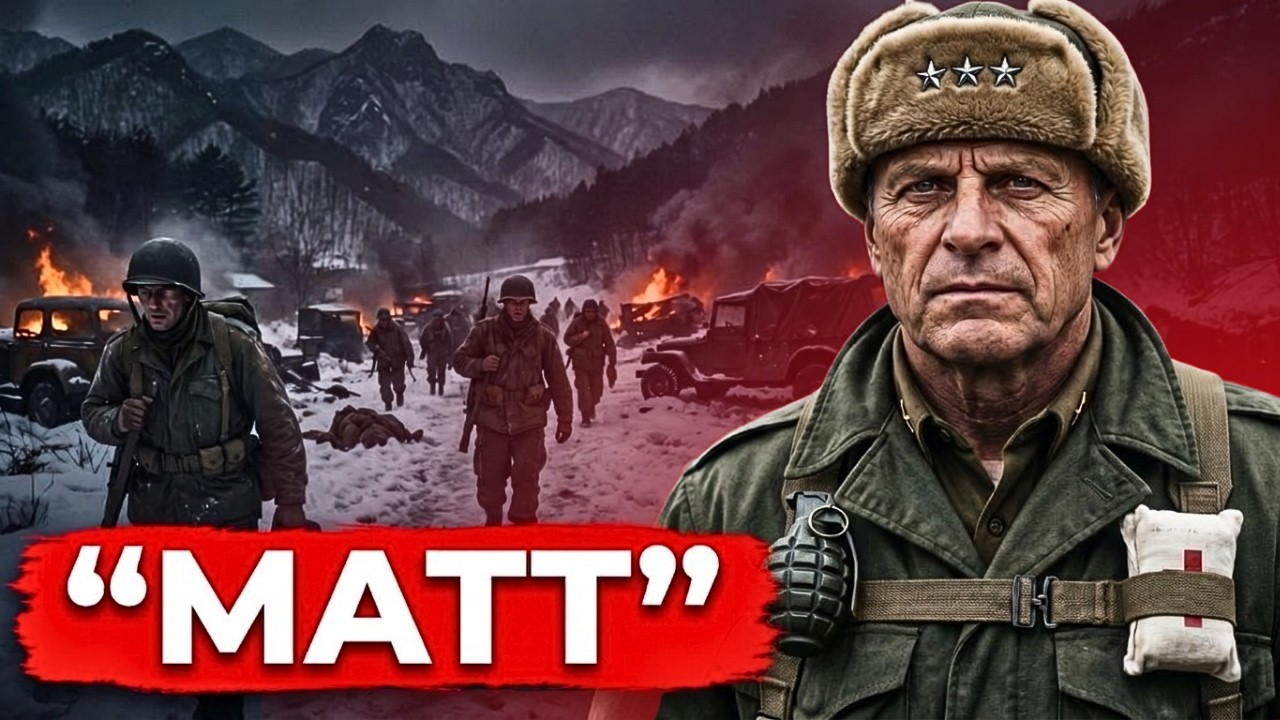
There was a detail about how he dressed for battle that the troops fixated on. Ridgway went forward with a live hand grenade taped to one shoulder strap of his harness and a first aid pouch on the other. The men, with the rough affection soldiers reserve for commanders they decide they will follow, called him Old Iron Tits. Underneath the joke was a fact they all understood: the general was carrying the same things into the same places as they were.
Ridgway despised showmanship and drew a deliberate line between himself and men like Patton and MacArthur. His style was relentless, personal, and physical. He believed a commander’s job was to be where the danger was, in the cold, in the mud, in the front-line command posts, looking men in the face. In 1950, Ridgway was serving in the Pentagon as the Army’s Deputy Chief of Staff for Administration.
Every report coming out of Korea crossed his desk, and he had quietly been designated in advance as the emergency replacement should anything happen to Walker. When Walker died, the machinery moved fast. The way Ridgway tells it in his memoir, simply titled Soldier, the call came on the night of December 22nd while he was at a neighbor’s house at Fort Myer. It was Collins, his old classmate, on the line.
Collins told him Johnny Walker had been killed in a jeep accident, that Ridgway had been designated to take over, and that he should get his things together and get out there as fast as he could. Collins asked what officers Ridgway wanted to bring with him. Ridgway’s answer tells you the whole character of the man in a single sentence: he would go this one alone. It was Christmas, he said, and even a bachelor would have made plans.
He would not pull other men away from their families on a few hours’ notice to fly into a catastrophe. He would walk into it by himself. He flew to Tokyo and met MacArthur on December 26th, 1950. In that meeting came the exchange historians have quoted ever since.
Ridgway asked MacArthur a direct question: whether, if he got to Korea and found the situation warranted it, he had MacArthur’s permission to attack. Everyone was talking about evacuation. Ridgway was asking about going forward. MacArthur, to his credit, gave the only answer that could have saved the situation.
The Eighth Army was Ridgway’s, he said. Do what you think best. With those words, MacArthur handed Ridgway a latitude Walker had never been given—the freedom and responsibility to run the ground war as he saw fit. Ridgway took command of the Eighth Army on December 26, 1950, and immediately did the thing MacArthur had just authorized him to consider: he thought about attacking.
Then he did the thing that separates a good commander from a great one. He looked at the actual condition of his army and admitted to himself that it was not ready to do what he wanted it to do. His diagnosis, recorded in his memoir The Korean War, is one of the most honest assessments any American general has ever written about troops under his own command. He discovered the forces were simply not mentally and spiritually ready for the kind of action he had been planning.
The men he met along the road all conveyed the same thing. This was, in his words, a bewildered army, not sure of itself or its leaders, not sure what it was doing there. He visited command post after command post and found the same atmosphere everywhere—a sense of lost confidence and an absence of spirit. He saw, with an infantryman’s eye, the tactical symptoms of that lost spirit.
The army had become road bound. It clung to the valleys and the roads where its trucks could go and surrendered the high ground that controls those roads to the enemy. It had stopped patrolling. It had lost contact with the enemy to its front, so it never knew where the Chinese were until they were on top of it.
It barely knew the terrain it was fighting on. Ridgway’s verdict was blistering: the army was reluctant, in his phrase, to get off its bloody wheels and put shoe leather to the earth, to get up into the hills and meet the enemy where he lived. That single image—getting off the wheels and putting shoe leather on the ground—became the essence of the turnaround. First, he attacked the leadership immediately and without sentiment.
At his very first briefing with the First Corps staff, he asked the operations officer for the plan to attack, and the officer did not have one because no one was thinking about attacking. Within days, the First Corps had a new operations officer. Ridgway relieved commanders he judged to be defeated in their own minds, and he did it fast because a frightened headquarters produces a frightened army. He also instituted a rotation system so that division commanders served fixed tours and fresh, aggressive leaders kept coming forward.
Second, he attacked the physical misery of the troops. He saw men in summer-weight clothing in sub-zero cold. He pushed hot food forward to the front lines. He got mail moving.
He got proper winter clothing and gloves up to the men in the holes. As he put it himself, he knew it was vital to restoring the fighting spirit of the troops to make clear to all of them that their leaders were concerned for their safety and would not throw their lives away for nothing. He was about to launch some of the most aggressive operations of the war, designed to inflict mass casualties, and at the same time he was obsessed with not wasting his own men’s lives. Those two things were not in contradiction.
A soldier will go forward and take terrible risks for a commander he believes is not careless with him. He will not go forward for a commander he believes is. Ridgway, touring the front in his open jeep in temperatures well below freezing, would stop and talk to ordinary soldiers in their holes, asking them plain questions. Where is the enemy?
When did you last see him? Where is your commander? Over and over, he heard that the men did not know where the enemy was, had not patrolled to find out, and had not seen a senior officer forward in days. So he made himself the answer to his own question.
He went forward constantly, where the men could see him in the cold they were in, close enough to the front that on more than one occasion his jeep drew fire. An army watches its commander to learn how afraid it is allowed to be. If the commander is in a warm headquarters 60 miles back talking about how far to retreat, the army will be afraid and will retreat. If the commander is up on the ridge in the wind asking where the enemy is so he can go kill him, the army will slowly begin to believe that killing the enemy is the plan again.
Ridgway changed the mood of the Eighth Army largely by the simple, exhausting, dangerous act of being seen at the front every single day. Third came the tactical core. He got the army off the roads and back onto the high ground, and he ordered aggressive patrolling. He wanted contact.
He wanted his units actively hunting the enemy rather than waiting passively to be found. He went so far as to order positions erased from the situation maps unless they had been confirmed by recent actual contact. And he changed the entire object of the war as his army fought it. He told his commanders, down to the company level, to stop thinking about holding ground at all costs.
Real estate, he said, was not the point. The point was the destruction of the enemy. Ground was to be taken only when taking it helped kill more of the enemy or protect more of his own men. This was, in plain terms, a strategy of attrition.
The press would later give it a brutal nickname: the meat grinder. That word does not belong to Ridgway—it was what reporters and historians called the offensive because of the casualties it inflicted. Fourth, he told the army why it was there. On January 21, 1951, Ridgway issued a memorandum to his commanders known by its opening question: Why are we here?
What are we fighting for? He had sensed that the men did not understand the purpose of the war, and that you cannot ask men to die for a purpose they cannot name. He told them the fight was not about this or that Korean town or village—real estate was incidental. The real issue was whether the values of Western civilization would stand against communism.
You can agree or disagree with the Cold War framing, but as an act of leadership, of giving a beaten army a reason to turn around and fight, it was exactly the right instrument at exactly the right moment. He did all of this while the enemy was still attacking. On December 31, 1950, the Chinese launched their third phase offensive, the New Year’s Offensive, and Seoul fell to the communists for the second time on January 4, 1951. Ridgway pulled the army back again, roughly 40 miles south of the Han River.
But he pulled it back as a fighting army conducting controlled, coordinated withdrawals, not as a fleeing mob. The bug out was over. Then he went over to the offensive in deliberate stages. On January 15, 1951, came Operation Wolf Hound, a reconnaissance in force built around the 27th Infantry Regiment, the Wolfhounds.
The purpose was almost psychological: push north, find the enemy, hit him, and prove to the army that it could move toward the Chinese instead of always away from them. The operation inflicted an estimated 1,380 enemy casualties, the large majority from air strikes, at a cost of three Americans killed and seven wounded. Ten days later, on January 25, 1951, came Operation Thunderbolt, a much larger reconnaissance in force that grew into a general advance. Ridgway advanced phase line by phase line.
He kept his units tied together flank to flank so there were no gaps for the Chinese to infiltrate. He led with massed artillery and air power, grinding down enemy positions before his infantry closed with them. On the day of that counterattack, the Eighth Army numbered roughly 365,000 men against an enemy force intelligence estimated at something approaching one million. Ridgway attacked anyway because he had concluded something the high command in Tokyo had not: the Chinese could not sustain a long offensive.
That judgment is the single most important point in the whole story, the point that separates honest history from the comic book version. The Chinese armies that had chased the Eighth Army for 200 miles had a fatal weakness, and Ridgway saw it clearly when MacArthur’s headquarters did not. They had outrun their own supply lines. The Chinese had almost no motor transport and no air cover.
Their soldiers carried food and ammunition forward on their backs, on bicycles, and pack animals, marching it down from the Yalu by night. They could sustain a furious offensive for about a week—the length of time a man can carry—and then they had to stop and resupply. On top of that, they were taking horrific losses to the cold itself, to frostbite in those mountains. When the Chinese offensives kept stalling after a few days, that was not only Ridgway’s doing—that was Chinese logistics reaching their limit.
The popular image of how the Chinese fought is mostly wrong. They are remembered for human wave attacks, masses of men charging blindly into machine guns. That is not really what happened. The Chinese army that beat the Eighth Army in November was tactically sophisticated within the harsh limits of its equipment.
It moved at night and hid by day to neutralize American air power. It specialized in infiltration, sending small units to slip between and behind American positions to set up roadblocks on escape routes and attack command posts and artillery from the rear—which is exactly what shattered the Second Infantry Division at Kunu-ri. The bugles and whistles were not theatrics. They were a command and control system for an army that had almost no radios.
What looked like a mindless wave was usually a series of probing attacks designed to find the weak seam in a line, followed by a concentrated thrust through that seam. Ridgway understood this, and his entire method was built to defeat it. Hold the high ground so you cannot be infiltrated from above. Tie your units flank to flank so there is no seam to find.
Patrol aggressively so you see the enemy massing before he strikes. Bring down such a weight of artillery and air on the point of attack that no amount of courage on foot can carry it. He did not outmuscle the Chinese; he outfought them, and then let American firepower do the rest. The honest synthesis is this: the Chinese advance was going to culminate on its own because of supply.
But it took a commander of real insight to recognize that culmination was coming, to rebuild the will of a broken army in time to exploit it, and to build the firepower machine that turned a natural pause into a violent reversal. Victor Davis Hanson, in his book The Savior Generals, devotes a whole chapter to Ridgway’s roughly 100 days in Korea precisely because the timing and judgment were so good. The Chinese gave Ridgway an opening. He is the one who saw it, seized it, and made it pay.
By February the line was moving north for the first time since November. Inchon and Kimpo airfield were back in American hands by February 10. Just before the famous battle came one that showed the army was already changing. At the end of January and into February 1, 1951, at a place the Americans called the Twin Tunnels, the 23rd Regimental Combat Team, again with a French battalion fighting alongside, was caught and surrounded by a much larger Chinese force in the central mountains.
The old Eighth Army would have run. This force formed a perimeter, held through the night, called in air and artillery. In the morning, with the help of a relief column, it did not just survive. It mauled three Chinese regiments and held the field.
Then came the battle that, more than any other, proved the Eighth Army had been reborn. It happened at a crossroads village in the central mountains called Chipyong-ni. In mid-February 1951, the Chinese launched a counterstroke against the central front, and the 23rd Regimental Combat Team, commanded by Colonel Paul Freeman, found itself surrounded at Chipyong-ni. Attached was a French battalion led by Ralph Monclar, whose real name was Raoul Monclar Vernerey, a three-star general in the French Army who had voluntarily reduced himself in rank to lieutenant colonel so he could lead troops in this war.
Roughly 5,600 American and French defenders were surrounded by something on the order of 25,000 Chinese troops—elements of three full Chinese armies. The old Eighth Army would have bugged out. In fact, the corps commander above Freeman wanted to pull the regiment back rather than see it destroyed. Ridgway said no.
He ordered Chipyong-ni held, and he had decided to turn the village into a killing ground, to let the Chinese throw themselves against a prepared American perimeter supported by artillery and air and to bleed them white doing it. For three days, from February 13 to February 15, 1951, the 23rd held. The French battalion at one point fixed bayonets and counterattacked behind the scream of a hand-cranked siren and broke a Chinese assault face-to-face. American artillery fired over open sights.
Air resupply and air strikes came in over the perimeter. On the third day, an armored relief column punched through to the defenders. The result was the first clear, unambiguous Chinese tactical defeat of the war. The defenders lost 51 men killed, 250 wounded, and 42 missing.
The Chinese lost roughly 2,000 killed and 3,000 wounded trying to take the crossroads. Paired with the simultaneous artillery slaughter of the Chinese assault near Wonju, sometimes called the Wonju Shoot, Chipyong-ni broke the back of the Chinese central offensive. The Wonju Shoot was the clearest single demonstration of the new way the Eighth Army fought: as the Chinese massed in the open to assault the central front, American forward observers and artillery brought down a concentration of fire so heavy and so well directed that the attacking formations were torn apart before they could close. Together, Chipyong-ni and the Wonju Shoot are why historians have called this stretch of the central front the Gettysburg of the Korean War.
It was the high-water mark of the communist advance, the place where the tide turned and did not turn back. Colonel Freeman’s regiment received the Presidential Unit Citation. The message to the rest of the Eighth Army was unmistakable: you can stand, you can hold, you can win. The bug-out fever was cured at Chipyong-ni.
After that, the advance became methodical and inexorable. Operation Killer ran from February 21 through early March. Ridgway kept that violent name over the objection of his own chief of staff back in Washington, who thought it sounded bad in the press, because Ridgway said the name described exactly what the operation was meant to do. Then came Operation Ripper, beginning March 7, 1951, which drove the army back up to and across the 38th parallel.
Seoul changed hands for the fourth and final time on March 14 and 15, 1951, recaptured by Ridgway’s army. The city was a ruin by then, its pre-war population of around one and a half million collapsed to roughly 200,000. But it was back in friendly hands, and this time it would stay there. The before and after side by side make the whole point.
In late December, the Eighth Army was retreating by the longest measure—275 miles—gripped by bug-out fever, having lost 11,000 men in a single battle at the Chongchon, an army its own new commander described as bewildered and spiritless. Less than three months later, that same army, with largely the same soldiers, had stopped the Chinese cold at Chipyong-ni at a casualty ratio of better than ten to one in its favor, retaken Seoul, and pushed the front back across the 38th parallel. Same men, same equipment, more or less, same enemy. The variable that changed was command.
Operationally, the difference was specific. The November Army fought tied to its roads in the valleys, blind to the high ground and blind to the enemy, reacting to Chinese envelopments after they had already happened. The February Army fought on the ridgelines with patrols out front and flanks tied together, choosing its ground, leading every advance with a curtain of artillery and air power so dense that the Chinese were forced to attack into the teeth of it or not attack at all. The November Army measured success in ground held.
The February Army measured success in enemy destroyed and let the ground follow. That is not a difference of equipment. It is a difference of doctrine and of will, and both came down from one man, enforced by him in person in a freezing open jeep up and down the front day after day. While Ridgway was rebuilding the Eighth Army, MacArthur was unraveling at the top.
He could not accept the limited war Washington had decided to fight. He wanted to widen it, to strike China directly, and he increasingly said so in public, undercutting his own government’s policy. In March 1951, just as the administration was preparing a careful diplomatic overture to open negotiations, MacArthur issued his own pronouncement that effectively torpedoed it. Then a letter surfaced in which he declared there was no substitute for victory, a direct public challenge to the president’s authority.
For Harry Truman, that was the end. On April 11th, 1951, the president relieved General Douglas MacArthur of all his commands. The man chosen to step into his shoes was the one who had just proven he could actually win on the ground. Matthew Ridgway was elevated to Supreme Commander of the United Nations Forces in the Far East Command.
Command of the Eighth Army passed on April 14th, 1951, to Lieutenant General James Van Fleet. Ridgway did not get long to settle in before the test came. On April 22nd, 1951, the Chinese launched their largest offensive of the entire war, the Spring Offensive, throwing something like 700,000 men at the UN line. It was the climax, the all-out attempt to drive the Americans into the sea, and the army Ridgway had rebuilt held.
It held at the Imjin River, where the British 29th Brigade, and especially the Glosters, made one of the most famous last stands in British military history against the Chinese 63rd Army. The Gloucestershire Regiment, a single battalion of something like 650 men, was cut off and surrounded on a hill above the Imjin and ordered to hold a crossing the Chinese needed. They held it for three days against an entire Chinese division, until they were out of ammunition and the wounded could not be moved. When the order finally came that it was every man for himself, only about 40 of them made it back to friendly lines.
The hill they died on is called Gloucester Hill to this day. A few miles away at Kapyong, Australian and Canadian battalions—the Royal Australian Regiment and the Princess Patricia’s Canadian Light Infantry—did the same thing, standing on the high ground and breaking Chinese assaults that should, by the arithmetic of numbers, have rolled over them. In the last week of April, the Chinese are estimated to have suffered somewhere between 40,000 and 60,000 casualties against roughly 4,000 for the UN—a ratio between ten to one and fifteen to one. The army that could not stop a running in December had, four months later, absorbed the heaviest blow the enemy could throw and shattered it.
In the narrow sense, the system acknowledged it. Ridgway got MacArthur’s job. He would later become Army Chief of Staff. But ask the average person to name the American general associated with Korea, and they will say MacArthur—MacArthur, who was relieved, who got the ticker tape parade and the address to Congress.
The man who actually saved the war, who took a broken army and made it whole and beat the Chinese with it, is the one almost nobody outside professional military circles can name. S. L. A.
Marshall wrote that in his experience no other individual performance compared with Ridgway’s feat of taking over the beaten and demoralized Eighth Army in late 1950 and transforming it into a confident, hard-driving, unified force in less than a month. Some of that is the nature of Korea itself—the forgotten war, fought between the triumph of 1945 and the trauma of Vietnam, ending in a stalemate near where it started. Some of it is Ridgway’s own character; he genuinely despised the showmanship that made MacArthur and Patton famous. And some of it is simpler and harder.
The work Ridgway did was the work of restoration, not conquest. He did not win a glamorous victory; he stopped a defeat. He took something broken and made it function again. There is a coda to his career that only sharpens the point.
Ridgway became Army Chief of Staff in 1953, and he used the job to do the same thing he had always done: tell the truth as he saw it, regardless of what it cost him. In 1954, when the French garrison at Dien Bien Phu was collapsing and there was serious pressure inside the government for the United States to intervene with force in Indochina, Ridgway commissioned a hard-headed survey of what such a war would actually require. His soldiers brought back a sobering forecast of enormous troop commitments, enormous casualties, and hostile geography that would swallow an army whole. He took that assessment to President Eisenhower and argued against intervention.
Many historians credit that argument with helping keep the United States out of a ground war in Indochina in 1954. The war he warned against came anyway, a decade later, fought in much the way he had predicted. His reward for that candor was that he was not reappointed. He served a single two-year term as Chief of Staff and was quietly eased out.
Why did the army send one man to save a beaten army? The answer is that the army had correctly diagnosed its own problem. The Eighth Army in December 1950 did not need more divisions, though it would get them. It did not lack firepower or supplies.
What it lacked was will, confidence, and competent aggressive leadership at the top. Those things cannot be shipped across the Pacific in cargo holds. They have to be installed by a human being, in person, by example, by the daily physical act of a commander going forward into the danger and refusing to flinch. The army bet that the right man could change the character of an entire field army by force of his own character.
It was a bet on the proposition that leadership is real, that one person in the right place can be the difference between a rout and a victory. It was both wisdom and luck. The army was lucky that the Chinese supply lines were about to give out. But it was wise enough to put a man in command who would recognize the opening, exploit it, and rebuild the instrument capable of exploiting it in the few weeks of grace the enemy’s exhaustion provided.
The Eighth Army he rebuilt fought on for two more years to a stalemate roughly along the line where the war began, the 38th parallel. It is fashionable to call that outcome a tie, even a defeat. But the alternative being seriously planned in Washington in the last week of December 1950 was evacuation—the complete loss of Korea. South Korea exists today as one of the most prosperous free nations on earth, in part because one man got off an airplane in a frozen, beaten country at the end of December, refused to plan a retreat, and asked instead for permission to attack.
That is not a tie. That is a save.






