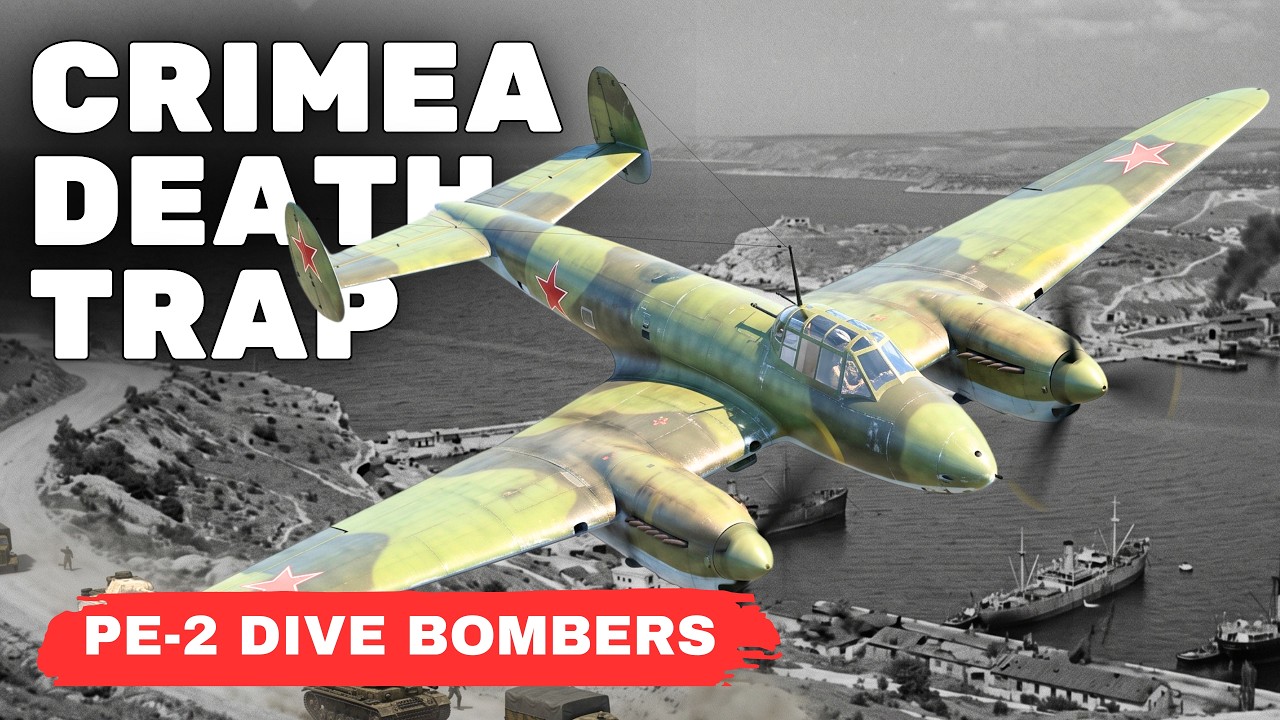
In the spring of 1944, the same stretch of beach that had witnessed a Soviet army die two years earlier filled once more with trapped columns and desperate men scanning an empty sea. But this time the soldiers waiting on the rocks of Cape Chersonesus at the western tip of the Crimea wore German uniforms, and the dive bombers that screamed down out of the sun carried red stars on their wings. At the center of this reversal was a fast little aircraft the crews called the Peshka, the pawn, a plane that had been born not in a clean design office but in a prison. The man who created it was Vladimir Petlyakov, one of the finest aircraft engineers the Soviet Union ever produced.
Born in 1891, he rose through technical studies after the revolution and became a key figure in the design group of Andrei Tupolev, the country’s most celebrated aircraft designer. Petlyakov’s great achievement in the 1930s was the TB-7, a four-engine heavy bomber that flew for the first time in December 1936 and would later be renamed the Pe-8 in his honor, one of the only true heavy bombers the Soviets fielded during the entire war. By any measure, he should have been celebrated. Instead, in 1937 during Stalin’s Great Purge, he was arrested on charges of sabotage.
The accusations were nonsense, but the secret police were not in the habit of letting facts get in the way. Petlyakov was too valuable to shoot, so the state imprisoned him in a sharashka, a special prison run by the secret police where captured engineers produced weapons under armed guard. It was there, behind locked doors and barred windows, that Petlyakov and his team began designing a new aircraft. The first concept was a high-altitude interceptor called the VI-100, a sleek, pressurized-cabin fighter meant to hunt enemy bombers in the thin, cold air.
In 1938, it was years ahead of its time. But the war that was coming would not be fought at high altitude. The command ordered the design changed from a fighter into a dive bomber. The pressurized cabin came out.
Dive brakes went in. A glass nose was cut into the front for a bombardier. The aircraft was rebuilt for a crew of three and given wings that could carry bombs. The engineers had 45 days to complete the redesign while living as prisoners.
They did it. The result was the Pe-2, which became the most produced twin-engine combat aircraft the Soviet Union ever built, with more than 11,000 rolling off the lines before the war ended. The Peshka was unlike the slow, high-flying bombers that lumbered over targets and dropped their loads wherever they happened to be. It could reach roughly 336 miles per hour, faster than many fighters in the early years of the war.
It carried a pilot up front, a navigator and bombardier crouched in the glass nose, and a gunner and radio operator in the rear. When it attacked, it rolled over and dropped into a screaming dive, the airframe shaking as the target rushed up to meet it. The navigator released the bombs at the last possible second, and the pilot hauled back on the controls to claw the plane out of the dive. This allowed bombs of around 1,300 pounds to hit columns of trucks, ships at anchor, or gun positions dug into hillsides with a precision nothing else in the Soviet arsenal could match.
By 1944, the crews flying these planes were veterans. They flew in tight groups of six to nine aircraft, alternating between diving and level attacks to confuse German gunners, and they had learned to land at forward strips near the front, rearm, and fly again as many as four or five times in a single day. That skill had been bought at a terrible price. In the opening months of the war, the Soviet Air Force had been gutted, with hundreds of aircraft destroyed on the ground and half-trained crews thrown into combat against battle-hardened German pilots.
Every trick these veterans used in 1944 came from the survivors of those early disasters. The situation that brought the Peshka to the Crimea began with the first time the peninsula became a killing ground. In September 1941, the German 11th Army under Erich von Manstein smashed through the Perekop Isthmus, the narrow land bridge onto the peninsula, and overran nearly all of it. One place held out: Sevastopol, the great fortress port on the southwestern coast.
Manstein ringed the city and battered it for months with some of the largest artillery pieces ever built. The Soviets attempted to break the siege by landing troops on the Kerch peninsula in the east, which briefly pulled German strength away. But the Germans destroyed that bridgehead in May 1942 and turned their full weight back on the fortress. The final assault opened on the 7th of June 1942, and by early July Sevastopol collapsed.
The senior Soviet commanders were lifted out by submarine and aircraft. The ordinary soldiers were not. Tens of thousands were left behind, pushed back to the western tip of the peninsula at Cape Chersonesus. There they waited for rescue ships that never came in sufficient numbers, and the Germans closed in and took them or killed them.
Two years later, the wheel had turned. After Stalingrad and the collapse that followed, the Red Army drove west across the Ukraine in a vast tide. In November 1943, Soviet forces reached the approaches to the Crimea and cut the peninsula off by land, severing the land bridge. The German 17th Army and its Romanian allies, hundreds of thousands of men, were now an island supplied only by sea and air.
The smart move was to evacuate them, and the German commander on the spot, General Wenck, drew up plans for a naval withdrawal. Manstein himself argued the Crimea should be given up. The order from the top, made hundreds of miles away, was no. The Crimea would be held to avoid frightening Romania and uncovering the oil and coast beyond.
The evacuation was refused, and a quarter of a million men were left sitting in a trap. The hammer fell on the 8th of April 1944, when the Soviet 4th Ukrainian Front under General Fyodor Tolbukhin launched its assault across the Perekop Isthmus, the same neck of land Manstein had stormed three years earlier. At the same time, a separate coastal army pushed in from the Kerch direction in the east. Above it all, the Peshkas went to work.
As the 17th Army fell back toward Sevastopol, it had to move men, guns, trucks, and horses along a handful of exposed roads across a flat peninsula with nowhere to hide. The dive bombers came down on the retreating columns again and again. Knock out the first and last trucks in a column, and everything between was frozen, nose to tail, unable to move, and then worked over at leisure. Kerch fell on the 11th of April.
Simferopol, the city in the heart of the peninsula, fell two days later. In barely a week, the defensive plan had collapsed, and the 17th Army was streaming toward the coast with the Red Army close behind and the Peshkas overhead. By mid-April, the survivors had pulled back into the Sevastopol fortress zone, the same ground where Soviet defenders had stood two years before. Now they had to defend a city they had spent almost no time fortifying against attack from this direction, and they were exhausted and short of everything.
The final assault opened in early May. Soviet artillery hammered the German positions, Soviet infantry pushed up the slopes, and the Pe-2s dove on strong points and gun positions. The key was the Sapun Heights, the ridge dominating the eastern approach to the city. Once the Red Army stormed those heights, the city was finished.
Sevastopol fell on the 9th of May 1944, almost to the day the Soviets had surrendered it two years earlier. The fall of the city was not the end of the killing. The survivors of the 17th Army ran for the only ground left: Cape Chersonesus, the same low, narrow finger of rock where the abandoned Soviet defenders had waited to die two years before. Roughly 40,000 men were driven onto that headland in the second week of May, with the Red Army tightening the noose behind them and the sea in front.
German ships did come, steaming out from Romanian ports to lift the trapped men off. But now the full weight of Soviet air power came down. A transport ship packed with thousands of soldiers was the most vulnerable target imaginable for a dive bomber. On the 10th of May, the day after Sevastopol fell, two large transports, the Totila and the Teja, were caught and sunk, with the loss of up to 10,000 men drowned or killed in the water in a single day.
It was a nightmare without an exit. The ships that came to save them became death sentences the moment they appeared. The fighting on the headland from the 10th to the 14th of May was savage, the pocket shrinking as men fought with the water at their backs. Some got off.
Many did not. Across the whole collapse, the German and Romanian formations lost roughly 57,000 men, a huge share of them drowned in the evacuation meant to save them. The 17th Army had been smashed and scattered into the sea. In little over a month, the peninsula that had been a German fortress was swept clean.
The Peshka did not win the Crimea alone. The infantry climbed the heights, the artillery broke the lines, the tanks drove the breakthroughs. But the dive bombers shaped the entire battle in a way nothing else could. They made the roads deadly, so the retreat became a slaughter.
They smashed strong points, so the assaults went faster. And at the end, over the beaches and boats of Cape Chersonesus, they turned the only escape route into a graveyard. An army trapped against the sea cannot survive if it cannot use the sea. It was a fitting end for an aircraft born in a prison, designed by a man the state had lauded and then locked away.
The Peshka grew into one of the sharpest instruments the Soviet Union ever fielded, flown by crews who had spent three brutal years learning their trade the hard way. The pawn had been promoted, and on the cliffs and beaches of the Crimea, it helped erase an entire German army from the map. Two years after the Germans stood on those heights watching a trapped Soviet army die, the same beach, the same sea, and the same hopeless wait for ships had come full circle.
Only this time, the red stars were the ones in the sky, and the 17th Army was the one with the water at its back.






