June 6th, 1944. The English Channel, twenty-three kilometers off the French coast. In the pre-dawn darkness, salt spray crashed over the bow of landing craft tank 2273 as Lieutenant Dean Rockwell gripped the radio handset.
Through the gloom he could make out the silhouettes of thirty-two amphibious Sherman tanks, their canvas screens erected like medieval siege towers against the horizon. The message came from Task Force O. H-Hour confirmed.
0630 hours. Beach obstacles identified. Heavy fortifications intact.
Captain Ned Elder of the 743rd Tank Battalion studied the five-foot swells through his binoculars and made a decision that would save hundreds of American lives. The DD tanks would not swim. They would ride their landing craft all the way to the beach.
What none of them knew was that this single decision, made in the churning waters of Normandy, would trigger the most devastating armored breakthrough in the European theater.
The hedgerows of France had taught German forces that their Tigers and Panthers were apex predators. Superior armor. Devastating 88mm guns.
Mechanical precision that made them nearly invincible in defensive positions. The Wehrmacht's armored doctrine had established kill zones across the Norman countryside. Hundreds of concealed positions.
Anti-tank guns sighted on every approach. Tank traps and obstacles that would channel Allied armor into predetermined killing fields.
The Sherman tank churned through the English Channel at four knots. Its Chrysler 57 multibank engine strained against thirty-three tons of steel and determination. Each M4A4 Sherman displaced enough water to flood a small building when fitted with its duplex drive system.
Staff Sergeant Paul Reagan stood in the commander's hatch of his tank aboard LCT 600, studying the tactical situation. His tank carried ninety rounds of 75mm ammunition, 4,750 rounds of . 30 caliber machine gun ammunition, and the hopes of the entire amphibious assault.
The Sherman represented American industrial philosophy at its most pragmatic. Unlike the German Tigers that cost 250,000 Reichsmarks and required specialized maintenance, the Sherman could be mass-produced, shipped across oceans, and maintained by farm boys from Kansas using basic tools. Chrysler's Detroit Tank Arsenal alone was producing over four hundred Shermans per month by 1944.
The mathematics were compelling. While Germany struggled to produce one hundred Tigers monthly, American factories churned out over two thousand Shermans per month at peak production. Factor in mechanical reliability, fuel consumption, and ease of repair, and the equation became overwhelming.
Tank commander William Focusad had trained with the 743rd Tank Battalion at Camp Laguna, Arizona. A veteran who would later earn a Silver Star and Purple Heart, Focusad understood that victory in mechanized warfare wasn't just about armor thickness or gun caliber. It was about putting steel on target, maintaining operational tempo, and most critically, adapting to battlefield conditions faster than the enemy could react.
Aboard Panther number 424 of the 2nd Panzer Division, Unterscharführer Klaus Weber reviewed his ammunition loadout. Seventy-nine rounds for the long-barreled 75mm KwK42 gun. 4,200 rounds of machine gun ammunition.
His Panther's frontal armor measured 100mm thick, sloped at 55 degrees for an effective thickness of 140mm. The American 75mm guns couldn't penetrate it beyond one hundred meters. Weber's tank displaced forty-five tons, powered by a Maybach HL230P30 engine that consumed fuel at rates that would have horrified American logistics officers.
The Panther achieved one mile per gallon on roads, half that cross-country. But positioned hull-down in a Norman hedgerow with interlocking fields of fire, the Panther didn't need to move. It only needed to kill.
The German defensive positions at Omaha Beach represented two years of fortification work. Widerstandsnester 62, overlooking Easy Red Sector, contained multiple machine gun positions, a 50mm anti-tank gun, and mortar pits. Hinrich Seau, manning an MG42 machine gun, would later claim to have fired over 12,000 rounds, a figure historians consider greatly exaggerated given the physical impossibility and total casualty figures.
The kill zones were mathematically perfect. Overlapping fields of fire created no dead space where attackers could find cover. Pre-registered artillery coordinates meant that mortars could drop shells anywhere on the beach within thirty seconds of target identification.
At 0550 on June 6th, Captain Elder aboard LCT 2037 observed the sea state through spray-soaked binoculars. Waves measured five to six feet. Wind force eighteen knots from the west.
The DD tanks' canvas screens, designed for three-foot seas, would collapse in these conditions. Of the sixty-four Sherman DD tanks scheduled to swim ashore at Omaha Beach, only twenty-nine would attempt it. And of those twenty-nine, belonging to the 741st Tank Battalion on the eastern sectors, twenty-seven would sink in the cold waters of the English Channel.
But Elder's 743rd Tank Battalion would not launch. His thirty-two DD tanks, plus support vehicles, would ride their LCTs directly onto Dog Green and Dog Red beaches. It meant exposing the thin-skinned landing craft to direct fire, but the alternative was watching his tanks disappear beneath the waves.
The mathematics of the decision were stark. Risk the landing craft and their naval crews, or lose the tanks and their army crews before they fired a shot.
At 0615, the naval bombardment commenced. USS Texas fired 14-inch shells at the bluffs above Omaha. USS Arkansas added 12-inch rounds.
Smaller destroyers crept within one thousand yards of the beach, firing directly at visible fortifications. The bombardment was supposed to last forty minutes, pulverizing German positions before the first wave hit the beach. In reality, most shells overshot their targets.
Low clouds forced the heavy bombers to release late, their payloads falling harmlessly in the fields behind the beach. Of 446 B-24 Liberators that attacked Omaha Beach, not one bomb fell on the beach itself.
The Sherman's first combat action at Omaha came at 0629, one minute before H-Hour. Company A, 743rd Tank Battalion, fitted with deep wading equipment, rolled directly off their LCTs into four feet of water. These tanks had been waterproofed with special kits, their exhausts extended with improvised stacks that allowed them to wade through six feet of water.
The first tanks hit the beach with tracks grinding against the shingle as 75mm guns swung toward the bluffs.
The initial German response was devastating. An 88mm anti-tank gun in WN61 fired eight rounds in ninety seconds. Three Shermans exploded, their 75mm ammunition cooking off in spectacular fireballs that could be seen from the naval vessels offshore.
Machine gun fire sparked off tank hulls like hellish rain. Mortars walked their way across the beach, bracketing tanks with methodical precision.
But the Shermans kept coming. By 0700, forty tanks were on Omaha Beach. Some were already burning.
Others threw tracks on the obstacles or bogged in the shingle. But those still operational began engaging German positions with direct fire. The psychological impact was immediate.
German infantry trained to expect an infantry assault found themselves facing armor that could absorb machine gun fire and respond with high explosive shells.
Technical Sergeant John Ducoan of the 743rd Tank Battalion had landed in the second wave at 0640. His tank immediately took two hits from a 50mm anti-tank gun. Both rounds penetrated the hull, but missed critical components.
Ducoan's driver, Private First Class Howard Froberg, drove directly at the German position while the gunner pumped five rounds of high explosive into the fortification. The anti-tank gun fell silent.
This became the pattern. Individual tank commanders, unable to communicate by radio—saltwater had destroyed most sets—fought private wars against specific German positions. A Sherman would absorb multiple hits from smaller caliber weapons while methodically destroying machine gun nests with its 75mm gun and bow-mounted .
30 caliber machine gun. The bow gunner position, unique to American tanks, proved invaluable for suppressing German infantry, while the main gun engaged hardened positions.
By 0730, the crisis at Omaha Beach was evident to naval observers. General Omar Bradley, watching from USS Augusta, considered diverting follow-up waves to Utah Beach. The 16th Infantry Regiment had taken catastrophic casualties.
Company A had ceased to exist as a fighting unit. Company E was down to twenty-three men from 180. The beach was littered with destroyed equipment and wounded men seeking cover behind German obstacles.
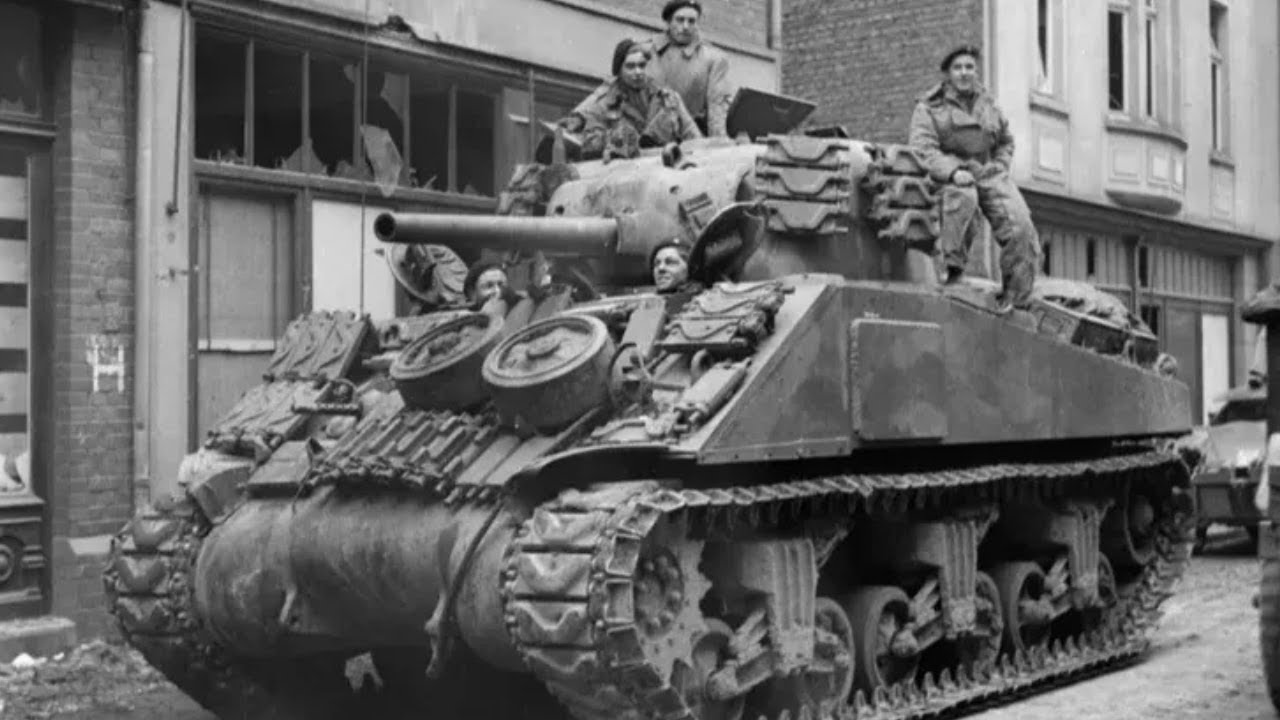
But the tanks were making a difference. Lieutenant Colonel Robert Ploger, commanding the 743rd Tank Battalion's Company C, directed his tanks to engage the fortifications at Les Moulins Draw. Using a technique developed in training, tanks would fire white phosphorus rounds to mark targets, then follow with high explosive.
The white phosphorus had an additional effect. Its burning particles penetrated vision slits and gunports, forcing defenders to abandon their positions.
At 0815, Widerstandsnester 66 reported to German sector command. "Enemy tanks on beach. Infantry decimated but tanks advancing.
Request immediate anti-tank support." The response was sobering. No mobile reserves were available.
The 352nd Infantry Division's anti-tank battalion was positioned ten miles inland, held back by Field Marshal Rommel's order to defend against expected airborne landings. The beach defenders would have to hold with what they had.
The Sherman's mechanical simplicity now proved decisive. Tank Barbara of Company B, 743rd Tank Battalion, commanded by Sergeant Walter Basker, took seven hits from various weapons in the first hour. The tank lost two bogey wheels, had its turret traverse mechanism damaged, and suffered a fuel leak, but the crew made field repairs using basic tools and spare parts carried on the tank.
By 0900, Barbara was back in action, engaging German positions at Vierville Draw.
This was the Sherman's great advantage. A damaged Tiger or Panther required specialized recovery vehicles and trained mechanics. A Sherman could be repaired by its crew using parts cannibalized from knocked-out tanks.
Throughout D-Day, Sherman crews performed miracles of field maintenance. Tracks were replaced under fire. Gun barrels damaged by shell hits were swapped in twenty minutes.
Engines that should have required depot-level maintenance were coaxed back to life with improvisation and determination.
At 0845, the first German armor appeared. Two StuG III assault guns from the 352nd Infantry Division's assault gun battalion engaged the Shermans at eight hundred meters. Their 75mm StuK40 guns could penetrate Sherman armor at that range, but the American tanks had a crucial advantage: numbers.
For every German assault gun, there were five Shermans. The StuGs managed to destroy two Shermans before being overwhelmed by concentrated fire from multiple tanks.
By 0900, combat engineers supported by tanks had blown gaps in the seawall at Easy Red Sector. Shermans began moving off the beach, engaging German positions from the flank. This was the breakthrough moment.
German defensive doctrine depended on keeping attackers pinned on the beach. Once armor penetrated inland, the entire defensive system began to unravel.
Private First Class Charles Lombardo of the 741st Tank Battalion had survived the swim to shore in one of only two DD tanks that made it. His tank, waterlogged and barely functional, managed to engage and destroy a concrete bunker at one hundred meters with five rounds of armor-piercing ammunition followed by high explosive. The bunker had been holding up the advance of an entire infantry company.
With its destruction, 150 infantrymen were able to move off the beach.
The German response to the armored breakthrough followed established doctrine. Panzerfaust teams were deployed to establish close-range ambushes. The Panzerfaust, a single-shot anti-tank weapon, could penetrate 200mm of armor at thirty meters.
In the bocage country behind Omaha Beach, every hedgerow could conceal a Panzer team. But the Americans had learned from the disasters at Kasserine Pass and Sicily. Infantry-tank cooperation had been drilled relentlessly.
Every Sherman advancing inland had infantry walking alongside, checking hedges and buildings for anti-tank teams.
At 1030, German infantry reinforcements arrived with Panzerfaust anti-tank weapons. But the Americans had learned from disasters at Kasserine Pass and Sicily. Infantry-tank cooperation had been drilled relentlessly.
Every Sherman advancing inland had infantry walking alongside, checking positions for anti-tank teams.
In the days following D-Day, German armor would arrive in force. Panthers from the 2nd Panzer Division and Tigers from the 101st SS Heavy Panzer Battalion would engage American tanks near Caen and Villers-Bocage. The pattern of these engagements would prove consistent.
German tanks were individually superior, but American tactics emphasized fire and maneuver. While one Sherman platoon engaged frontally, another would maneuver for flank shots. The mathematics were brutal but effective.
Trading three Shermans for one Panther was considered acceptable when America was producing thirty Shermans for every Panther Germany built.
By noon on D-Day, fifty-one Sherman tanks were operational on Omaha Beach and its immediate inland areas. They had suffered terrible losses—40 percent knocked out or disabled—but they had achieved their mission. The beach was secured.
Follow-up waves were landing without catastrophic casualties. Most critically, the psychological impact on German forces was decisive. The myth of impregnable Atlantic Wall defenses had been shattered.
At German 352nd Infantry Division headquarters, General Dietrich Chries received fragmentary reports throughout the morning. American tanks overwhelming beach defenses. Widerstandsnester fallen.
Enemy armor advancing on Colleville. By 1300, Chries understood that Omaha Beach was lost. Without armor reserves to counter the American tanks, his infantry could only conduct a fighting withdrawal.
The Sherman's impact extended beyond direct combat. Their presence allowed engineers to clear obstacles without being massacred by machine gun fire. Their 75mm guns could engage fortifications that naval gunfire couldn't reach.
Most importantly, their psychological effect on American infantry was transformative. Soldiers who had been paralyzed on the beach began advancing once they saw tanks moving forward.
Technical innovations implemented for D-Day proved their worth. The deep wading equipment, developed in secrecy and tested in Scotland, allowed tanks to land in deeper water and avoid the worst obstacle belts. Waterproofed ammunition storage prevented catastrophic explosions when tanks were hit.
Most importantly, the addition of armored telephones on tank rear decks allowed infantry to communicate with tank crews despite the loss of radios.
By 1400 on D-Day, American tanks were pushing inland toward their D-Day objectives. The advance was slower than planned. Hedgerows that looked like simple field boundaries on aerial photos proved to be formidable obstacles.
These ancient earthen walls, some dating to Roman times, were three to four feet thick at the base, topped with dense hedge, and fronted by drainage ditches. Tanks attempting to climb over exposed their thin belly armor to anti-tank fire.
But American ingenuity was already at work. Sergeant Curtis Culin of the 102nd Cavalry Reconnaissance Squadron had noticed that German beach obstacles—steel hedgehogs designed to rip landing craft hulls—could be cut up and welded to tank bows as hedge-cutting devices. Within hours of landing, maintenance crews were modifying tanks with these improvised hedge cutters.
A soldier from Tennessee named Roberts had suggested the idea. "Why don't we get some saw teeth and put them on the front of the tank and cut through these hedges?" Culin had recognized the brilliance in this simple observation.
The German high command's response to the Normandy landings was hampered by confusion and Hitler's personal intervention. The Führer, convinced that Normandy was a feint and the real invasion would come at Pas-de-Calais, refused to release the strategic armor reserve. The 2nd SS Panzer Division, 130 miles from Normandy, wasn't released until late afternoon.
By the time they arrived, American armor had established blocking positions on all major approaches to the beachhead.

At 1600 hours on D-Day, Company B, 743rd Tank Battalion encountered its first Tiger I near Formigny. The Tiger from the 101st SS Heavy Panzer Battalion had been dispatched from its position near Caen to halt the American advance. Tank commander SS Unterscharführer Wilhelm Müller was a veteran of Kursk, where his Tiger had destroyed nineteen Soviet T-34s.
His 88mm gun could penetrate a Sherman at 2,000 meters.
The engagement demonstrated the tactical evolution American tankers had undergone. Instead of engaging the Tiger head-on, the Sherman platoon leader, Lieutenant James Johnson, ordered smoke rounds fired to obscure the Tiger's vision. While one Sherman maintained suppressing fire, three others maneuvered through a small orchard.
The Tiger, focused on the lone Sherman firing at its frontal armor, didn't notice the flanking movement until too late. At two hundred meters, Sherman gunners put five rounds into the Tiger's engine compartment. The massive tank shuddered to a halt, smoke pouring from its rear deck.
Müller's crew abandoned their burning Tiger, but the psychological impact rippled through German forces. If Tigers could be destroyed by Shermans, what chance did infantry have?
Reports reaching German command painted an increasingly dire picture. Enemy tank strength overwhelming. Multiple Tiger and Panther losses.
Infantry retreating from armored spearheads. The reality was more nuanced. For every successful flanking attack, Shermans paid a heavy price in frontal engagements.
But American doctrine accepted these losses. The Sherman was designed to be good enough, not perfect. It could be transported by standard Liberty ships—two Shermans in the space required for one Tiger.
It could be maintained by conscript mechanics with three months of training. Most importantly, it could be produced in numbers that made losses acceptable.
By 1800 on D-Day, the 743rd and 741st Tank Battalions had established a continuous line inland from Omaha Beach. They had lost forty-eight tanks destroyed or disabled, with forty-five crew killed and sixty wounded. But they had put fifty-eight operational tanks ashore and broken the Atlantic Wall.
German casualties were harder to quantify, but included multiple fortified positions destroyed, three assault guns knocked out, one Tiger and three Panthers destroyed, and hundreds of infantry casualties.
The technological lessons were immediately apparent. The Sherman's 75mm gun, while unable to penetrate heavy German armor frontally, was devastatingly effective against fortifications and infantry. The tank's reliability under combat conditions exceeded expectations.
Despite saltwater immersion, beach obstacles, and intense combat, 70 percent of Shermans that made it ashore were still operational at day's end. In contrast, of six Tiger IIs deployed to Normandy in July, five would break down before reaching combat.
On the night of June 6th to 7th, American maintenance crews worked through the darkness. Using acetylene torches to cut up German beach obstacles, they welded crude but effective hedge cutters to Sherman bows. By dawn on June 7th, fifteen tanks had been modified.
Within a week, 60 percent of American tanks in Normandy would carry these "rhino" devices, named because the prongs resembled rhinoceros horns.
The German 352nd Infantry Division's war diary for June 7th recorded: "Enemy tank attacks supported by massive artillery have made defensive positions untenable. Withdrawal to second defensive line authorized." This represented a fundamental shift in German defensive doctrine.
The Atlantic Wall hadn't just been breached. It had been rendered obsolete by American armor.
Lieutenant General Omar Bradley, commander of First Army, would later write: "The tanks saved Omaha Beach. Without them, we would have been thrown back into the sea." This wasn't hyperbole.
The twenty-nine infantry companies that assaulted Omaha Beach suffered 50 percent casualties, but the two tank battalions, despite heavy losses, maintained offensive capability throughout the day. Their presence turned potential disaster into costly victory.
The weeks following D-Day would see the full development of American armored doctrine. Operation Cobra, launched on July 25th, would showcase American combined arms tactics. Three thousand aircraft would carpet-bomb German positions.
Seven hundred Shermans, 60 percent equipped with Rhino hedge cutters, would punch through the bocage. The breakthrough would transform the Normandy stalemate into a war of movement that American armor was designed to fight.
Sergeant Culin's hedge cutter would become standard equipment. Within six weeks of D-Day, five hundred Shermans would be modified with various hedge-cutting devices. The British would develop their own version called "prongs."
The innovation spread so rapidly that German intelligence reported in August: "All enemy tanks now equipped with hedge-breaking devices. Bocage defensive positions no longer tenable."
The Panther tank remained technically superior throughout the campaign. Its long 75mm gun could penetrate Sherman armor at ranges where the Sherman's gun was ineffective. But technical superiority couldn't overcome numerical inferiority, logistical constraints, and mechanical unreliability.
A study by the British Operational Research Section found that in Normandy, Panthers had only 37 percent operational availability compared to 70 percent for Shermans.
The mathematics of attrition were inexorable. Germany produced approximately 6,000 Panthers throughout the entire war. America produced 49,234 Shermans, with nearly 50,000 total when including all variants.
In Normandy alone, over 2,000 Shermans would see combat. Even achieving a 3:1 kill ratio, which German tanks rarely managed, couldn't stem the tide. For every Panther destroyed, five Shermans appeared.
For every Tiger lost, ten Shermans rolled off ships at Normandy's artificial Mulberry harbors.
By August 1944, the German armor forces in Normandy were effectively destroyed. The 2nd Panzer Division, which had entered combat with 180 tanks, was reduced to twenty-five. The 116th Panzer Division fell from 120 tanks to twelve.
The vaunted 1st SS Panzer Division Leibstandarte Adolf Hitler could muster only seventeen operational tanks from an initial strength of 150. The Falaise Pocket in mid-August would see the final destruction of German armor in Normandy. Caught between British, Canadian, Polish, and American forces, German tank crews abandoned their vehicles and fled on foot.
Allied pilots reported roads littered with burning Tigers and Panthers, their crews unable to maintain or fuel these mechanical monsters during the retreat.
American losses were also severe. The 743rd Tank Battalion alone would lose fifty-one tanks totally destroyed in the Normandy campaign, with another eighty requiring major repairs. Crew casualties exceeded 50 percent.
But unlike German losses, American losses were replaced. For every Sherman destroyed, two arrived from England. For every crew member killed, three replacements were in the pipeline.
The human cost was sobering. Tank warfare in the bocage was particularly brutal. The average distance of tank engagement was four hundred meters.
At that range, first shot usually meant first kill. Tank crews developed a fatalistic humor. "The Sherman lights first time, every time," they would joke, referencing Ronson lighter advertisements.
But they also knew that their sacrifice was enabling victory.
Private First Class Wayne Robinson of Company B, 743rd Tank Battalion, would later write about his tank Barbara. "She wasn't the best tank in the world. The Germans had better, but she was there when we needed her.
She took us through hell and got us home. That's all you can ask of a tank or a friend."

The technological evolution continued throughout the campaign. The British Sherman Firefly, mounting a 17-pounder gun capable of penetrating Tiger armor at one thousand meters, began arriving in significant numbers. By August, one in four British Shermans was a Firefly.
American units received 76mm-armed Shermans starting in July, giving them improved anti-tank capability, though still inferior to German guns.
But the greatest innovation remained tactical, not technical. American armor doctrine emphasized combined arms, mobility, and mass. Tanks didn't operate alone, but as part of integrated teams including infantry, artillery, engineers, and air support.
This systematic approach to warfare proved more decisive than any individual weapon system.
German tank commander Otto Carius, who destroyed 150 enemy tanks on the Eastern Front, would later write: "The Americans understood something we didn't. War isn't about having the best tank. It's about having enough good tanks, fuel to run them, parts to fix them, and men trained to use them.
We had the best tanks. They had everything else."
Statistical analysis after the war revealed the true story of tank combat in Normandy. The average Sherman in combat was hit 1. 2 times.
Of those hit, 60 percent were knocked out permanently, 20 percent were repairable in the field, and 20 percent required depot-level maintenance. Crew survival rates were surprisingly high. Seventy-five percent of Sherman crew members survived their tank being knocked out.
This was partly due to the Sherman's large hatches and partly due to American emphasis on crew escape training.
German tanks showed different patterns. Panthers hit averaged 2. 3 penetrations before destruction, suggesting they could absorb more damage.
But once hit, 80 percent were permanent losses due to inability to recover and repair vehicles during retreat. Tiger crews had only 45 percent survival rates when their tanks were destroyed, mainly due to ammunition fires and smaller escape hatches.
The Normandy campaign transformed American armored warfare. Lessons learned in the bocage would be applied across Europe. Hedge cutters evolved into dozer blades.
Tank-infantry phones became standard equipment. Most importantly, the mythology of German armored superiority was shattered. American tankers learned they could defeat Tigers and Panthers through superior tactics and teamwork.
By late August 1944, as Allied forces broke out across France, the strategic impact was clear. Germany had lost not just a battle, but the capacity to conduct mobile warfare in the West. The cream of the Panzer forces lay burned out in Norman fields.
Experienced crews who had survived Russia were dead or captured. The training schools in Germany couldn't replace such losses.
The Sherman tank would continue to be criticized by historians focused on technical specifications. Its armor was thinner than German tanks. Its gun was less powerful.
Its gasoline engine was more flammable than diesel alternatives. All these criticisms were valid in isolation. But war isn't fought in isolation.
The Sherman was part of a system—industrial, logistical, and tactical—that proved superior to German alternatives.
Admiral Sir Bertram Ramsay, Allied naval commander for D-Day, would later observe: "The success at Normandy wasn't due to any single weapon or tactic. It was the culmination of Allied industrial might, logistical superiority, and tactical adaptation. The Sherman tank embodied all these qualities.
Not perfect, but perfectly adequate for the task at hand."
The long-term impact extended beyond World War II. The Sherman's success validated American military doctrine emphasizing production quantity, mechanical reliability, and tactical flexibility over technical perfection. This philosophy would influence American tank design through the Cold War.
The M48, Patton M60, and even early versions of the M1 Abrams emphasized these same qualities.
German military theorist Heinz Guderian, father of Blitzkrieg, would write in his memoirs: "We made the perfect tank. The Americans made the tank that won the war. There's a lesson in that for all military planners.
Perfect is the enemy of good enough, especially when good enough can be produced in overwhelming numbers."
The memorial at Omaha Beach today includes a preserved Sherman tank from the 743rd Tank Battalion. Its hull still bears scars from German shells. Flowers are regularly placed on it by French civilians who remember the liberation.
The memorial's inscription reads: "To those who came in steel coffins to give us freedom." It's a fitting tribute to the citizen soldiers who climbed into inferior tanks and made them superior through courage, innovation, and sacrifice.
In the final analysis, the Sherman tank's success at Normandy and beyond wasn't about armor thickness or gun caliber. It was about American industrial capacity producing one thousand tanks monthly. It was about farm boys from the Midwest maintaining complex machinery under fire.
It was about tactical innovation like the Rhino hedge cutter that transformed battlefield dynamics overnight. Most fundamentally, it was about the democratic arsenal proving that quantity has a quality all its own.
The numbers tell the story. In June 1944, Germany had approximately 1,500 operational tanks on all fronts. America alone produced 2,000 Shermans that month.
By August, Allied forces in northwest Europe fielded 4,000 tanks. German forces had fewer than 500. The mathematics of modern industrial warfare had rendered tactical superiority irrelevant.
The Tiger might win individual battles, but the Sherman had already won the war.
Field Marshal Erwin Rommel, who had argued for positioning Panzer reserves near the beaches, was proven correct in his assessment. In his papers discovered after his forced suicide in October 1944, he had written: "The Americans will come with thousands of tanks, not better than ours, but thousands. We cannot stop thousands.
The war is lost when the first American tank rolls off the beach."
On June 6th, 1944, at 0629 hours, the first Sherman tanks of Company A, 743rd Tank Battalion rolled off the beach at Normandy. The war in the West was effectively decided at that moment, though hundreds of thousands would die before its conclusion. The Sherman tank, imperfect, mass-produced, manned by citizen soldiers, had broken the Atlantic Wall and begun the liberation of Europe.
The legacy of those twelve hours on June 6th would influence military doctrine for generations. Every major military would study the lessons of Normandy and conclude that in modern warfare, industrial capacity, logistical superiority, and tactical adaptation matter more than technical specifications. The Sherman tank had not just won a battle.
It had validated an entire approach to warfare.
In the depths of Norman soil, German tanks still rest where they fell. Tigers and Panthers, engineering marvels that represented the pinnacle of 1940s tank design, slowly rust away. Their crews, some of the most experienced tank soldiers in history, died manning weapons that were individually superior but collectively insufficient.
They were honored by both sides for their skill and courage. But their sacrifice marked the end of an era when tactical superiority could overcome strategic disadvantage.
The future belonged to nations capable of mass production, rapid innovation, and systematic application of combined arms warfare. The Sherman tank, for all its flaws, represented these qualities perfectly. It wasn't the best tank of World War II, but it was the tank that won World War II.
In the arithmetic of modern warfare, that's the only statistic that matters.






