The scratch of a pen in a quiet office on January 8th, 1945, was louder than any artillery barrage on the Western Front. General Dwight D. Eisenhower, the Supreme Allied Commander, was not writing a battle order.
He was writing an ultimatum that would strip Field Marshal Bernard Law Montgomery of his command, his glory, and his future. The document, drafted in cold fury, was a single sentence away from detonating the most fragile alliance in modern history. Eisenhower had finally reached his breaking point.
 The peacemaker was gone. In his place stood a commander prepared to burn his own career to the ground rather than tolerate another insult from the man he had protected for three years.
The trigger was a press conference held just twenty-four hours earlier in a freezing tent in the Ardennes. Montgomery, flush with the perceived success of his role in the Battle of the Bulge, had stepped before the world’s media with a smirk that betrayed his contempt for his allies. He spoke of the battle as a personal triumph, a “most interesting and tricky” problem that he alone had solved.
He described the American troops not as brothers in arms, but as wayward children he had been forced to rescue from their own incompetence. The word “I” dripped from his lips like venom. “I employed the whole available power,” he declared.
“I put it into the fight with a bang.” The British journalists, starved for heroic narratives, scribbled his words down as gospel. They did not see the 19,000 American graves that were still being dug in the snow.
They only saw a British lion roaring over a fallen American eagle.
Three hundred meters away, Eisenhower held the transcript of that speech in his trembling hands. The fury was not loud. It was a cold, silent rage that settled into his bones.
For three years, he had swallowed Montgomery’s arrogance. He had endured the condescending lectures on tactics. He had protected the Field Marshal from the wrath of Washington, believing that his strategic brilliance was worth the diplomatic headache.
But this was not a private insult whispered in a war room. This was a public humiliation broadcast to the world. Montgomery had not just insulted Eisenhower.
He had insulted every American soldier who had bled into the frozen soil of the Ardennes. The patience, the compromise, the political maneuvering—it all evaporated in that single moment. Eisenhower realized that the alliance could no longer survive with Montgomery in a position of power.
To understand the depth of this rupture, one must understand the toxic marriage that held the Allied command together. It was an arrangement born of necessity, not affection. On one side stood Eisenhower, a master of consensus, a politician in uniform whose primary genius lay in keeping a coalition of volatile egos from tearing itself apart.
He viewed the war as a team sport, a grinding effort where logistics and cooperation were as vital as courage. On the other side stood Montgomery, the hero of El Alamein, a man of undoubted tactical brilliance who was crippled by a narcissism so profound that it blinded him to reality. Monty did not see a team.
He saw a stage, and he was the star. The Americans were merely the supporting cast, useful for their numbers but utterly lacking in strategic vision. He openly dismissed Eisenhower as a “nice chap” who should stick to supply chains and let the real soldiers fight the war.
For months, the tension had been a ticking bomb. Montgomery had repeatedly demanded total command of all ground forces, a move that would have effectively demoted Eisenhower to a figurehead. Churchill had intervened time and again to save his troublesome general from the wrath of the Pentagon.
Eisenhower had always relented, choosing to absorb the 𝓪𝓫𝓾𝓼𝓮 for the sake of the mission. He believed that Monty’s meticulous planning was worth the daily humiliation. The Americans provided the steel and the numbers; the British provided the experience.
That was the unspoken deal. But as the winter of 1944 descended, the balance of power had shifted irrevocably. The student had become the master, and the master refused to accept his demotion.
The resentment festered in the frozen command posts, waiting for a spark to ignite the powder keg.
That spark came with the snow. In the weeks leading up to the German offensive, Montgomery had retreated into a reality of his own creation. Inside his mobile tactical trailer, surrounded by portraits of defeated enemy generals, he convinced himself that he was the only man capable of saving the alliance.
He looked at the maps of the Western Front and saw only American failure. He saw Omar Bradley’s lines stretched too thin. He saw Patton’s aggression as reckless gambling.
In Monty’s mind, the chaos of the war was a direct result of Eisenhower’s broad-front strategy, a timid approach that lacked the killer instinct only he possessed. He wrote letters to London, claiming that the American high command was useless without his guidance. He was not acting out of malice.
He was acting out of a supreme, blinding conviction that he was destiny’s chosen instrument.
He believed he was indispensable. He believed the Americans needed him so desperately that they would tolerate any insult, any demand, just to keep him on the field. He assumed Eisenhower was too weak, too political, to ever fire him.
It was a belief born of pure hubris. He forgot that even the greatest general is ultimately just a soldier, and every soldier answers to someone. He did not see the knife hanging over his head.
He was so consumed by his own myth that he failed to notice the shifting tectonic plates beneath his feet. The war was no longer a British enterprise with American support. It was an American juggernaut with British assistance.
 Monty was fighting a 1942 war in a 1945 reality, and reality was about to crush him.
The crisis that triggered the explosion began on December 16th, 1944, when the Germans launched their massive surprise offensive through the Ardennes. The attack smashed into the American lines, creating a deep wedge that physically separated General Bradley’s headquarters in the south from his two massive armies in the north. Communications were severed.
Chaos reigned. Eisenhower made a difficult, pragmatic decision. He looked at the map and saw that Bradley could not command the troops in the north.
Swallowing his pride, he ordered the temporary transfer of 200,000 American soldiers to Montgomery’s command. It was a purely military move to ensure unity of command during a crisis. For Bradley, this was a humiliation.
Giving up his men to his British rival felt like a demotion. For Patton, it was treason. The American generals were furious, but they obeyed.
They expected Montgomery to act as a caretaker, a temporary steward who would respect the American chain of command. They expected professionalism. Instead, they got a lecture.
Montgomery did not arrive at the American headquarters quietly. He swept in like a feudal lord visiting a peasant village. He strode into the operations room of the US First Army, refusing to look the exhausted American officers in the eye.
He immediately rejected their defensive plans. He reorganized their lines. He stopped their counterattacks.
He spoke to seasoned American generals as if they were cadets who had failed their first exam. “I shall tidy up this mess,” he reportedly said, a phrase that burned into the souls of the American staff. He refused to travel to meet Bradley, forcing the American commander to come to him.
When they met, Monty was patronizing, lecturing Bradley on basic tactics while the American general ground his teeth in silence.
The atmosphere in the Allied camp turned poisonous. American officers began to openly discuss whether they would rather fight the Germans or the British. But Monty was oblivious.
He mistook their silence for agreement. He mistook their discipline for submission. He successfully stabilized the northern front.
That is undeniable. But in doing so, he destroyed the last shreds of goodwill he had with his allies. He was winning the battle on the map but losing the war in the headquarters.
And then he decided to brag about it. The press conference of January 7th was the spark that blew up the powder keg. The data from the transcripts is damning.
Montgomery stood before the world and presented a version of the Battle of the Bulge that was bordering on fiction.
He described the battle as one of the “most interesting and tricky” he had ever handled, trivializing the desperate struggle where 19,000 Americans died. He barely mentioned the heroic defense of Bastogne by the US 101st Airborne. He ignored Patton’s grueling drive from the south.
Instead, he painted a picture where the Americans were crumbling until he, the British master, stepped in to save them. The British press, hungry for a victory, ate it up. The headlines in London screamed, “Monty saves the Yanks.”
When the news reached General Bradley, he told Eisenhower he would resign rather than serve under Montgomery again. Patton demanded to be let loose. The entire US command structure was in revolt.
They had bled for every inch of snow in the Ardennes. And now this man was claiming their sacrifice as his personal tactical exercise. The illusion of a united alliance shattered.
Eisenhower realized he could no longer compromise. The scene in his office was quiet. There was no shouting, no throwing of objects, just the scratching of a pen.
Eisenhower sat at his desk, his face set in stone. He was done with the politics. He was done with the appeasement.
He pulled out a sheet of paper and began to draft a cable to General George Marshall in Washington. The words he wrote were cold, precise, and final. He detailed the breakdown of trust.
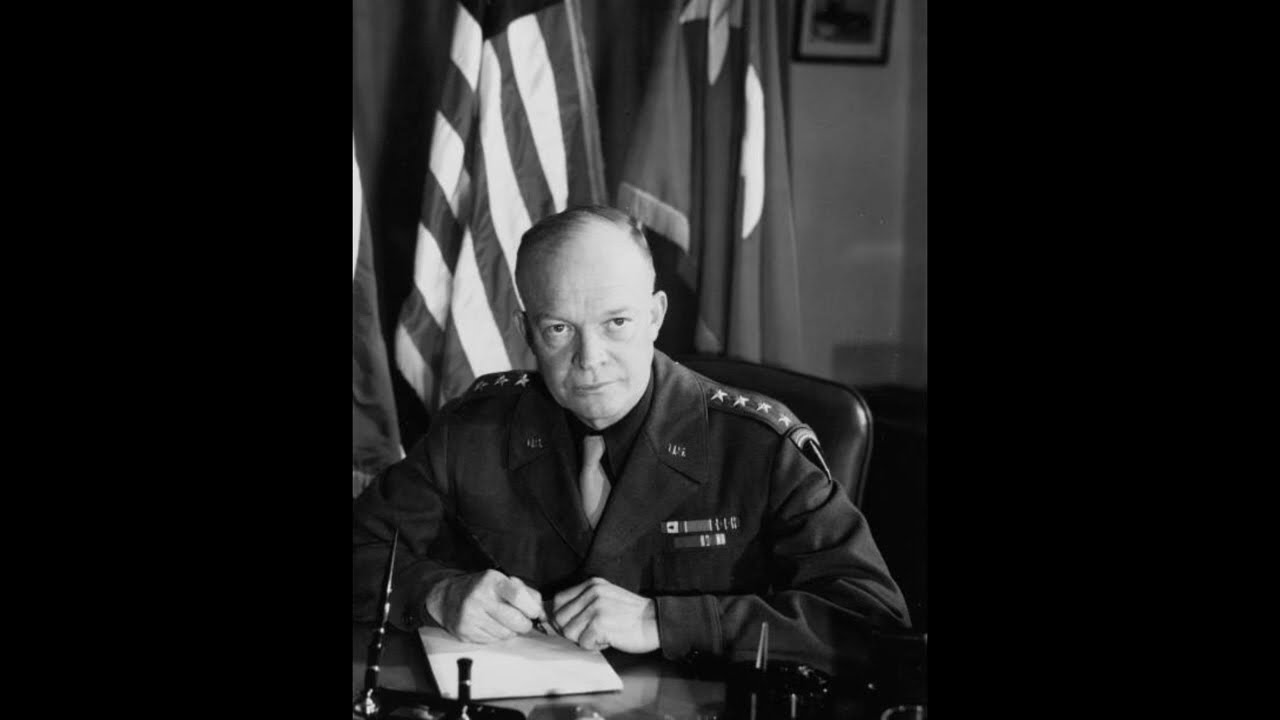 He explained that the current command structure had become unworkable. And then he wrote the ultimatum that would change history. He stated clearly that if Montgomery’s attitude did not change, or if he was not removed, he, Eisenhower, would resign.
The equation was simple. It is him or me.
This was not a bluff. Eisenhower was offering the combined chiefs of staff a choice between the supreme commander of all Allied forces or a difficult field marshal. He showed the draft to Montgomery’s chief of staff, Freddie de Guingand.
When de Guingand read the words, the blood drained from his face. He looked at the paper, then at Eisenhower, and realized the terrifying truth. Eisenhower wasn’t asking for an apology.
He was preparing to fire the most famous general in the British Empire. The order was ready to be sent. De Guingand rushed out of the office and drove through a blizzard to reach Montgomery’s tactical headquarters.
When he arrived, Monty was as cheerful as ever, completely unaware of the storm he had created. De Guingand didn’t waste time. He slammed his hand on the table and told Monty to stop talking.
“Ike is going to fire you,” de Guingand said. “And he has the full support of Washington and London.” For a moment, Monty laughed.
He couldn’t believe it. “Ike wouldn’t do that,” he said. “He needs me.”
De Guingand shook his head and described the letter. He described the look in Eisenhower’s eyes. He told Monty that even Winston Churchill could not save him this time.
The reality hit Montgomery like a physical blow. The smirk vanished. He slumped into his chair, looking suddenly small and old.
For the first time in the war, the great Field Marshal was terrified. He realized he had miscalculated everything. He wasn’t dealing with a weak politician.
He was dealing with the most powerful man in the western world, and he had pushed him one step too far. The silence in the trailer was absolute. The indispensable man was about to be discarded.
Why did it come to this? The conflict wasn’t just about egos. It was about the shifting tectonic plates of the war.
In 1942, Britain was the senior partner, providing the experience and the bases. But by 1945, the United States was providing 80% of the men, 90% of the equipment, and almost all the oil. Montgomery was fighting a 1942 war in a 1945 reality.
He failed to understand that the Supreme Command was a political entity as much as a military one. Eisenhower’s job was to keep the alliance together. By humiliating the US Army publicly, Monty didn’t just insult soldiers.
He threatened the political stability of the coalition. He forced Eisenhower to choose between his own army and his British ally. And when forced to choose, Eisenhower chose his own men.
It was a failure of emotional intelligence.
Monty treated war as a game of chess where only the moves mattered. Eisenhower treated war as a human endeavor where morale and trust were the ammunition. Monty could move the pieces, but he had forgotten that he didn’t own the board.
And the board was about to be flipped. The next morning, a letter arrived on Eisenhower’s desk. It was written in Montgomery’s hand.
It was not arrogant. It was not demanding. It was a total, unconditional surrender.
“Dear Ike,” it read, “I am distressed that my note may have upset you. I am your very devoted subordinate.” He promised to do whatever Eisenhower wanted.
He signed it, “Your very devoted servant, Monty.” It was the most humiliating moment of Montgomery’s life. He had to beg for his job.
 Eisenhower read the letter. He didn’t gloat. He didn’t celebrate.
He simply nodded, took the firing order he had drafted, and placed it in his secret file.
He sent a reply, accepting the apology, but the tone was cool, professional, and distant. The crisis was averted. The press was told that all was well.
The alliance held, but the friendship was dead. Eisenhower never trusted Montgomery again. The relationship became purely functional.
From that day forward, Eisenhower leaned more heavily on Omar Bradley, giving the Americans the lead in the final race into Germany. When the Rhine crossing came, Eisenhower let the Americans take the glory, leaving Monty to stage his own elaborate crossing that mattered little to the strategic outcome. The “shut up or get out” moment also cemented American dominance in the post-war world.
It was the moment the baton passed definitively from the British Empire to the United States. Churchill knew it. He privately told his staff that Monty had nearly wrecked everything.
In the history books, they stood side by side on Victory Day. But in the private corridors of power, Montgomery was isolated. He had won his battles, but he had lost the respect of the men who mattered.
He remained a hero to the British public, but to the Allied high command, he was a liability that had been neutralized. He kept his stars, but he lost his voice. History often remembers the Battle of the Bulge for the tanks and the snow.
But the most dangerous battle was fought with a pen in a warm office. Eisenhower’s victory over Montgomery was not a tactical one. It was a victory of character over ego.
It reminds us that in the high-stakes world of global warfare, brilliance is not enough. You can be a tactical genius, you can be a national hero, but if you cannot respect the men bleeding beside you, you are useless.
Montgomery thought he was bigger than the war. Eisenhower showed him that no man is bigger than the mission. That day, the alliance was saved not by a cannon, but by an ultimatum.
The reverberations of that single document were felt for decades. It signaled the end of an era where British generals could dictate terms to their American counterparts. It was the final nail in the coffin of the old world order.
The United States was no longer a junior partner to be patronized. It was the dominant power, and it would not be disrespected. Montgomery’s fall from grace was swift and absolute.
He spent the rest of the war as a ghost in the command structure, present but ignored. His plans were shelved. His advice was dismissed.
He was a hero without a stage.
The irony is that Montgomery was right about one thing. He had stabilized the northern front. His tactical intervention had been crucial in blunting the German offensive.
But he was so toxic, so arrogant, that his success could not be acknowledged. He had made himself the enemy of the very men he needed to work with. The lesson of January 1945 is not about military strategy.
It is about the fragility of power. It is about the danger of believing your own press. Montgomery believed the headlines.
He believed the myth of his own indispensability. He forgot that alliances are built on trust, not genius. He forgot that a leader who cannot inspire loyalty is just a manager of resources.
Eisenhower, by contrast, understood that the ultimate weapon was unity. He was willing to sacrifice his own career to preserve that unity. And in doing so, he secured his legacy as the man who won the war not by force of arms, but by force of will.
The document that nearly fired Montgomery remains one of the most explosive artifacts of the Second World War. It was never sent. It sits in an archive, a testament to a moment when the entire Allied cause hung in the balance.
It is a reminder that the greatest battles are often fought in silence, in the space between two men who hold the fate of millions in their hands. Eisenhower’s pen was mightier than any sword. It cut through the fog of ego and arrogance, and it saved the alliance from self-destruction.
Montgomery spent the rest of his life trying to rewrite the narrative, but the truth was etched in that cold, precise cable. He was a great soldier, but he was a terrible ally. And in the end, that was all that mattered.






