The winter fog of Versailles clung to the palace gardens like a shroud, muffling the world outside Supreme Headquarters, Allied Expeditionary Force. Inside Room 24, the air was thick with the acrid smell of burnt tobacco and the weight of a war that refused to end by Christmas. General Dwight D.
Eisenhower sat alone, the glow of a single desk lamp casting long shadows across the maps that papered every wall. He was reading the latest G-2 intelligence summary, a compilation of interrogated German prisoners and intercepted communications, when his eyes froze on a single, damning line. All Panzer reserves positioned against Patton’s probable axis of advance.
 Montgomery’s front considered secondary threat. He read it again, the words burning into his consciousness, and then a third time, as if repetition could somehow alter their meaning.
The Supreme Commander of the largest Allied force ever assembled, a man commanding over four and a half million men across a thousand-mile front, leaned back in his chair. He removed his reading glasses, the gesture slow and deliberate, and stared at the ceiling as if seeking an answer in the cracked plaster. The intelligence was unambiguous.
The entire strategic calculus of the German High Command, their allocation of scarce armored divisions, their desperate defensive preparations, was not predicated on where the Allies were strongest, but on the primal, paralyzing fear of one unpredictable American general. Eisenhower stubbed out his cigarette, the ember dying with a hiss, and reached for the phone. The conversation that followed, quiet, tense, and devastating, would expose a truth the Allied public was never meant to hear, a truth that would quietly reshape the final six months of the war in Europe.
The office was a testament to the immense pressure of his position. Ashtrays overflowed on the mahogany desk, a physical manifestation of the chain-smoking that never ceased. Maps covered every available inch of wall space, their colored pins and arrows telling competing stories of the campaign.
Montgomery’s blue arrows in the north showed the grim reality of Operation Market Garden, stalled in the Dutch mud, a bold gambit that had failed to secure the bridge at Arnhem. Patton’s arrows in Lorraine, however, pushed forward relentlessly, despite being denied the fuel he screamed for daily. The political mathematics of the alliance exhausted Eisenhower more than any military calculation.
Churchill cabled constantly, pressuring him to favor British commanders, while American newspapers demanded Patton receive priority. He needed both men, Montgomery for his methodical planning and set-piece battles that minimized casualties, and Patton for his aggressive exploitation that kept the Germans off balance. But the friction between them was a constant drain, poisoning every command meeting with unspoken rivalry.
Eisenhower lit another cigarette, watching the smoke curl toward the ceiling, a ghostly echo of his own troubled thoughts. The stress was etched into the lines around his eyes, visible in the curt tone of his recent memos. But something else troubled him tonight, a pattern emerging in the intelligence reports that did not match the command structure he had so carefully built.
Since El Alamein in 1942, Montgomery had worn invincibility like the two badges on his beret. He was the careful planner who never lost, the master of the set-piece battle who had defeated Rommel in the desert. Eisenhower had deferred to this reputation, assigning him the main northern thrust toward the Ruhr, the industrial heart of Germany, and providing the bulk of Allied logistics to support it.
In staff meetings, British liaison officers presented Montgomery’s plans with reverence, emphasizing his methodical brilliance and his refusal to attack until conditions were perfect.
The fluorescent lights hummed overhead during those briefings, casting a sterile glow on maps that promised steady, unstoppable progress. Fuel allocations favored the 21st Army Group, supply priorities went north, and Eisenhower approved it all, trusting the mythology that had conquered North Africa and broken through Normandy. But in the back of his mind, quiet doubts were accumulating.
Market Garden had failed spectacularly in September. Antwerp had taken weeks longer to clear than promised. The northern advance moved with a caution that felt more bureaucratic than strategic.
Eisenhower said nothing publicly, as questioning Montgomery meant angering Churchill and destabilizing Allied unity. Yet the dissonance grew, fed by numbers that did not add up and intelligence reports that told a different story than the one he had been believing.
By late November, the G-2 intelligence section at Versailles began compiling reports that defied Allied assumptions. Ultra decrypts, the precious intercepts of German military communications, revealed Wehrmacht field commanders obsessed with Patton’s probable breakthrough sector. The pattern became impossible to ignore.
German situation reports referred to Patton even when he held a smaller front with fewer divisions than Montgomery. Colonel Benjamin Monk Dickson, Patton’s own intelligence chief, sent summaries to SHAEF noting that captured German maps marked Third Army positions with red danger zone annotations, while Montgomery’s entire army group received standard defensive markings. Eisenhower read these reports at his desk after midnight, his coffee gone cold, circling phrases in red pen and underlining Patton’s name three times.
Wehrmacht Panzer reserves, the mobile armored fist that could decide battles, were consistently positioned opposite Patton’s front, not Montgomery’s.
The intelligence analysts presented it as a curiosity, not a conclusion. But Eisenhower saw what they were documenting, the enemy’s fear. Not respect, not caution, but pure, unadulterated fear.
 The kind that makes you hold back your best troops, that makes you refuse to commit reserves elsewhere because you are certain Patton will exploit any weakness the moment you turn your back. He set the file aside, not yet ready to question the mythology he had invested months defending, but unable to ignore the data accumulating with every new intercept. On December 10th, 1944, an interrogation facility behind Allied lines yielded an admission that stopped the room cold.
A captured Oberst from the Fifth Panzer Army sat across from American intelligence officers and stated, We know Montgomery will come. We can prepare defenses, calculate his build-up, position our forces. Patton, we never know where Patton will strike, so we must hold everything in reserve.
The transcript reached Eisenhower’s desk that evening, stamped confidential in red ink. A handwritten note from Bedell Smith was paper-clipped to the front, reading, This matches 17 other interrogation summaries since October. Eisenhower read it once, then again, the winter cold seeping through the palace walls as the weight of the revelation settled over him.
That same week, German Field Marshal Gerd von Rundstedt’s operational orders were intercepted. The language was explicit, almost desperate. All available armor must remain mobile to counter Patton’s exploitation operations.
Montgomery’s front can be held with fixed defenses and static infantry divisions. Eisenhower stood at his office window after midnight, hands clasped behind his back, watching snow fall silently on the palace courtyard. The illusion he had maintained for months dissolved in that silence.
Not that Montgomery was incompetent, but that the enemy did not fear him the way they feared Patton. The Germans respected Montgomery enough to build defenses. They feared Patton enough to refuse committing reserves anywhere else.
On December 11th, Eisenhower ordered his operations staff to compile a comprehensive analysis of where German Panzer and mechanized divisions were actually positioned along the Western Front. The order was quiet, almost casual, but everyone in the room understood what was being asked. The resulting maps, laid out on the massive table in the SHAEF war room, told an undeniable story.
Against Montgomery’s 21st Army Group, comprising 33 full divisions with overwhelming logistics and clear priority, the Wehrmacht positioned six panzer divisions in static prepared defenses. Against Patton’s Third Army, a force of only 12 divisions, constantly fuel-starved and operating as a supporting effort, the Germans had positioned 11 panzer divisions, plus all mobile reserves within 48 hours striking distance. The mathematical disparity stunned the room into silence.
Patton faced nearly double the armored opposition with a third of Montgomery’s strength, yet Third Army still advanced faster and penetrated deeper.
Eisenhower traced the red enemy unit markers with his finger, each one representing thousands of German soldiers and hundreds of tanks, entire formations positioned not where Allied strength was greatest, but where German fear was greatest. The numbers screamed what the mythology had been hiding for months. In that moment, standing among his silent staff in the war room, Eisenhower realized he had been fighting the wrong war.
He had been allocating resources to satisfy Allied politics and command structure, while the enemy allocated resources based on psychology and terror. And in war, the enemy’s decisions matter more than your plans. At 21:40 hours, back in Room 24, away from the operations center, Eisenhower summoned General Walter Bedell Smith, his chief of staff, his confessor, the only man who could hear the truth without it leaking to Churchill or Marshall or the press.
Smith entered to find Eisenhower standing at the window, hands in his pockets, staring at nothing. The room was cold, a single desk lamp providing the only light. Without turning, Eisenhower asked, Beetle, I need you to tell me the truth.
When you read those German intercepts, what do you actually see? Smith hesitated, then replied, They’re positioning for Patton, sir. They’ve been positioning for Patton since September.
Eisenhower turned, his face drawn and exhausted, cigarette ash spilling onto the carpet. He stated, They’re not afraid of Monty. They respect him.
They plan for him. But they’re not afraid of him. Patton.
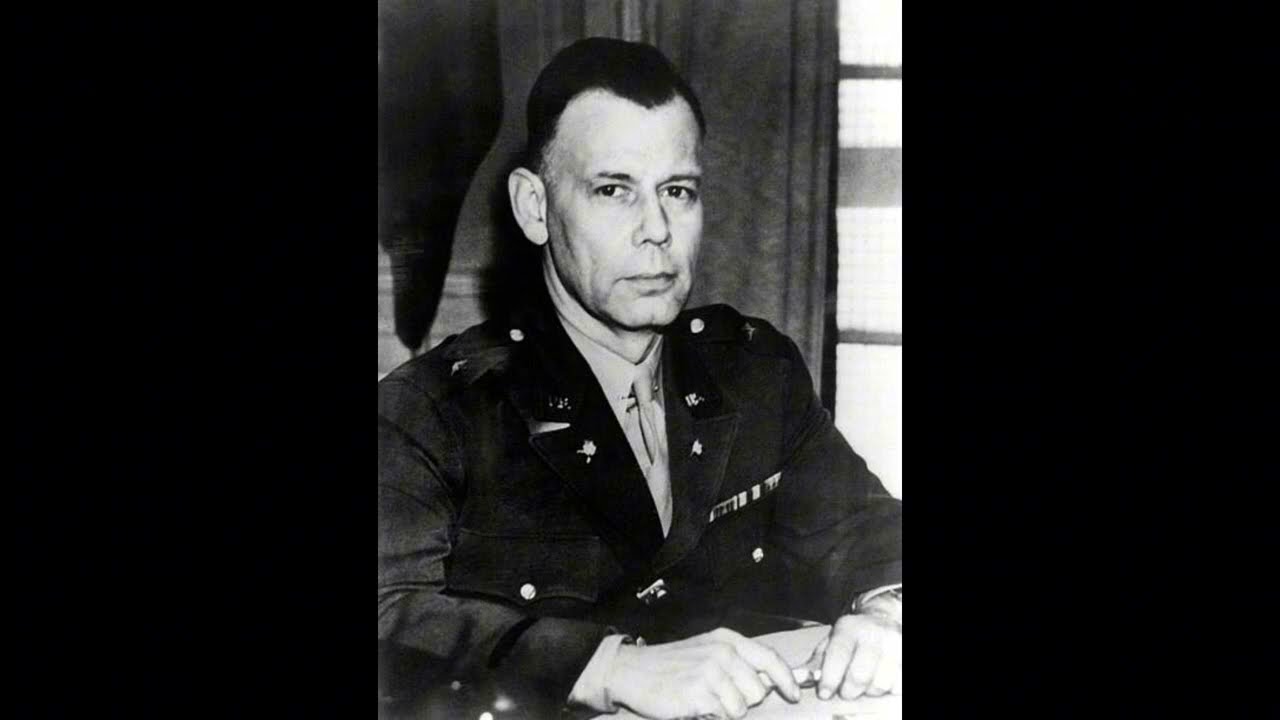 They’re terrified he’ll do something they can’t predict, can’t contain, can’t stop once it starts. The words hung in the room like gunsmoke after a firing. Smith nodded slowly, acknowledging, That’s what the data says, sir.
Eisenhower walked to his desk, picked up the intelligence file with both hands, and his voice dropped to barely above a whisper. Then Patton’s worth more to us scaring them than Montgomery is beating them. And I’ve been running this war backwards.
He set the file down and looked at Smith, the weight of six months of misallocated resources, political compromises, and mythology over mathematics settling between them like a third presence in the room. Outside, the palace clock tower chimed ten times, marking the moment when Allied command philosophy shifted from mythology to psychology, from politics to enemy perception, from what made Churchill happy to what made German generals lose sleep. In the 48 hours following that conversation, Eisenhower’s decisions shifted in ways only his inner staff noticed.
He drafted a carefully worded memo to General Marshall in Washington explaining that Third Army’s aggressive operational posture created disproportionate German defensive commitments that should be exploited as psychological leverage. He quietly redirected fuel allocations, not dramatically, as that would trigger political firestorms, but enough that Patton’s staff noticed increased supply flow starting December 13th. When Montgomery requested priority for his next northern offensive, Eisenhower’s response was measured, almost cautious, asking for revised timelines and questioning whether German reserves were actually committing to that sector.
Around SHAEF headquarters, senior staff noticed the change in tone during briefings. There was less automatic deference to Montgomery’s methodical plans and more questions about where German strength was concentrating versus where Allied politics demanded action. Bedell Smith began framing operational discussions around enemy force disposition rather than Allied offensive priorities, subtly reorienting the command group’s thinking without explicitly overturning established command relationships.
But Eisenhower said nothing publicly. Admitting Patton’s psychological value would inflame the Montgomery-Patton rivalry, infuriate Churchill, and create headlines questioning Allied unity at the moment unity mattered most. So the shift remained quiet, internal, visible only in fuel tonnages and operational approvals that subtly changed without formal announcements.
Yet everyone close to the Supreme Commander felt it, the mythology cracking, replaced by something harder and more ruthless.
In a classified assessment Eisenhower drafted for his personal files, never circulated or discussed in meetings, he articulated why Patton generated more German fear than Montgomery commanded German respect. The analysis was clinical, almost cold, stripping away personality and focusing purely on operational psychology. Montgomery telegraphed his intentions weeks in advance through massive supply buildups, methodical preparations, and public statements about not attacking until conditions were perfect.
German intelligence tracked every supply convoy, calculated the buildup schedule, and prepared layered defenses accordingly. Wehrmacht commanders could read Montgomery like sheet music, predictable tempo, known rhythm, prepared crescendos. Patton, however, operated on improvisation and exploitation.
He struck before enemy forces consolidated. He changed objectives mid-operation based on opportunity rather than plan. He pushed exhausted units beyond what German staff officers, trained in Prussian military doctrine, considered tactically sustainable.
His logistics were perpetually inadequate by textbook standards, yet he advanced anyway, living off captured supplies and accepting risks that violated every principle of conventional warfare.
Wehrmacht commanders could not compute this. They were trained to calculate logistics ratios, defensive frontages, and reserve positioning based on predictable enemy behavior. Patton’s behavior was not predictable.
It was instinctive, opportunistic, willing to gamble on chaos. Captured documents revealed German units opposite Third Army received standing orders to maintain mobile reserves at all times and prepare for exploitation in any direction, effectively pinning down entire divisions that could reinforce other sectors. In his private notes, locked in the safe in Room 24, Eisenhower wrote one line that captured everything.
Patton’s value isn’t in the ground he takes. It’s in the ground the Germans won’t leave because they’re afraid he’ll take it. The page sat in darkness, too politically sensitive to share, too strategically important to ignore.
Four days after Eisenhower’s realization, the Germans launched their surprise offensive through the Ardennes, the Battle of the Bulge.
 On December 16th, Wehrmacht armored spearheads smashed through American lines in Belgium, creating chaos and threatening to split the Allied front. But Eisenhower’s new understanding proved critical. While other commanders scrambled to understand the German objective, Eisenhower immediately ordered Patton to disengage Third Army from the Saar offensive, wheel 90 degrees north, and strike the German southern flank.
It was an audacious maneuver, redeploying an entire army over 100 miles in winter conditions, attacking into a fluid battle with minimal preparation. Patton accomplished it in 48 hours. German planners had assumed it would take a week minimum, time enough to consolidate their gains and prepare defenses.
Instead, Third Army hit the southern shoulder of the bulge on December 22nd, six days after the offensive began, catching Wehrmacht forces still extended and vulnerable. German commanders panicked. Intercepted communications showed Rundstedt screaming for reserves to block Patton’s breakthrough sector, even though Montgomery’s larger forces in the north were closer to the critical German supply lines at St.
Vith.
The entire southern shoulder collapsed not because Patton’s divisions were larger or better equipped, but because the Germans committed disproportionate strength trying to contain him, reserves they desperately needed elsewhere. In the SHAEF war room, watching blue pins advance where German panic created opportunity, Eisenhower saw his December 12th insight validated in real time. He did not gloat or explain to his staff why he knew Patton’s movement would trigger German overreaction beyond rational calculation.
He simply smoked his cigarette, studied the map, and made a mental note that psychological warfare shaped operational reality more than any logistics chart could ever predict. Through the winter and spring of 1945, Eisenhower leveraged Patton’s psychological impact with increasing sophistication. He allowed Third Army to make ostentatious preparations for Rhine crossings that drew German reserves south, then executed Montgomery’s actual crossing at Wesel with significantly reduced opposition.
He used Third Army reconnaissance as strategic bait, pushing aggressive patrols forward in sectors where he wanted Germans to commit strength, effectively turning Patton into a mobile deception asset.
The Wehrmacht, conditioned by months of fearing Patton’s exploitation operations, fell for it repeatedly, shifting reserves to block Patton’s probable axis of advance, while Hodges’ First Army or Patches’ Seventh Army advanced through weakened sectors elsewhere. By April, German situation maps captured in collapsed headquarters showed Patton’s position circled in red ink, annotated with Hauptgefahr, main threat, even when Third Army operated as a supporting effort rather than the main attack. The German obsession with Patton had become strategic paralysis, forcing them to maintain mobile reserves against contingencies rather than committing forces where battles were actually being fought.
Eisenhower never publicly explained this dynamic. After the war, military historians credited Montgomery’s Rhine crossing at Wesel, the Ruhr encirclement, and the methodical campaigns that fit conventional military theory. Patton’s role as strategic scarecrow, the general whose reputation pinned down German reserves more effectively than actual combat, remained buried in classified intelligence files.
In his private memoirs years later, Eisenhower wrote one cryptic line about the dynamic. Sometimes the greatest contribution a commander makes is not what he captures, but what he forces the enemy to defend. The palace lights at Versailles went dark in May 1945, and with them the secret of how psychological warfare shaped the final campaign more than firepower, logistics, or any battle plan Eisenhower’s staff ever drafted.
Decades passed. Historians celebrated Montgomery as the master planner, cautious, methodical, the general who never lost. They portrayed Patton as the aggressive cowboy, brilliant but reckless, effective but undisciplined.
The intelligence files showing which general the enemy actually feared remained locked in military archives, declassified only after everyone involved was dead. Eisenhower took the secret to his grave in 1969, never publicly admitting that German psychology shaped his command decisions as profoundly as Allied strength. To do so would diminish Montgomery, anger Britain, and complicate the clean narrative of Allied unity that served post-war politics better than uncomfortable truths about fear and perception.
But the pattern remains undeniable in those dusty files. Wehrmacht commanders positioned their best divisions against Patton, redirected reserves to block his probable breakthroughs, and sacrificed operational flexibility because they could not stop imagining what he might do next. The lesson Eisenhower learned that December night in Room 24, that enemy perception matters more than friendly strength, that fear is as decisive as firepower, that the mythology you create in the enemy’s mind can win battles you never have to fight, never made it into command manuals or staff college curricula.
The war ended with parades and medals. Montgomery was knighted. Patton died in a jeep accident nine months after Germany surrendered.
Eisenhower became president on a record that never mentioned how he weaponized one general’s reputation against the enemy’s nerve. In the end, the most effective strategy remained the least discussed, buried beneath decades of public mythology that served political purposes better than historical accuracy. Sometimes the truth costs more than wars.






