The air in the Third Army headquarters in occupied Germany was thick with tension, a palpable charge that even the most hardened staff officers found difficult to ignore. The date was March 1945, and the war in Europe was in its final, brutal throes, but the battle being prepared in this commandeered mansion was not against the Wehrmacht. It was a battle of perception, a confrontation with the very arrogance that had fueled the Nazi war machine, and it was about to be waged by one of the most volatile and brilliant commanders in American history, General George S.
Patton.
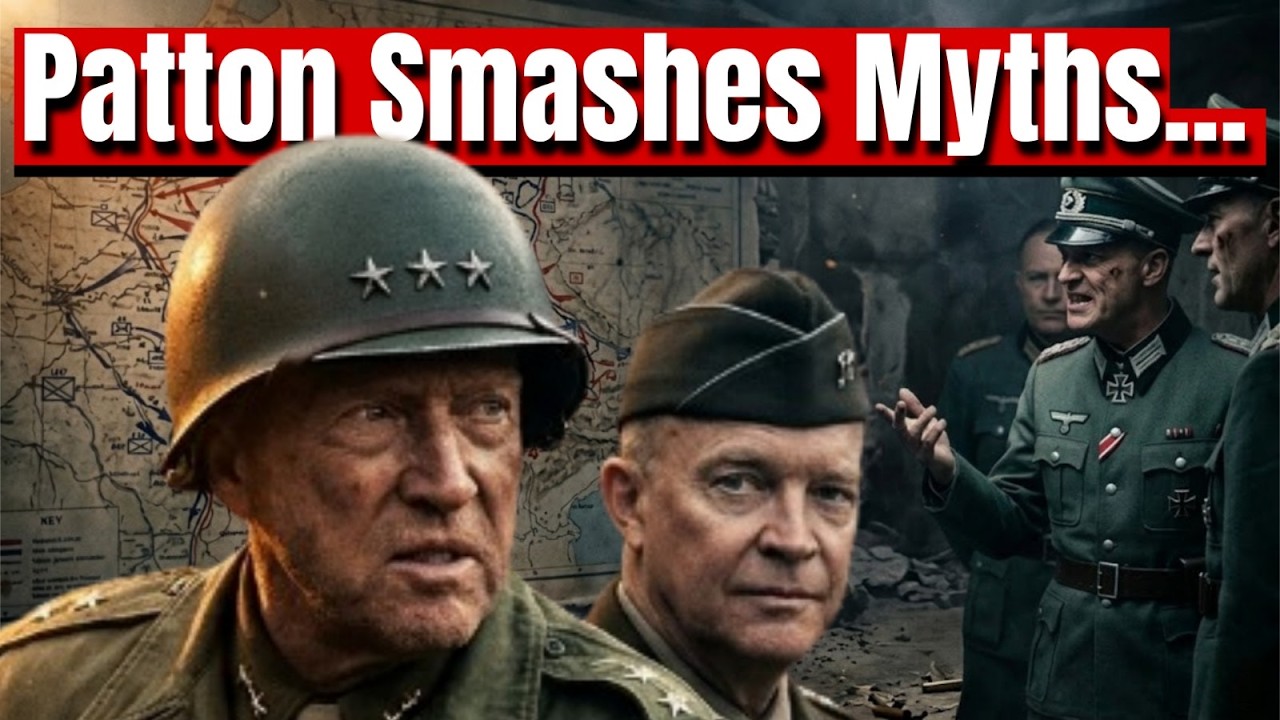 The catalyst for this impending storm was a report delivered to Patton just hours earlier, a report that detailed a scathing critique of the American high command made by a captured German general. Generalmajor Kurt Steiner, a decorated veteran of both the Eastern and Western fronts, had used his interrogation as a platform to insult the very foundations of Allied leadership. He had called Supreme Allied Commander Dwight D.
Eisenhower a “desk general” and a “politician in uniform,” and had dismissed General Douglas MacArthur in the Pacific as a “peacock” who posed for photographers from miles behind the lines. The only American he deemed worthy of the title “general” was Patton himself, a backhanded compliment designed to sow discord and elevate the German military tradition above all others.
Patton had listened to the communications officer’s report in complete silence, his face an unreadable mask. The silence stretched for what felt like an eternity, a period of intense calculation that every man in the room knew preceded something significant. When he finally spoke, his voice was low and measured, asking for confirmation of the German’s specific words.
He wanted to be absolutely certain that Steiner had, in his attempt to praise Patton, insulted his fellow American commanders. Upon confirmation, a slow, predatory smile spread across Patton’s face. It was not a smile of amusement, but the chilling grin of a hunter who has just cornered his prey.
“General Major Steiner thinks he’s paying me a compliment while insulting my colleagues,” Patton said, his voice dripping with controlled contempt. “He thinks he’s being clever driving a wedge between American generals by praising one at the expense of others. What he doesn’t understand is that American generals, real American generals, don’t operate on the German model.
We work as a team. And if General Major Steiner can’t understand that, then I’m going to have to educate him.”
The order was issued with the precision of a military directive. Steiner and his two fellow officers were to be transported to Third Army headquarters within 24 hours. Patton was going to give them a personal master class in why the American system of command, the very system they mocked, was superior to the German model of frontline heroics.
This was not about ego, though Patton had plenty of that. This was about loyalty. Patton and Eisenhower had a famously contentious relationship, often clashing over strategy and pace.
But the bond between them, forged in the crucible of war, was unbreakable. An enemy general insulting his commander was an insult Patton could not and would not tolerate.
The next morning, the German officers were brought into a large conference room in the commandeered mansion. Patton was waiting, surrounded by a dozen of his staff officers, a stenographer to record every word, and a large map table displaying both the European and Pacific theaters of operation. He let the Germans stand in silence for five full minutes, a deliberate tactic to establish dominance and unsettle them before a single word was spoken.
When he finally looked up, his ice-blue eyes fixed on Steiner with an intensity that had unnerved far more confident men. “General Major Steiner,” Patton began, his voice smooth as Tennessee whiskey but with a bite like broken glass, “I understand you have some opinions about American generalship. Specifically, you seem to think that General Eisenhower and General MacArthur are what you called desk generals, politicians in uniform who don’t understand real combat.
Is that an accurate summary of your statement?”
Steiner, still clinging to his arrogance despite his captivity, nodded. “It is an objective military assessment, General Patton. No disrespect to you personally, but your supreme commander has never led troops in combat.
He’s an administrator, a coordinator. In the German military, such a man would never achieve supreme command.” Patton nodded slowly, as if seriously considering the perspective, before gesturing for the Germans to join him at the map table.
“Come here, General Major. I’m going to give you gentlemen a free education in why you lost this war. And it has everything to do with your fundamental misunderstanding of what generalship actually means in modern warfare.”
Patton’s finger traced the massive scope of Allied operations on the map of Europe, from North Africa through Sicily, Italy, Normandy, and deep into Germany itself. He pointed out that this represented the largest amphibious invasion in human history, followed by the coordination of millions of men, thousands of aircraft, naval vessels, and supply chains stretching across an ocean. “And you know who planned and coordinated all of that?
The desk general, Dwight D. Eisenhower.” Patton’s voice took on a hard edge as he explained that wars at this scale are not won by individual heroics, but by logistics, coordination, alliance management, and strategic vision.
He detailed how Eisenhower managed coalition warfare, keeping Americans, British, Canadians, French, and a dozen other nationalities working together toward common objectives, a task of immense difficulty that involved balancing competing national interests and managing egos the size of mountains, including his own.
 Patton then pivoted to dismantle the German “warrior general” model, pointing to the fates of Rommel, Manstein, and Guderian. “You had Rommel, brilliant tactical commander, who won impressive victories in North Africa. And where did that get Germany?
Defeated in Africa. You had Manstein, tactical genius on the Eastern Front, still lost in the East. You had Guderian, pioneer of panzer warfare, and yet here you are, defeated, occupied, your country in ruins.
You know why? Because your system promotes generals who are great at winning battles, but terrible at winning wars.” The words landed like a hammer blow, and for the first time, a crack appeared in Steiner’s arrogant facade.
Patton pressed the advantage, explaining that the German focus on tactical brilliance and personal glory came at the expense of the strategic and logistical systems needed to win a modern industrial war. He contrasted this with Eisenhower, who had built the most effective military supply chain in human history and coordinated air and ground operations across multiple theaters.
Moving to the Pacific theater map, Patton addressed the insult to MacArthur. He described how MacArthur had coordinated island-hopping campaigns across thousands of miles of ocean, managed combined Army-Navy operations in the most difficult terrain imaginable, and was systematically destroying the Japanese Empire with a fraction of the resources allocated to Europe. “MacArthur doesn’t lead from the front, because that’s not where he’s most effective.
He’s most effective coordinating carrier groups, planning multi-stage amphibious assaults, and managing theater-wide strategy. That’s not a weakness, General Major. That’s understanding where a senior commander adds the most value.
Something your German generals apparently never figured out.”
Patton then delivered the knockout punch, pulling out a folder with statistics. He detailed how, in just four years of active fighting, the American “desk generals” had coordinated operations resulting in the complete defeat of Italy, the liberation of France, the destruction of German military power in the West, and the near-total annihilation of Japanese naval and air forces in the Pacific. He contrasted this with the German record since 1939, which had resulted in defeat on every front and the destruction of their own country.
He cited the Allied supply chain, which moved more tonnage in a single month than the entire German logistics system moved in a year, and the superior coordination between air and ground forces that made German troops afraid to move in daylight. “This isn’t luck, General Major. This is the result of having desk generals who understand modern warfare better than your warrior generals ever did.”
The German officers were pale, their confidence shattered. But Patton was not finished. He was about to make a point about American military culture that would hit even harder.
“Here’s what you fundamentally misunderstand about American generalship. And it’s the same thing every European military has misunderstood about America since 1776. You think warfare is about individual heroism, personal glory, and warrior traditions.
We think warfare is about solving problems efficiently and going home. You build your military around creating legends. We build our military around winning and getting it over with.”
He leaned forward, his voice intense, explaining that Eisenhower didn’t need to lead from the front to prove his courage, as he had proven his value by planning and executing the most complex military operation in history. He argued that MacArthur didn’t need to storm beaches personally to demonstrate leadership, as he demonstrated it by out-thinking his enemies and achieving objectives with minimal casualties. “That’s not being a desk general.
That’s being a smart general. And smart beats heroic every single time.”
Patton stood up straight, his voice taking on a note of something almost like pity. He explained that the German generals were so in love with their warrior mythology that they forgot the actual objective of war, which is winning it. He pointed out that they got their men killed by the millions in heroic last stands and brilliant tactical retreats, while American desk generals figured out how to win battles without unnecessary casualties, how to use industrial capacity as a weapon, and how to coordinate multinational forces toward strategic objectives.
“And that’s why I’m standing here in a nice German mansion and you’re standing there as a prisoner.” He then delivered the final blow, addressing Steiner’s compliment directly. “You said I was the only real American general because I lead from the front, because I fit your idea of what a general should be.
But here’s the truth, General Major. I’m effective because I have desk generals like Eisenhower handling the strategic and logistical complexity that I don’t have the patience for. Ike lets me do what I do best, drive my army forward, because he’s handling everything else.
 That’s not a weakness. That’s a perfect division of labor.”
Patton explained that he didn’t want Eisenhower’s job and would be terrible at it, but that Ike was brilliant at it, which freed Patton to be brilliant at what he did. “That’s how a mature military operates. You put people where they’re most effective, not where they look most heroic.
And the fact that you can’t understand that is exactly why Germany lost this war.” He turned to his staff and ordered the officers taken back to their holding facility, ensuring they received copies of the transcripts of the conversation so they could think about what was discussed. As the MPs prepared to escort them out, Steiner found his voice one more time, asking why Eisenhower held Patton back if he was such a brilliant strategic mind.
Patton laughed, a genuine, appreciative laugh. He explained that Eisenhower held him back not out of timidity, but because his job was to win the war, not individual battles. He cited specific examples, like being stopped from driving straight to Berlin to maintain the alliance with the Russians, and being stopped from outrunning his fuel supplies.
“He sees the whole board, not just one piece. And yeah, sometimes that pisses me off. Sometimes I argue with him.
Sometimes I think I know better. But you know what? More often than not, Ike’s right.
Because his job is strategic vision, and he’s damn good at it. That’s not being a desk general. That’s being the kind of general who actually wins World Wars.”
Patton pressed on, explaining the fundamental difference between the two military cultures. “Your system created brilliant tacticians who couldn’t see past the next battle. Our system created strategic thinkers who sometimes lose battles but always win wars.
Your generals were artists, dramatic, heroic, individually brilliant. Our generals are engineers, practical, systematic, focused on outcomes rather than glory. And in modern industrial warfare, engineers beat artists every single time.”
He gestured to his staff, stating that they were standing in Germany, Berlin was surrounded, and Japan was being systematically destroyed, proving that the American way was superior. He then delved deeper into Eisenhower’s career, highlighting his management of Operation Torch in North Africa, a diplomatic and military nightmare involving coordinating American, British, and Free French forces while negotiating with Vichy French commanders. “Could Rommel have done that?
Hell no. Rommel was a brilliant battlefield commander, but he had the political sophistication of a tank. Could any of your warrior generals have managed the alliance politics, the logistical complexity, the diplomatic finesse required for that operation?
Not a chance. Because your military culture doesn’t value those skills. You think they’re beneath real warriors.
And that blind spot is exactly why you lost.”
He moved to stand directly in front of the three German officers, his voice hardening as he spoke of MacArthur’s challenges in the Pacific, managing Australian sensitivities, coordinating with Navy commanders, and dealing with supply lines across thousands of miles of ocean. “That requires a completely different skill set than leading panzer divisions. And it’s just as important.
More important, actually. Because tactical brilliance means nothing if your strategic framework is flawed.” Steiner finally spoke up, his voice quieter now, stripped of its earlier arrogance.
“General Patton, are you saying that Germany lost because our generals were too focused on battlefield excellence and not enough on strategic coordination?” Patton nodded. “That’s exactly what I’m saying.
You had some of the best tactical commanders in the world. Rommel, Manstein, Guderian, all brilliant at what they did. But your system never developed the kind of strategic and logistical thinking that modern warfare requires.
 You were still fighting World War I with better tanks, while we completely reimagined what industrial warfare could be.”
Patton walked back to the map table one last time, pointing out the scale of Allied coordination from North Africa to Norway. “We’re managing supply chains that cross oceans. We’re integrating air power, naval power, and ground forces in ways that your general staff never even conceptualized.
And we’re doing it with a military that barely existed 5 years ago, led by generals who your professional officer corps dismissed as amateurs.” His voice hardened as he delivered the final lesson. “You called Eisenhower a desk general like it was an insult.
But desk work, logistics, coordination, alliance management, strategic planning, that’s what wins modern wars. Heroic cavalry charges and brilliant tactical maneuvers make for great stories, but they don’t defeat industrial powers. The system beats heroism.
Coordination beats individual brilliance. And strategic vision beats tactical genius. That’s the lesson of this war, General Major.
And you learned it the hard way.”
The room fell silent, the only sound the scratching of the stenographer’s pen. Steiner stood there, visibly processing the implications of everything he had heard, his entire understanding of military excellence being forcibly reconstructed. Patton’s final statement was delivered in a quieter voice, but it carried the weight of absolute certainty.
“When this war is over and you go home to Germany, you’re going to hear a lot of myths about why you lost. You’ll hear that it was because of Hitler’s incompetence, or because Germany was outnumbered, or because of betrayal from within. Those are comfortable lies that let you preserve your sense of military superiority.
But the truth is simpler and harder. You lost because American generals, including the desk generals you mock, were better at their jobs than German generals were at theirs. We out-thought you, out-organized you, out-coordinated you, and yes, we out-fought you.
Not because individual American soldiers were superior warriors, but because our entire system, from strategic planning to logistical support to alliance management, was superior to yours.”
As Steiner was being escorted out, he turned back one final time. “General Patton, may I ask one final question?” Patton nodded.
“You’ve earned the right.” Steiner asked, “If you could choose, would you rather be Eisenhower or yourself?” Patton didn’t hesitate.
“I’d rather be exactly who I am, doing exactly what I’m doing, supported by exactly the kind of desk general that Eisenhower is. Because together, we’re unbeatable. Separately, we’d both be less effective.
That’s what you Germans never understood. American strength comes from combining different talents, not from worshipping one model of leadership.” With that, Steiner was escorted out, leaving Patton alone with his staff.
One of his colonels spoke up, noting it was one hell of a defense of General Eisenhower. Patton smiled. “I may think Ike is too cautious sometimes, and I may argue with his decisions, and I may complain about being held back, but he’s my commander.
He’s my fellow American general. And I’ll be damned if I let some defeated German general talk about him. Ike’s doing his job brilliantly, even if it drives me crazy sometimes.
And that German needed to understand that before he spread his poison through the POW camps.”
The story of Patton’s defense of Eisenhower and MacArthur spread quickly through American forces and POW camps alike. German officers who had consoled themselves with myths of tactical superiority found those myths challenged by one of the few American generals they actually respected. And Eisenhower himself, when he heard about it, simply smiled and said, “George and I may fight like cats and dogs, but we’re both American cats and dogs.
Nobody else gets to criticize him, and apparently, nobody gets to criticize me, either.” The incident became a defining moment of the war, a testament to the unique strength of the American military command structure, which valued strategic coordination and teamwork over individual glory. It was a lesson delivered with Patton’s characteristic force and flair, a master class in leadership that would be remembered long after the guns fell silent, proving that the true strength of the American military lay not in any single warrior, but in the powerful, coordinated system of “desk generals” and frontline commanders working together to achieve a common goal.






