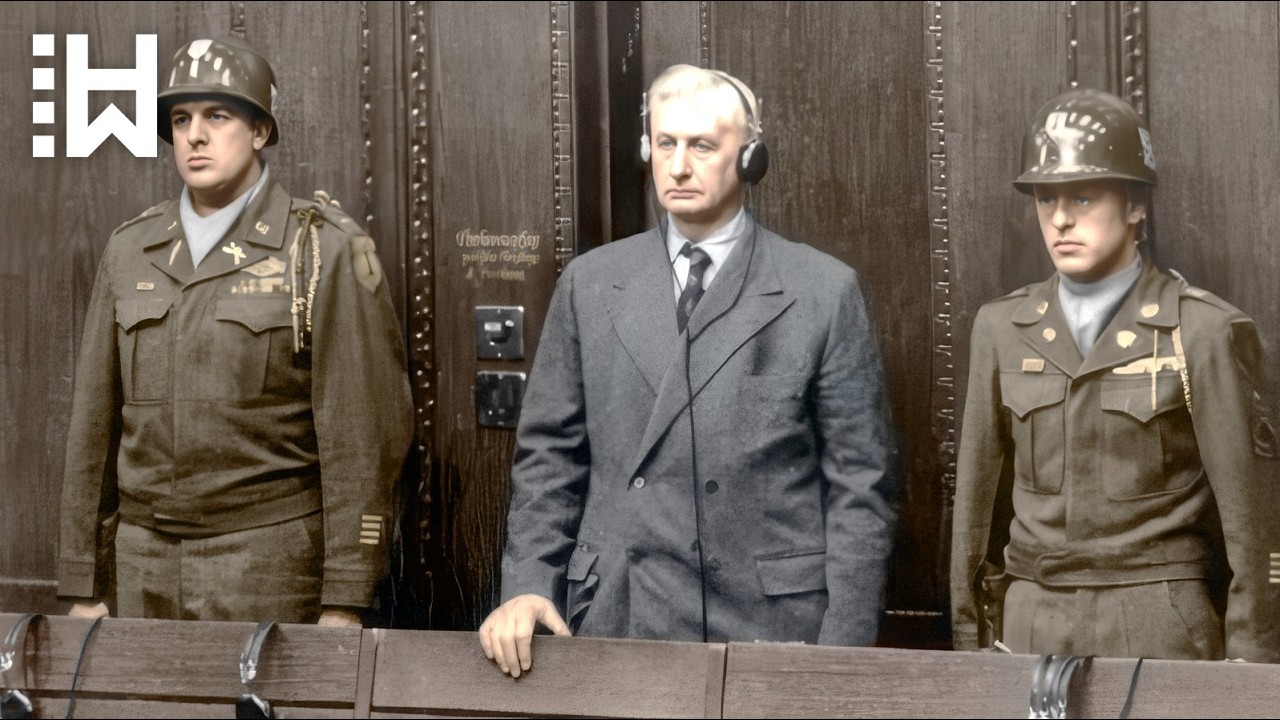
On the 22nd of December, 1947, Friedrich Flick stood before the International Military Tribunal in Nuremberg and heard the sentence that would decide the rest of his life. He was sixty-four years old, one of the richest men in Germany, and now a convicted war criminal. The tribunal found him guilty of war crimes and crimes against humanity, and sentenced him to seven years in prison.
Flick refused to accept it. He insisted, "Nothing will convince us that we are war criminals." But the verdict stood, and he was taken away to serve his time.
The question that hung over the proceedings, and that would follow him for the rest of his life, was how a man who had built one of the greatest industrial empires in the world had come to stand accused of some of the worst crimes in history.
Friedrich Flick was born on the 10th of July, 1883, in the town of Ansdorf, then part of the German Empire. After completing secondary school, he began a commercial apprenticeship at a steelworks known as the Bremmerhütte. He then performed his military service and went on to study at the Cologne School of Commerce.
From an early age, he showed a strong interest in business. Flick spent his time studying company balance sheets and became one of the first students to study not only business administration but also economics. Among his teachers was Eugen Schmalenbach, a leading figure in the field and the developer of dynamic balance theory.
After graduating in 1906 with a degree in business administration, Flick returned to the Bremmerhütte, where he began his professional career. In May 1913, he married Marie Schuss, and the marriage produced three sons.
Flick's rise began in 1915, when he became a board member at the Charlottenhütte Steel Works in the town of Niederschelden in West Germany, where he gradually acquired shares in the company. During the First World War, which lasted from July 1914 to November 1918, Friedrich Flick benefited greatly from the rapid expansion of the armaments industry. As demand for coal and steel surged, his company grew into a highly profitable enterprise.
The war created opportunities for industrialists who could supply raw materials essential for weapons production, and Flick positioned himself to take full advantage of this demand. By the end of the war, he had already laid the foundations of a growing industrial empire.
Flick became extremely wealthy under the Weimar Republic, which emerged after the fall of the German Empire in 1918. In this period of instability and economic uncertainty, he expanded aggressively, building major industrial concerns in the coal and steel sectors. Through acquisitions and strategic investments, he consolidated his position and became one of the wealthiest industrialists in Germany.
However, the Great Depression placed his business empire under severe strain. Many of his companies no longer paid dividends, and his financial situation became increasingly precarious.
In 1931, Flick managed to stabilize his position by selling majority shares of Gelsenkirchener Bergbau AG to the German government under Chancellor Heinrich Brüning at more than three times their market value. The deal, later known as the Gelsenberg affair, caused a public scandal, not only because of the inflated price, but also due to Flick's political donations to multiple parties, ranging from the Social Democratic Party to the National Socialists, to whom he donated significantly less money. Flick made large financial contributions to influential politicians, including Chancellor Heinrich Brüning.
Members of the government received a total of 450,000 Reichsmarks, an equivalent of 2. 5 million United States dollars today, to support Paul von Hindenburg's campaign in the 1932 presidential election.
In 1932, a pro-Nazi newspaper threatened, in reference to the Gelsenberg affair, that Flick would be expropriated after the party seized power. Flick then sought closer ties with the Nazi Party. In a meeting with Heinrich Himmler, head of the SS, Flick agreed that all future donations to the Nazi Party would go exclusively to the SS.
It is estimated that by 1945, he had contributed more than 7. 65 million Reichsmarks. It is believed that Flick's donations were less about bringing the Nazis to power and more about securing himself and his business interests against all possible outcomes.
On the 30th of January, 1933, Adolf Hitler was appointed Chancellor of Germany by President Paul von Hindenburg, bringing an end to German democracy. Guided by racist and authoritarian ideas, the Nazis abolished basic freedoms and sought to create a society united under one Führer. The Third Reich quickly became a police state, where individuals were subjected to arbitrary arrest and imprisonment.
Through propaganda, the regime won the support of millions, paving the way for persecution, war, and ultimately genocide. But this system did not function on ideology alone. It was sustained by industry, by production, and by men willing to profit from it.
From 1933 onward, Flick pushed aggressively into the armaments industry. He expanded production even before it was needed, aiming to pressure the military into using it. In February 1933, Flick attended a secret meeting with Adolf Hitler and leading industrialists, where Hitler outlined his policies and reassured them that property rights would remain intact.
Flick became a member of the so-called Circle of Friends linked to Heinrich Himmler. The group consisted of German industrialists whose aim was to strengthen ties between the Nazi Party and the industrial sector. Flick was also made a member of the Academy for German Law, an organization tasked with implementing the Nazi program in the fields of law and economics and funded by industrialists.

After the Nazis consolidated power, Flick quickly aligned his businesses with the regime's needs. His companies received contracts for aircraft production, bombs, grenades, and ammunition. Flick's businesses profited greatly from the process of Aryanization, under which Jews were forced to sell their businesses, often for a fraction of their value.
Flick formally joined the Nazi party on the 1st of May, 1937, and in 1938, he was named a military economic leader.
The Second World War started on the 1st of September, 1939, when Nazi Germany invaded Poland. Flick's enterprises played a key role in Nazi Germany's rearmament efforts. During the war, the number of forced laborers steadily increased.
By 1944, the Flick Group employed around 130,000 workers, about half of whom were forced laborers and concentration camp prisoners subjected to exploitation. In total, an estimated 80 to 100,000 forced laborers passed through his enterprises. Initially, like many companies, there was little interest in employing foreign workers.
This changed due to labor shortages from late 1939 onward. From 1942, the number of forced laborers became particularly high in the armaments and mining industries.
During the Second World War, tens of thousands of forced laborers, mainly from Eastern Europe, as well as concentration camp inmates, were used in Flick's enterprises. More than 10,000 victims are estimated to have died due to malnutrition and brutal treatment. Conditions were extremely harsh, and even official authorities noted how severe they were.
A state inspection report from December 1942 described conditions at SN Eisenkoller AG, one of Flick's companies, as follows: "Eastern workers are currently housed in prisoner of war barracks with heavy barbed wire and barred windows. Disinfection inadequate, much vermin, straw mattresses removed, therefore sleeping only on wire frames, occasional beatings, wage issues unresolved, food not particularly good."
Friedrich Flick was one of the greatest beneficiaries of the Nazi armaments boom and wartime economy. The group's assets increased from 225 million Reichsmarks in 1933 to 953 million in 1943. During the Second World War, group holding company Friedrich Flick KG grew into a conglomerate of 132 companies with annual revenues of 550 million Reichsmarks.
His personal fortune was estimated at around two to three billion Reichsmarks, an equivalent to approximately 20 to 30 billion United States dollars today.

Despite this, the war brought Flick not only wealth, but also a personal blow. During Operation Barbarossa, the German invasion of the Soviet Union, his middle son, Rudolf Flick, a German army officer, died in Ukraine on the 28th of June, 1941, at the age of 21 or 22.
The Second World War ended on the 8th of May, 1945. After the war, the 61-year-old Flick was arrested on the 13th of June, 1945, and put on trial for war crimes on the 19th of April, 1947. His case, known as the Flick trial, was one of the 12 subsequent Nuremberg trials, which targeted the military, political, and economic leadership of Nazi Germany.
Flick stood trial alongside five other senior directors from his group of companies. The charges focused on the use of forced labor and the plundering of occupied territories. Flick and one of his top executives, Otto Steinbrinck, were also accused because of their membership in the Circle of Friends, whose members donated around 1 million Reichsmarks each year to a special account controlled by Himmler.
Flick refused to admit any guilt. He insisted, "Nothing will convince us that we are war criminals." Despite this, he was found guilty of war crimes and crimes against humanity.
And on the 22nd of December, 1947, the International Military Tribunal sentenced him to 7 years in prison.
After the war, East Germany confiscated 75% of his former empire. And in West Germany, American and British authorities forced him to break up what remained of his companies. Flick was released from Landsberg prison in August 1950.
During his time in prison, he had already begun planning his return. Known for avoiding public attention, he left the prison in a large red Mercedes shouting at reporters, "Get out of here. I do not want to have anything to do with you."
Once released, he immediately set about rebuilding what was left of his coal and steel empire. By the 1950s, Friedrich Flick had once again become one of the richest men in West Germany. He soon became the largest shareholder in Daimler Benz, today's Mercedes-Benz Group, and held major stakes in companies such as Feldmühle, Dynamit Nobel, Buderus, and Krauss-Maffei.
By 1955, he controlled around 100 companies with a total turnover of approximately 8 billion Deutsche Marks. By the late 1960s, Flick was widely regarded as the richest man in Germany.
In the early 1960s, he chose his youngest son, Friedrich Karl Flick, as his successor. His eldest son, Otto Ernst Flick, challenged this decision but failed and eventually left the company in 1966. That same year, after the death of his wife, Marie, Flick withdrew from active business life due to illness and moved to the city of Konstanz in southern Germany.
When the 89-year-old Friedrich Flick died on the 20th of July, 1972 in Konstanz, he was one of the richest people in the world and left behind a vast industrial empire. The group included around 330 companies, employed approximately 300,000 people, and generated annual revenues of about 18 billion Deutsche Marks. The man who had been sentenced as a war criminal had rebuilt everything, and he died with his fortune intact, the question of his guilt left to history.






