Two men, one war. Hold them side by side and do not ask yet what connects them. The first is a major general in his middle fifties, standing on a bare ridge in Sicily above a mountain town his division has just taken. The fight for that town ran six days.
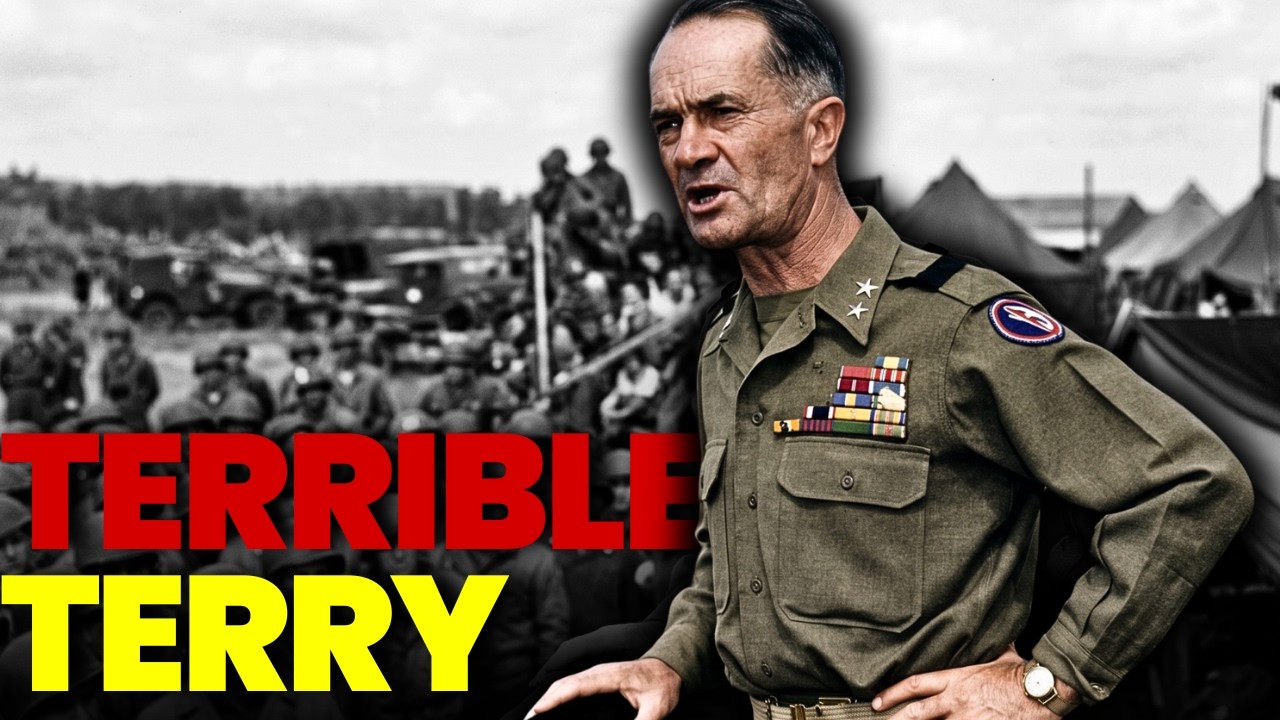
His rifle companies absorbed more than two dozen counterattacks to get into it. By any measure the army actually keeps, he is among the most battle-experienced division commanders the United States has in that theater. He has put a division ashore under fire twice, in two countries, in eight months. And as of this morning, he does not have a division.
The order came to his command post. His assistant division commander was relieved the same day, by the same signature, for the same reasons—whatever those reasons were. Two days after that, his face goes up on the cover of Time magazine on newsstands and drugstore racks all across America: The Fighting General. He is looking at his own face on a magazine rack while he waits for a boat home.
The second man stands inside a tunnel bored into a mountain in central Germany. The tunnel is full of rockets—not blueprints, not components. Whole rockets lying on their sides in the dark, and the camp that built them is a few hundred yards outside, and most of the men in that camp are past helping. His division took the place at a run.
Behind him are nearly six months of continuous fighting, a river crossing made in darkness under machine-gun fire, a burned-out city on the Rhine cleared block by block, and a timberwolf’s head on the shoulder. By the time he is finished, his division will have taken more than 50,000 German prisoners and will have lost 27 men captured. Twenty-seven in 178 days of combat. Same man, same war, same voice, same temper, same refusal to sleep anywhere his rifle companies were not sleeping.
Between the two pictures there was a firing, a long ride home, a country he had to start over in at the age of 55. Nothing about him changed in between—not the tactics, not the manners, not one habit. What changed was the name at the bottom of his efficiency report. His name was Terry de la Mesa Allen.
He was born at Fort Douglas in Utah Territory on the 1st of April 1888. He went to West Point in 1907 and did not graduate; mathematics and ordnance beat him, and the academy sent him away. He took a degree from Catholic University instead and came into the army through the side door, commissioned in the cavalry in November of 1912. In the First World War he led an infantry battalion, won a Silver Star, and took a German bullet through the jaw.
According to the historian Jerry Morelock, who has written the best short account of his career, that wound cured a stutter Allen had carried since he was a boy. Hold that picture, because it explains a great deal of what follows: a man shot through the face while walking his battalion forward does not develop a high regard for officers who send orders from thirty meters back. In 1940 he was still a lieutenant colonel of cavalry. On the 1st of October that year he was made a brigadier general.
Twenty months later he was a major general with the First Infantry Division. That is not a normal career progression. That is an army in a panic, reaching past the seniority list for the men it thinks can fight. And he could.
That is the part nobody disputes, then or now. On the 8th of November 1942, the First Infantry Division went ashore at Oran in Algeria. Allen’s assistant division commander, Brigadier General Theodore Roosevelt Jr. , took the 26th Infantry into the attack personally.
Worth pausing on: the assistant division commander of an American infantry division led a regimental attack on the first morning of the war in the West. That was the culture of that division, top to bottom, and it started at the top. Four months later came the operation that made Allen’s reputation. II Corps called it Operation Satin.
The army’s official history of the campaign—George Howe’s volume Northwest Africa: Seizing the Initiative in the West—lays out the mission plainly. The First Infantry Division was expected to take Gafsa and then force the defile at El Guettar, east of a place called El Guettar. They walked into Gafsa on the 17th of March 1943 and found it empty of defenders and thick with mines and booby traps. The pass was the real problem.
A frontal attack up a road into a defended defile is how you lose a regiment, so Allen did not make one. On the night of the 20th–21st of March, the 1st Ranger Battalion was sent in—horse-wise, on a cautious and difficult ten-mile detour over the shoulders of Jebel Orbata—to come down on the pass from the north in the dark while the 26th Infantry attacked along the road at the same time. The Americans took over 700 prisoners at that pass. Hold onto that night march; it comes back later in the story, in Germany.
Two days later the Germans came for him. At 0300 hours on the 23rd of March, the 10th Panzer Division attacked straight down the axis of the Gabès–Gafsa road into the First Division’s positions. In the afternoon they came again, with 38 tanks in a single group. American artillery and the tank destroyers of the 61st and 899th Tank Destroyer Battalions knocked out nearly 30 enemy tanks, and the minefield stopped eight more.
A second attack at 1830 hours was broken up before it reached the infantry. El Guettar was the first time in the war that an American division stood in the open and beat a German panzer division at its own game. It was not cheap. Howe gives the cost of that whole push east of El Guettar as 126 killed, 1,036 wounded, and 159 missing.
Then Sicily, and Sicily is where the legend really got built. The First Division landed at Gela on the 10th of July 1943, and the Germans hit the beachhead almost at once. The official history of that campaign, written by Albert Garland and Howard McGaw Smyth, describes what came at them: the Hermann Göring Division put in a tank-heavy force of about 90 Mark III and Mark IV tanks, and an infantry-heavy force with an attached company of 17 Mark VI Tigers. On the 11th at 0615 hours they came again in three task forces.
German armor reached the highway west of Santa Tina, 2,000 yards from the water. Two thousand yards—a mile and a bit from the landing beaches. On the second day of the invasion of Europe, the 32nd Field Artillery Battalion came ashore in amphibious trucks, drove straight into firing positions along the edge of the sand dunes, and fired direct at the mass of German armor to its front. When it was over, 16 German tanks lay burning on the Gela plain.
Garland and Smyth put the German tank loss across those five days at a minimum of 26 and a maximum of 45, most of them on the 11th. Nobody threw the First Division into the sea. And the reason nobody did is that the division did not need to be told what to do when the situation went to pieces at dawn. That was the high-water mark.
Five weeks later the whole thing came apart. Troina was the last real anchor of the German line in front of Messina. It sat on a mountain, and the 15th Panzer Grenadier Division was on it—united for the first time in the campaign, dug into ground that looked down on every approach. The attack opened on the 31st of July.
Colonel Flint’s 39th Infantry jumped off toward Cerami at dawn and had the town by 0900 hours. Then it stopped, because everything stopped. Allen fed in regiment after regiment. The 26th Infantry went in at 0500 hours on the 1st of August in a column of battalions and took Monte Basilio.
The 16th Infantry worked the ground south of the highway. The 18th went at the southern flank. General Andrus, the division artillery commander, had 165 artillery pieces under his hand—eight organic battalions from the 1st and 9th Divisions, plus nearly as many again attached from II Corps—and he used all of them. Bradley talked the air forces into two large-scale attacks, 36 fighter-bombers each.
The Germans counterattacked more than two dozen times in a week. By the 3rd of August, Garland and Smyth record, the German division had lost at least 1,600 men. Somewhere in the middle of that, with the attacks stalled and the casualty lists climbing, Allen said the line that Morelock records and that his soldiers repeated for the rest of their lives: “Hell, we haven’t begun to fight. Our artillery hasn’t been overrun yet.
”
The Germans pulled out on the night of the 5th of August. Troina fell on the 6th. It was the hardest single fight American troops had in Sicily. On the 7th of August 1943, Lieutenant General Omar Bradley relieved Major General Terry Allen of command of the First Infantry Division.
He relieved Brigadier General Theodore Roosevelt Jr. on the same day. Major General Clarence Huebner took the division that afternoon. Now, about the title: “Patton called Allen the best division commander in the army.
” I went looking for that sentence, and I want to tell you exactly what I found, because you deserve better than a line somebody remembered. I could not find it—not in a form anyone can retrieve and check. A full-text search of the phrase across the digitized book record turns up American Civil War material and nothing else. So I am not going to put words in Patton’s mouth.
What Patton did say is stranger and worse. Patton loved that division. When Eisenhower lectured him on the poor discipline of Allen’s outfit, Patton contradicted the Supreme Commander to his face. Carlo D’Este quotes the diary in Patton: A Genius for War: “I told him he was mistaken,” Patton wrote, “and that anyhow no one whips a dog before putting him into a fight.
” When there was talk of using a different division at Gela, Gerald Astor records in Terrible Terry Allen that Patton went to Eisenhower and said he wanted “those sons of bitches” and would not go without them. That is the man in the title—the general who fought to keep Terry Allen’s division. And on the 31st of July 1943, the very day the attack on Troina opened, Patton wrote in his diary that he had asked Eisenhower for permission to relieve both Allen and Roosevelt on the same terms, on the theory of rotation of command. The entry is printed in Martin Blumenson’s edition of The Patton Papers.
“There will be a kick over Teddy,” Patton added, “but he has to go. ” He did not let them take Terry Allen. He asked for it first. So what was the charge?
Discipline. Not tactics, not casualties, not a failed attack. Discipline in the rear areas. And I want to give that case its full weight before I take it apart, because it is a better case than the audience for this channel usually allows.
When the fighting in Tunisia ended in May of 1943, the First Infantry Division came out of the line and went into rest camps in Algeria, and it behaved abominably. Morelock’s account is blunt: the division ran amuck, terrorizing locals and attacking rear-echelon troops, defying the best efforts of the military police to restore order. Eisenhower called Bradley in and, in Morelock’s phrase, gave him a royal chewing out. Bradley went away from that meeting and wrote about the “utter disregard for discipline everywhere evident in Allen’s cocky division.
” He had already told Patton before Sicily that Allen was a very poor disciplinarian. In A Soldier’s Story, published in 1951, Bradley put it in a sentence that has followed Allen ever since: “While the Allies were parading decorously through Tunis, Allen’s brawling First Infantry Division was celebrating the Tunisian victory in a manner all its own. ” Thirty-two years later, in A General’s Life, written with Clay Blair, Bradley was more candid about the reasoning. He called the relief one of the most unpleasant duties he ever performed, and he named the offense: Allen and Roosevelt loved their division too much.
The serious version of that argument goes like this, and it deserves to be stated properly. An American infantry division is not a private army. It is a piece of national equipment. It gets a number, a table of organization, a stream of replacements, and eventually a different commander, because commanders are killed, promoted, exhausted, and reassigned, and the division has to keep working when they go.
If a division’s fighting spirit is welded to one man’s personality, then that division is a wasting asset the moment he leaves. Worse, a division that believes it is special stops taking orders it does not respect. It starts negotiating. It develops opinions about corps headquarters.
And corps headquarters cannot run a campaign against a division that argues. Bradley was not a coward for thinking that. He was thinking like a man who had to move an army group across France and into Germany. Somebody had to be able to hand the First Infantry Division to a stranger and have it still work.
Clarence Huebner took it and tightened it hard. And ten months later, that division walked into the fire on Omaha Beach and stayed there. That happened. It belongs in the ledger.
That is the strongest case for the prosecution. Hold it in your head, because the rest of this story is the evidence against it. And the evidence is not an argument I made up. It is a division.
Two days after the relief, Terry Allen was on the cover of Time magazine. Think about how that landed at Seventh Army headquarters. The American public was being handed a ground-combat hero in the same week the army quietly took his division away for reasons nobody was willing to print. Roosevelt went out the same door on the same day.
He is not the subject of this story; he is the proof of it. Roosevelt was 56 years old, a brigadier general, the son of a president, and in my view the most physically courageous senior officer the American army had. Ten months after being relieved for loving his division too much, he waded onto Utah Beach in the first wave on the 6th of June 1944, the only American general to land with the assault. He found the landing craft had put him a mile from where he was supposed to be and said, “We’ll start the war from right here.
” He was dead of a heart attack on the 12th of July. On the day he died, Bradley had selected him for promotion and command of the 90th Infantry Division. The Medal of Honor came on the 21st of September, posthumously. The army fired him, then decorated him, then promoted him—in that order—and he was not alive for the last two.
Allen got on a boat. Seven weeks after the relief, a letter reached him from Eisenhower. “I’m certain,” it said, “that after you have had your well-deserved rest from the battlefield, your experience and courage will command your assignment to equally, if not more important duty. ” Eisenhower was more direct in private.
In his own papers he wrote that “it is a terrible injustice to General Allen to hint that he was relieved for inefficiency. ” Read that sentence twice. The Supreme Commander in the Mediterranean is on record saying that the official explanation for the most talked-about firing of the campaign was not the real one, and he is saying it because he knows perfectly well what a relief does to a man’s name. Morelock records that Bradley’s own recommendation was that Allen be used as a corps commander.
Sit with that for a second: the man who had just relieved him proposed to promote him. Whatever Bradley thought he was solving on the 7th of August, he did not think he was removing an incompetent from the war. Eisenhower did not give him a corps. On the 15th of October 1943, Terry Allen was given the 104th Infantry Division.
Understand what that was. The 104th had been activated on the 15th of September 1942 at Camp Adair in Oregon under Major General Gilbert Cook. It had never been overseas. It had never been shot at.
It had no battle honors, no reputation, no traditions, no nickname anybody outside Oregon had heard, and no expectation of getting one. Its shoulder patch was a gray timberwolf’s head on balsam green, and its men were called Timberwolves. In the autumn of 1943, that meant precisely nothing. Allen took a division that had never fought and had roughly ten months to do something with it.
What he decided to do with those months is the reason this story exists. He did not build the 104th in the image of the First Division. He built it around the single tactical idea that had worked best for him in North Africa, and he pushed that idea harder than any American division commander pushed any idea in the Second World War. Night attack.
When the rest of the army said “night operations,” it usually meant patrolling, or a night approach march followed by a dawn assault. Allen meant deliberate, rehearsed battalion and regimental attacks delivered in full darkness against a prepared enemy. Morelock puts the training load at 30 to 35 hours a week of night work—three to four times what army training directives required. Allen’s refrain, drilled into every officer and non-commissioned officer in the division, ran like this: “Find them, fix them, fight them, take the high ground, inflict maximum damage on the enemy with minimum casualties to ourselves.
” He said it so often it stopped being a slogan and became a reflex. They trained for it at Camp Adair and in the Oregon maneuvers in the autumn of 1943, and then in the worst terrain the army could find. From the 7th of December 1943 to the 9th of February 1944, the division sat at Camp Hyder in the Arizona desert and then Camp Granite in California, learning to move at night across ground that offered no cover and no landmarks. Then Camp Carson in Colorado.
Then Camp Kilmer in New Jersey on the 20th of August 1944, which is where American divisions went when their turn had come. Why night? Because in 1944 the Germans still owned the defensive fight in daylight. An 88 can kill a Sherman in the open at a range no American tank gun could answer—and it cannot see anything at two in the morning.
Registered mortar and artillery fire loses most of its value against troops nobody can observe. A machine gun on fixed lines still fires, but it fires at a map, not at men. Darkness takes the Germans’ best weapons, which are observation and range, and hands them back to the side willing to pay the price. And the price is real.
A night attack is the hardest thing infantry does. Units get lost. Companies shoot each other. Supporting fire is a liability.
Every man has to know the ground from a sand table, because he will not be able to see it. That is why almost nobody did it. And it is why 35 hours a week for ten months was not enthusiasm. It was the entry fee.
Terry Allen paid it in Oregon and Arizona so that he would not have to pay it in Germany. The division sailed from New York on the 27th of August 1944, and the army’s own order of battle records put it in the European theater on the 7th of September. It went straight to France rather than staging in England first—off the ships and into Normandy. On the 23rd of October, Eisenhower wrote to Allen again: “I know that you will get along splendidly with your British associates.
You are an experienced commander, and I expect nothing but the best from you. ” Eisenhower wrote that because the 104th Infantry Division was not going into the American line at all. It was going under First Canadian Army in the flooded polder country north of Antwerp to help clear the approaches to the port the entire Allied advance was starving for. That same day, the Timberwolves entered the line near Wuustwezel, astride the main highway running northeast out of Antwerp toward Breda.
Charles MacDonald’s volume in the official history, The Siegfried Line Campaign, calls the 25th of October their baptism of fire. Two days later, Colonel Walter Woelkers took the 413th Infantry into Zundert behind an artillery preparation and a squadron of British Churchill tanks. Essen fell on the 28th. On the 30th, Colonel John Cochran’s 415th Infantry reached the Mark River.
And on the night of the 31st of October, a week into their war, an American division that had never seen a shot fired in anger before that month made an opposed river crossing in the dark. MacDonald describes it in one sentence I have not been able to forget: “Men of the leading company clung to the sides of their assault boats to avoid grazing machine gun fire. ” Major Fred Meenen got a battalion across and held a bridgehead until six German tanks came at him and drove him back to the water by nightfall. They came again two nights later.
At 2100 hours on the 2nd of November, the whole crossing went in at once—the 413th west of Standdaarbuiten under Lieutenant Colonel Collins Perry, the 415th at the town and east of it. By 0115 hours on the third, engineers had a treadway bridge across the Mark. A German counterattack with four tanks came in after midnight and was broken. First Lieutenant Cecil Bolton of the 413th, wounded while directing his 60mm mortars, went after machine-gun positions with grenades and led bazooka teams against strongpoints in the dark.
He got the Medal of Honor for it. The first fight cost the division almost 1,400 casualties. It took 658 prisoners. And the Canadian general, Simonds, said of them that “all hell could not stop the Timberwolves”—a remarkable thing to say about a division that had been in Europe for eight weeks.
Then it got harder. On the 4th of November the division was pulled out and sent to Aachen. It joined VII Corps under General Collins and Courtney Hodges’ First Army, which was part of 12th Army Group, which was commanded by Omar Bradley. I want to be precise about that rather than dramatic: Bradley did not personally supervise the 104th Infantry Division—an army group commander does not—but the fact stands, and it stands for the rest of the war.
From November of 1944 until the German surrender, every mile Terry Allen’s division took, it took inside the command of the man who had relieved him for not being disciplined enough to be trusted with a division. On the 16th of November, the First Army opened Operation Queen, and the 104th went into the industrial sprawl between Stolberg and the Rur. This is not open country. It is slag heaps, strip mines, chemical works, brickyards, coal towns, and factory walls—all of it fortified and all of it observed.
On the 19th, the 415th began clearing Stolberg. Atschweiler was taken on the 21st and 22nd. The 414th under Colonel Anthony Tuart went for Weisweiler and took the power plant there by night assault on the 23rd and 24th of November. The division took 600 prisoners in that fight.
The Germans posted 1,845 casualties for the 12th Volks Grenadier Division. MacDonald sets down the reason in Allen’s own words, and it is the closest thing this story has to a doctrine statement: “On General Allen’s theory,” he writes, quoting the man directly, “the more they push under cover of darkness, the better it is for them. ”
Then Inden, which was five days of the ugliest kind of fighting there is. Two American battalions lost 319 men there, 40 of them killed and 156 missing.
MacDonald’s summary of the place afterward is four words long: “Inden was nothing but rubble. ” On the night of the 2nd and 3rd of December, the 415th crossed the Inde River at Lamersdorf—fording it and scrambling over the wreckage of a railroad bridge—and went for the village of Lucherberg on the ridge above. MacDonald explains the calculation exactly: “Confident of the ability of his men in night operations, Allen believed they might get past the strip mines, the factories, and the cliff-like portion of the ridge into Lucherberg before the Germans awoke to their presence. ” That is the entire idea in one sentence.
You do not fight through the obstacle; you are past it before anybody knows you left. Company I got into three houses and was cut to pieces holding them. Then Companies F and L came up the ridge, and MacDonald records what happened next: “In a matter of only 10 to 15 minutes, both Companies F and L had broken into Lucherberg. ” Ten to fifteen minutes for a position that had cost a rifle company most of its strength by daylight.
The Germans spent the next three days trying to take it back. On the 5th of December they came with 8 to 10 tanks and about 450 infantry and were beaten off. The 415th Infantry lost 25 killed, 21 missing, and about 60 wounded in that village. German losses were about 204 killed, 209 captured, and 400 to 500 wounded.
Which brings me to one sentence in the United States Army’s official history, and I would ask you to weigh who wrote it and when: “The noteworthy aspect of the 104th Division’s campaign to this point,” MacDonald writes, “was that the attack had carried almost four times as far as had the First Division in the VII Corps main effort. ” Despite the urban nature of the battlefield: four times as far as the First Infantry Division. Terry Allen’s new division, in its second month of combat, moving through the worst terrain on the front, outran the division the army had taken away from him for being unfit to command it. And the comparison is not mine.
It is the official historians’, written into the campaign volume in a paragraph almost nobody quotes. Through the German counteroffensive in the Ardennes that winter, the Timberwolves held the line on the Rur in an active defense from the middle of December until the middle of February. Then First Army went across. On the 23rd of February 1945 the artillery opened at 0245 hours.
H-hour was 0330. The 104th was the left assault division of VII Corps—the 415th Infantry on the north wing, the 413th on the south. They crossed in the dark, of course. By dark that evening the 413th had cleared most of the northern half of Düren.
In the suburb of Birkesdorf they captured an entire battalion of the 27th Volks Grenadier Regiment, complete with its staff. An entire battalion with its headquarters taken intact. That does not happen to units that see you coming. On the 5th of March the VII Corps attack on Cologne began in earnest.
The 3rd Armored Division broke into the city soon after daylight on the 6th, and the 104th came in from the west two hours behind it. The stiffest fight was at an airfield where the Germans swung 16 fixed 88mm antiaircraft guns down onto American tanks. By noon on the 7th of March, almost all of Cologne had been cleared. The cathedral was still standing, damaged.
The Hohenzollern Bridge had a gap 1,200 feet wide blown in the middle of it. MacDonald describes the city the Timberwolves walked into as “a wasteland from long years of aerial bombardment. ” They had been in Europe for six months. They crossed the Rhine at Honnef on the 22nd of March, and then the war turned into a chase.
On the 1st of April, Easter Sunday, the First and Ninth Armies closed the ring behind the Ruhr. The two columns met on the eastern fringe of Lippstadt at about 1300 hours. The 104th held the corps’ left flank facing Winterberg while that happened, put a mobile task force into Brilon, sent the 414th and 415th Infantry off attached to the armored spearheads driving on Paderborn, and then spent the next two days beating down German breakout attempts at Hallenberg and Medebach. Inside that ring were the headquarters of Army Group B, all of Fifth Panzer Army, most of Fifteenth Army, and two corps of First Parachute Army—VII Corps counted 19 divisions.
American intelligence estimated the trapped force at some 150,000 men, and MacDonald, writing later, notes dryly that they were far too conservative. Then Nordhausen. On the 11th of April 1945 the division’s armor swept into the town, and what it found there is in the official history in language the Green Books almost never use: “grisly, almost unbelievable evidence of Nazi bestiality in another concentration camp. ” Outside the town, men of the 104th Division found large underground factories, one of them for manufacturing V-2 rockets.
Scientific teams later shipped a hundred of the rockets to the United States for study, along with scientific data found buried in an abandoned mine a few miles away. The slave camp attached to those tunnels had been built for 30,000 workers, and there was evidence that 150 bodies a day were being cremated. The men who walked into that place had spent ten months in Oregon and Arizona learning to move in the dark. Nothing had trained them for what they walked into on the 11th of April.
They took Halle between the 15th and the 19th of April, cleared their sector to the Mulde by the 21st, and on the 26th of April 1945 the 104th Infantry Division shook hands with the Red Army at Pretzsch. That is where Terry Allen’s war ended—on a riverbank in Saxony, with a division nobody had heard of in 1943. So put the two divisions side by side, because the numbers are the argument. The First Infantry Division fought 151 days of combat in North Africa and Sicily—essentially Allen’s tenure.
In that time it lost 93 men killed, 3,681 wounded, 170 missing, and 531 taken prisoner. The 104th Infantry Division fought 178 days of combat, every one of them under Allen. It lost 1,294 killed, 5,035 wounded, 385 missing, and 27 taken prisoner. Hold those last two figures next to each other, because I think they are the single most important pair of numbers in this story.
The 531 men of the First Infantry Division were taken prisoner in North Africa and Sicily. Twenty-seven men of the 104th were taken prisoner in Germany. Twenty-seven across six months of continuous offensive fighting, most of it at night, most of it inside built-up ground where a lost squad is a captured squad. That number is not luck.
That is what a division looks like when every man in it has done the thing so many times in training that he can still find his platoon at 2 in the morning in a strange town in the rain. And it is the exact opposite of what Terry Allen was fired for. The rest of the ledger: the 104th’s battle casualties came to 7,011. Add non-battle losses—frostbite, trench foot, sickness, accident—and the total reaches 13,347, which the army’s records put at 95.
1 percent of the division’s authorized strength. In other words, over six months the division lost the equivalent of almost every man on its rolls, and it never stopped attacking. It took 51,727 German prisoners. Its men were awarded 16 Distinguished Service Crosses, 53 Silver Stars, 1,869 Bronze Stars, and one Medal of Honor.
Three campaign credits: Northern France, Rhineland, Central Europe. For scale on the other side of the hinge: the entire Sicilian campaign ran 38 days and cost Patton’s Seventh Army 7,421 casualties against 11,843 from Montgomery’s Eighth Army. Seventh Army’s military police processed 122,240 prisoners of war before it was over. At Troina alone the German 15th Panzer Grenadier Division had lost at least 1,600 men by the 3rd of August.
At the pass east of El Guettar, Allen’s division took over 700 prisoners in a night, then broke a panzer division with nearly 30 tanks knocked out and eight more stopped in a minefield. Those are the numbers of the man the United States Army decided was not steady enough to be trusted with a division. Most of you already know Allen’s reputation. What gets discussed far less is the mechanics of how a night attack actually ran in the 104th.
And the mechanics are where this stops being a matter of taste. First, the clock. The failures teach that better than the successes do. On the 23rd of November 1944, in the fight for Weisweiler, MacDonald records that the 414th Infantry tried a night attack and it did not come off.
“By the time the men had threaded their way to the line of departure,” he writes, “the pre-dawn darkness had dissipated. ” That is the whole difficulty of the method in one line. Darkness is not cover; darkness is a consumable, and you are spending it from the moment you leave the assembly area. Every minute a company loses feeling its way to the start line is a minute stolen from the attack itself.
And if the arithmetic goes wrong, you arrive at a defended village in the gray light with no artillery preparation and no surprise. That same morning, the 413th Infantry got it right, and MacDonald’s phrasing is worth noticing: “Turning once again to the stratagem of night attack, two companies moved in the pre-dawn darkness. ” Once again. It was not a trick they pulled out for special occasions.
It was the house method, and they ran it until it worked. Second, notice what the objective usually was. At Lucherberg, Allen was not trying to fight through the strip mines, the factories, and the cliff face on the ridge. He was trying to be past them before anybody noticed.
Once two companies were inside the village, the German position on that ridge was worth nothing, and it collapsed in a quarter of an hour after holding out all day against a frontal fight. Third, the artillery. Look at the Rur crossing again: guns open at 0245, infantry in the water at 0330—45 minutes. The standard American practice by 1945, as I read the campaign histories, was a long, methodical preparation followed by a daylight assault, and it told the defender exactly where and roughly when.
Allen’s division kept the preparation short and went in while the night still had an hour to run. Fourth, and this is the part that connects the two halves of the story: a night attack cannot be commanded. Once the companies step off, the division commander, the regimental commander, and the battalion commander are all blind. The attack is run by lieutenants and sergeants navigating on a compass bearing they memorized off a sand table, deciding on their own whether to go on or go to ground, with no visible flanks and no way to ask.
The entire method depends on pushing decision authority further down than any American division was comfortable pushing it. And that, I believe, is the answer to Omar Bradley. What Bradley saw in North Africa was a division that did not stand around waiting to be told. He called it cocky.
He called it a disregard for discipline. He was describing, in the language of a staff officer, the exact quality that makes night attacks possible—and he was describing it as a defect. Bradley eventually said so himself, in a way. Gerald Astor, in Terrible Terry Allen, records Bradley’s later verdict on Allen and the Timberwolves: “He brought the only division I know of that was prepared for night combat.
” The only one he knew of in the whole American army. So the question that matters: did the system ever admit it got this one wrong? Not in any way that cost anybody anything. Terry Allen commanded the 104th Infantry Division from Oregon to the Mulde.
He took it through three campaigns and a winter, and he finished the war exactly where he had started it—as a major general commanding a division. No corps, no third star. He retired in 1946 with the two stars he had been wearing since June of 1942. Consider the shape of that.
Between 1940 and 1942, the army took a lieutenant colonel of cavalry all the way to major general in 20 months because it needed men who could fight. In the summer of 1943 it took his division away. And for the 21 months of hard war that followed—during which he demonstrated the point in the most public way available to a soldier—it never once revisited the decision. And then it wrote it down.
In 1951, Omar Bradley published A Soldier’s Story with that sentence about the brawling division in it, and Terry Allen was alive to read it. He lived another 18 years. For the rest of his life, one of the most widely read American accounts of that war carried a sentence about his division that a reader could only take one way. The more generous assessment in A General’s Life arrived in 1983.
Allen had been dead for 14 years. I want to be fair to Bradley here, because this is not a hit job. He never claimed Allen could not fight. He never claimed the relief was for failure in battle.
He called it one of the most unpleasant duties he ever performed, and he was on record as the man who suggested Allen be used as a corps commander afterwards. That is not the behavior of a man settling a score. It is the behavior of a man who believed he was solving an institutional problem and who never seriously examined whether the institution had the problem backwards. Here is my verdict on the case against Terry Allen.
I think it was factually true and analytically worthless. And those two things need separating carefully, because the discipline complaints were not invented. They were not. The First Infantry Division behaved badly out of the line in Algeria.
Men were beaten up. Property was wrecked. The military police could not control it. That is a genuine failure of command, and Allen owned it, because a division commander owns everything his division does.
But look at what the army did with that fact. It took a real problem—rear-area discipline—and used it to answer a completely different question, which was whether this officer should keep commanding troops in battle. Those are not the same question. They were never the same question.
And the proof that they were never the same question is that the identical officer, with the identical methods and the identical personality, then produced the prisoner figure I gave you a few minutes ago—one of the most disciplined performances any American division turned in during that war. Discipline in a bar in Oran and discipline on a compass bearing at 3 in the morning are not the same commodity. The army of 1943 had no instrument that could tell them apart. So it graded the one it could see.
That is the systemic point, and it is bigger than Allen. The American army in the Second World War had a structural blind spot. It could measure conformity, and it could measure results. When the two disagreed, it believed conformity, because conformity is legible from a headquarters and results are not.
A corps commander cannot personally observe whether a night attack was well-handled. He can observe instantly whether the division commander’s men saluted, whether the paperwork was on time, and whether anybody wrote him an angry letter about a wrecked bar. So the system optimized for the thing it could see, and it told itself that the two things correlated. They do not correlate.
In this case they ran in opposite directions, and the army had no way to notice. And if that sounds familiar to you—if you have ever watched the person who actually does the work get moved sideways while the person who is easy for the hierarchy to process gets moved up—you are not imagining a pattern that is not there. It is the same mechanism. It is older than any of us, and it has never been solved anywhere.
Two things follow from that. First, Patton. The title of this story is too kind to him, and I said at the start that I would not let a remembered line stand in for the record. Patton did not merely fail to protect Terry Allen.
Patton went to Eisenhower and asked for the authority to remove him, on the theory of rotation of command, on the 31st of July—while the First Infantry Division was still in contact at Troina and taking casualties. The same man who had told the Supreme Commander not to whip the dog first. Both of those are Patton. That swing, from defending the division against Eisenhower to requesting its commander’s relief in the middle of its hardest battle, is the actual story.
And I find it far more revealing than any compliment would have been. Patton did not turn on Allen because Allen changed. Patton turned on Allen, in my reading, because Patton was learning what the hierarchy rewarded and wanted to be seen learning it. Second, Bradley was right about the general principle and wrong about this division.
A division cannot belong to one man. Agreed. But the remedy for that is a system that can rotate a commander without destroying his career. And the American army did not have one.
It only had the relief, and a relief in wartime is a verdict on a man’s competence, whether or not anybody intends it that way. Eisenhower understood that perfectly, which is why he wrote the line I read you earlier about the terrible injustice—and then he presided over a system in which the hint was the only thing anybody heard. So, the whole of it: I believe the relief of Terry Allen was defensible as personnel management and indefensible as an assessment of the man, and that the army knew the difference and let the confusion stand because clearing it up would have cost somebody something. And I believe the 104th Infantry Division is the most complete reputation any relieved American general ever got, because he did not argue with the verdict.
He went to Oregon and built the counterargument out of ten months and 35 hours a week. He went home to El Paso and retired in 1946. There is one more thing, and you will know why it belongs here. Terry Allen had a son, Terry de la Mesa Allen Jr.
, who followed him into the army. On the 17th of October 1967, in Vietnam, Lieutenant Colonel Terry Allen Jr. was killed leading his battalion. He was commanding the 2nd Battalion, 28th Infantry Regiment—a Big Red One battalion.
He died at the head of a battalion of the First Infantry Division, 24 years after the army took that division away from his father. Allen never recovered from it. He died in El Paso on the 12th of September 1969, and he is buried at Fort Bliss National Cemetery next to his son. The legend says Terry Allen was too good at his job and the system fired him for it.
That is close, but it lets the system off lightly. He was not fired for being good. He was fired because the army could not tell the difference between a man who was hard to command and a man who was hard to beat, and it had never built anything that could tell them apart. He then spent the last two years of his war demonstrating the difference at a scale nobody could miss, and nothing moved, because there was no machinery anywhere in that institution for taking the point.
Twenty-seven prisoners in 178 days. That is the answer. It just took a second division to write it down.






