I was on my way to the airport when I realized I’d forgotten my late husband’s will. I rushed home, but as I quietly opened the door, I overheard my son and his wife planning something horrifying. I wasn’t supposed to hear it, but I did. And I…
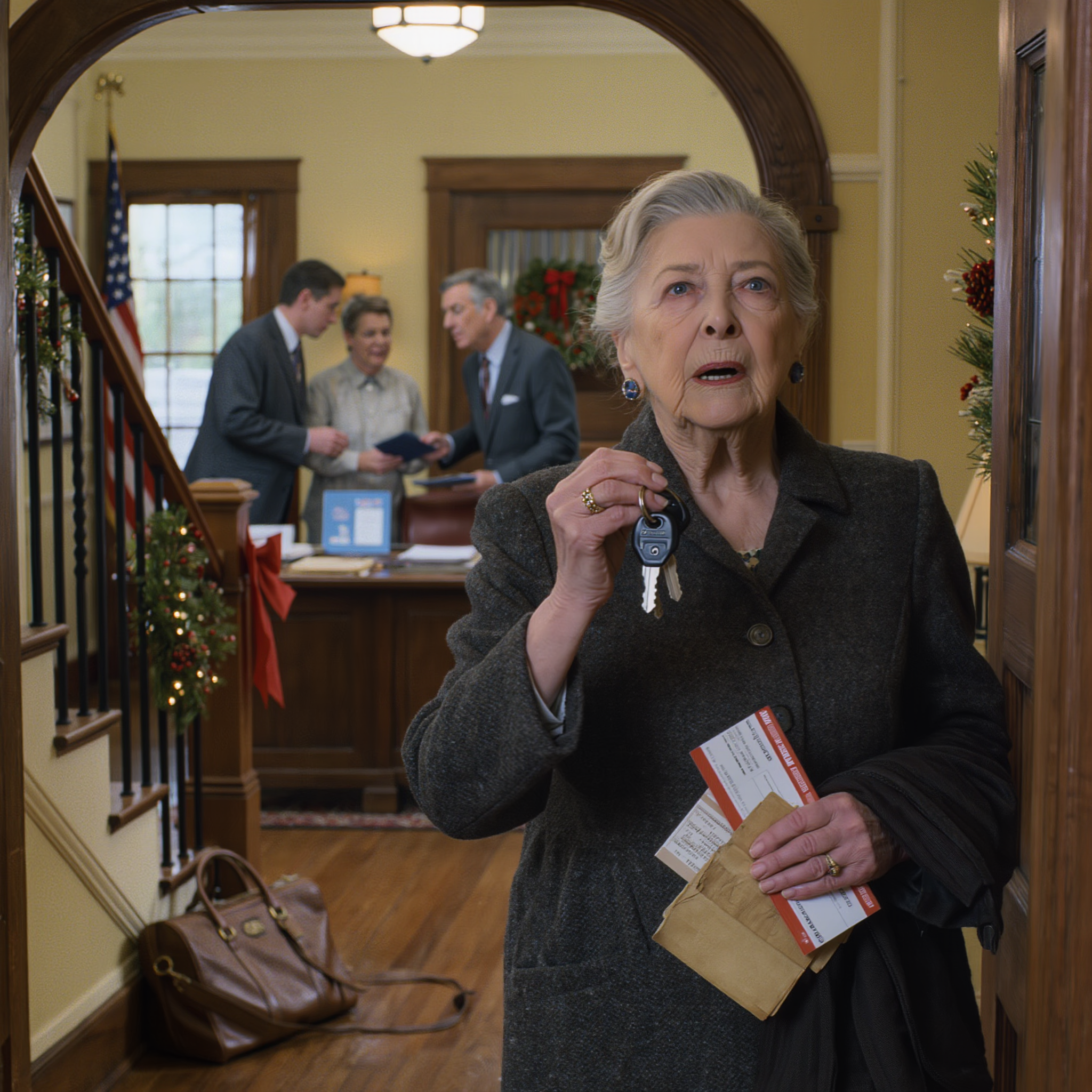
I was supposed to be on a flight to Portland, heading to my sister’s lake house for the holidays.
My bag was already checked, and my boarding pass was in my hand.
But just as I reached the long-term parking lot, something stopped me cold.
I had forgotten the original will.
Arthur’s will.
The real one, not the copy I kept in the desk drawer.
I turned the car around, thinking I would be in and out in five minutes.
But what I walked into was something no mother should ever hear.
Not in her own home.
Not from her only son.
The front door creaked softly when I opened it.
I did not call out.
The air inside felt still.
Too still.
My keys rested in my palm, but I did not drop them into the bowl as I always did.
Something inside my chest went quiet.
I stepped into the hallway, my shoes brushing against the wooden floor.
The voices came from the study.
Low.
Deliberate.
Careful.
I stopped behind the archway, pressing my back against the wall and barely breathing.
“If she’s showing signs, we can make the case,” said a voice I recognized too well.
Grant.
“She’s 74,” another voice replied. “With the right filing, diminished capacity will not be difficult to demonstrate.”
Ashby.
That was the lawyer Grant had begun bringing around after Arthur died, supposedly to help organize his father’s belongings.
My heart beat slowly and heavily.
I could not see them, but I could feel the shape of their conversation.
They were discussing guardianship.
They were discussing me.
Grant continued.
“I’ve already started compiling the list. She has been misplacing things and repeating stories. She barely touched her taxes last year.”
I wanted to step forward and shout his name.
Instead, I backed away carefully.
I did not want the floorboards to reveal me.
Outside, the afternoon sunlight was warm, but everything inside me had turned cold.
I returned to my car and sat staring through the windshield, the keys still clutched in my hand.
The woman who had raised him and worked night shifts in the archives so he could attend college without loans was now being cataloged like a file in a case.
I pressed my lips together.
Not in anger.
In disbelief.
That was the moment something inside me shifted.
It did not shatter.
Not yet.
But the remaining warmth inside my chest began to cool.
Do you know what the hardest part was?
It was not what I had heard.
It was realizing how long I had ignored what I already knew.
If you have ever watched your own child become a stranger inside your home, you will understand what I mean.
That was the day I stopped being a mother first and began becoming something else entirely.
Let me take you there.
I did not return to the airport.
I did not call my sister.
I simply kept driving.
My hands remained steady on the steering wheel, but my mind drifted somewhere else.
I passed the interstate entrance and allowed instinct to guide me through streets I had not visited in decades.
When I finally stopped, I was parked in front of a bakery tucked between a laundromat and a faded barbershop.
The awning was new, but the smell drifting through the open door was exactly the same.
Cinnamon.
Butter.
Toasted almonds.
Arthur used to bring me there every Sunday, rain or shine, when we lived in a two-bedroom apartment off Union Street.
Back when Grant was still a boy with scraped knees and a mind filled with inventions.
I went inside.
The counter had been replaced with something sleek and polished, but the tables were still mismatched.
Each held a small vase of flowers.
I ordered coffee and sat beside the window.
My fingers curled around the cup, searching for warmth and something to anchor me.
I watched people pass outside in thick coats, their heads lowered as they moved quickly along the sidewalk.
I remembered Arthur reading the newspaper at that same table while Grant built towers from sugar packets.
He asked questions about everything.
Bridges.
Trains.
How elevators worked.
He did not want simple answers.
He wanted blueprints.
And I gave them to him.
I brought books home from the library and circled paragraphs in pencil.
I enrolled him in robotics camp before he even asked.
He had been curious.
Not entitled.
At least, not then.
Somewhere between that child and the man I overheard that morning, something had changed.
Not suddenly.
Not overnight.
It was like a kettle left on the stove too long.
The steam began quietly and then hissed until it filled the room.
I remembered when Grant insisted on managing Arthur’s estate because he said it was too much for me.
I remembered when he replaced our family accountant with a firm I had never heard of.
I remembered when he arranged automatic payments for my property taxes without asking permission.
I had noticed the signs.
But I had given him the benefit of the doubt.
A tired mother’s trust.
A widow’s hope.
Now the pieces rearranged themselves, as though a puzzle had finally been turned the right way.
The picture became clear.
I left the bakery after drinking only half the coffee.
Its bitter taste remained on my tongue.
Not because of the beans.
Because of the memories.
Outside, the sky had turned gray.
I zipped my coat to my chin and stood still for a moment.
I was not ready to return home.
Not because I was afraid.
Because I needed to remember who I had been before I began allowing other people to define me.
That quiet detour was the beginning.
The parking lot behind the library was almost empty when I arrived.
It was late afternoon, and the sky had already begun fading into the soft gray of early winter.
I parked in the same space I used when I worked there.
Muscle memory.
Old habits.
For a moment, I watched the branches of the large oak tree near the rear entrance move gently in the wind.
Inside, everything was quieter than I remembered.
The carpets had been replaced.
The checkout stations had been upgraded.
But the smell remained the same.
Ink.
Dust.
Old wood.
A scent that had always made me feel calm, capable, and whole.
I walked past the fiction shelves and continued toward the archive room at the back.
It had changed very little.
The same tall filing cabinets.
The same beige ceiling lights that flickered if you watched them too long.
I nodded to the young woman at the desk and asked whether I could review a document I had once cataloged.
A copy of my husband’s will.
She did not question me.
She slid a clipboard across the desk and directed me to a table in the corner.
I found the file easily.
My hands still knew where to look.
The folder was thick.
Not because of the will itself, but because of Arthur’s notes.
He had annotated everything.
The margins were covered in arrows, dates, and abbreviations written in his clipped handwriting.
They had made sense to him.
Over the years, they had also come to make sense to me.
I spread the pages carefully across the table and examined every line.
The will was intact.
Nothing had been crossed out.
But the sticky notes Arthur left inside the folder caught my attention.
One read:
Dolores, if you ever feel uncertain, the answer is always in the numbers.
I turned to the final page.
There was a chart breaking down the assets.
Property.
Investments.
Bonds.
Beside each category, Arthur had written instructions.
D to retain.
D or Grant if qualified.
Legal hold until independent review.
Not Grant to manage.
No full access for son.
Arthur had been precise.
He had trusted me.
Heat rose inside my chest.
Not from anger.
From recognition.
From memory.
From the sensation of finally slipping back into my own skin.
I took a notepad from my bag and began writing a list.
First: copies.
Second: legal counsel.
Third: audit recent account changes.
I underlined each item with slow, steady pressure.
By the time I left the library, the sun had disappeared below the rooftops.
The sky had turned soft navy blue.
The cold air did not bother me.
I walked toward my car with purpose, my breath clouding in front of me.
For the first time in weeks, I did not feel old.
I did not feel confused.
I did not feel like someone being managed.
I felt like Dolores Whitaker.
The woman who used to organize rare collections.
The woman who could recite policy by heart.
The woman who once found a lost Revolutionary War letter behind a broken filing cabinet.
And the woman who would now find her way back, one document at a time.
The following morning, I moved slowly.
Not because my body ached.
Because I needed the illusion to look real.
I tucked a small voice recorder into the lining of my coat.
It was one I had once used during interviews at the library.
Barely larger than my thumb.
It made a soft click when recording began.
I checked that the red light blinked once before disappearing beneath the wool.
I left the front door unlocked.
The sun was high enough to cast shadows across the kitchen floor.
I switched off the overhead lights and allowed the natural light to do its quiet work.
I made tea and deliberately spilled a little on the counter.
Then I left the kettle slightly ajar.
Small signs of disorder.
Subtle enough to be mistaken for forgetfulness.
Grant arrived at 10:30.
I had not asked him to come.
He rarely called before appearing anymore.
He entered carrying a grocery bag and wearing the careful smile he used when he wanted something.
I sat at the kitchen table in my robe.
A half-finished crossword lay in front of me beside a pen without its cap.
I looked up slowly.
Grant kissed my cheek and commented on how cold the house felt.
I nodded and said I must have forgotten to turn up the heat again.
He placed the grocery bag on the counter.
Inside were a container of soup, a loaf of bread, and a tin of crackers.
The performance began.
He asked how I had been sleeping.
I said I was not sure.
Then I changed subjects in the middle of a sentence.
I allowed my hands to fumble slightly with the spoon.
When he offered to warm the soup, I smiled and accepted as though he were doing me a favor.
Grant moved through the kitchen like someone taking inventory.
His eyes scanned the calendar.
The medication beside the sink.
The unopened mail.
He commented on a letter from the insurance company.
I said I had not gotten around to opening it.
He offered to review it for me.
I pretended not to hear.
After lunch, he leaned against the doorway and watched me for a long moment.
Then he said something that confirmed what I already knew.
He had been researching care homes.
“Just options,” he said.
Places with gardens.
Music therapy.
Staff trained in memory care.
He said it softly, as if it were kindness.
I blinked and gave him a faint smile.
“It might be nice to have somebody else do the cooking.”
Then I asked what day it was.
He looked satisfied.
While he gathered the dishes, I sat silently and stared through the window.
The recorder had been running throughout the entire visit.
Every word.
Every pause.
Every calculated kindness.
After Grant left, I locked the door and entered the study.
I removed the coat and placed the recorder gently on the desk.
My hands did not tremble.
In silence, I replayed the encounter inside my mind.
Not with anger.
With precision.
I now had more than memory.
I had evidence.
And the silence that had once felt unbearable had become my greatest ally.
The following morning, I found Helen’s old telephone number inside a yellowed Rolodex behind my cookbook shelf.
I had not spoken with her in years.
Not because we had fallen out, but because life folded in upon itself after Arthur died.
Helen and I had worked together for 15 years at the university library.
She was sharp and always one step ahead.
She could identify the flaw in a plan before it unraveled.
I called and left a message.
My voice was calm and direct.
I told her I needed a legal mind I could trust.
I told her it was personal.
Within an hour, she sent a text saying she would arrive by four.
Her presence filled the room without taking control of it.
She wore a navy wool coat and had pulled her hair into a tight knot.
She looked exactly like herself.
Grounded.
No pleasantries.
No forced smiles.
We sat at the kitchen table.
I poured chamomile tea into mismatched cups.
Then I slid the recorder and the file toward her.
I offered no long explanation.
Only silence.
Helen listened to the complete recording.
Her expression did not change.
When it ended, she looked at me.
“We are going to fix this.”
She opened her laptop.
Her fingers moved rapidly.
She asked whether my existing power of attorney had been updated since Arthur’s death.
“No.”
She nodded.
The first step would be revoking Grant’s authority.
Then we would create a new will.
Designate a trusted executor.
Notify the appropriate state offices of the changes.
Everything would be documented and time-stamped.
She asked whether I had digital backups.
I said no.
“We’ll fix that too.”
During the following hour, she outlined a plan.
Clean.
Quiet.
Legal.
Everything Grant assumed I had forgotten, I was about to rewrite.
Helen was precise but never cold.
She was not surprised.
She had seen similar situations before.
Not necessarily involving children.
But involving people who believed access meant ownership.
We moved into the den.
She scanned copies of Arthur’s annotated will.
She helped me create encrypted cloud storage.
She made a dedicated folder labeled:
Dolores — Legal — Private.
She explained how to update the entries, where to store medical reports, and which versions to preserve.
Before leaving, she placed one sheet of paper in front of me.
It was a formal revocation of power of attorney.
My name.
Grant’s name.
The date.
I signed it.
Helen placed the document inside her briefcase.
“This is the first step,” she said.
After she left, I sat beside the window and watched the bare dogwood branches sway in the wind.
The house was quiet again.
But this was not empty quiet.
It was the sound of something solid being rebuilt.
One decision at a time.
One document at a time.
One version of myself at a time.
I was not alone anymore.
The following days unfolded with quiet precision.
Helen gave me a checklist, but by the second morning, I no longer needed to read it.
The rhythm of protecting myself became routine.
It was the kind of order I had not felt since my early years in the archives, when every document told its own story and my responsibility was simply to preserve it.
I began with my medical records.
I scheduled an appointment with Dr. Elkins, the same physician I had visited for more than ten years.
During the appointment, I requested a cognitive evaluation.
Not because I doubted myself.
Because I wanted the result in writing.
Dr. Elkins did not question me.
He conducted the assessment, checked my reflexes, and reviewed my medical history.
Then he handed me a signed letter.
Cognitively sound.
No evidence of impairment.
I folded it carefully and placed it inside the folder I now carried in my bag.
Back home, I collected everything that demonstrated my mental clarity.
Grocery receipts.
Bank statements with handwritten notes in the margins.
Emails printed from the previous two years.
I made lists.
I dated every page.
I organized everything into categories.
Legal.
Medical.
Personal.
I labeled the folders the same way I once labeled historical collections.
Clear.
Consistent.
Irrefutable.
I scanned every page into the new cloud storage.
Helen had shown me the process twice.
Now I could complete it with my eyes closed.
I used the scanner she loaned me.
Small but fast.
Every file was saved with a timestamp.
Each document became another brick in the wall I was constructing between myself and the person Grant believed I had become.
At the back of my closet, behind winter coats and an unused suitcase, I discovered a box labeled:
Arthur — Misc.
Inside were letters.
Most were notes from the early years of our marriage.
Grocery lists.
Quick reminders.
Small hearts drawn beside Arthur’s name.
But one stood out.
A single handwritten page in his bold script.
Dated ten years earlier.
There was no envelope.
It had been folded into quarters and placed between two travel brochures.
If the day comes when our son makes you doubt yourself, trust your instincts.
You have always seen more clearly than you believe.
I sat on the edge of the bed with the letter resting in my lap.
The house was still.
My heart beat steadily.
Outside, the wind brushed against the windows like fingertips.
Arthur had known.
Not the details.
But the possibility.
He had seen something I had not been prepared to see.
I was prepared now.
That night, I created another backup of everything.
I sent copies to Helen and placed a flash drive inside a safe-deposit box.
Then I added a final entry to my journal.
There is no such thing as being overprepared when somebody is trying to erase you.
That night, I slept without leaving the hallway light on.
For the first time in weeks, I did not wake to check the locks.
I had completed the work.
I was no longer merely defending myself.
I was documenting my survival in my own handwriting, in real time.
Grant appeared on Wednesday.
I did not hear his car arrive, but the doorbell rang shortly after noon.
I breathed slowly and approached without rushing.
He stood outside holding a paper bag in one hand and a small bouquet of supermarket tulips in the other.
He wore the same soft expression he used as a child after being caught taking a snack before dinner.
I stepped aside and allowed him to enter without speaking.
The tulips were yellow.
I thanked him and placed them inside the old green vase on the dining-room table.
He commented on how quiet the house was.
He said it felt peaceful.
I agreed.
He unpacked the bag in the kitchen without asking permission.
Vegetable soup.
A crusty roll.
A chocolate bar.
I offered to warm the soup, but he waved me away and did it himself.
He moved through the kitchen like he belonged there.
He always had.
We sat at the table.
He asked how I had been sleeping.
“Some nights are better than others.”
He nodded and asked whether I had considered hiring someone to check on me once or twice each week.
I said it might not be a bad idea.
I allowed my spoon to linger inside the broth.
My hands moved more slowly than usual.
Grant watched closely, the way somebody watches a dial they have just adjusted.
Then he began discussing the places he had researched.
Assisted-living communities with wellness programs.
Walking paths.
Private rooms.
He presented the idea gently, as though it were only a suggestion.
He said I deserved to rest.
He said being alone too often was unsafe.
I looked down and ran my fingers along the edge of the napkin.
“I’ll think about it.”
His expression softened.
Perhaps with relief.
When he offered to drive me to tour one of the facilities the following week, I smiled.
“Perhaps.”
Then I asked him to remind me what day it was.
He answered.
I nodded as though I had forgotten.
I allowed the silence to stretch between us.
He remained for another half hour.
He walked through the hallway as though checking for things I had overlooked.
He pointed out a flickering bulb in the laundry room.
He mentioned that the porch railing looked loose.
I made a mental note of everything he noticed.
Before leaving, he touched my shoulder gently.
“I only want what is best for you.”
I placed my hand over his.
“I know.”
As soon as the door closed, I walked to the rear window.
Grant sat inside his car for several minutes, typing something on his phone.
His lips moved slightly, as though he were rehearsing.
I turned and entered the study.
The recorder hidden inside the bookshelf had been operating since the moment he arrived.
Every sentence.
Every suggestion.
Every careful word had been archived.
That evening, I uploaded the recording and labeled it:
Visit — Grant — Assisted-Living Discussion.
The performance had been nearly perfect.
But so was the record.
The morning after Grant’s visit, I rearranged the living room.
Not because it required changing.
I wanted to create space beneath the side table for a second recorder.
Placement mattered.
Grant often paced beside the window when nervous.
I tested the angle and confirmed that the microphone would also capture conversations on the porch.
I left the front door unlocked again.
A gesture of openness.
Of vulnerability.
Then I moved slowly through the kitchen, deliberately creating small signs of forgetfulness.
I left the refrigerator door slightly open.
I placed the measuring cup inside the sink instead of the cupboard.
When I passed the hallway mirror, I tousled my hair enough to look as though I had not noticed its condition.
At 10:40, Grant’s car entered the driveway again.
He walked up the stairs humming.
I stepped onto the porch with a cardigan wrapped tightly around my shoulders and asked what had brought him back.
“I was in the neighborhood. I thought I would check on you.”
He handed me a new packet from the care center he had previously mentioned.
I held it with both hands and allowed my fingers to tremble slightly.
I did not open it immediately.
Instead, I sat on the porch swing and asked what time it was.
He smiled.
Answered softly.
Then sat beside me.
I glanced at the folder.
“The pictures look nice.”
He leaned closer and described the walking paths and music room as though he were selling a vacation property.
Then he raised the subject of paperwork.
He had spoken with someone named Ashby, a legal adviser he trusted.
Ashby could help file the necessary documents.
Grant said he wanted everything prepared so there would be no confusion if something happened.
I nodded slowly and kept my eyes on the street.
Grant stepped away to answer a call.
His voice drifted through the open window.
He spoke clearly, although not loudly.
Ashby’s name came up again.
So did the phrases expedited review and mental competence.
Grant mentioned the following week.
He said I was nearly ready.
I remained still.
Not stiff.
Not rigid.
Only quiet.
The microphone on the porch captured every word.
When he returned, he brought me a cup of tea.
I thanked him.
Then I asked whether we had discussed the subject during his previous visit.
Grant smiled as though he were proud that I remembered.
He asked whether I wanted to tour the center on Thursday.
“I’ll think about it.”
I took a sip of tea and allowed it to remain on my tongue.
“The flavor reminds me of something Arthur used to prepare.”
Grant did not respond.
He nodded and said he would call the following day.
After he left, I disconnected the microphone from beneath the porch ledge.
I uploaded the recording and labeled it clearly.
Helen came by later that night.
She brought her tablet, and we transferred the files to two encrypted backups.
I showed her the notes Grant had left inside the care-center brochure.
He had circled a sentence in the admissions policy:
Transfer of medical proxy contingent upon observed need.
Helen looked at me.
Then she handed me a folder of her own.
Inside was a sworn affidavit confirming my current legal and medical competence.
It was signed by Dr. Elkins and two notaries.
The game had shifted.
Grant believed he was closing in.
But I was already documenting every move he made.
For the first time in a long while, I felt I was doing more than surviving.
I was preparing to be seen.
Three days after Grant’s final visit, Helen submitted a formal response to Ashby’s office.
The envelope contained extensive documentation.
The affidavit confirming mental capacity.
The newly notarized power of attorney.
The updated will.
A written notice declaring all previous authorizations void.
Everything had been logged, timestamped, and signed in duplicate.
It was not a declaration of war.
It was a shield.
Helen did not send it electronically.
She delivered it personally to the downtown legal complex where Ashby’s firm occupied a second-floor office above a dental practice.
She left the envelope with the receptionist and requested that it be placed directly into his hands.
Then she walked away.
That evening, Helen called me.
Her voice was calm, but something unreadable rested beneath it.
Ashby had telephoned her shortly after receiving the documents.
He had not called to argue.
He had not tried to defend his actions.
He said he had reviewed everything carefully and would be withdrawing from the situation.
Then, without being asked, he added something strange.
Arthur had once helped him during a period when very few other people would.
It was not a confession.
But it opened a crack in the wall Grant had built.
I sat with the call and replayed it inside my mind.
Then I took out Arthur’s handwritten letter.
I traced the final line with my thumb.
The following day, a courier delivered a letter.
It was not from Grant.
It was from Ashby.
The message was brief and typed on the firm’s letterhead.
He stated that he would no longer participate in any legal matter involving my estate.
Enclosed was a printed record of every document filed on my behalf during the previous six months.
Including the documents Grant had initiated.
The paper trail was thorough.
Dates.
Digital logs.
Proposed drafts.
Emails.
I spent the afternoon reading every line.
I recognized phrases from my conversations with Grant.
Sentences he had spoken over soup appeared word for word inside a draft declaration of concern attached to a proposed guardianship filing.
There were template affidavits designed to be completed later by neighbors or friends regarding supposed memory problems they had observed.
Grant had been constructing a case in silence.
Now I possessed his playbook.
I called Helen.
We agreed on the next step.
She would prepare a statement of intent to file if Grant made any further legal move.
A warning.
Not a threat.
Any attempt to bypass my rights would be treated as legal overreach and elder coercion.
It would become part of the official record.
That night, I placed Ashby’s letter beside Arthur’s note inside my nightstand drawer.
Two men.
One who had tried to erase me quietly.
One who had left enough light for me to find my way back.
I did not feel triumphant.
I felt steady.
As though I had finally left a holding pattern and entered clear air.
The silence inside the house no longer pressed against me.
It stood beside me.
Strong.
Waiting.
Grant arrived without warning.
No telephone call.
No message.
Only tires crunching over gravel and the slow creak of the front gate.
I had expected him.
Ashby’s letter had changed something.
I knew Grant would not wait long to reassert control.
From the window, I watched him walk along the path with a folder beneath his arm.
His pace was measured.
His shoulders were tight.
The mask of concern remained, but it was thinner now.
Stretched over something sharper.
When I opened the door, I did not pretend to be surprised.
I stepped aside and invited him in.
He followed me into the kitchen and commented on the smell of cinnamon.
I had warmed cider on the stove and deliberately allowed the fragrance to fill the house.
Grant did not sit.
He placed the folder on the table and remained standing, as though waiting for a cue.
I poured two cups of cider.
I gave him one and took my seat across from him.
The space between us felt clean.
Almost ceremonial.
He began gently.
Ashby had unexpectedly withdrawn, leaving matters uncertain.
I nodded.
Grant said he was concerned that certain legal documents had been changed without his knowledge.
I took a sip of cider.
Then I opened the drawer beside me and removed a small stack of papers.
Clean copies.
Not accusations.
Facts.
The new power of attorney.
The updated will.
Dr. Elkins’s statement.
The notarized affidavit confirming my capacity.
I slid them across the table individually.
Grant did not pick them up.
He only stared.
I looked at him.
Not angrily.
Not fearfully.
Clearly.
“I have made decisions for myself.”
“Legal decisions.”
“Responsible decisions.”
“I know exactly what I am doing.”
“Pretending otherwise will not change that.”
He did not respond.
His jaw shifted once.
His eyes moved over the documents and then toward the hallway.
I wondered whether he was searching for evidence that someone else was inside the house.
Or that I was bluffing.
Then I said something simple.
“Not all silence is weakness.”
Grant remained still for another moment.
Then he collected the papers and placed them back on the table without folding them.
He walked toward the door.
He did not slam it.
He said nothing else.
He left the same way he had arrived.
After the engine sound disappeared, I returned to the table.
I picked up the recorder hidden beneath the napkin holder and stopped it.
I already knew the file name.
Quiet Confrontation — Full Clarity.
That night, I did not dream of Grant’s childhood.
I did not dream of Arthur’s voice or legal phrases echoing through courthouse hallways.
I dreamed of a room filled with order.
Labeled boxes.
Clean ledgers.
A window open to crisp air.
For the first time in years, my decisions belonged only to me.
That was enough.
The silence that had wrapped itself around the house for weeks began changing.
Not with noise.
With presence.
Helen’s daughter, Tessa, arrived shortly after noon on a bright Saturday.
She carried a canvas duffel bag, a laptop case, and an easy way of moving through the hallway as though she had always belonged there.
She was not loud.
She did not ask too many questions.
She settled into the small guest room with quiet confidence.
She connected her hard drive.
Organized her textbooks.
Stacked binders beside the nightstand.
Tessa was studying archival science.
She already spoke with the same calm, deliberate cadence that reminded me of my years at the university.
By evening, the house felt different.
She offered to prepare tea and stood inside my kitchen as though it were her own.
She hummed while waiting for the kettle.
Nothing dramatic.
Only the melody of a folk song I had not heard in decades.
The scent of lemon verbena drifted through the hallway.
That night, I heard her typing from farther down the corridor.
Not quickly.
Not frantically.
Steadily.
The sound reminded me of Arthur’s old typewriter, which he had kept in the basement long after word processors became common.
There was something anchoring about it.
During the following days, Tessa became part of the household rhythm.
She took out the trash without being asked.
She printed labels for several old photograph albums.
She asked whether she could digitize the notebooks from my library years.
She treated everything carefully.
She never tried to impress me.
She simply completed the work.
On the third day, I gave her the legal folder.
Not the original documents.
Clean copies of everything.
The medical affidavit.
The power of attorney.
The revised will.
The audio transcripts.
She stored them on an encrypted drive, established backup protocols, and uploaded them to a secure university-grade cloud system.
Grant called that night.
His name appeared on the screen.
I allowed the telephone to ring.
He left no message.
Later, Tessa sat at the dining-room table with her laptop and asked whether I wanted to label the boxes in the garage with her the following morning.
“Yes.”
It felt like saying yes to something larger than cardboard and tape.
It felt like saying yes to movement.
To a life beyond defense.
The rooms no longer echoed when I walked through them.
There were fingerprints in the kitchen again.
The floors needed sweeping more often.
I liked that.
That night, I wrote one sentence inside my journal.
The house is no longer quiet, and neither am I.
The morning air had changed.
The trees outside the window rustled with quiet confidence, as though they knew something had ended and something else had begun.
I sat at my desk with my journal open.
It was the same journal I had kept since Arthur died.
The pages had grown thicker.
Not only with words.
With clarity.
I thought about how far I had traveled.
Not in miles.
Not through accomplishments that could be measured.
Through a slow, deliberate walk back to myself.
There had been no shouting.
No final door slammed.
Only small decisions gathered and stacked like stones along a path I carved alone.
I turned to the final page.
My pen moved steadily.
Let him speak first.
Then watch him fall.
I closed the journal and placed it inside the drawer beside Arthur’s letter.
Then I slipped the key into my sweater pocket.
The kitchen was warm.
Tessa had left early for campus, but her teacup remained beside the sink.
The steam was gone.
The memory remained.
I walked slowly through the house.
My fingers trailed along the walls.
The photographs had returned to their places.
The rug beside the front door had a fold where Tessa’s backpack had been dropped too many times.
The hallway lamp flickered once before settling into its glow.
Outside, the wind pressed gently against the glass.
I stood beside the window and watched leaves turn in the air.
Gold on one side.
Fading green on the other.
There was no announcement.
No audience.
But I knew something had ended.
Not my story.
Only the part where I waited for somebody else to decide how it should unfold.
That was enough.
If this story stayed with you, perhaps it is because somewhere deep inside, you have felt that kind of silence too.
The kind that is not weakness.
The kind that is survival.
If you have ever been overlooked, dismissed, or made to doubt your own voice, I hope this reminded you that dignity does not require permission.
You are not alone in your quiet strength.
You never were.
If this moved you, I would love for you to share your thoughts.
Or simply carry this story with you a little longer.