At 2:41 in the morning on May 7th, 1945, a German general named Alfred Jodl put a fountain pen to a single page and surrendered every German force still under arms everywhere, without conditions. The building was a red brick technical school on a side street in Reims, and at that hour it smelled of coal smoke and wet wool. A classroom on the ground floor had been stripped of its desks and hung with mapboards, the front lines inked in grease pencil, the surviving German pockets shaded and labeled like tumors. A long table sat under the maps with chairs around it for men who had not slept in two days.
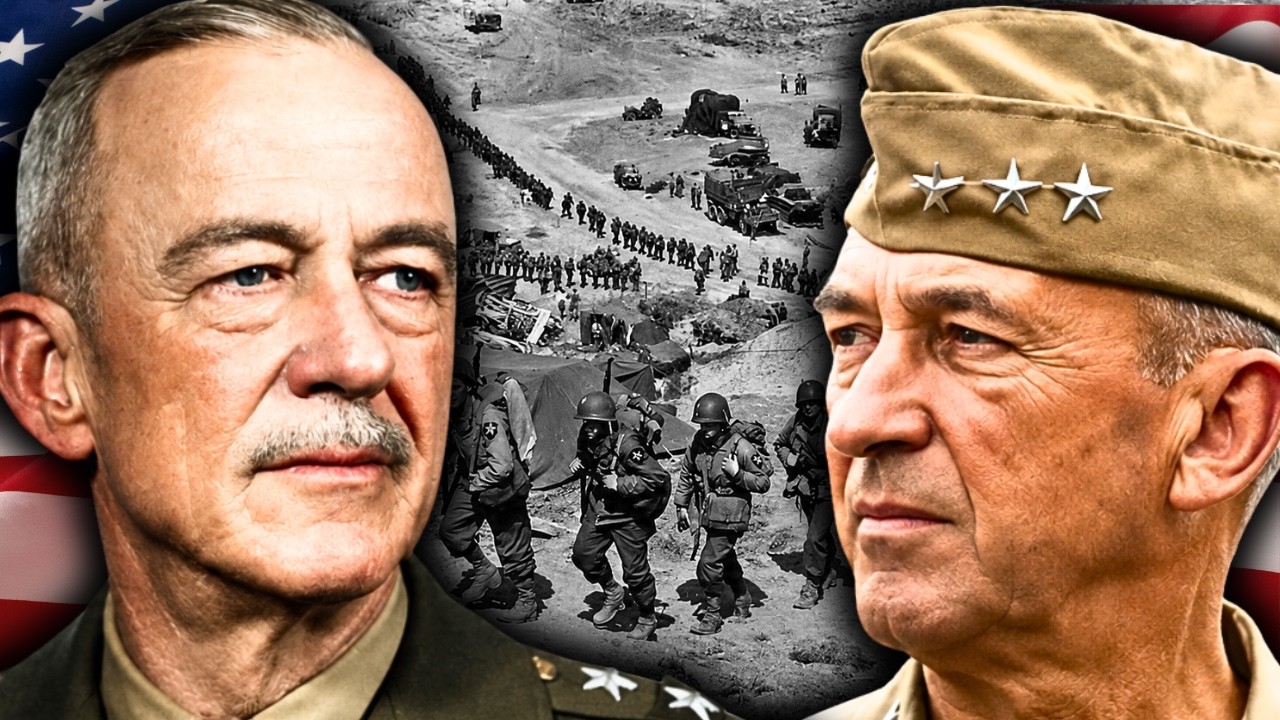
The man who signed that page for the Allied Expeditionary Force was not the Supreme Commander. Dwight Eisenhower was down the corridor in his office, waiting to be told it was finished, because he had decided he would not sit in a room with them. The signature that closed the war in Europe on behalf of the Western Allies belonged to his chief of staff, Lieutenant General Walter Bedell Smith. Now hold that room in your head, a room of brick and maps, and put another one beside it.
On the same day, on the other side of the world, no brick, no maps under glass. A field command post on the island of Luzon, canvas and folding tables and a radio section. Forward of it, up in the mountains, a two-lane road called Route 5 climbed out of the central plain. The road starts at about one thousand feet at a place called Puttlan.
It ends at three thousand feet at a saddle called Balete Pass. To get from one to the other, it runs through a gorge where the ridges come down to the road on both sides and what the official history calls razorbacked crests, the ravines between them so overgrown as to be practically impassable. The 25th Infantry Division had been trying to force that gorge since February. They would take the pass on May 13th, 1945, six days after Jodl signed.
The man who owned that road, and the better part of a dozen divisions in a front that ran the length of an archipelago, was sixty-four years old, reading message traffic. There were no photographers in his command post, and there had not been for two years. Here is what those two rooms have in common, and it is the only thing in this story that everybody agrees on. Neither man in them had a West Point diploma.
Neither man had a college degree. Both started their military careers as privates carrying a rifle, being yelled at. And both ended it wearing four stars. The claim that they were the only two men in American history to do that needs testing, because there is a third man with a serious argument, and there are two Marines who blow the whole thing open if you read the words loosely.
The claim survives, but only on a specific basis, and the basis is the interesting part. The man in the Luzon command post was Walter Krueger. The man with the pen at Reims was Walter Bedell Smith. Two Walters, one born in a Prussian town that is now in Poland, one born in Indianapolis.
One spent the war within artillery range of his own front line. One spent it within reach of a telephone that could call anybody on Earth. The American army of the 1940s produced exactly one path from the bottom of the enlisted ranks to the top of the officer corps, and these two men are what happened to the two people who walked it. Krueger was born on January 26th, 1881, in Flatau in West Prussia, a town called Złotów today, inside Poland.
His father Julius died when he was three. His mother remarried a Lutheran minister, and the family immigrated. Walter Krueger grew up in Madison, Indiana, and then in St. Louis, in a household where the language at the dinner table was German.
That detail would matter more than anything else in his early life. He went to Cincinnati Technical School from 1896 to 1898, which is the entirety of his formal education past grade school. No college. No academy.
When the Spanish-American War came, he was seventeen years old. On June 17th, 1898, he enlisted as a private in the Second United States Volunteer Infantry and spent about eight months in Cuba, reaching the ground outside Santiago weeks after the fighting on San Juan Hill was over. The defining experience of his first war was not combat. It was garrison duty in a malarial camp, watching an American army discover that it had no idea how to feed, water, or move itself.
He was mustered out in February of 1899 as a sergeant. Most men would have gone home to Indiana. In June of 1899, he enlisted again, this time in the regular army, in the 12th Infantry, and shipped for the Philippines, where the United States was fighting an insurrection it had not planned for and did not understand. He made sergeant a second time.
And on July 1st, 1901, at the age of twenty, Walter Krueger passed a competitive examination and was commissioned a second lieutenant in the 30th Infantry. That is the whole trick. In that era, the army commissioned a small number of enlisted men every year by examination. It was a real door, and a very narrow one.
A mustang lieutenant in 1901 had no academy classmates, no ring, no sponsor, and no institutional memory working on his behalf. He had a service record and whatever was between his ears. Krueger translated German military theory into English professionally for the United States Army while serving as a junior officer. He translated Wilhelm Balck’s tactics, which became a standard text at American service schools before the First World War, and he translated Hugo von Freytag-Loringhoven’s work on the role of personality in command.
A man with a technical school certificate became one of the army’s conduits to the German general staff tradition because he happened to be a native speaker who had also learned how a rifle company actually works. One episode from 1927 tells you something about him. At forty-six, already a staff officer with a reputation, Krueger tried to qualify as a pilot. His instructor washed him out, and the instructor’s name was Claire Lee Chennault, who would later run the Flying Tigers in China.
Krueger went back to his books and never reached for the glamorous branch again. He was the officer the army sent for when a thing had to be worked out on paper before it could be done on the ground, which describes his whole career and most of the reason the archive is thin on him. He went through the infantry and cavalry school at Fort Leavenworth in 1904 and finished with honors. He came back through the staff college in 1907.
In the First World War he went to France as an operations officer with the 84th Division and then the 26th, ending the war as chief of staff of the Tank Corps, taking the Distinguished Service Medal for it. Then came twenty years of the unglamorous work that decides who is ready when a war starts. In 1920, in the post-war shrinkage, he was reverted from temporary major back to captain and promoted to major again the next day. Command of the 55th Infantry Regiment in Kansas, Army War College, Naval War College, the War Plans Division from 1922, where officers spend their days writing contingencies for wars that mostly never happen.
He made brigadier general in October of 1936 at fifty-five, which by the standards of the interwar army was not late. He took the 2nd Infantry Division in February of 1939 and ran it through the tests that turned the old square division into the triangular division the army actually fought with, three regiments instead of four, built to move. And on May 16th, 1941, Walter Krueger was made a lieutenant general and given Third Army. He needed a chief of staff.
He asked the War Department for a lieutenant colonel then working for Ninth Corps on the West Coast, a man Krueger had never served with but had heard about. The War Department sent him. The lieutenant colonel did not want the job. He wanted troops.
He came anyway, and that autumn the two of them took 472,000 American soldiers into the pine woods of Louisiana for the largest field exercise the United States Army had ever run. The lieutenant colonel’s name was Dwight Eisenhower. Walter Bedell Smith had a different kind of childhood. He was born on October 5th, 1895, in Indianapolis, into a family with no money and no connections.
He went to Public School 10 and then to Manuel High School. There was no college for him either, no academy, and no examination that was going to hand him a commission, because by the time he came of age, the door Krueger had walked through was closing. So he used the other door. He joined the Indiana National Guard as a private while still a schoolboy.
Most accounts, including the Encyclopedia of Indianapolis, put that enlistment in 1910, which would make him fifteen years old. Some accounts put it a year later at sixteen. The exact year is disputed, but nobody disputes the shape of it. He was a teenager in Company D of the Second Indiana Infantry, drilling in an armory in Indianapolis, and he stayed in it through the Mexican border mobilization of 1916.
When the United States entered the First World War, that guard time was the only credential he had, and it was enough to get him into officer training at Fort Benjamin Harrison. He was commissioned a second lieutenant on November 27th, 1917. He went to France with the 4th Infantry Division, arrived at Brest in May of 1918, went into the Aisne-Marne offensive on July 18th. And on July 20th, 1918, two days later, shell fragments put him out of the war.
He was twenty-two years old, and he had been in combat for less than seventy-two hours. It was the only combat he would ever see. Everything else in his career, every decision he ever made that mattered, he made from behind a desk, and the men who resented him for that never stopped mentioning it. The interwar army was a place where a wounded mustang lieutenant with a high school education went nowhere for twenty years, and Bedell Smith went nowhere for twenty years.
He worked in military intelligence on the general staff. He instructed at the infantry school at Fort Benning. He did not make captain until September of 1929, twelve years after he was commissioned. He did not make major until 1939.
What changed his life was that somewhere in that long grind, George Marshall noticed him. Everyone who worked with Bedell Smith describes the same three things: an incisive mind, a memory that did not lose things, and an attention to procedural detail that most combat officers find unbearable but every functioning headquarters is built on. By September 1st, 1941, Bedell Smith was secretary of the general staff, the job where you learn what the army actually is by watching every piece of paper in it cross your desk. On February 2nd, 1942, he became the first secretary of the newly created Joint Chiefs of Staff and of the Combined Chiefs of Staff, and he was made a brigadier general the same day.
He was forty-six. The machinery by which the American and British high commands talked to each other for the rest of the war, the agendas, the minutes, the record of what had actually been decided in rooms full of men who each remembered it differently, was set up by a former Indiana guard private who had spent two days in combat. They called him Beetle. It was not affectionate.
The words that recur in descriptions of him, from officers who admired him as much as from officers who loathed him, are stone-faced, brusque, profane, rude, and ruthless. And the same men will tell you in the next sentence that he was the most competent officer they ever worked for. Both halves are in the record. He was not a pleasant man, and he was not trying to be one.
In an alliance held together by the personal vanity of about nine people, unpleasantness turned out to be a scarce and useful commodity. He was also in more or less constant physical pain. He had a duodenal ulcer that would eventually cost him most of his stomach, and it was already tearing at him before he ever left Washington. People who worked for him learned to read the ulcer the way sailors read a barometer, and more than one of the famous outbursts they remembered for the rest of their lives was a man whose insides were bleeding trying to get a decision out of a room.
Back to Louisiana. The war games started on September 15th, 1941. Lieutenant General Ben Lear had Second Army playing the Red Force, with George Patton’s 2nd Armored Division to hit with. Krueger had Third Army playing Blue, with Eisenhower drafting the defense.
In the first phase, Lear attacked and lost. In the second phase, the roles reversed, Krueger attacked, and Patton took his armor on a four-hundred-mile end run around the flank and finished it. The maneuvers were not a game for the men who ran them. Of the forty-two corps and division commanders who took part, thirty-one were relieved outright or moved to jobs that ended their careers.
Bradley, Ridgway, Van Fleet, and Collins came out of that autumn on the fast track. Eisenhower, a lieutenant colonel in September, was a brigadier general by the end of the year, skipping a grade entirely. In the fall of 1941, Walter Krueger was a lieutenant general commanding an army, and Dwight Eisenhower was his staff officer. Three years later, Eisenhower would be a five-star general of the army, and Krueger would still be waiting for his fourth star.
Bedell Smith spent that same autumn in Washington building the plumbing. When the British arrived for the Arcadia Conference after Pearl Harbor, he was the man who made the meetings produce documents instead of arguments. And in June of 1942, when Eisenhower was sent to London to command in Europe with almost no staff and no idea how to run a coalition, the man he asked Marshall for was Bedell Smith. Smith reached London on September 10th, 1942, and took over as chief of staff on the 15th.
He would hold that job through Allied Force Headquarters in the Mediterranean and then through Supreme Headquarters in Europe until the war ended. No other American held one post that long at that altitude. Then it got worse for everybody, because North Africa went badly. Kasserine Pass in February of 1943 was the American army’s education, and it was expensive.
One biographer’s account is not flattering to the Supreme Commander. It describes an Eisenhower who dithered after the disaster, who was moody, frequently indecisive, and anxious to avoid confrontation, and a chief of staff who absorbed the consequences of that indecision and converted it into orders. That is a minority reading. What is not in dispute is the pattern that started at Kasserine and never stopped.
When somebody had to be told they were finished, Eisenhower did not tell them. Bedell Smith told them. Six months later they gave him a different kind of job. In August of 1943, the Italian government sent an emissary, General Giuseppe Castellano, to open surrender talks.
The Allies had two sets of terms drafted, a short military armistice and a long political one, and the negotiations were a mess of competing authorities in Washington, London, Lisbon, and Sicily. Eisenhower sent Bedell Smith to handle it. Not a diplomat, not a political officer. His chief of staff.
On September 3rd, 1943, at 17:15 hours, in an olive grove at Cassibile in Sicily, Castellano signed the short terms for the Italian government, and Walter Bedell Smith signed for Eisenhower. The official history of the campaign walks through the whole tangle, and what comes off the page is a staff officer pressing an increasingly frightened Italian general on the one question that mattered, whether he actually had the authority to sign, and then writing modifications by hand when the answer kept changing. An American army had just taken the surrender of a European nation, and the man who did it had enlisted in a national guard armory as a boy. Meanwhile, six thousand miles away, Krueger had been handed something considerably less tidy.
He arrived in Australia on February 7th, 1943, and took command of Sixth Army on the 16th. MacArthur had asked Marshall for him by name, citing their long and intimate association, which was a stretch. They had known each other forty years and had never been close. What Krueger inherited was two divisions that had been chewed up in New Guinea, the 32nd and the 41st, spread with everything else across two thousand miles of ocean between Brisbane and the Papuan coast.
Before he fought anybody, he spent months on logistics and on malaria discipline, which is not the kind of thing that gets a general remembered and is the reason his divisions were still on their feet a year later. Then Sixth Army started moving, and it did not stop for two years. Woodlark and Kiriwina at the end of June 1943. Arawe and Cape Gloucester on New Britain in December.
Saidor in January of 1944. The Admiralty Islands in February, a reconnaissance in force that turned into a full invasion because the first troops ashore found the place lightly held and MacArthur gambled. Hollandia and Aitape in April, a leap of several hundred miles beyond the existing front that cut off an entire Japanese army to the east of it. Wakde in May.
Biak in May. Noemfoor in July. Sansapor at the end of July. And in between, on the Driniumor River near Aitape, the bill for all that leapfrogging came due.
The Japanese army Krueger had bypassed at Wewak did not sit down and wait. It marched east through the jungle and hit the Driniumor line in July and August of 1944 in a series of night attacks, and Sixth Army had to fight a stand-up defensive battle in country with no roads to hold a perimeter around airfields it had taken three months earlier. This is the part of the leapfrogging strategy that never makes the maps. Every island you bypass leaves an intact enemy force behind your shoulder, and somebody has to be standing there when it decides to come back.
Twenty successful amphibious operations across roughly four thousand five hundred miles of coastline, by the count in one profile of him. In the New Guinea operations, his troops killed or captured 33,553 Japanese soldiers and lost 2,459 Americans killed or missing. Look at the tempo rather than the totals. A major landing every six or seven weeks for a year.
Each one on a different coastline with different reefs and different weather. Each one supported over a longer sea line than the last. Each one planned by the same staff that was still running the previous operation. There is no rest cycle in that schedule.
The reason military professionals rate Krueger higher than the public ever did is that they know what the calendar costs a headquarters. Robert Eichelberger’s Eighth Army, working the southern Philippines the following year, put fourteen major amphibious assaults and twenty-four minor landings ashore between February 19th and April 3rd of 1945. Forty-four days, an assault landing every day and a half on average. That tempo and better than sixty landings across the whole war is how Eighth earned the nickname “the Amphibious Eighth.
” Eichelberger was doing it against a broken and dispersed enemy on small islands, and Krueger was doing it against an intact enemy on a continent-sized coastline. The numbers are not a scoreboard. But if you want to know which of the two American field armies in that theater built the machinery for this kind of war, Krueger built it first, and Eichelberger, who had served under him at Biak and had no great affection for him, ran on it. While Krueger was leapfrogging the New Guinea coast, Bedell Smith moved to the biggest headquarters the Western Allies ever built.
Supreme Headquarters Allied Expeditionary Force stood up in January of 1944, and he became its chief of staff on the 18th. The numbers tell you what the job was. On July 12th, 1944, five weeks after the landings, Supreme Headquarters carried 1,185 officers, 101 warrant officers, and 3,628 enlisted men. By February 1st, 1945, authorized strength was 16,312, split down the middle by nationality: 1,581 American officers against 1,229 British, 8,344 American enlisted men against just over 5,000 British.
Counting units attached, more than 30,000 people were working for Supreme Headquarters by the end. Bedell Smith ran that. That headquarters was not an American headquarters with British liaison officers bolted on. It was integrated by design, section by section, with the deputy of each division deliberately drawn from the other nationality, so that no piece of the machine could be captured by one country’s interests.
That structure is the reason a coalition with two governments, three service branches, and at least four irreconcilable personalities produced a single set of orders every day for eighteen months. You can argue about his judgment. You cannot look at that organization chart and call the man a clerk. His judgment is worth arguing about, though, and September of 1944 is where the argument lives.
Supreme Headquarters intelligence, run by British Major General Kenneth Strong, picked up indications that the II SS Panzer Corps was refitting in the Netherlands near Arnhem, which was the far end of the airborne carpet Montgomery proposed to lay for Operation Market Garden. By the standard account, Bedell Smith flew to Montgomery’s headquarters, raised the armor, and proposed strengthening the Arnhem drop. He was turned down. The operation went in, and the British 1st Airborne Division was destroyed at the far bridge.
That account rests heavily on Bedell Smith’s own recollection given years later, and historians have never fully squared it with the contemporary paper. Some accept it, some treat it as a staff officer improving his own record after the fact. The honest statement is that Supreme Headquarters held intelligence about German armor near Arnhem, that the concern reached Montgomery’s headquarters in some form, and that the strength of the objection is contested. Three months later the same headquarters was surprised in the Ardennes, a harder charge and one Bedell Smith never dodged.
When the German attack came out of the Eifel and the whole American estimate of the enemy collapsed inside forty-eight hours, the thing that saved the situation was not a brilliant plan. It was that Supreme Headquarters could physically do things fast. Reserves committed. Two airborne divisions had trucks and were moving north before anyone knew what they were moving into.
An army boundary redrawn across a national line so that Montgomery took temporary control of American formations north of the bulge, an order that would have caused political explosion in any coalition without a machine to absorb it. The Verdun conference on December 19th settled the counterattack in a single sitting, and the orders went out the same day. None of that is genius. All of it is architecture.
A headquarters that has practiced writing down what it decided, that knows who owns which railhead, and that has a chief of staff whom every subordinate commander in two armies believes is speaking with the Supreme Commander’s authority, can turn a strategic surprise into a manageable problem in two days. A headquarters without those things loses a campaign in the same two days. That is what Bedell Smith built. On October 20th, 1944, Krueger put Sixth Army ashore on Leyte with two corps abreast, X Corps and XXIV Corps, from a fleet of 701 ships including 157 warships.
The center of military history campaign study puts the ground force he commanded there at 225,000 men. Leyte was supposed to be quick. It was not. The Japanese decided to fight for it and fed reinforcements in from Luzon faster than anyone had predicted.
More than 34,000 troops and over 10,000 tons of material landed on the island by December 11th alone. It rained for weeks. The airfields Krueger’s engineers were supposed to build turned into mud, and MacArthur’s headquarters, which had promised airfields and a fast campaign in its communiqués, began complaining about the pace of the army that was in the mud. Krueger broke the stalemate by putting a division ashore behind the Japanese line on the west coast.
And on December 25th, when the 77th Division took the port of Palompon, MacArthur declared organized resistance at an end. The mopping up went on for another six months. The campaign cost American forces 15,584 casualties, of whom 3,504 were killed. The Japanese lost roughly 49,000 men, most of them combat troops.
Then came Luzon, and Luzon is where Krueger’s war and Krueger’s reputation collide. He landed at Lingayen Gulf on January 9th, 1945. Ten days later, Sixth Army had 143,993 men assigned. By February 12th, it had 232,925 men on its rolls, which makes it the largest American field army committed anywhere in the Pacific War.
His intelligence officer, Colonel Horton White, told him there were about 234,500 Japanese troops on Luzon. MacArthur’s own theater headquarters said 158,000. Postwar records put it above 267,000. Krueger’s man was closer, and Krueger fought the campaign as though his own G-2 were right, which meant he refused to strip his left flank and race for Manila the way MacArthur wanted.
MacArthur moved his headquarters forward to lean on him. He told his own staff he might have to relieve Krueger, describing him as an overage officer who did not drive his troops hard enough, and he sent a message deploring what he called a noticeable lack of drive and aggressive initiative in Sixth Army. An army of nearly a quarter million men fighting a garrison that turned out to be more than 100,000 stronger than the theater estimate was being told from the rear that it lacked aggression. The advance went in anyway, on Krueger’s terms.
Manila cost 1,010 American dead and about 16,000 Japanese, and it killed something on the order of 100,000 Filipino civilians, a number that should be in every conversation about the pace of that campaign and almost never is. In the mountains, the 25th Infantry Division ground up Route 5 and took Balete Pass on May 13th. When the accounting was done, the official history recorded 8,310 Americans killed and 29,560 wounded on Luzon, against something like 217,000 Japanese dead and 9,050 taken prisoner. And while Sixth Army was still buying a mountain road by the yard, the man from the Indianapolis armory had already signed the war in Europe out of existence.
So where do these two lives actually intersect? Not in a room. They never fought each other, never competed for the same command, and, as far as the record shows, barely knew one another. The collision is structural, and it runs through one man.
Dwight Eisenhower was Walter Krueger’s chief of staff in 1941. Walter Bedell Smith was Dwight Eisenhower’s chief of staff from 1942 to the end. The same job, one echelon apart, four years apart, and it functioned as an elevator in one direction and a floor in the other. Krueger’s staff officer became supreme commander and got five stars in December of 1944.
Krueger, his old boss, the man who requested him and taught him what an army echelon does, got his fourth star on March 5th, 1945, at sixty-four years old. It was the last thing the army ever gave him. Bedell Smith, who did for Eisenhower exactly what Eisenhower had done for Krueger, finished the war with three stars and was still wearing three stars six years later. The staff politician did not out-promote the combat commander.
It went the other way. Krueger got his fourth star in the war for commanding an army in the field. Bedell Smith did not get his until August 1st, 1951, at fifty-five years old, six years after the shooting stopped, and he got it as a civilian intelligence chief rather than a soldier. He was director of central intelligence when the fourth star came through.
The American army in 1945 would give four stars for commanding an army in combat and would not give them for running the largest coalition headquarters in history. There is a third man, and his name is Courtney Hodges. Born January 5th, 1887, in Perry, Georgia, he went to West Point and washed out of his first year for failing geometry. In 1906 he enlisted as a private in Company L of the 17th Infantry at Fort McPherson.
He made sergeant, passed the competitive examination, and was commissioned in November of 1909, three years behind the classmates who had stayed. He commanded First Army from Normandy to the Elbe, and he was promoted to general on April 15th, 1945, six weeks after Krueger. So three men went from private to four stars, not two. Hodges is real.
His enlistment is real. Any version of this claim that ignores him is wrong. Here is the basis on which the claim still stands. Hodges had been a West Point cadet.
He wore the uniform, sat in the classrooms, and carried the class of 1909 with him for the rest of his life, even though he never graduated with it. Krueger and Bedell Smith never set foot in the place as cadets. They are the only two men to reach four-star general in the United States Army who entered the service as enlisted privates and had no connection to the military academy at all. That is the accurate version, and it is a narrower claim than the round one that circulates.
And if you count the Marines, Robert Barrow enlisted in 1942, was commissioned in May of 1943, and became a four-star general and commandant of the Marine Corps from 1979 to 1983. Alfred Gray enlisted in 1950, made sergeant, took his commission in April of 1952, and became a four-star general and commandant in 1987. Say United States history, and you are wrong. Say United States Army in the generation that fought the Second World War, and you are right.
There is one more collision, and it is the one that complicates both men. Biak is a coral island off the New Guinea coast with three airfields on it, and MacArthur wanted those airfields immediately. The invasion went in on May 27th, 1944, with two regimental combat teams, about 15,677 combat troops and 5,832 service troops. Intelligence said roughly 4,400 Japanese on the island, with only 2,500 of them combat troops.
The actual garrison was about 11,400 men under Colonel Naoyuki Kuzume, with something like 4,000 combat effectives dug into a cave system in the coral terraces above the airfields that no air photograph had revealed. The 41st Infantry Division’s commander, Major General Horace Fuller, went at it methodically, because coral caves do not respond to anything else. On June 5th, MacArthur cabled Krueger that he was becoming concerned about the failure to secure the Biak airfields. On June 8th, Krueger replied that he had considered relieving Fuller and now believed Fuller would accomplish the mission.
On June 14th, MacArthur sent an eyes-only message saying the situation at Biak was unsatisfactory and the strategic purpose of the operation was being jeopardized. That same day, Krueger relieved Horace Fuller as task force commander and put Robert Eichelberger in his place. Fuller asked to be relieved of his division as well and left the island by destroyer on June 18th. Eichelberger stayed until June 29th and finished the job with essentially the same troops and the same methods, at a total cost of 471 Americans killed and more than 2,440 wounded, with thousands more knocked out by disease.
One historian puts it in a single line: Fuller failed because he could not win the Biak battle the way MacArthur wanted it won, fast. Another judgment holds that MacArthur and Krueger between them bungled the operation and then handed the bill to Fuller, calling the relief a great injustice. Krueger’s biographer is close to alone in defending it on the merits of Fuller’s tactics. Another historian reads it as MacArthur running an unrealistic timetable built on bad intelligence and a compulsion to get back to the Philippines.
The man who fired Fuller had spent two years being told by the same headquarters that he himself lacked drive. Krueger did to Fuller what MacArthur was doing to Krueger, one echelon down, and the mechanism was identical. Somebody upstairs wanted speed the terrain would not give, and the fastest available way to produce the appearance of action was to remove a name, which is precisely what Bedell Smith did for a living. Eisenhower’s own explanation of why he kept him was blunt.
Every commander, he said, needs a son of a bitch to protect him, and Bedell Smith was his. He fired the people Eisenhower would not fire. He delivered the verdicts Eisenhower could not stand to deliver in person. He absorbed the hatred that would otherwise have attached to the Supreme Commander, and he did it while an ulcer ate through his stomach lining.
Now, how they actually fought. This is the part that separates the two men on something other than temperament. Start with a piece of paper trickery almost nobody outside the Pacific literature knows about. When Sixth Army arrived in Australia, MacArthur had a command problem.
Under the Southwest Pacific Area arrangements, Allied land forces were commanded by the Australian General Sir Thomas Blamey. By that logic, an American army in the theater should have reported to an Australian. MacArthur was not going to allow it. So the solution was a fiction.
Sixth Army headquarters was duplicated under a new name, Alamo Force, after Krueger’s adopted San Antonio, and Alamo Force reported directly to MacArthur. Same general, same staff, same tents, different letterhead. For roughly eighteen months, the largest American ground formation in the theater fought its campaigns under a designation invented to keep an Australian out of the chain of command. For a year and a half, Krueger’s army officially did not exist.
Second, reconnaissance. Krueger did not trust the intelligence he was getting from theater, and Biak proved he was right not to. On November 28th, 1943, on Fergusson Island off New Guinea, he stood up a training center for a unit of his own invention. He called them the Alamo Scouts.
Six-week course, volunteers only, mostly enlisted, taught to swim, navigate, paddle rubber boats through surf at night, live on an island for a week, count the enemy, and come back without firing a shot. Across eight classes from December 1943 to September 1945, roughly 250 enlisted men and 75 officers graduated. Only 117 enlisted men and 21 officers were retained for operations, formed into ten teams. Those teams ran 106 missions behind Japanese lines over 1,482 days of operations.
They liberated 197 Allied prisoners in New Guinea and brought back 84 Japanese for interrogation. They did not lose a single man killed or captured, not one in the entire war. And on January 30th, 1945, two Alamo Scout teams did the reconnaissance that put Company F of the 6th Ranger Battalion through the Japanese lines to the prison camp at Cabanatuan, twenty-five miles behind the front, and brought out more than 500 Allied prisoners of war who had been in Japanese hands since 1942. That unit exists because a sixty-two-year-old general refused to accept any estimate of an enemy he could not trace back to an American who had physically stood on the ground and counted.
Third, the way he moved. Krueger’s amphibious method was built around short hops he could support shore-to-shore rather than ship-to-shore where geography allowed it, using engineer amphibian units and small craft instead of waiting for a fleet of ocean transports. It is less spectacular than a central Pacific assault landing, and it is why he could strike a new coastline every few weeks with the same divisions. It also meant he personally walked the ground.
Officers who served under him complained about a field army commander who kept turning up at regimental command posts, which is a complaint worth reading twice. Fourth, Krueger’s army fought the last year of the war with more heavy metal than the jungle imagery suggests. In the mountains of northern Luzon, his divisions took cave positions apart with direct-fire artillery hauled up a switchback road, with tanks used as assault guns against firing slits at a few hundred yards, and with tank-mounted flamethrowers, because nothing else reaches into coral or volcanic rock. The arithmetic is brutal and instructive.
In one thirteen-day stretch in that gorge, the 25th Infantry Division lost about forty men killed and 165 wounded while killing something like 1,250 Japanese. That is not a jungle skirmish. That is siege engineering with a divisional slice of American firepower, run by a commander who had been telling his theater headquarters for two years that the enemy was stronger than they believed and that speed was the wrong currency. Put Bedell Smith’s craft beside it.
By the autumn of 1943, his headquarters in the Mediterranean numbered roughly 4,700 people. His method was not to command them. It was to design a structure in which the commander’s intent survived contact with two governments, every general staff division integrated by nationality, every decision minuted so that it could not be relitigated the following week by whoever remembered it differently. A secretariat that produced a written record of what had actually been agreed, which is the single most radical thing about how the Western Allies ran that war and the reason the coalition did not come apart in the winter of 1944 when Montgomery and Bradley stopped speaking to each other in anything but memoranda.
Krueger’s specialty was making sure a rifle company on a coral shelf had what it needed. Bedell Smith’s specialty was making sure that a decision taken in a villa in Algiers was still the same decision when it reached that rifle company. Both of those are command. Only one of them photographs.
What happened to each of them afterward is where the two lines finally separate for good. Krueger took Sixth Army to Japan. His men landed on September 23rd, 1945, and he ran the occupation of Kyushu, Shikoku, and western Honshu, more than forty million civilians, from a headquarters in Kyoto. He held the army until January of 1946, disarmed a defeated empire without an incident anybody remembers, and retired in July of that year at sixty-five, which was the mandatory age.
You will read that Krueger was denied further advancement, and it is not that simple. He was sixty-five. The rule was the rule, and there was no post-war command he was eligible to hold. The fair charge is not that the army refused to promote him.
It is that between 1943 and 1945, while his army was carrying the main weight of the theater’s ground war, the machine that produced the public record of the war in the Southwest Pacific ran through one headquarters, and that headquarters had one name in it. That is not a promotion question. It is an authorship question, and it is worse. He went home to San Antonio, and the rest of it is hard to read.
His wife Grace died of cancer in the mid-1950s after more than fifty years of marriage. His son James was dismissed from the army in 1947 for conduct unbecoming an officer. In 1952 his daughter Dorothy stabbed her husband, an army colonel, and was tried by court-martial and convicted, the conviction standing until 1957 when the Supreme Court ruled that civilian dependents overseas could not be court-martialed at all. Krueger wrote his memoir, From Down Under to Nippon, in 1953, a flat, careful operational account by a man who had clearly decided not to settle any scores.
He died of pneumonia on August 20th, 1967, at eighty-six, and is buried at Arlington. MacArthur, characteristically, produced the eulogy the record itself had not. He said history had not given Krueger due credit for his greatness, and that he did not know what Krueger would have been in defeat because he was never defeated. Both halves of that sentence are true, and MacArthur was in a better position than anyone alive to know why the first half happened.
Bedell Smith went in the other direction entirely. Truman sent him to Moscow as ambassador from April 3rd, 1946, to Christmas Day of 1948, and he wrote a book about it, My Three Years in Moscow, one of the earliest hard-eyed American accounts of Stalin’s government. In 1949 the ulcer finally won, and surgeons removed most of his stomach. He came back anyway.
From October 7th, 1950, to February 9th, 1953, he was director of central intelligence, and it was during that tour, on August 1st, 1951, that the fourth star finally arrived. Then under secretary of state until October of 1954, and head of the American delegation at the Geneva Conference on Indochina, a room whose consequences ran for twenty more years. Afterward he went where senior men went, corporate boards. One account places him on the board of the United Fruit Company after he left government, a detail that needs stating plainly and not editorializing, given that the agency he had just run had helped remove a government in Guatemala that United Fruit wanted removed.
He died of a heart attack in Washington on August 9th, 1961, at sixty-five, the same age at which Krueger had been retired. Set the two ledgers side by side, before and after, and the shape of it is stark. Before the war ended, Krueger held one command for thirty-five straight months, from the day Sixth Army was activated to the day it stood down, and fought the same enemy across one ocean for all of it. He took his fourth star in uniform in the field at an age when the army was retiring his contemporaries.
Bedell Smith held one staff post for thirty-two months, watched the headquarters under him more than triple in seven months, and finished the war wearing one star fewer than the army group commanders he was issuing orders to. One man’s output is measured in coastline. The other man’s output is measured in decisions that did not fall apart. After 1945, the ledgers invert.
Krueger got one more year of service, a spare operational memoir, and a family that came apart. Bedell Smith got an embassy, an intelligence directorate, a state department, a fourth star, a seat at Geneva, and the boards. The combat commander’s career ended when the shooting did. The staff officer’s career was only half over, because the skill he had built, running an institution full of people who disagreed with each other, is the skill that peace rewards.
One historian of Marshall’s generals argues that George Marshall picked his army and corps commanders on a fairly consistent set of criteria. Character first, then schooling, specifically Leavenworth and the Army War College, then youth, because he believed field command was a young man’s job. And his sharpest observation is about what happened after selection. The generals with real connections to the men above them got better evaluations and more second chances than the ones with nobody upstairs.
Run the two men through that. Krueger had the character and the schooling in abundance, more of it than most academy graduates, and he was a decade and more older than the men Marshall was pushing forward. He got his army anyway, for one reason. MacArthur asked for him personally.
Bedell Smith had the character and the procedural brilliance and no combat record at all. And he got the most important staff job of the war for one reason. Marshall had noticed him, and then Eisenhower asked for him personally. Neither of these men rose because the system contained a ladder for enlisted talent.
They rose because a patron reached down. The American army of that generation did not have a functioning mechanism for turning private soldiers into four-star generals. It had a narrow legal provision, the commissioning examination, and then it had patronage. The examination got you in the door, while the patronage decided everything after.
In roughly half a century on the army side, it worked three times. And every one of the three needed a sponsor. Two or three, if you count Hodges, out of the hundreds of thousands of Americans who ever wore sergeant’s stripes, is not a statistic about exceptional men. It is a statistic about a closed institution that occasionally made an exception and then congratulated itself on the exception.
The easy framing of the staff officer as the villain, the man in the villa versus the man in the mud, is lazy, and in this case it is wrong. Bedell Smith was a private in an Indianapolis armory. He was wounded in two days of combat and spent the rest of his life being told he had never seen any. He built the machine that led a coalition fight as one army, and he signed the surrender of two enemy nations.
He did it in physical agony, and the reward the army gave him was to leave him at three stars while it promoted men he had spent the war making effective. Krueger’s obscurity was not an accident of modesty. It was a function of a theater in which one headquarters wrote the communiqués, and the phrase that headquarters preferred was not Sixth Army. He was not unsung.
He was uncredited on purpose, by a system that had decided in advance whose campaign it was. Krueger spent nearly three years commanding in the field, never put his name on a surrender document, and got his fourth star from a battlefield. Bedell Smith was in combat for less than seventy-two hours in his entire life, took the surrender of Italy and then of Germany, and got his fourth star from a president six years after the war he had ended. The number that stays with you is not the four stars either of them wore.
It is 106. One hundred and six missions behind Japanese lines, authorized by a man whose own first war had been eight months in a fever camp outside Santiago without a shot fired, and who had concluded from it that nobody’s word about an enemy is worth anything until an American has walked the ground and come back. Whatever else the enlisted route put into Walter Krueger, it put that in, and no academy in the world teaches it.






