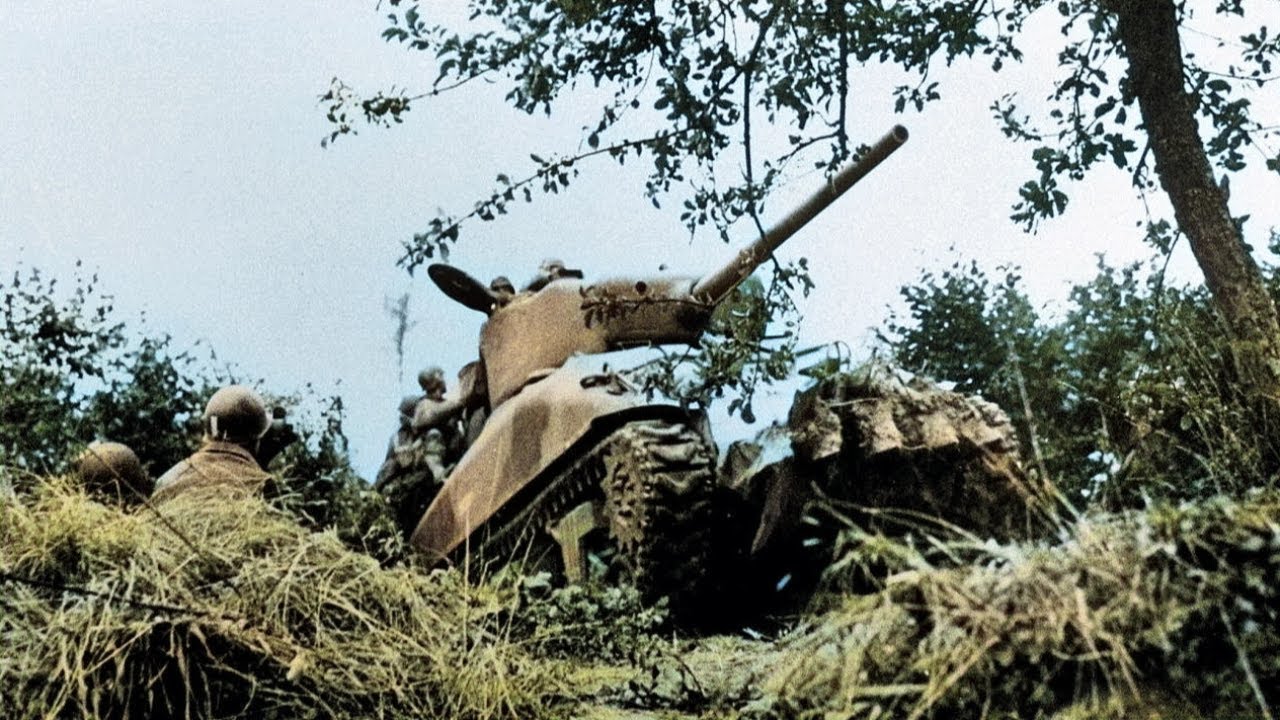
July 14th, 1944, three miles southwest of Saint-Lô, Lieutenant General Omar Bradley stood with his arms crossed, watching a Sherman tank back away from a hedgerow that had stopped the American advance cold for six weeks. Around him stood a small group of officers, including Major General Leonard Gerow, commander of Fifth Corps, and several ordnance specialists who had been summoned to witness what might be either a breakthrough or another failed experiment. Welded to the front of the tank were four steel prongs that jutted forward like tusks, a contraption so simple that Bradley had initially dismissed the report when it first crossed his desk.
But desperate times demanded desperate measures, and the American breakout from Normandy hung in the balance.
The tank’s engine roared to life. The driver shifted into gear and accelerated directly at the ancient earthen wall. Ten miles per hour.
Fifteen. The steel prongs struck the hedgerow with a sound like tearing canvas, a noise that would become familiar to American tankers across France in the coming weeks. Earth and roots exploded upward in a fountain of dirt.
The tank did not climb or tilt. It drove straight through, its prongs cutting into the base of the hedgerow like enormous knives through tough fabric. And then, in less than five seconds, the Sherman burst through to the other side, trailing broken branches and torn vegetation, but otherwise undamaged, its belly armor never exposed to enemy fire.
Bradley’s staff officers erupted in cheers. Ordnance specialists scrambled to examine the hedgerow, measuring the breach, checking for damage to the tank. The general himself remained silent for a moment, his mind already calculating the implications.
If this device worked reliably, if it could be manufactured in quantity, if it could be installed on enough tanks before the planned offensive, then perhaps Operation Cobra could succeed. Perhaps the stalemate could be broken. He turned to Lieutenant Colonel John Medaris, his chief ordnance officer, and spoke words that would change the course of the war.
“I want these devices manufactured and fitted to as many tanks as possible. Every Sherman, every Stuart, every tank destroyer we can modify. I want them ready before Operation Cobra launches.
Round-the-clock production. Use every ordnance unit, every maintenance depot, every welder we have. This is top priority.”
What Bradley had just witnessed was the solution to a problem that had threatened to turn the greatest amphibious invasion in history into a bloody stalemate. For six weeks, the bocage of Normandy had defeated the most powerful army ever assembled. The hedgerows, ancient boundaries between Norman fields, had proven more formidable than German concrete fortifications, more effective than minefields, more deadly than the Atlantic Wall itself.
And the man who had solved this seemingly impossible problem was not a general with decades of military experience, not an MIT-trained engineer with advanced degrees, but a twenty-nine-year-old sergeant from New Jersey who had improvised a solution from scrap metal salvaged from German beach obstacles and applied nothing more complicated than common sense and a welding torch.
Three hundred miles away, Supreme Commander Dwight D. Eisenhower paced in his headquarters at Southwick House near Portsmouth, studying maps that told a story of mounting disaster. It was mid-June 1944.
The D-Day landings, executed just days earlier, had succeeded beyond even the most optimistic projections. Despite horrific casualties on Omaha Beach, where American forces had nearly been thrown back into the sea, by nightfall of June 6th more than 150,000 American, British, and Canadian troops had established footholds along fifty miles of French coastline. Within a week, the Allies had landed over 300,000 troops and established a continuous beachhead from the Cotentin Peninsula to Caen.
The greatest amphibious assault in history had breached Hitler’s Atlantic Wall.
But the maps told a darker story. The advance inland, the rapid exploitation that was supposed to carry Allied armies deep into France, had stalled almost immediately. By mid-June, two weeks after D-Day, Allied forces controlled a beachhead barely twenty miles deep and fifty miles wide.
More than a million troops were now ashore, but they were wedged into a narrow coastal strip, unable to advance, bleeding casualties by the thousands every day, and facing the very real possibility that the entire invasion might collapse into the same kind of static trench warfare that had characterized World War I.
The grand strategy called for a rapid breakout. British and Canadian forces would seize Caen, a critical road and rail junction, on D-Day itself and push south into open tank country. American forces would cut across the Cotentin Peninsula, capture the port of Cherbourg within nine days, then wheel south toward Brittany.
Within two weeks, the Allied penetration was supposed to extend fifteen miles inland along a continuous front. Instead, the Allies were bogged down in brutal close-quarter combat, advancing by yards rather than miles, losing thousands of men for tiny gains in territory. And the reason had a name: the bocage, the hedgerows of Normandy.
On June 7th, 1944, twenty-four hours after the successful landing on Omaha Beach, soldiers of the First Infantry Division, the Big Red One, pushed inland from the coast. They were exhausted from the beach assault, having suffered nearly 2,000 casualties in the landing, but they were alive, and they had broken through the Atlantic Wall. They expected to encounter retreating German forces, perhaps some hastily prepared defensive positions in the villages and towns inland.
What they found instead was a landscape that seemed designed by nature itself to favor defenders and destroy attackers, a green maze that would prove more deadly than the German fortifications they had just overcome.
Private James Henderson of the 26th Infantry Regiment wrote in his diary that first day, a passage that would be discovered decades later in the National Archives: “We thought we were through the worst after the beach. We had beaten the Atlantic Wall. We had survived the worst that Hitler could throw at us.
Then we came to these hedges, these damned Norman hedges. God help us. God help us all.”
The hedgerows were not hedges in any sense that American soldiers understood. They were not decorative shrub borders or agricultural fencing that could be cut or pushed aside. They were ancient fortifications built up over centuries by Norman farmers who had shaped this landscape since the Middle Ages.
The process had begun a thousand years earlier when farmers cleared their fields of stones and rocks, piling them along property boundaries to mark ownership and create barriers for livestock. Generation after generation had added to these walls. More stones.
More earth. Seeds from plants growing on top would fall and take root. Trees would sprout.
Over centuries, the walls grew into earthen banks three to twelve feet high and one to ten feet thick at the base. The soil was packed hard as concrete, compacted by centuries of settling and reinforced by the root systems of the vegetation growing on top. On these earthen ramparts grew oak trees, hawthorn bushes, brambles, wild roses, and thorns that intertwined into barriers rising fifteen feet above the earthen base.
The roots penetrated deep into the banks, some extending ten or fifteen feet down through the packed earth, creating a reinforced structure stronger than most man-made fortifications. These root systems were so dense, so thoroughly intertwined after centuries of growth, that the hedgerow could not be dug through without power tools, and could not be blown apart without massive explosive charges that would reveal American positions to every German within miles.
These hedgerows surrounded irregular fields that varied wildly in size, averaging two hundred to four hundred yards across. Some fields were nearly square. Others were long and narrow.
Some were triangular. The pattern was completely irregular, the product of a thousand years of inheritance law, land division, and agricultural practice. Aerial photographs taken by reconnaissance aircraft in the weeks before D-Day had revealed the true scope of the problem, though intelligence officers had failed to appreciate its tactical significance.
One photograph of the American sector covering just eight square miles near Saint-Lô showed nearly 4,000 separate hedgerow-enclosed fields. Each field was a potential fortress. Each hedgerow formed a defensive wall, and there were thousands of them stretching across the entire American sector.
For German defenders, every hedgerow was a ready-made defensive position superior to anything military engineers could construct. Machine gun teams could dig firing positions into the earthen banks, creating small apertures just large enough for the gun barrel that overlooked the open fields. These positions were invisible from more than a few yards away, protected from artillery by the earthen bank itself, immune to everything except a direct hit by a large-caliber shell.
The vegetation on top provided perfect concealment from aerial observation. Spotter planes flying overhead saw only an unbroken canopy of green. A German soldier crouched behind a hedgerow was safer than a soldier in a concrete pillbox, because the pillbox could be identified and targeted while the hedgerow position was invisible until it opened fire.
The tactical advantages for defenders were overwhelming. A single German squad, eight or nine men properly positioned behind a hedgerow with a machine gun and rifles, could cover an entire field and hold off an American company of two hundred men for hours. The Germans did not need continuous defensive lines.
They simply positioned small groups throughout the bocage, creating a defense in depth where each position supported the others. When American forces attacked across a field, they faced fire not just from the hedgerow directly in front of them, but from hedgerows on their flanks, creating a crossfire that turned every field into a killing zone.
American attackers faced tactical problems that were almost impossible to solve with available resources and doctrine. Infantry attempting to cross the open fields were completely exposed. There was no cover in the middle of a Norman field.
No trees, no rocks, no depressions in the ground. Just open grass or crops with German machine guns and rifles covering every square yard from positions that could not be seen until they opened fire. The Germans had already registered their weapons on likely crossing points, marking ranges, calculating angles, preparing to deliver fire.
The instant American troops emerged from the previous hedgerow, they were journeying through pre-targeted killing zones where German gunners did not need to aim. They simply fired at predetermined points and hit whatever was there.
The sunken lanes that connected the fields, worn deep into the earth by centuries of cart traffic, were equally deadly. These narrow passages, some barely wide enough for a single vehicle, were obvious routes for American advance and therefore obvious places for German ambush. The Germans would block the lanes with felled trees, rubble from destroyed carts, or simple piles of earth.
Then they would position machine guns to cover the obstacles from concealed positions. American troops attempting to clear these lanes were channeled into narrow defiles where a single machine gun could stop an entire platoon.
And American tanks, the Sherman medium tanks that were supposed to be the key to mobile warfare, were neutralized completely by the bocage. The Sherman was a good tank by any reasonable standard. Its 75mm gun could destroy any German tank at normal combat ranges.
It was reliable, easy to maintain, and produced in quantities that German industry could not match. American factories were building Shermans at a rate of more than 1,000 per month. But all these advantages meant nothing in the bocage, because Sherman tanks could not penetrate the hedgerows.
The earthen banks were too thick, too solid, too heavily reinforced by root systems. A Sherman’s 75mm gun could blow a hole in the vegetation on top, but that did not create a breach large enough for the tank to pass through. The earthen base remained intact.
Tank commanders, frustrated and desperate, began attempting to breach obstacles by brute force. They would back up to get a running start, then accelerate directly at the hedgerow, attempting to use the tank’s weight and power to smash through or climb over. This tactic was suicidal.
When a Sherman attempted to ride up and over a hedgerow, the front of the tank would rise as it climbed the earthen bank. The tank would tilt backward at an angle of thirty or forty degrees. This exposed the belly of the tank, the underside between the tracks, which was protected by only one inch of steel armor.
This armor was designed merely to resist mine fragments, not to stop anti-tank weapons. A German soldier with a Panzerfaust, the shoulder-fired anti-tank rocket issued to German infantry by the thousands, could position himself in the next field and simply wait. He would hear the tank engine roaring as the Sherman climbed the hedgerow.
He would see the front of the tank rise above the vegetation, and when the belly armor was exposed, he would fire. One rocket was usually sufficient. The Panzerfaust could penetrate nearly six inches of armor against the Sherman’s one-inch belly plate.
Lieutenant Colonel Wesley Yale, commanding a tank battalion in the Second Armored Division, lost four Sherman tanks in a single morning attempting to breach a hedgerow near the town of Isigny. Four tanks destroyed, four crews killed or wounded, sixteen men dead or injured, and not a single successful breach. His after-action report, filed on June 15th, captured the frustration and rage felt by every American armor officer in Normandy: “The enemy need not even see our tanks to destroy them.
They position themselves in the next field behind the next hedge row and simply wait. They listen for the sound of our engines. They hear us climbing the obstacle.
And when we reach the top, when our belly is exposed, they fire. We are losing crews and machines to an enemy we never see, never engage, never have a chance to fight. Our tanks, which should be our greatest advantage, have become death traps in this cursed country.”
American forces tried every solution their training and doctrine suggested. Combat engineers trained in demolitions were brought forward to blow gaps in the hedgerows using explosives. This technique worked technically.
A properly placed charge of TNT or Composition C could blast a hole through even the thickest hedgerow, creating an opening large enough for a Sherman to pass through. But the tactic had fatal flaws. First, it was slow.
Engineers had to move forward under fire, approach the hedgerow, place the charges, connect the detonators, retreat to a safe distance, and blow the charge. This process took ten to fifteen minutes under ideal conditions, longer under fire. Second, the explosions announced American intentions to every German within hearing, which in the relatively quiet Norman countryside meant every German within two or three miles.
Enemy machine gunners and mortar teams would train their weapons on the gap before the smoke cleared. Third, American infantry and tanks advancing through these blown breaches were funneled into a single narrow opening that became a pre-targeted killing zone.
Specialized armored vehicles, particularly bulldozer tanks, proved little better. These were standard Sherman tanks fitted with heavy steel bulldozer blades on the front, designed originally for clearing beach obstacles during amphibious landings. In theory, these vehicles could push through or scrape aside the hedgerows, creating passages for following tanks.
In practice, they became priority targets for German anti-tank gunners. The bulldozer tanks were slower than standard Shermans, less maneuverable, and highly conspicuous. German observers would identify them immediately and direct anti-tank fire at them, knowing that destroying the bulldozers would deny the Americans their primary means of breaching obstacles.
The 75th Armored Division, which had landed in Normandy with fourteen bulldozer tanks, lost eleven of them in the first three weeks of combat. By early July, American forces had virtually no bulldozer capacity left, and the few surviving vehicles were being hoarded for critical missions rather than routine hedgerow clearing.
By late June 1944, six weeks after D-Day, the American advance had slowed to a nightmarish crawl measured not in miles per day, but in yards per hour. The human cost was staggering and unsustainable. Official US Army histories document that Eighth Corps, advancing through the bocage toward La Haye-du-Puits and Lessay, suffered over 10,000 casualties while advancing approximately seven miles.
Some secondary sources have cited figures of 1,000 killed per kilometer for portions of this advance, though these specific numbers are difficult to verify from official records. What is certain is that American infantry was dying at rates that rivaled or exceeded the worst battles of World War I. The capture of Mont Castre, a hill overlooking the Cotentin Peninsula, cost American forces approximately 2,000 casualties in brutal close-quarters fighting.
The First Infantry Division, which had landed on Omaha Beach on D-Day, lost 75 percent of its frontline infantry in the first month of combat. Companies that had landed with 150 men were down to thirty or forty effectives. The 29th Division suffered equally catastrophic losses.
General Omar Nelson Bradley, commander of the First United States Army, faced a crisis that threatened not just his personal reputation, but the entire strategic plan for the invasion of Europe. His forces were exhausted, demoralized, and bleeding irreplaceable infantrymen at rates that could not be sustained. The British and Canadian forces to the east, fighting around the city of Caen, were making equally limited progress against heavy German armor.
Field Marshal Montgomery’s plan to seize Caen on D-Day had failed completely. The city would not fall until mid-July, more than a month behind schedule. The grand strategy that had guided two years of planning was collapsing into the same kind of static trench warfare that had characterized the Western Front in World War I.
Bradley’s chief of staff, Major General Walter Bedell Smith, who also served as Eisenhower’s chief of staff at Supreme Headquarters, described the situation in blunt terms that captured the growing sense of crisis. In a memorandum to Eisenhower he wrote: “In the south of Normandy, every small field is a fortress, every hedge a German strong point. We are fighting World War I again, but this time the trenches are green and growing.
Our advantages in mobility, armor, and firepower are negated by terrain. The Germans are trading space for casualties, and they are winning that exchange.”
The German defense of Normandy was brilliant in its simplicity and effectiveness. Rather than attempting to hold a continuous front line, which would have required more troops than they had available, German commanders positioned small groups of infantry throughout the bocage, using the natural fortifications to create a defense in depth that was nearly impossible to overcome with conventional tactics. A typical German defensive position consisted of two or three machine gun teams, a mortar crew, and a handful of riflemen, perhaps twenty to thirty soldiers total.
These small units would occupy a cluster of three or four hedgerows, positioning themselves to create interlocking fields of fire and mutually supporting positions. When American forces attacked, the Germans would hold their fire until the Americans were fully committed, emerging from cover and crossing the open fields. Then they would open fire with devastating effect.
German machine guns, particularly the MG42, which was capable of firing 1,200 rounds per minute, could scythe down an entire American platoon in seconds. The Americans would take cover, call for artillery support, attempt to identify the German positions. By the time American artillery rounds began falling, the Germans would have already displaced to their alternate positions in the next hedgerow, leaving the Americans to attack empty positions while German fire came from a completely different direction.
German snipers used the height advantage provided by trees growing on top of the hedgerows to observe American movements and pick off officers and non-commissioned officers. The loss of small-unit leaders was particularly devastating to American forces. A rifle company that lost its experienced sergeants and lieutenants in the first few days of combat would be far less effective even if it received replacement officers, because the new leaders did not know the men, did not know who could be trusted in combat, did not have the bonds of mutual trust that held units together under fire.
German snipers understood this and deliberately targeted anyone who appeared to be giving orders or carrying maps and radios.
The Germans camouflaged their positions with extraordinary care and discipline. They would cut fresh branches every morning to replace wilting camouflage. They would cover the track marks left by their vehicles, sometimes going so far as to try to make flattened grass stand upright again.
They dug tunnels under hedgerows to create protected routes for movement between defensive positions, allowing them to displace without being exposed to American fire. Some German units dug elaborate trench systems connecting multiple hedgerows, creating underground networks that allowed them to move entire squads from position to position without ever being visible to American observers or spotter aircraft.
The psychological impact of this combat on American troops was severe and cumulative. Men who had survived the horrors of Omaha Beach, who had faced German machine guns and artillery during the landing, who thought they had endured the worst combat imaginable, found the bocage even more terrifying. On the beach, at least the enemy was visible.
You could see the German bunkers. You could identify targets. You knew where the fire was coming from.
In the hedgerows, death came unseen from positions that could not be located until they opened fire. Every field was a potential killing ground. Every advance across open ground was a journey into terror, waiting for the moment when German machine guns would open fire and cut you down before you could react.
Captain Joseph Ewing, serving with the 175th Infantry Regiment of the 29th Division, described the approach to Saint-Lô in terms that captured the suffocating claustrophobia of hedgerow combat. He later wrote: “We advanced through a vast maze of natural fortifications miles in depth. Every hedge row was a possible enemy position.
Every field crossing was potentially fatal. We could not see more than one field ahead. We had no way of knowing where the Germans were until they opened fire.
The tension, the constant awareness that at any moment machine gun fire might erupt from invisible positions, wore men down faster than actual combat. Veterans became hollow-eyed and shaking. New replacements broke under the strain within days.”
Into this desperate situation, where the entire Normandy campaign teetered on the edge of failure, where American casualties mounted by the thousands and no solution seemed possible, came an ordinary soldier with an extraordinary idea.
Curtis Grubb Culin III was twenty-nine years old in the summer of 1944. A sergeant serving with the 102nd Cavalry Reconnaissance Squadron, part of the 102nd Cavalry Group operating under the command of Fifth Corps, he was nobody special in the vast hierarchy of the American army. He held no advanced degrees.
He had no engineering training. Culin was from Cranford, New Jersey, a small town about fifteen miles west of New York City. His father worked as a salesman for a liquor distributor.
Curtis had attended local public schools, graduating from Cleveland High School in Cranford in 1935. He had worked before the war as a sales promotion assistant for Schenley Industries, the same liquor company that employed his father. When the war came, he had enlisted in the New Jersey National Guard and been mobilized with his unit.
He was trained as a tanker and driver. He knew how to maintain and operate a Sherman tank. He knew how to fight in armored combat, but he had no special technical expertise that would suggest he was about to solve a problem that had baffled the best minds in the American military establishment.
What Curtis Culin had was something that could not be taught in any school or acquired through formal training. He had practical American ingenuity, the kind of problem-solving ability that came from growing up during the Great Depression when money was scarce and you learned to fix things yourself, to make do with whatever materials were available, to improvise solutions rather than waiting for someone else to solve your problems.
In early July 1944, during a brief respite from combat operations, soldiers from Culin’s unit gathered in an informal group to discuss the hedgerow problem. This was not an official meeting or planning session. It was just soldiers talking, sharing frustrations, venting anger about their situation.
Tank crews, infantry, and officers all contributed to the conversation. They talked about friends who had been killed or wounded. They talked about tanks that had been destroyed attempting to breach hedgerows.
They shared ideas, most of them impractical or impossible, about how to solve the problem.
At some point in this discussion, a soldier from Tennessee made a suggestion that sounded to most of the group like a joke or perhaps the ramblings of a man driven half mad by combat stress. Military historian Max Hastings, in his book Overlord: D-Day and the Battle for Normandy, published in 1984, identifies this soldier only as a Tennessee hillbilly named Roberts. Hastings provides no first name, no rank, no unit designation, no documentation.
Despite extensive research by military historians in the decades since, no primary source has ever been found that verifies this man’s identity or even confirms his existence. The account rests entirely on Hastings’s single mention, possibly based on oral history or anecdotal information that cannot be verified.
Nevertheless, according to Hastings, this soldier said something like: “Why don’t we get some saw teeth and put them on the front of the tank and cut through these hedges?” Most of the soldiers listening laughed or dismissed the idea immediately. It sounded ridiculous.
Saw teeth on a tank, like some kind of cartoon monster. But Curtis Culin, sitting quietly in the group, did not laugh. He heard something in the suggestion that others missed.
He recognized that beneath the crude phrasing was a mechanically sound principle. If tanks could not climb over hedgerows without exposing their vulnerable undersides, and if they could not punch through the solid earthen banks by brute force, then perhaps they could cut through them. Use the tank’s own weight and power to drive steel blades through the base of the hedgerow, severing roots and penetrating earth like a plow cutting through tough soil.
Culin began thinking about the problem systematically. He envisioned a set of steel prongs or tusks projecting forward from the tank’s hull. These prongs would need to be angled slightly downward so that when the tank drove into a hedgerow, they would bite into the earthen bank at ground level rather than riding up the face of the obstacle.
As the tank continued forward with full engine power, the prongs would cut through the roots and earth while the tank’s weight kept it level and prevented the dangerous upward tilt that exposed the belly armor. The severed vegetation and earth would be pushed up and over the tank, but the tank itself would drive straight through the breach at ground level.
The concept was simple, elegant, and achievable with available technology, but it required the right materials. The prongs needed to be strong enough to penetrate centuries of packed earth and dense root systems. They needed to be heavy enough to hold their position under stress, but not so heavy that they overloaded the tank suspension or reduced its mobility.
They needed to be made from high-quality steel that would not bend or break under the enormous forces involved in cutting through a hedgerow.
Where could such materials be found in Normandy in July 1944? The answer was literally lying on the beaches where the invasion had taken place six weeks earlier. Before D-Day, German engineers had installed thousands upon thousands of obstacles along the Normandy coast, creating a barrier system designed to destroy Allied landing craft before they could reach shore.
Among the most common obstacles were devices called Czech hedgehogs, named for their resemblance to the anti-tank obstacles the Czech army had developed before the war. Each hedgehog was constructed from three steel I-beams, industrial-grade structural steel about six feet long, welded together at angles to form a six-pointed obstacle that looked somewhat like a giant jack from a children’s game. These hedgehogs were supposed to rip open the hulls of landing craft or provide anchor points for mines.
In the event, the invasion had bypassed or destroyed most of them. Thousands of Czech hedgehogs now lay scattered along the invasion beaches, having failed to stop the Allied assault. They had been pushed aside by the landing forces, blown up by combat engineers, or simply bypassed.
The steel beams, still intact and of excellent quality, were being collected in salvage yards behind the beaches, waiting to be shipped back to England for recycling.
Here was exactly what Culin needed. High-quality structural steel already cut to convenient lengths, available in unlimited quantities. All he needed was permission to experiment and access to welding equipment.
Getting approval from his immediate superiors proved surprisingly easy. Officers at every level of the American army in Normandy were desperate for any solution to the hedgerow problem. When Curtis Culin approached his company commander with rough sketches and an explanation of his concept, including where he planned to source materials, the captain gave immediate approval.
Within forty-eight hours, Culin had been given access to a Sherman tank for experiments, welding equipment from the unit maintenance section, and authorization to organize a work party to retrieve steel beams from a salvage yard near Omaha Beach.
The prototype took three days to construct in early July 1944. Culin and his work party selected four sections of steel I-beam from the salvage yard, each approximately five feet long and weighing about one hundred pounds. They used cutting torches to bevel the forward ends of the beams, creating angled cutting edges that would bite into earth and roots more effectively than blunt ends.
They welded a horizontal crossbar to hold the four prongs in position, spacing them evenly across the width of the tank’s front hull. Then they welded the entire assembly, prongs and crossbar together, to the lower front armor plate of the Sherman, positioning it so the prongs projected forward and angled slightly downward.
The result was crude but functional. Four steel tusks projecting forward from the tank’s hull, angled downward at perhaps ten degrees from horizontal, ready to be driven into a hedgerow. The assembly added about four hundred pounds to the tank’s weight, not enough to significantly affect performance, but enough to be noticeable.
The prongs extended about four feet in front of the tank’s normal profile, which meant drivers would need to be careful in close-quarters maneuvers. But if the device worked, these minor inconveniences would be more than justified.
The first test was conducted on July 11th, 1944, in a field near the town of Isigny-sur-Mer, several miles inland from Omaha Beach. A small group of perhaps twenty soldiers gathered to watch, mostly tankers and officers from Culin’s unit. Most of them expected another failure.
They had seen too many proposed solutions to the hedgerow problem, all of which had failed in one way or another. A tank with steel prongs welded to the front seemed unlikely to succeed where explosives and bulldozers had failed. But they were willing to watch, if only to be able to say they had been there when yet another crazy idea fell apart.
The test hedgerow was selected carefully. It needed to be representative of typical Norman bocage, not an unusually small or weak example that might give false results. The hedgerow they chose was about four feet high at the earthen base, topped with fifteen feet of mature vegetation, including oak trees with trunks four or five inches in diameter.
This was an average hedgerow, the kind American tankers encountered dozens of times every day. If Culin’s device could breach this obstacle, it could breach most of the hedgerows in Normandy.
The Sherman tank backed up to give itself room to build speed. The driver, a corporal from Pennsylvania whose name has not been preserved in historical records, was understandably nervous. If the device failed, if the tank bellied up on the hedgerow, as so many tanks had before, he and his crew might be the next casualties of the bocage.
But he trusted Sergeant Culin, who had explained the theory carefully and seemed confident it would work.
The driver shifted into gear, advanced the throttle, and aimed directly at the hedgerow. Five miles per hour. Eight.
Ten. The tank hit the hedgerow with the prongs leading. There was a sound like heavy canvas tearing, a deep ripping noise as steel cut through earth and roots.
The prongs bit into the earthen bank and penetrated deep. For a moment, it seemed the tank might stall, might be stopped by the resistance of the obstacle. Then the engine roar increased.
The driver gave it full throttle. The tank’s treads gripped the ground and pushed forward. Earth fountained up and over the tank’s hull, blown upward by the force of the breach.
Branches snapped. Tree trunks splintered. Vegetation showered down on the turret and rear deck.
And then, less than five seconds after impact, the Sherman burst through to the other side of the hedgerow, trailing broken branches and torn roots, but otherwise completely undamaged.
The tank had not climbed the obstacle. It had cut through at ground level, exactly as Culin had predicted. The watching soldiers erupted in cheers and shouts.
Some of them were crying, not from sadness, but from relief and hope. For six weeks they had watched friends die in futile attempts to breach these obstacles. For six weeks they had felt helpless against terrain that seemed unconquerable.
Now, suddenly, impossibly, a simple device made from scrap metal had solved the problem. The tankers surrounded Culin, shaking his hand, pounding his back, thanking him with a fervor that embarrassed the modest sergeant.
But a single successful test, however dramatic, was not enough to transform the course of a military campaign. The device needed to prove itself in repeated trials under various conditions. More tests were conducted over the next two days.
Different hedgerows, different angles of approach, different speeds. Every test succeeded. The device worked reliably, predictably, safely.
Tank crews quickly learned the optimal technique. Approach at ten to twelve miles per hour. Aim directly at the hedgerow, not at an angle.
Give full throttle at impact. The tank would shudder as the prongs bit into earth, but it would drive straight through without climbing or exposing its belly. Breaching time averaged five to eight seconds from impact to emergence on the far side.
Word of Culin’s invention spread rapidly through the Second Armored Division and beyond. Within three days of the first successful test, Major General Edward Brooks, commanding the Second Armored Division, had seen reports and requested a formal demonstration. Brooks was a competent, aggressive commander who understood armor tactics and recognized a breakthrough when he saw one.
He immediately grasped the significance of Culin’s device and understood that it needed to be demonstrated to the one man whose approval and support could authorize mass production and force-wide implementation.
On July 13th, General Brooks sent a message to First Army headquarters requesting that Lieutenant General Omar Bradley visit the Second Armored Division area for a demonstration of a new hedgerow-breaching device. Bradley, buried under reports and complaints about the stalled offensive, was initially skeptical. He had seen proposed solutions before, all of which had failed.
But Brooks insisted this was different, and Bradley trusted his division commanders. He agreed to visit the following day, July 14th, 1944.
Bradley arrived with his entourage, including Major General Leonard Gerow of Fifth Corps and several ordnance specialists. Two tanks had been prepared for demonstration. A light M5A1 Stuart tank and a medium Sherman, both equipped with Culin’s device.
The hedgerow selected for the demonstration was carefully chosen to be representative of typical bocage terrain. A five-foot earthen bank topped with thick brush and mature trees. The kind of obstacle that had stopped American advances for six weeks.
The light tank performed first, backing up to gain speed, then accelerating directly at the hedgerow. The impact. The sound of tearing earth and breaking roots.
The fountain of dirt exploding upward. And then the tank bursting through in less than five seconds. Before anyone could react, the Sherman demonstrated the same capability with even more dramatic effect.
Its greater weight and power drove through the obstacle like it was soft clay rather than a centuries-old earthen wall reinforced with tree roots.
Bradley stood silent for a moment, his mind racing through implications. Six weeks of stalemate. Thousands of casualties.
An offensive about to be launched that might fail if tanks could not maneuver through the bocage. And here, demonstrated twice in the space of two minutes, was the solution. Simple.
Reliable. Achievable with available materials. He turned to his ordnance chief and issued the orders that would change everything.
The conversation that followed the demonstration lasted less than ten minutes, but set in motion a manufacturing effort unprecedented in its speed and scale. Bradley wanted these devices on as many tanks as possible before Operation Cobra launched. The offensive was scheduled to begin in eleven days, on July 25th.
That meant eleven days to manufacture hundreds of devices, transport them to units scattered across Normandy, and weld them onto tanks. It meant round-the-clock production. It meant mobilizing every ordnance unit, every maintenance depot, every welder in the American sector.
It meant improvising a mass production system for a device that had been invented less than a week earlier.
Lieutenant Colonel John Medaris, First Army Ordnance Officer, was given personal responsibility for the manufacturing program. He was a West Point graduate, class of 1930, a professional officer with extensive experience in logistics and matériel. He understood immediately that this was not a routine production job.
This was an emergency crash program that might determine the outcome of the entire Normandy campaign.
Medaris returned to his headquarters and within hours had issued orders that would set in motion the most rapid military production program of the war. Every ordnance company, maintenance battalion, and repair depot in the American sector received orders on July 14th to begin immediate production of hedgerow-cutting devices. Specifications were transmitted by telephone and radio.
Four steel prongs approximately five feet long, made from German beach obstacle steel. Beveled cutting edges on the forward ends. Crossbar to hold prongs in position.
Entire assembly welded to lower front hull of tank. Simple enough that any competent welder could fabricate it. Complex enough that it required skill and care to ensure the welds would hold under combat stress.
The raw material was abundant. Salvage yards behind the beaches contained thousands of tons of steel from destroyed German obstacles. Trucks began hauling steel beams to ordnance units across Normandy.
The beams arrived in bundles, still covered with rust and barnacles from their time underwater, some still showing damage from explosives or shellfire. Ordnance troops would sort through the beams, selecting those that were straight and undamaged, rejecting any that showed cracks or severe corrosion. The selected beams would be cut to length using acetylene torches, beveled on the ends, and set aside for welding.
The welding work was brutal. Summer heat in Normandy in July 1944 reached into the eighties and nineties Fahrenheit. Welders worked in heavy leather protective gear, wearing face shields and gloves, manipulating steel beams that weighed over one hundred pounds each.
The work was done outdoors or in canvas-sheltered areas because there was no time to set up proper workshops. Each device required multiple hours of welding. The four prongs had to be welded to the crossbar.
The crossbar had to be welded to the tank’s hull. Every weld had to be strong enough to withstand the enormous forces generated when the tank drove into a hedgerow at full speed. A weak weld could fail at the moment of impact, potentially causing the tank to belly up on the obstacle, exactly as unmodified tanks did.
The ordnance units worked in shifts twenty-four hours a day. Welders worked six-hour shifts, then rested while other crews took over. Acetylene tanks and welding rods had to be trucked in constantly to keep the work going.
When one ordnance company ran low on materials, trucks would be dispatched to transfer supplies from units that had excess. The entire system operated with the kind of flexible improvisation that characterized American military logistics at its best. There were no detailed plans, no carefully calculated production schedules.
There was only the urgent need to produce as many devices as possible before Operation Cobra launched.
Tank crews from combat units would drive their vehicles to the nearest ordnance facility, wait while the device was fabricated and installed, then drive back to their units. Some crews waited six or eight hours. Others waited overnight, but they waited because they knew the device might save their lives.
Tankers who had lost friends to Panzerfaust fire when tanks bellied up on hedgerows understood that Culin’s device could prevent those deaths. They were willing to wait as long as necessary to get their tanks modified.
The modified tanks began appearing in combat units in mid-July. At first, there were just a few, a handful per battalion. Crews with modified tanks would volunteer for the most dangerous missions, testing the devices under actual combat conditions.
The reports that came back were uniformly positive. The devices worked exactly as demonstrated. Tanks could breach hedgerows in seconds without exposing their vulnerable undersides.
Tank commanders could choose their own routes through the bocage rather than being forced to follow roads or search for gaps that might be covered by German fire. The tactical flexibility was transformative.
By July 20th, five days before Operation Cobra was scheduled to begin, approximately 300 tanks in First Army had been fitted with Culin’s device. This represented about 15 percent of American armor in the theater. It was not enough.
Bradley wanted more. Medaris pushed production harder. More ordnance units were diverted from other tasks.
More welders were pulled from maintenance work and set to manufacturing hedgerow cutters. The pace became frantic, desperate, driven by the knowledge that Operation Cobra was approaching. And every tank without a device was a tank that might be stopped by the bocage.
By July 24th, the day before Operation Cobra launched, approximately 500 devices had been manufactured and installed on American tanks. This represented nearly 60 percent of the Sherman medium tanks, Stuart light tanks, and M10 tank destroyers that would participate in the offensive. It was not 100 percent.
There had not been enough time. But it was enough. Enough to give American armor the mobility it needed, enough to restore tactical flexibility, enough to break the stalemate.
The tanks themselves looked fearsome with their new equipment. The four steel prongs projecting from each hull gave the Shermans an aggressive, almost predatory appearance. Soldiers began calling them rhino tanks, drawing the obvious comparison to the horned animals of Africa.
Others called them rhinoceros tanks. The names stuck. Within days, everyone in the American army knew what a rhino tank was.
The final days before Operation Cobra were filled with feverish preparation. Infantry units rehearsed assault techniques. Artillery officers registered their guns on pre-planned targets.
Air Force liaison officers coordinated with ground units to ensure close air support would be available. And throughout the American sector, hundreds of Sherman tanks with newly welded steel prongs conducted final tests, training crews in the techniques of hedgerow breaching, ensuring that when the offensive began, armor could exploit any breakthrough achieved by infantry and air power.
July 25th, 1944. 0940 hours. The sky over Normandy filled with the sound of approaching aircraft.
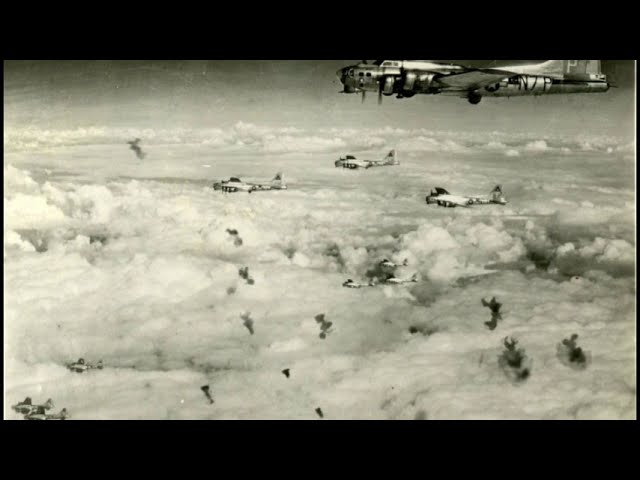
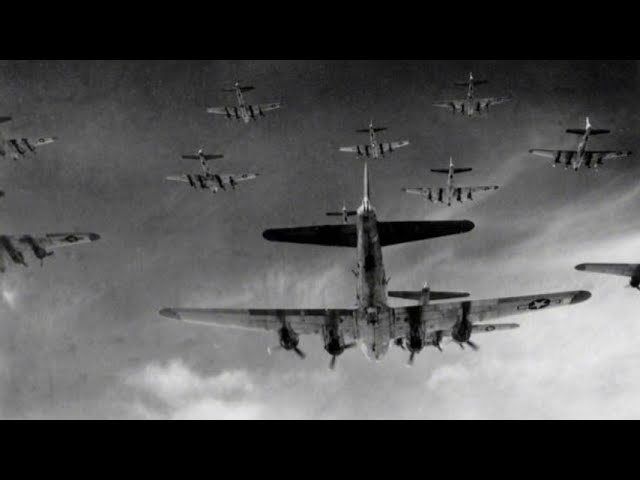
More than 1,500 B-17 Flying Fortress and B-24 Liberator heavy bombers, flying in formations so large they darkened the sky, approached their targets in a rectangular area northwest of Saint-Lô. The bombers had taken off from bases in England hours earlier, climbing to altitude over the English Channel, forming up into their massive formations, then flying south across the invasion beaches toward their assigned target zones.
The target area for the carpet bombing was a rectangle approximately five miles long and one and a half miles wide between the towns of Marigny and Hébécrevon. This was the sector held by German forces directly in the path of the planned American offensive. The bombing was intended to obliterate German defenses, destroy command and control networks, kill or stun German soldiers, and create chaos that would allow American ground forces to penetrate deep into German rear areas before effective resistance could be organized.
The bombardment began at exactly 0940. The first bomber wings released their loads from altitude. High-explosive bombs and fragmentation bombs fell in a deadly rain.
The effect on the ground was apocalyptic. Bombs weighing 500 pounds, 1,000 pounds, even 2,000 pounds detonated in rapid succession. The earth heaved and shook.
Trees were blown to splinters. Hedgerows were obliterated. Buildings collapsed.
German soldiers caught in the open or in inadequate shelters were killed instantly by blast or shredded by flying fragments. Those who survived the initial explosions were left stunned, deafened, unable to think or function.
The bombing continued for nearly one hour. Wave after wave of heavy bombers passed over the target area, each plane releasing its bombs, then turning for the flight back to England. Following the heavy bombers came approximately 1,000 medium bombers and fighter-bombers, carrying incendiary bombs and additional high explosives.
By the time the last aircraft departed, approximately 3,300 tons of high-explosive bombs and 60,000 incendiary bombs had been dropped on the target area. The bombardment covered twelve square kilometers with approximately 5,000 bombs per square kilometer. The landscape was transformed into a pockmarked lunar moonscape of overlapping craters, splintered trees, and burning debris.
But the precision that bombardiers had hoped for proved impossible to achieve. The target area was close to American front lines, separated in some places by only a few hundred yards. Thick clouds obscured visibility.
Bomb aiming was done by dead reckoning and radar, both imprecise methods under the best circumstances. Some bombs fell short of the target zone, landing instead on American positions. The results were tragic.
111 American soldiers were killed and nearly 500 wounded by bombs from their own aircraft. Among the dead was Lieutenant General Leslie James McNair, who had been observing the bombardment from a forward position with troops of the 30th Infantry Division. McNair was the highest-ranking American officer killed in combat in the European theater during World War II.
He held the rank of lieutenant general at the time of his death, though he would receive a posthumous promotion to full general. The friendly-fire casualties on July 25th added to casualties from a similar incident the previous day, when initial bombing runs had been aborted due to weather, but not before some aircraft had already released their bombs, killing and wounding over 150 Americans. The total friendly-fire casualties from the Operation Cobra bombardment exceeded 800 killed and wounded.
Despite these tragic losses, the bombardment achieved its primary objective. German defenses in the target area were effectively destroyed. The Panzer Lehr Division, one of the elite German armored formations defending the sector, was reduced to a remnant of its former strength.
Its commander, General Fritz Bayerlein, later described the scene in terms that captured the sheer overwhelming violence of the bombardment: “I observed a pillar of dust with fountains of earth spewing high in the air. My front lines looked like a landscape on the moon, and at least 70 percent of my troops were out of action, dead, wounded, crazed, or numb.” Approximately 1,000 German soldiers were killed in the bombardment.
Dozens of command posts were destroyed, obliterating the command and control network that coordinated German defenses. Communications were cut. Telephone lines were severed by explosions.
Radio antennas were knocked down. Officers attempting to give orders found themselves unable to communicate with subordinate units. Survivors of the bombardment emerged from their shelters stunned, deafened, many of them suffering from concussion and shock.
German defensive positions that had withstood weeks of American attacks were obliterated in less than an hour.
Into this chaos, American ground forces advanced. The Seventh Corps, commanded by Major General J. Lawton Collins, formed the main thrust of Operation Cobra.
Collins was one of the most aggressive and competent corps commanders in the American army. A man who understood the importance of maintaining momentum and exploiting success. His nickname was “Lightning Joe,” earned during fighting in the Pacific, and it reflected his tactical philosophy of speed and violence of action.
Three infantry divisions formed the assault force for Seventh Corps: the Fourth Infantry Division on the right flank, the Ninth Infantry Division in the center, the 30th Infantry Division on the left. These divisions had been fighting in Normandy since D-Day. They were experienced, battle-hardened, and grimly determined.
Their mission was to attack south from positions near Saint-Lô, penetrate German defenses shattered by the bombardment, and open a corridor through which American armor could exploit. Behind the infantry divisions waited two armored divisions. The Second Armored Division, the “Hell on Wheels” division, was commanded by Major General Edward Brooks.
The Third Armored Division, the “Spearhead” division, was commanded by Major General Leroy Watson. These divisions contained the bulk of American armor that would participate in Operation Cobra, and a substantial portion of their Sherman tanks, approximately 60 percent, were now equipped with Curtis Culin’s hedgerow-cutting devices.
The infantry assault began in the early afternoon of July 25th, several hours after the bombing ended. American troops advanced through the devastated landscape, moving cautiously at first, expecting German resistance to materialize at any moment. But the resistance was disorganized and weak.
German soldiers who had survived the bombardment were in no condition to mount an effective defense. Many were still stunned, sitting in bomb craters, unable to comprehend what had happened. Others attempted to resist, but found their weapons buried under rubble or their ammunition expended.
Command and control had broken down completely.
The initial advance on July 25th penetrated approximately one mile beyond the start line. This was slower than hoped, evidence that even the massive bombardment had not completely eliminated German resistance. Hedgerows, even when damaged by bombing, still provided some defensive value.
American infantry still had to clear German positions field by field in brutal close-quarters combat. But the resistance was not the organized, coordinated defense that had stopped previous American attacks. This was the fighting of scattered survivors, individual acts of courage or desperation rather than systematic defense in depth.
Major General Collins, monitoring the advance from his forward command post, recognized something that others might have missed. The German resistance, though still deadly, was not coherent. There was no defensive plan being executed, no coordinated counterattacks, no systematic attempt to establish new defensive positions.
The German command structure had been destroyed by the bombardment. Units were fighting in isolation, without support, without direction. The German front line was not bending under American pressure.
It was breaking.
Late in the afternoon of July 25th, Collins made the bold decision that would transform Operation Cobra from a limited offensive into a breakthrough that changed the entire Normandy campaign. He ordered his two armored divisions to begin their exploitation immediately, ahead of the original schedule. The plan had called for infantry to open a wide corridor before armor advanced.
But Collins saw that waiting might allow the Germans time to recover, to establish new defensive positions, to bring up reinforcements. He decided to commit his armor while the Germans were still reeling from the bombardment, gambling that American tanks could exploit the chaos before German defenses could solidify.
The armored exploitation began at dawn on July 26th. Combat Command A of the Second Armored Division, led by Brigadier General Maurice Rose, drove south from the Saint-Lô area with orders to advance as far and as fast as possible. Rose was an aggressive commander who understood armored warfare and knew how to exploit success.
His column consisted of Sherman tanks, tank destroyers, armored infantry in half-tracks, and self-propelled artillery. And crucially, the majority of his tanks were equipped with Culin’s hedgerow-cutting devices.
For the first time since D-Day, American armor operated with true mobility and freedom of maneuver in the Norman bocage. The Rhino tanks crashed through hedgerow after hedgerow, choosing their own routes, avoiding German strong points, exploiting gaps in the disintegrated German defense. Tank commanders no longer needed to follow roads where German anti-tank guns might be positioned.
They no longer needed to search for gaps in hedgerows that might be covered by German fire. They simply drove cross-country, breaching obstacles at will, maintaining momentum, preventing Germans from establishing new defensive positions.
The psychological impact on German forces was catastrophic. For six weeks, German defenders had relied on the bocage as their primary defensive advantage. They had used the hedgerows to channel American attacks into predetermined killing zones.
They had positioned anti-tank weapons to cover the few routes through which American armor could advance. Now, suddenly, impossibly, American tanks were appearing from unexpected directions, breaking through hedgerows that Germans had assumed were impossible barriers. The entire German defensive system, carefully constructed over weeks of combat, was rendered obsolete in a single day.
German attempts at counterattack proved futile. Small groups of German infantry attempting to block American advances found themselves bypassed and isolated as American tanks drove through hedgerows on either side of their positions. German anti-tank guns, carefully positioned to cover roads and known passages, found their fields of fire blocked by hedgerows, while American tanks emerged from directions the Germans had not anticipated.
German officers attempting to coordinate defense found themselves unable to predict where American armor would appear next.
By midday on July 26th, lead elements of the Second Armored Division had advanced six miles beyond the start line. Six miles in half a day. This was farther than the entire First Army had managed to advance in the previous two weeks of grinding attritional combat.
The contrast was stark and dramatic. The town of Marigny, a significant road junction six kilometers south of the start line, fell to the First Infantry Division supported by the Third Armored Division. German prisoners, many of them reinforcements who had just arrived from training battalions in Germany, surrendered in such numbers that American units simply directed them to walk to the rear without guards.
There were not enough military police to process them all.
A senior non-commissioned officer in a German medical unit, identified in captured documents only by his last name, Kleine, wrote in his diary on the evening of July 26th: “Today we understood that everything is lost. The Americans have broken through. Their tanks are everywhere.
They come from directions we thought impossible. Our defensive positions that held for weeks are suddenly worthless. The men are talking among themselves in ways that would have been unthinkable a week ago.
They speak of survival, not victory. They speak of escape, not defense. Morale has collapsed overnight.”
July 27th, the American advance accelerated. The 30th Infantry Division, which had suffered the worst of the friendly-fire casualties on July 25th, reported in words that would become famous: “This thing has busted wide open.” The Third Armored Division reached the area around Coutances, a critical road junction approximately fifteen miles behind what had been the German front line just two days earlier.
German forces attempting to withdraw south to avoid encirclement found their routes blocked by American armor that had already penetrated deep into their rear areas. Entire German units were cut off, surrounded, destroyed, or forced to surrender.
The breakthrough, achieved by July 28th, exceeded even Bradley’s optimistic projections. American forces had penetrated more than twenty miles beyond the start line in just three days. The German Seventh Army, which had fought the Americans to a standstill for six weeks in the bocage, was in full retreat, its units scattered and disorganized, its command structure shattered, its ability to conduct coordinated defense destroyed.
The bocage, the nightmare terrain that had seemed to make sustained offensive operations impossible, was now behind American lines. Ahead lay the relatively open country of central France, where American mobility and firepower advantages could be employed without restriction.
Post-battle analysis conducted by American intelligence officers in the weeks following Operation Cobra revealed the decisive role of the Rhino tanks. Staff officers examined after-action reports, interviewed unit commanders, and compiled statistics on how hedgerows had been breached during the offensive. The conclusion was clear and dramatic.
Approximately 70 percent of successful hedgerow breaches during Operation Cobra were accomplished by tanks equipped with Culin’s devices. The remaining 30 percent required engineer support with explosives, bulldozers, or manual labor, all of which were significantly slower and more vulnerable to German defensive fire. Tank crews reported that the Culin devices allowed them to breach a typical Norman hedgerow in less than ten seconds from initial impact to emergence on the far side.
This speed was absolutely critical to maintaining momentum and preventing German forces from repositioning to counter each breach. Previous methods of breaching hedgerows had required anywhere from ten minutes to half an hour, allowing Germans to prepare defensive fire against any breach. The speed advantage provided by the Rhino tanks gave American forces the tactical surprise and tempo that made rapid exploitation possible.
American tanks equipped with Culin devices also suffered significantly fewer casualties than unmodified tanks operating in the same terrain. Ordnance officers analyzing loss rates found that Rhino tanks experienced approximately 40 percent fewer tank kills than standard tanks in bocage terrain. The primary reason was simple.
Modified tanks did not expose their vulnerable belly armor when crossing hedgerows, eliminating the single most common cause of tank losses in the bocage. German Panzerfaust teams that had devastated American armor in June and early July found their tactics suddenly ineffective against Rhino tanks that drove through hedgerows at ground level.
The strategic impact of Operation Cobra was immediate, dramatic, and far-reaching. By July 31st, just six days after the offensive began, the Eighth Corps had captured the town of Avranches, described by military historians as the gateway to Brittany and southern Normandy. The capture of Avranches opened routes south into Brittany and east toward central France.
The entire Normandy front, which had been static for six weeks, suddenly collapsed. German forces that had fought so effectively in defensive positions found themselves unable to conduct mobile defense in open terrain against American armor that could now maneuver freely. American forces poured through the gap at Avranches like water through a broken dam.
On August 1st, 1944, the Third United States Army was officially activated under the command of Lieutenant General George Smith Patton Jr. Patton was one of the most aggressive and controversial American commanders, a man who understood armored warfare and believed in rapid exploitation and deep penetration. Third Army’s mission was to exploit the breakthrough achieved by First Army, racing south into Brittany to capture the ports and east toward the Seine River to encircle German forces still fighting in Normandy.
Patton’s Third Army advanced with a speed that astonished both American and German commanders. Armored columns raced across France, sometimes covering fifty miles in a single day, bypassing German strong points, leaving isolated German units to be mopped up by following infantry. The war of attrition that had characterized Normandy from D-Day to late July was replaced almost overnight by a war of maneuver where American advantages in mobility, logistics, and air power could be fully exploited.
The liberation of Paris followed on August 25th, just one month after Operation Cobra began. General Charles de Gaulle led French forces into the city as German resistance collapsed. The encirclement and destruction of German forces in the Falaise Pocket, completed in mid-August, trapped between 50,000 and 100,000 German soldiers and destroyed the combat effectiveness of entire divisions.
Tanks, artillery, and vehicles that escaped the pocket itself were destroyed by Allied fighter-bombers as they retreated toward the Seine. The Wehrmacht in France never recovered from this catastrophic defeat.
For Curtis Culin, recognition came in the form of military awards and media attention, though both were somewhat bittersweet. General Omar Bradley personally recommended Culin for the Legion of Merit, a decoration typically reserved for officers who had distinguished themselves through exceptionally meritorious conduct in the performance of outstanding services. The citation accompanying the award praised Culin’s contribution to the success of Operation Cobra and noted that his invention had saved countless American lives by restoring tactical mobility to American armored forces at a critical moment in the campaign.
Newspapers in the United States picked up the story and transformed Culin into a minor celebrity. The Cranford Citizen and Chronicle, his hometown newspaper, published a feature article on September 7th, 1944, describing how a local sergeant had invented a device that revolutionized warfare in Normandy and contributed to the Allied breakthrough. The article included interviews with Culin’s parents, who still lived in Cranford, and descriptions of his pre-war life as an ordinary young man working in the liquor industry.
The story fit perfectly into the American narrative of citizen soldiers using practical ingenuity to overcome obstacles that defeated trained experts.
But Curtis Culin himself, demonstrating the modesty that characterized him throughout his life, refused to take full credit for the invention. In interviews with his commanders and later with journalists, he repeatedly attempted to give credit to the Tennessee soldier whose off-hand suggestion had sparked the initial idea. Culin insisted that this man, whoever he was, deserved recognition for the concept, even though Culin had been the one to develop the actual working device, build the prototype, test it, and demonstrate it to Bradley.
This attempt at sharing credit, though honorable, was largely forgotten in the publicity surrounding the invention and Culin’s rising fame. The Tennessee soldier, identified by historian Max Hastings only as Roberts from Tennessee, vanished from the historical record. Despite extensive research by military historians in the decades since, no primary source documentation has ever been found that verifies this man’s identity, rank, or unit.
The entire account rests on Hastings’s single mention in his book, possibly based on oral history or anecdotal information that cannot be independently confirmed. The man may have existed with a different name, or the account may be a conflation of multiple conversations, or Hastings may have been working from imperfect memory or secondhand sources. The mystery remains unsolved.
Four months after his moment of triumph at the July 14th demonstration, Curtis Culin’s war ended in Germany’s Hürtgen Forest. November 1944. The 102nd Cavalry Group, along with numerous other American units, fought in the Hürtgen Forest, a heavily wooded area along the German-Belgian border southeast of Aachen.
The Battle of Hürtgen Forest was one of the longest and most brutal battles fought by American forces in Europe, a grinding attritional struggle in terrain that resembled the bocage in its difficulty, but with the added horrors of winter weather and fanatical German resistance on their own soil.
During combat operations on November 2nd, 1944, Sergeant Curtis Culin was moving through the forest when he stepped on a German anti-personnel mine. The explosion shattered his left leg. He fell, and in falling detonated a second mine that severely wounded his right thigh.
He was evacuated under fire by his comrades, transported to a field hospital, then evacuated through the medical chain to rear-area facilities in Belgium and eventually England. Surgeons saved his life, but could not save his leg. The shattered limb was amputated.
His combat service was over.
Curtis Culin returned to the United States in 1945 for continued recovery and rehabilitation. He married Bernice Enright in 1945 in Cranford, though the marriage would later end in divorce in the early 1950s. He settled in New York City and, like millions of other veterans, returned to civilian life and attempted to build a normal existence after years of war.
He took a job as a salesman for Schenley Industries, the same liquor distributor that had employed his father for years and for which Curtis himself had worked before the war. He raised a family. He lived quietly.
He rarely spoke about his wartime experiences or his contribution to the Allied victory in France.
On January 10th, 1961, just ten days before leaving office, outgoing President Dwight David Eisenhower delivered remarks upon receiving the Hoover Medal Award from the American Society of Mechanical Engineers at the Statler Hilton Hotel in Washington, D. C. In that speech, delivered before an audience of engineers and business leaders, Eisenhower chose to tell Curtis Culin’s story as an example of American innovation and the critical importance of creating organizational systems that allow good ideas to rise from any level regardless of rank or formal credentials.
Eisenhower, who had been supreme commander of Allied forces in Europe and had overseen the Normandy invasion from the highest strategic level, said: “There was a little sergeant, his name was Culin, and he had an idea. And his idea was that we could fasten knives, great big steel knives, in front of these tanks. And as they came along, they would cut off these banks right at ground level.
They would go through on the level keel, would carry with themselves a little bit of camouflage for a while. And this idea was brought to the captain, to the major, to the colonel, and it got high enough that somebody did something about it, and that was General Bradley, and he did it very quickly.”
Eisenhower continued, emphasizing the broader lesson: “The biggest and happiest group, I suppose, in all the Allied armies that night were those that knew that this thing worked. It saved thousands of lives.” He went on to note that Culin had later lost a leg, but was still healthy and working as a salesman in New York the last time Eisenhower had seen him.
The speech was Eisenhower’s way of emphasizing that good ideas can come from anywhere in an organization, that leaders must create systems that allow innovation from the bottom up, and that sometimes the most important contributions come not from generals or experts, but from ordinary people who see problems clearly and solve them practically.
Curtis Grubb Culin III died on November 20th, 1963, in Greenwich Village, Manhattan, New York. He was forty-eight years old. The causes of death are not specified in available historical records.
He was buried with military honors in Fairview Cemetery in Westfield, New Jersey, near his hometown of Cranford. He was laid to rest as a veteran of the 102nd Cavalry Group, recipient of the Legion of Merit, Purple Heart, and other decorations. A memorial plaque was later placed on a boulder outside the Cranford Municipal Building in New Jersey, commemorating his service and his contribution to the Allied victory.
The Culin hedgerow cutter remained in use by American armored forces throughout the remainder of the war in Europe, though its importance and utility diminished as Allied forces left the bocage of Normandy and entered the more open terrain of central and eastern France. The devices were not removed from tanks after leaving Normandy. Many Rhino-equipped tanks fought in the liberation of Paris, the race across France, and even the winter campaigns in Germany.
But the hedgerows that had made the device necessary were unique to Normandy, and in other theaters the steel prongs were more of an inconvenience than an advantage.
The British forces in Normandy, observing the American Rhino tanks and recognizing their value, quickly developed their own version of the hedgerow-cutting device. British ordnance units called their version “prongs” and began manufacturing them in mid-July from German beach obstacles, using exactly the same source material that the Americans had discovered. By August 1944, British factories had manufactured 600 Mark I prongs, which were shipped to Normandy and fitted to Sherman V tanks in British and Canadian units.
Production continued through the autumn, with 1,000 Mark II prongs and 500 Mark III prongs manufactured for use on various tank types, including Shermans, M10 tank destroyers, and Cromwell tanks. Even some Churchill tanks, which were not generally considered to need hedgerow cutters due to their different hull design, were fitted with prongs.
The story of Curtis Culin and the hedgerow cutter has become an enduring part of American military tradition and is regularly taught at service academies, staff colleges, and professional military education courses as a case study in battlefield innovation and organizational flexibility. The story illustrates several lessons that remain relevant to military operations decades later. First, it demonstrates the critical importance of creating organizational cultures that encourage innovation at all levels of the command structure.
Curtis Culin was a sergeant, an enlisted man, not an officer or a trained engineer. Yet his immediate superiors were willing to listen to his idea, provide resources for testing, and forward the successful demonstration to higher command levels. This willingness to take ideas seriously regardless of their source was characteristic of the American military at its best.
Second, the story illustrates the value of practical ingenuity and hands-on problem solving over formal training and theoretical knowledge in dealing with unexpected challenges. The bocage was a tactical problem that had not been anticipated by Allied intelligence or planning staffs. No doctrine existed for fighting in this type of terrain.
No equipment had been developed specifically for bocage operations. The training exercises conducted in England before D-Day had focused almost entirely on beach assault techniques and had given virtually no attention to operations in the interior of Normandy. The solution to the hedgerow problem came not from high-level planning or from research and development laboratories, but from a soldier on the ground who looked at the problem, thought about available materials, and figured out a practical solution.
Third, the story demonstrates the critical importance of rapid implementation once a promising solution has been identified. Bradley’s decision to authorize immediate mass production of the Culin device, mobilizing every ordnance unit in the American sector for round-the-clock manufacturing, transformed a single sergeant’s improvisation into a force-wide capability in less than two weeks. This speed of implementation was possible only because American military logistics and industrial capacity were flexible enough to support rapid improvisation.
In a more rigid military system, the device might have been evaluated, tested by engineering boards, sent to factories in the United States for mass production, and finally issued to units months later, long after the critical moment had passed.
The hedgerow problem itself has become a subject of extensive study in military education as an example of how even excellent intelligence can fail to identify critical tactical challenges. Allied intelligence officers had excellent aerial photography of Normandy taken in the weeks and months before D-Day. These photographs clearly showed the hedgerow landscape with its thousands of enclosed fields.
British and American photo interpreters could count the hedgerows and measure their dimensions. But apparently no one in the intelligence chain or in the planning staffs thought to ask how tanks would maneuver through this terrain or what effect these ancient field boundaries might have on tactical operations. This failure of imagination, the inability to translate intelligence data into tactical implications, nearly caused the Normandy invasion to bog down into prolonged stalemate.
A battalion commander reflecting on this failure in a postwar interview expressed the frustration felt by many combat officers: “We were rehearsed endlessly for attacking beach defenses. We practiced amphibious landings again and again. We knew exactly what to expect on the beaches and we had trained specifically for those challenges.
But not one day was given to training for operations inland. Not one exercise simulated fighting in bocage terrain. We walked into Normandy completely unprepared for the actual fighting we would face, and thousands of men died because of that failure.”
The American soldiers who fought through the bocage in June and July 1944 experienced some of the most difficult and demoralizing combat conditions of the entire war in Europe. They fought in terrain that negated most of their advantages in firepower, mobility, and air support. They suffered casualties at rates that rivaled or exceeded the worst battles of World War I.
They watched friends and comrades die in attacks that seemed futile, assaulting positions that seemed impossible to overcome. They endured weeks of grinding attritional combat with no clear end in sight, no breakthrough, no victory, just endless fields and hedgerows and German machine guns. Yet they persevered through courage, through discipline, through adaptation, and ultimately through innovation.
They learned new tactics. They adapted to conditions their training had not prepared them for. And when one of their own invented a solution to the central tactical problem they faced, they embraced it eagerly and used it to break the stalemate that had defeated them for six weeks.
The breakout from Normandy in late July and August 1944 transformed the entire war in Western Europe. From late July through the end of 1944, Allied forces advanced from the Norman coast all the way to the German border, liberating France, Belgium, Luxembourg, and parts of the Netherlands. German forces which had fought the Allies to a standstill in the bocage never recovered from the catastrophic defeats at Falaise and during the subsequent retreat across France.
The Wehrmacht’s combat power in the west was effectively destroyed. Entire divisions ceased to exist. Equipment that had taken years to produce was abandoned or destroyed.
The road to Germany lay open.
The final collapse of Nazi Germany in May 1945 was the result of relentless pressure from multiple directions. Soviet forces advancing from the east, having driven the Germans back from Stalingrad and Moscow all the way to Berlin. Allied strategic bombers destroying German industry from the air, crippling the Nazi war economy.
And Anglo-American armies driving into Germany from the west, having crossed the Rhine and penetrated deep into the German heartland. But the Western Allied advance, which contributed decisively to Germany’s final defeat, began with the breakout from Normandy. And that breakout began when a sergeant from New Jersey figured out how to cut through a hedgerow using scrap steel and common sense.
The steel prongs that Curtis Culin welded to the front of a Sherman tank in July 1944 broke more than hedgerows. They broke a stalemate that had threatened to turn the greatest amphibious invasion in history into a bloody failure. They broke German confidence in their defensive strategy and their belief that the bocage made them invincible.
They broke open the road from Normandy to Paris, from Paris to the Rhine, from the Rhine to Berlin. They broke the last German hope of preventing Allied victory in the West.
On that July afternoon, when Omar Bradley watched a Sherman tank crash through a hedgerow that had stopped American advances for six weeks, he witnessed a turning point as significant as any major battle. The solution was, as Bradley himself later wrote, absurdly simple. So simple that it had baffled an entire army for more than five weeks.
But simplicity does not diminish importance. Often the best solutions are simple. Often the most effective weapons are not the most sophisticated, but merely the ones that solve the immediate problem.
Sometimes a sergeant with a welding torch and an open mind accomplishes what generals and engineers with all their training and resources cannot.
The Rhino tanks rolled through France in the summer and autumn of 1944, their steel prongs cutting through obstacles that had seemed impossible, restoring mobility to American armor, enabling the rapid exploitation that carried Allied armies from Normandy to Germany. They were crude devices improvised from scrap metal by desperate men fighting a war that had to be won. They added nothing to the firepower of the tanks they equipped.
They required no advanced technology, no exotic materials, no sophisticated manufacturing. They were simply steel prongs welded to the front of tanks. But they worked.
And in war, that is all that matters.
Curtis Culin never sought glory or fame for his invention. He tried repeatedly to share credit with the man whose casual suggestion had sparked his thinking, though that man’s identity remains lost to history. He returned to civilian life after the war and lived quietly, working as a salesman, raising a family, rarely speaking of his wartime service or his role in one of the most important innovations of World War II.
But history remembers him. Military historians remember him. The tankers who used his device and survived battles they might otherwise have lost remember him.
And the story of his innovation continues to be told to new generations of soldiers and officers as an example of what individual initiative and practical problem solving can achieve. Curtis Culin’s simple welding trick broke the Normandy stalemate, changed the course of World War II, and helped free a continent from tyranny. That is a legacy that deserves to be remembered.






