Friedrich Paulus sat in the basement of a department store in Stalingrad, gaunt and unshaven, surrounded by the remnants of his staff. He had just been promoted to field marshal by radio signal from Hitler, a promotion that carried an unmistakable message: no German or Prussian field marshal had ever been captured alive. The implication was clear.
Paulus was expected to take his own life rather than surrender. He told a fellow officer he had no intention of doing himself that favor.
The next morning, Soviet troops reached the basement. Major Anatoly Soldatov, among the first Soviet officers to enter, described the conditions inside as filthy beyond belief. Paulus surrendered his southern pocket without issuing a formal capitulation order.
Over the next two days, 22 German generals surrendered alongside the remnants of the 6th Army. Most would never see Germany again.
By late January 1943, the German 6th Army had been on the brink of collapse for weeks. Encircled since November by Soviet Operation Uranus, its soldiers had endured shrinking rations, freezing temperatures, and relentless bombardment. The Luftwaffe had promised to supply the pocket by air, but that promise collapsed almost immediately.
Transport aircraft could not deliver enough food, fuel, or ammunition to sustain over 200,000 trapped men. Field Marshal Erich von Manstein’s relief attempt, Operation Winter Storm, had stalled in December, 30 miles short of the encirclement. Inside Stalingrad, wounded men filled every cellar, and ammunition dwindled by the day.
Soldiers began giving themselves up in small groups along the perimeter.
On February 2nd, General Karl Strecker capitulated with the last northern pocket near the Barrikady factory. The Battle of Stalingrad was over.
In the hours that followed, Soviet troops sorted the prisoners. Generals and senior officers were separated from the file and placed under armed guard. Paulus, his chief of staff Lieutenant General Arthur Schmidt, and his adjutant Colonel Wilhelm Adam were driven away from the city under escort.
The remaining soldiers, roughly 91,000 men, began the long march to prisoner of war camps scattered across the Soviet Union. Many were already starving, frostbitten, or riddled with disease. Columns of ragged men stretched for miles across the frozen steppe, watched by Soviet guards with little sympathy for their condition.
Weakened by months of starvation and exposure, most of the Stalingrad prisoners did not survive the first months of captivity. Disease swept through the overcrowded transit camps, where men slept on bare ground without blankets, shelter, or medical care. Those who survived the initial weeks were transported to labor camps in Siberia, Central Asia, and the Urals, where harsh conditions persisted for years.
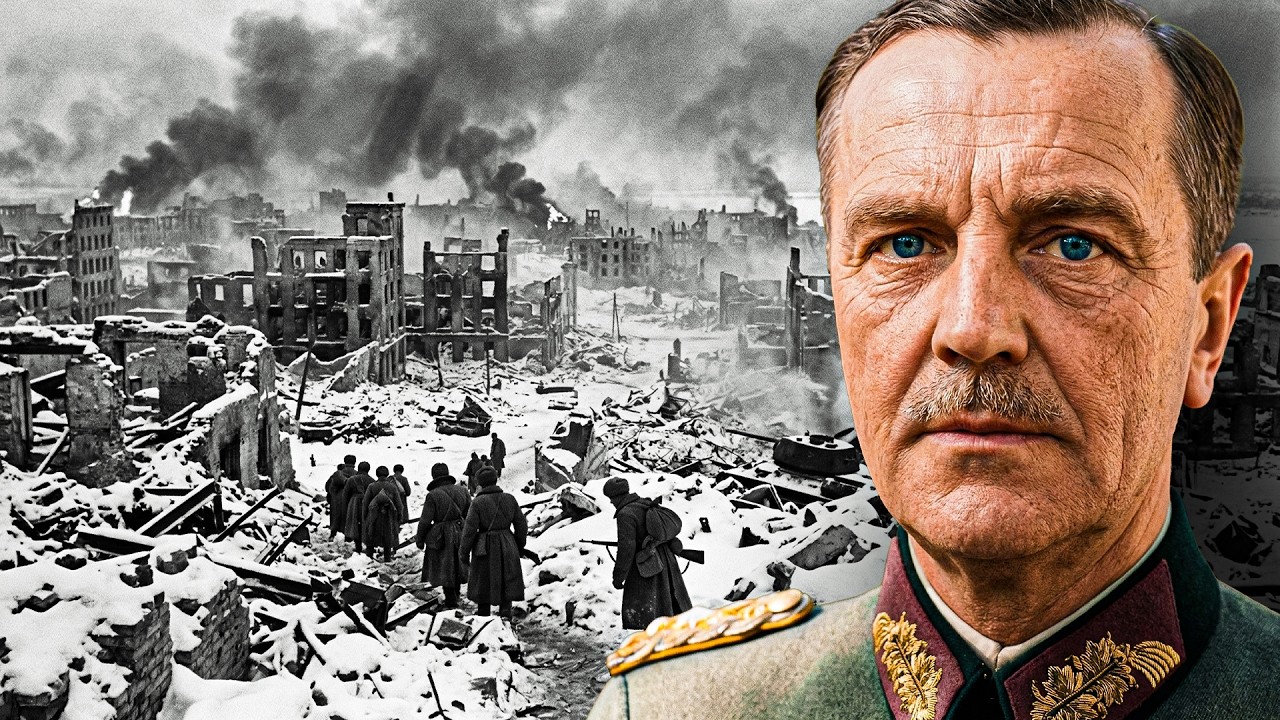
Of those captured at Stalingrad, only around 6,000 would ever return home.
The generals, held separately and treated as political assets, faced a very different path. By mid-1943, the captured generals had been moved to a special facility, Camp No. 48 at Voykovo, near the city of Ivanovo, roughly 300 kilometers northeast of Moscow.
The camp occupied a former sanatorium and was nicknamed the castle for its relative comfort compared to ordinary prisoner of war camps. Paulus, Schmidt, and more than 20 other senior officers lived there under close NKVD surveillance. Agents posing as interpreters and orderlies monitored their conversations and reported back to Moscow.
Soviet intelligence had identified these men not just as prisoners, but as potential tools for a larger propaganda strategy.
On July 12th, 1943, the Soviets established the National Committee for a Free Germany, or NKFD, in Krasnogorsk, near Moscow. Led by German communist exiles and carefully selected prisoners of war, the committee’s stated purpose was to encourage the overthrow of Hitler and call for an end to the war. Its real function was producing propaganda aimed at undermining Wehrmacht morale.
Two months later, in September 1943, a more targeted body emerged: the League of German Officers, known by its German acronym BDO. Its chairman was General Walther von Seydlitz-Kurzbach, who had commanded the 51st Army Corps at Stalingrad. Seydlitz had defied Paulus during the final days of the battle, giving his subordinate officers permission to surrender independently.
Paulus had stripped him of his command for it. Under Soviet supervision, the BDO produced radio broadcasts, leaflets, and written appeals urging German soldiers to desert. Seydlitz went further, proposing a 40,000-strong army of German prisoners to fight alongside the Red Army and be airlifted into Germany to spark an uprising.
Moscow never approved the plan, but the very idea alarmed the Nazi leadership. In Germany, the term Seydlitz troops became shorthand for traitors operating behind the lines. Hitler’s government sentenced Seydlitz to death in absentia in April 1944 and placed his family under Sippenhaft, collective detention imposed on relatives of accused traitors.
Paulus, however, initially refused all cooperation. For over a year, he insisted he remained loyal to Germany, despite growing pressure from the Soviet handlers. The turning point came after July 20th, 1944, when the assassination attempt on Hitler by Colonel Claus von Stauffenberg failed.
The execution of officers Paulus had known personally, including Field Marshal Erwin von Witzleben, shook his resolve. On August 8th, 1944, Paulus addressed German officers on Free Germany radio. “For Germany, the war is lost,” he declared.
“Germany must renounce Hitler.” In response, the Nazi government placed his wife, Elena, and his daughter under Sippenhaft. The field marshal who had once obeyed every order from Berlin had now turned against the regime entirely.

On February 11th, 1946, the courtroom at Nuremberg held its breath. For months, defense attorneys for Nazi leaders had dismissed Paulus’s earlier written testimony as fabricated under Soviet pressure. They demanded he appear in person, confident the Soviets would never produce him, a man they considered a prized captive.
When presiding judge Geoffrey Lawrence asked Soviet chief prosecutor Roman Rudenko how long it would take to bring the witness to Nuremberg, Rudenko replied calmly, “About 30 minutes.”
Paulus was already in the Soviet delegation’s residence just outside the courthouse. The Soviets had smuggled him across occupied Germany in a decoy convoy, using a double in a second car to deter any assassination attempt. His appearance caused a sensation.
Paulus testified that planning for the invasion of the Soviet Union had begun as early as September 1940, while he served as deputy chief of the General Staff. He described the operational drafts he had worked on in detail and confirmed that senior leaders, including Wilhelm Keitel and Alfred Jodl, had been directly involved in preparations for Operation Barbarossa. His testimony contributed to the conviction of both men, who were later executed.
For the defendants sitting across the courtroom, many of whom had last seen Paulus as a loyal field commander, the moment was devastating.
After the trial, Paulus returned to the Soviet Union, where his captivity continued under improved conditions. He lived in a guarded villa outside Moscow, receiving better food and limited freedom of movement.
Meanwhile, other Stalingrad generals faced sharply different outcomes. Arthur Schmidt, Paulus’s chief of staff, refused every Soviet attempt at cooperation. When interrogators offered better conditions in return for statements against the regime, Schmidt reportedly told them that he would rather stay in prison than break his oath.
He held that line for 12 years until his release in 1955.
General Ernst Walter Heitz, who had ordered his men to fight to the last bullet, died in Soviet captivity on February 9th, 1944, barely a year after being taken prisoner.
Other generals who had cooperated with the NKFD went on to build the new East German state. Otto Korfes, who had commanded the 295th Infantry Division at Stalingrad and was among the first senior officers to join the committee, took charge of military archives at the East German Interior Ministry after his release in 1948. By 1952, he held the rank of major general in the Kasernierte Volkspolizei, the armed police force that preceded East Germany’s National Army.
Arno von Lenski, who had commanded a panzer division at Stalingrad, followed a similar path. Others returned to a West Germany that wanted nothing to do with men who had broadcast Soviet appeals. Collaboration versus loyalty would follow those generals for the rest of their lives, splitting families and former comrades along Cold War lines.

In 1953, two years before the last ordinary prisoners returned, Paulus was released from Soviet custody and allowed to move to Dresden in East Germany. He took a position as a civilian chief of the East German Military History Research Institute, a quiet role that kept him close to the regime but out of public view. He lived modestly, gave occasional lectures to military audiences, and avoided the spotlight.
His wife, Elena, had died in 1949 in Baden-Baden, West Germany, without ever seeing him again. Their son, Friedrich, had been lost in action at Anzio, Italy, in February 1944. The family Paulus returned to no longer existed.
Seydlitz’s path proved even harder. Despite years of active cooperation with the Soviets, a Soviet military tribunal sentenced him to death in July 1950 on charges of war crimes committed during his earlier Wehrmacht service. The sentence was commuted within hours to 25 years of imprisonment.
He served five of those years before a diplomatic breakthrough changed his fate.
In September 1955, Chancellor Konrad Adenauer traveled to Moscow and negotiated the release of the last approximately 10,000 German prisoners of war still held in the Soviet Union. The event entered history as the Heimkehr der Zehntausend, the return of the 10,000. Seydlitz was among those released in October.
On October 7th, 1955, the first 600 former prisoners arrived at the Friedland transit camp near Göttingen. Crowds lined the roads as families who had waited a decade searched the faces of hollow-eyed, aging men they barely recognized. In exchange for the prisoners’ release, West Germany agreed to establish diplomatic relations with the Soviet Union.
Germans regarded Adenauer’s achievement as a defining moment of his chancellorship.
Seydlitz returned to a country that rejected him. Former comrades called him a traitor, and the Bundeswehr denied him military honors. His Nazi-era death sentence was overturned in 1956, but the stigma remained.
He settled quietly in Bremen and lived in near total obscurity until his death on April 28th, 1976, at the age of 87. Russia posthumously pardoned him in 1996.
Paulus died in Dresden on February 1st, 1957, exactly 14 years after his surrender at Stalingrad. His body was taken across the border to Baden-Baden and buried beside his wife. Karl Rodenburg, who had commanded the 76th Infantry Division, outlived them all.
He died in 1992 at the age of 98, the last of the Stalingrad generals.
Of the roughly 91,000 men who had surrendered with Paulus, only some 6,000 ever made the journey home. The generals had survived. Most of their soldiers had not.
Twenty-two generals walked out of a frozen city and into captivity that lasted longer than the war itself. Their fates were shaped by the same forces that defined post-war Europe: ideology, survival, and the long shadow of choices made under impossible pressure.






