The day before they fired her, Dana Carlton was on her knees in front of the office coffee machine, scraping dried grounds out of a plastic K-Cup shoot while the new CEO, Gavin, strutted past with a Bluetooth headset and muttered something about getting facilities to handle it. She didn’t look up. She just fixed the machine, the way she’d fixed everything for twenty years. Quietly, precisely, without drama.
Dana had been with the company since the beginning, back when it was four desks in a strip mall next to a laser tag arena. She ran the office, stocked toner, processed payroll, reviewed vendor contracts, and onboarded every new hire like they were her own kid heading off to school. When the company offered her stock options in 2002, she read the fine print, signed with a cheap ballpoint, and stuffed the certificates in a fireproof box next to her expired passport and her ex-husband’s dental records. She never sold a single share.
Not during the Series B, not when the company moved into its first real office downtown. Most of the early crew cashed out, but Dana simply forgot the shares were there. By the time she remembered, they weren’t worth selling. But they weren’t worthless either.
Over the last few years, the company had changed. Gavin was the third CEO in four years, all slick hair and MBA confidence and zero domain knowledge. He called her Debbie for two weeks, then Darla, then stopped addressing her altogether unless something was broken. She wasn’t surprised when he stopped inviting her to strategy meetings, reassigned her team under central ops, or took credit for a workflow she’d designed in 2013 that cut vendor processing time by forty percent.
She was surprised when she opened the company newsletter one Tuesday morning to the headline “Strategic Evolution: Preparing for Our Next Chapter. ” It was a press-friendly way of saying the company was getting acquired. A $150 million private equity merger, pending board and shareholder approval. Big payout for Gavin and his circle.
No legacy nod, no recognition for twenty years of blood and spreadsheets. Just a footnote: operational responsibilities will be consolidated under the new incoming COO. That’s when it hit her. She was already gone.
They just hadn’t told her yet. She printed the newsletter, folded it in half, and slid it into the fireproof box, right behind the stock certificates. They called it a quick alignment chat, a calendar invite sent at 4:58 on a Friday with a lowercase subject line. Conference Room B.
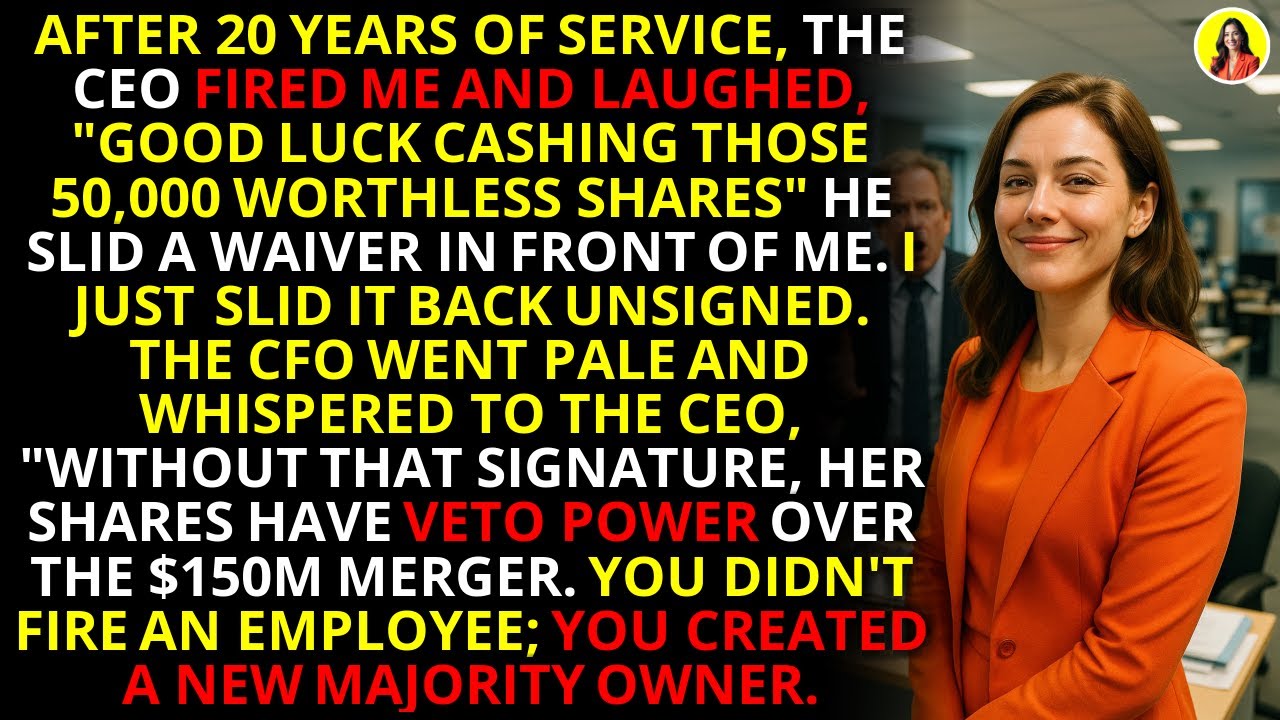
Gavin was already there, leaning back in his chair, and beside him was Jenna from HR, holding a manila folder like it was radioactive. They walked her through the standard boilerplate: termination letter, NDA, severance breakdown, COBRA pamphlet. Tucked right in the middle, like it belonged there, was a waiver of shareholder rights. Dana flipped back a page.
“This isn’t standard,” she said, pointing without looking up. Gavin shrugged, said it was symbolic mostly, laughed like they were old college buddies. “Those shares won’t even buy lunch once the merger goes through,” he said. Jenna giggled.
Dana set the pen down neatly. “I’ll need time to review,” she said. Gavin leaned forward with that wolfish fake compassion he used at company all-hands. Of course, they just needed everything wrapped by Monday.
Dana closed the folder and slid it back across the table. “I won’t be signing anything today,” she said. “I’d prefer any further communication go through counsel. ” She stood, straightened her blazer, and walked out without looking back.
That night, she didn’t go for the wine or the remote. She went to the fireproof box in the hall closet. Inside was paper, real paper, pre-digital, pre-cloud. Original grant documents, shareholder memos, printed email chains.
One document, dated June 9, 2006, stood out: an amendment to the shareholder agreement. The CFO back then had pushed for a clause giving early shareholders veto power over any material corporate transaction, merger, acquisition, or liquidation, if their combined voting block crossed a certain threshold. Dana had maybe 0. 5% back then.
But over two decades, most of the early crew had cashed out, sold their voting rights for liquidity, or had their clauses expire when they left without cause. She never had. She just held. She did the math three times.
After dilution, after expired proxies, after all the shares sold off by everyone else, her percentage still stood at 3. 14% of current Class A shares. The threshold was 2. 75%.
She held veto power over the merger. They hadn’t just tried to cut costs. They’d tried to eliminate an obstacle, and they’d failed. Monday morning, the emails started.
First from HR, a “gentle reminder” about her exit package review, attaching the same waiver she’d already declined. She deleted it. Then from someone in legal she’d never met, a “Jason with a Y,” referencing potential implications for pending corporate actions, suggesting further delay might introduce complications. She didn’t respond.
Tuesday, Gavin called, too bright, too cheerful, telling her she didn’t want to turn this into a legal issue. She let the silence hang. “It’s not like those shares actually mean anything,” he said. She ended the call mid-sentence.
He followed up with a text. “Let’s be adults about this. Don’t ruin a good legacy with stubbornness. ” She blocked the number.
By Wednesday, the smear campaign was in full swing. Old colleagues forwarded screenshots from internal Slack, threads speculating she’d been let go for performance misalignment. Someone called her robotic. Said she didn’t even cry when they told her.
The only winning move was silence. So she stayed silent, except with one person. Thursday morning, she walked into a beige office above a dry cleaner in a strip mall and sat across from a lawyer named Nina. Mid-fifties, sharp eyes, twenty years of corporate law.
Her office smelled like old wood and quiet vengeance. Dana handed her the folder. Nina flipped through it once, nodded, and said, “They’re screwed. ” She told Dana to do nothing.
“They’ll panic first. ”
They did. Friday, another email from legal, claiming her failure to engage could be interpreted as bad faith. Nina drafted the reply herself, two lines: Miss Carlton has not waived any rights.
Further communication should be directed to counsel. Then they waited. The first sign of trouble came from a junior associate at the acquiring firm’s legal team, someone buried in a spreadsheet the size of a phone book, doing the thankless job of reviewing the shareholder ledger. She spotted the problem around 11:15 on a Thursday.
One Carlton, Dana E. , listed as a Class A shareholder with legacy vesting privileges, but no proxy on file, no waiver, no consent. The merger documents assumed unanimous legacy consent had been obtained. It hadn’t.
By 3 p. m. , the acquiring firm’s lead counsel was on a conference call with Gavin, the CFO, and legal. Gavin dismissed it out of the gate.
“Oh, Dana. She was part of the old guard. Her shares are dust. We’ve got her exit paperwork.
” But the acquiring firm’s legal director had read the documents. “There’s no signed waiver, no proxy. Nothing to revoke her Class A rights. ” The answer came flat: the deal memo, the valuation assumptions, the closing timeline, all depended on a shareholder who still held a legal veto over the merger.
And she hadn’t agreed to any of it. By Friday, the CFO was starting to sweat. Every loophole came up dry. The clause was still active.
Her voting block was intact. Her refusal to sign wasn’t a delay. It was a loaded gun on the boardroom table. And she hadn’t even pulled the trigger.
Nina texted her one sentence: “They’re flailing. Say nothing. ” So she said nothing. Monday morning at 6:12 a.
m. , Gavin’s email hit her inbox, subject line reading “Re: Clarification and Closure Opportunity. ” It was full of gaslighting and veiled threats, the word “obstructionist” featured prominently. He closed with a warning about more formal action.
Nina responded with five words: “Our client declines to respond. ” That afternoon, the CFO tried a different angle, offering a “consulting transition bonus,” low six figures, in exchange for signing the waiver and walking away. Nina put him on speaker. “My client doesn’t accept hush money,” she said.
Dana unmuted just long enough to say, “Tell him I support the company. Not the clowns who came in late and think they can rewrite the script. ” Click. By Thursday, the emergency board meeting was called.
Gavin sat at the head of the long walnut table, tie loosened, panic barely hidden. The CFO sat to his right. The acquiring firm’s representatives sat at the far end. At exactly 8:59, Dana walked in first, quiet heels on hardwood, neutral expression.
Nina followed, calm, composed, and walked straight to the acquiring firm’s reps, placing a single black folder on the table. Inside were exact chronological records: original equity grants from 2002 through 2007, shareholder meeting minutes acknowledging Class A status, the full 2006 clause, documentation of holdings exceeding the veto threshold, and zero evidence of any waiver or proxy ever issued. The acquiring firm’s senior counsel leaned toward Gavin. “Why wasn’t this disclosed in the data room?
” Gavin stammered about assuming she was a non-factor, that she’d been terminated. Nina cut in, ice cold. “She’s not an employee. She’s a shareholder.
You stripped her of titles, not power. ” The acquiring firm’s rep closed the folder slowly. “The deal is frozen. ”
The meeting reconvened an hour later.
The acquiring firm’s general counsel, a woman named Miss Elridge, stood at the head of the table holding the folder like an indictment. She confirmed what Dana already knew: Dana held 3. 14% of current Class A shares, above the 2. 75% threshold, and retained veto authority.
The merger could not proceed without her written consent. Gavin tried to argue she was “residual. ” Elridge paused, then delivered the line that cracked him in half. “You made her more powerful when you fired her,” she said.
“By removing her operational duties, you severed her from fiduciary obligations. She no longer has any duty to act in the best interest of the company. She’s free to act solely in her own interest now. You gave her that freedom.
” The other acquiring exec added the final blow: “You misrepresented the cap table. That’s a breach of trust. ” Gavin’s seven-figure bonus evaporated in real time. The board chair finally spoke.
“What do you want, Miss Carlton? ” Nina slid a single-page memo across the table. Three terms. First, a revised payout structure allocating a separate tranche for legacy shareholders, those who built the foundation and held their equity through the volatile years.
Second, immediate cancellation of Gavin’s golden parachute, no bonuses, no exit package, no post-merger consulting retainer. Third, a formal board statement acknowledging Dana’s contributions and confirming her departure was not performance-based, disciplinary, or voluntary. Gavin called it extortion. The acquiring firm’s reps read the memo.
“This is doable,” the older one said. The CFO leaned back and said, “It’s this or nothing. ” The acquiring firm’s GC tapped her pen. “We’ll move forward with these revisions.
”
Dana signed the merger approval form, one clean signature, with the legacy compensation clause inserted, Gavin’s bonus redacted, and the official addendum clearing her record. She stood, collected her folder, and adjusted her jacket. Before she left, she looked Gavin in the eye and said softly, “Good luck cashing your bonus, Gavin. ” The color drained from his face.
She walked out. No fanfare, no applause. She didn’t need validation. She had her terms, her dignity, and the one thing none of them could ever take back: proof that she was never just an employee.
She was the fireproof safe they built the company on, then forgot existed, until she opened it.






