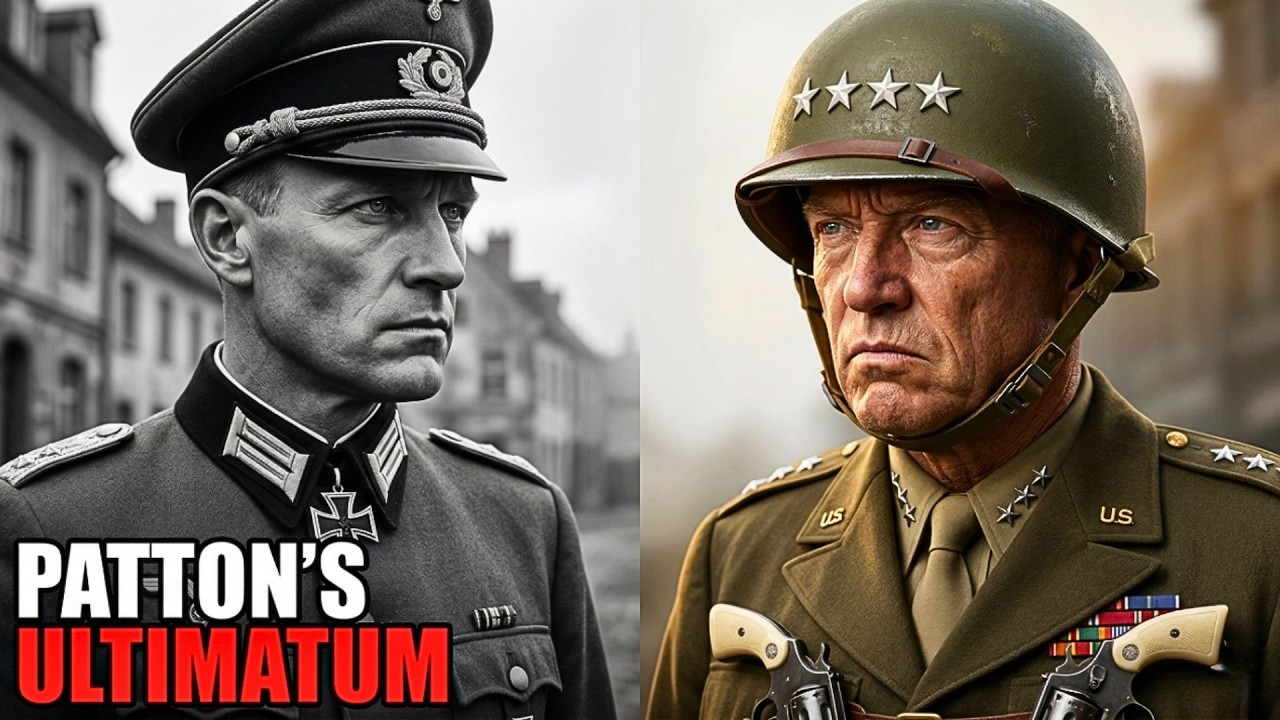
George Patton sat in his headquarters somewhere west of the Rhine, and the report on his desk was the kind he had spent three years in this war dreading. His lead elements had reached the outskirts of a small German town called Hammelburg, population three thousand, and what they had found there was not a fortified position or a stubborn garrison. It was a human wall. The German commander had dragged the town’s civilians into the streets and tied them to roadblocks, parked them in front of machine gun nests, placed children in doorways with soldiers crouched behind them.
Old men, mothers holding babies, boys and girls no older than ten. The message was unmistakable: attack, and you kill them. Patton’s officers had already worked through the options. They could bypass the town entirely, twenty minutes of driving around it, and leave the problem for someone else.
They could wait, bring up psychological warfare units, try to negotiate through the Red Cross. They could sit and starve the garrison out over days, maybe weeks. Every one of those options involved time, and every one of them involved letting a Nazi commander dictate the terms of battle. Patton’s chief of staff laid out the recommendations and waited for the general to choose the safe one.
Patton listened. Then he stood up. Get my jeep. His staff tried to stop him.
Sir, it’s too dangerous. This could go through proper channels. There’s no need for you to go personally. Patton ignored them, put on his helmet with its three stars, checked his revolvers, and drove toward Hammelburg.
He took two jeeps: himself, his driver, an aide, and four military policemen. That was the entire escort for an American army commander rolling into a town defended by two hundred SS soldiers who were using civilians as shields. At the forward American position, the company commander began to brief him. Patton cut him off.
Show me where the Nazi commander is. The captain pointed to the town hall in the center of town, surrounded by civilians held at gunpoint. Patton nodded, then ordered a white flag. His aide tied a white cloth to a rifle, and Patton’s jeep rolled slowly into Hammelburg.
The German soldiers watched in shock. An American general driving into their defensive position under a flag of truce, alone except for a handful of men. Patton’s jeep stopped in the town square, fifty feet from the town hall. Civilians were everywhere, terrified, crying.
Some tried to move toward the Americans; German soldiers shoved them back. Then the Nazi commander appeared on the steps of the town hall. His name was Obersturmbannführer Heinrich Kuhl, an SS officer, a true believer who still thought Germany could win the war if it just fought hard enough. By March 1945 that belief was not conviction, it was delusion.
The Russians were closing from the east, the Americans from the west, the Reich was collapsing in on itself, and Kuhl’s garrison of roughly two hundred SS men was defending a strategically worthless town against an American force that outnumbered them five to one. He knew he could not win. So he had decided to make the Americans pay the highest price he could extract, and his currency was the lives of his own people. His soldiers had gone door to door, dragging families into the streets, tying a grandmother to a roadblock, positioning a mother with a baby in front of a machine gun nest.
It was a war crime, a deliberate violation of every rule of warfare, and Kuhl knew exactly what he was doing. American generals cared about civilian casualties. That was the weapon. Kuhl looked at Patton and smiled.
General Patton, I am honored. I did not expect you to surrender personally. Patton stepped out of the jeep. His MPs stayed close, weapons ready but lowered.
He spoke in German, fluent and cold. I’m not here to surrender. I’m here to give you one chance to release these civilians. Kuhl laughed, actually laughed.
Why would I do that? They are the only reason you haven’t already attacked. Patton took three steps forward, closing the distance. You think hiding behind children makes you safe?
Kuhl’s smile faded slightly, but he held his ground. I think it makes you hesitate. That is enough. The square went silent.
Civilians watching. German soldiers watching. American MPs watching, rifles half raised. This was the moment when Patton could have negotiated, offered terms, traded time for lives.
Instead, he spoke loud enough for everyone to hear. I want you to understand something. You are not the first coward I’ve met who thought using innocent people as shields made him smart. Kuhl’s face hardened.
Patton kept going. You think I won’t attack because civilians will die. You’re wrong. Here’s what’s actually going to happen.
He pointed at the townspeople. I’m going to give these people exactly ten minutes to get out of this town. Every man, woman, and child. They’re going to walk down that road behind me.
My soldiers will protect them. Kuhl started to interrupt. Patton spoke over him. You’re going to let them go, because if you don’t, I’m not bypassing this town.
I’m not negotiating. I’m going to destroy it. Every building, every defensive position, every single place you’re hiding. You’ll kill civilians, Kuhl said.
No, Patton replied. You will, because you’re the one using them as weapons. I’m giving them a chance to leave. If you shoot them in the back as they run, that’s on you, not me.
The square went even quieter. Patton stepped closer, until he was fifteen feet from Kuhl. You made a calculation. You thought I valued their lives more than I valued destroying you.
You were half right. I do value their lives, that’s why I’m giving them ten minutes to evacuate. But here’s what you got wrong. I value destroying Nazis like you even more.
Kuhl’s hand moved toward his pistol. The American MPs raised their rifles instantly. Patton didn’t flinch. Go ahead.
Draw it. See what happens. Your men are surrounded by an entire American division. You shoot me, you die ten seconds later.
And then my boys turn this town into rubble anyway. The only difference is you won’t be alive to see it. Kuhl’s hand stopped. He did not draw.
Patton turned away from him and addressed the civilians directly, still in German. Anyone who wants to live, start walking toward the American lines. Now. You have ten minutes.
Nobody moved. The civilians looked at Kuhl, at the German soldiers, terrified of what would happen if they broke. Patton raised his voice. These soldiers can’t stop all of you.
If you run, some of you will die. If you stay, all of you will die when we attack. Choose. One woman broke.
She grabbed her child and started running. A German soldier raised his rifle. Patton’s MP shot him, a single round, and the soldier dropped. That broke the dam.
Civilians started running, dozens, then hundreds, streaming across the square toward the American lines. The German soldiers panicked. Some tried to stop the fleeing families; others lowered their weapons, unwilling to shoot people they had known, people running for their lives. Kuhl screamed at his men to hold position, but the defensive line was collapsing.
Without the human shields, they had nothing. Within eight minutes the town square was empty. The civilians were streaming toward American lines, and the German soldiers were in chaos. Kuhl stood alone on the town hall steps.
Patton looked at him. You have two minutes to decide. Surrender, or die with your town. Kuhl stared back, pride, hatred, desperation all visible in his face.
Then he shouted in German. We are SS. We do not surrender. Patton nodded.
I was hoping you’d say that. He walked back to his jeep, got in, and drove out of the town. As soon as he crossed the American lines, he gave the order. Level it.
The artillery opened up, sixty guns in a sustained barrage, and Hammelburg disappeared under high explosive shells. The German soldiers who refused to surrender died fighting. Kuhl died in the basement of the town hall when a shell brought the building down on top of him. The battle lasted forty minutes.
When it was over, Hammelburg was rubble, but the civilians were safe. Every single one. Patton’s after-action report was brief. Enemy used illegal human shield tactics.
Civilians evacuated. Town destroyed. Minimal American casualties. His superiors questioned the decision.
He could have waited, negotiated, avoided bloodshed. Patton’s response was simple. If we negotiate with Nazis who use human shields, every Nazi will start using human shields. I sent a message.
Use civilians as weapons, and you die, not them. You. The story spread through the German military, and after Hammelburg, the use of human shields dropped dramatically. Patton had proven something: using civilians did not stop the Americans, it just made them angrier.
Years later, one of the evacuated civilians was interviewed and asked whether she blamed Patton for the destruction of her town. Her answer was recorded. He gave us a choice, run or die. The Nazi commander gave us no choice at all.
I blame the man who tied us to his war, not the man who set us free. Patton never spoke publicly about Hammelburg, but privately he called it one of the hardest decisions of the war. Not because he regretted it, but because he hated that it had been necessary. The use of human shields is a war crime because it puts defending soldiers in an impossible position: attack and kill innocents, or refuse to attack and let the enemy win.
Patton refused the dilemma and created a third option. Give the civilians a way out, then destroy the enemy anyway. It was brutal. It was controversial.
But it worked.






