The landing craft hit the reef with a sound that carried across the water, a grinding of metal on coral that stopped every boat in its tracks. They had been told the tide would be high enough. The charts said so. The tide tables said so.
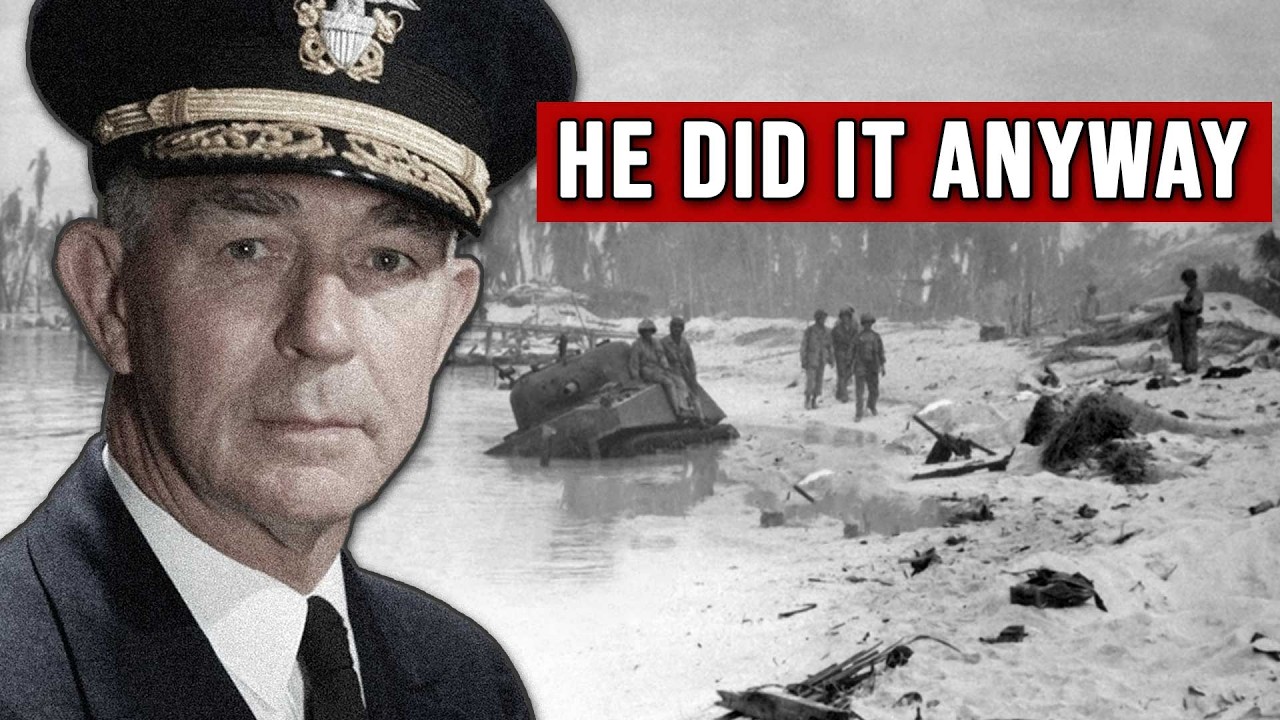
But the water was not where it should have been, and now the boats sat grounded somewhere between the reef and the shore, a stretch of open water roughly 300 yards wide that no one had thought to measure beforehand. The ramps went down. The Marines got out, chest-deep in the water, waist-deep, sometimes ankle-deep where the coral rose toward the surface and left a man completely exposed, moving slowly across open killing ground with nowhere to hide and no way to hurry. The Japanese opened fire from the bunkers on Betio.
The first wave took 75 percent casualties before it reached the sand. Not on the beach. Before it reached the beach. That was Tarawa.
By the time the island was secured, 76 hours later, 1,009 Marines were dead, and most of them had not died on the island at all. They had died in the water. Fifteen months later, on February 19, 1945, another force hit another beach, Iwo Jima. The Japanese commander there, Tadamichi Kuribayashi, had spent eight months preparing the island.
Every approach covered, every landing zone assigned its fields of fire, more than 11 miles of tunnels cut into the rock, gun positions that could not be seen from the air. The defenses were far harder than anything at Tarawa. Yet on the first day, 30,000 Marines went ashore. They did not pile up on the reef.
They did not wade 300 yards under point-blank fire. They crossed the water and reached the beach, their approach lanes verified, their landing zones mapped. Same ocean, same kind of enemy, same coral and sand. A different result.
The distance between those two outcomes has a name in the history of the United States Navy, though not one that appears in most accounts of either battle. His name was Richmond Kelly Turner. His sailors called him Terrible Turner, a nickname invented by his own men, not by the Japanese. This is the story of what he did in the 15 months between those two beaches.
And it was not, mostly, the story the newspapers were telling. Turner was born in Portland, Oregon, in 1885. His father was a school teacher. He graduated from the Naval Academy in 1908, a competent midshipman, not a standout, not the man anyone expected to make headlines.
He went to sea on cruisers and destroyers, rotating through gunnery, navigation, and ship handling, the kind of assignments that build a career without defining one. His fitness reports were good. His reputation did not extend beyond his immediate chain of command. For nearly 20 years, that was the shape of his life.
Then, in 1927, Turner did something no one had ordered him to do. He learned to fly. He was 42 years old, a surface officer whose entire career had been built on steel decks and gun mounts, while naval aviation belonged to young men who had grown up with the airplane. There was no professional reason for him to climb into a cockpit, except one: he believed naval aviation was going to change everything about how wars at sea were fought, and he did not want to understand that change by reading another man’s report about it.
He qualified. He never became an aviator by career, but he became something rarer: an officer who knew from the inside what aircraft could and could not do. In 1935 the Navy sent him to the Naval War College at Newport, Rhode Island, the sort of posting most officers treated as a box to be checked. Turner treated it as a workshop.
He stood in front of classrooms in 1935 and told his students something very few men in the American military were willing to say aloud: the next war in the Pacific would not be decided in the classic engagement between battleships the Navy had spent 30 years training for. It would be decided on beaches, on contested shorelines, in that brutal, exposed space between the ship and the sand where men would have to get off boats into enemy fire with nowhere to hide and no way back. The Navy had no doctrine for that. Turner started writing one.
He studied the British landings at Gallipoli, the Japanese operations in China, the small-unit amphibious experiments the Marine Corps had been quietly running for years. He sat with Marine officers and asked questions admirals did not usually ask. In October 1940 he left Newport for Washington, named director of the war plans division, one of the most consequential jobs in the Navy and almost invisible to anyone outside the building. He brought with him the studies he had spent years refining.
The core argument was simple, and it was correct: if the United States found itself fighting in both Europe and the Pacific, it could not win both at once. It would have to choose Europe first. Defeat Germany, secure the Atlantic, then turn the full weight of American power against Japan. In November 1940, Chief of Naval Operations Harold Stark sent a memorandum to the President.
History would call it Plan Dog, after the fourth option Stark outlined and recommended. Stark signed it, but the strategic logic in it, the framework for prioritizing theaters, the conclusion that Germany had to fall before Japan could be finished, came directly from Turner’s Newport studies. The plan shaped every major American strategic decision for the next five years. The historians remembered Stark’s name.
Turner’s name did not appear in the newspapers. He had done the work; someone else held the document. In June 1942, Admiral Chester Nimitz gave Turner command of all amphibious forces in the Pacific. At that moment it was a title without much substance.
The United States had no functioning amphibious doctrine, no seasoned landing force, no established procedure for putting an army onto a defended island and keeping it supplied while it fought. What the country had was Turner, and what Turner had was everything he had spent 20 years building. The men who served under him did not describe him warmly. One officer who had worked alongside him before the war said Turner was the meanest man he had ever seen, then added, without irony, that he was also the most competent naval officer he had ever served with.
Those two judgments were not in tension. They were the same fact seen from two angles. On August 7, 1942, for the first time since Pearl Harbor, the United States Navy went on the offensive. Transports, cargo vessels, destroyers, cruisers, and Alexander Vandegrift’s Marines moved against Guadalcanal, Tulagi, and the smaller islands of the lower Solomons.
Turner commanded the amphibious force. The landings went better than anyone had a right to expect. The Marines got ashore, and the airfield, the entire reason for the operation, was taken on the first day. For a few hours it looked as though it might actually work.
Then Admiral Frank Jack Fletcher sent a message. His carriers, the air cover standing between Turner’s transports and the Japanese air forces at Rabaul, were withdrawing. His destroyers were low on fuel. He was pulling back.
This was not a Japanese torpedo. It was an American admiral making a decision at a desk, and what it meant was that Turner’s ships were sitting in those waters with no air cover, still only half unloaded, within two hours’ flying time of Japanese land-based aircraft. Turner did not have the authority to override Fletcher. He had the problem.
The night of August 8, Turner called a meeting aboard his flagship, the McCawley. He summoned Vandegrift and Rear Admiral Victor Crutchley, who commanded the screening cruisers. He told them what Fletcher’s withdrawal meant: without carrier cover he could not keep the transports in the area much longer. He would have to begin pulling out.
The supplies still in the holds, the artillery shells, the food, the heavy equipment Vandegrift’s men needed to hold the island once the Navy left, most of it was not yet on the beach. They were still talking when it became irrelevant. Outside in the darkness, Vice Admiral Gunichi Mikawa was moving, a column of Japanese cruisers and destroyers running down the passage between the islands, the stretch of water that would later be known simply as the Slot. Running without lights, moving fast.
The picket ships that should have detected him had lost track of the contact hours earlier. The Coast Watcher reports that should have raised the alarm had been delayed in transmission. By the time Turner’s staff understood what was happening, Mikawa was already inside the screen. At 1:36 in the morning, Mikawa gave the order to fire.
The USS Astoria took a salvo and began to burn. The Quincy was hit repeatedly and sank within minutes. The Vincennes rolled over and went down. The Australian cruiser HMAS Canberra took so much damage in the opening minutes that her crew could not save her.
Thirty-seven minutes. Four cruisers gone. More than a thousand men dead in the water south of Savo Island. It was the worst surface defeat in the history of the United States Navy.
The men aboard Turner’s flagship waited for orders. What came next was the decision almost no one talked about afterward, and that almost everyone got wrong when they did. Turner ordered the unloading to continue. Not to stop, not to form up and run, but to keep pulling supplies out of the holds and putting them on the beach.
Through the day of August 9, with no air cover and no cruiser screen and Japanese aircraft expected at any hour, the transports kept working. When they had put ashore everything they could put ashore, and not before, Turner gave the order to withdraw. For years, the public memory of Guadalcanal’s opening was the disaster at Savo Island. The four cruisers, the thousand dead, Turner’s name attached to it in the way commanding officers’ names get attached to failures on their watch, fairly or not.
The formal inquiry cleared him, but the shadow stayed. What almost no account of those days mentions is what Vandegrift wrote afterward. He and Turner had clashed throughout the planning, but in his memoir Vandegrift was direct: if Turner had pulled those transports out immediately after Savo Island, the Marines on Guadalcanal would have been left with four days of ammunition and a ration count that depended on captured Japanese supplies to stretch further. The first American land offensive of the Pacific War would have collapsed before it truly began.
The Japanese would have retaken the airfield. Turner understood all of this in the hours after the battle. He made his calculation, kept the ships in the water, finished the job, and left. He did not explain it to anyone.
He did not ask for credit. The Battle of Savo Island followed him for the rest of the war. It was the first thing people knew about him. He did not fight it.
He filed his report, accepted the findings, and began planning the next operation, and the one after that. New Georgia. The Russell Islands. Each step forward, each one a refinement of the doctrine he had been building since Newport.
He was not working toward a reputation. He was working toward a problem he had not yet solved. The problem found him on November 20, 1943, on a piece of coral and sand roughly the size of Central Park called Betio, in the Tarawa Atoll. The Japanese had spent a year fortifying it, concrete bunkers, buried artillery, interlocking fields of fire covering every approach.
Rear Admiral K. G. Shibazaki told his men that a million Americans could not take the island in a hundred years. He was wrong about that, but the price of proving him wrong was going to be terrible.
Turner commanded the overall operation, Operation Galvanic, the invasion of the Gilbert Islands. He positioned himself with the northern attack force at Makin, where the army was landing against lighter resistance. Betio, the hard target, the one with the airfield, was assigned to Rear Admiral Harry Hill and the 2nd Marine Division. At 9:10 on the morning of November 20, the first wave went in.
The landing craft ground to a stop on the reef, the reef the planners had studied, the reef the tide tables said would be passable. The tide did not cooperate. The boats stopped 200 to 300 yards from shore. The Marines got out and walked.
The first wave took 75 percent casualties before it reached the beach. When Hill and Holland Smith sent the message up the chain to Turner, issue in doubt, Turner released the reserve regiment, the 6th Marines, and sent them in. He sat with the reports coming in from Betio. He waited, and he read, and he understood that what was happening on that beach would define everything that came after.
Seventy-six hours later the island was secured. More than 1,000 Marines dead, 2,100 wounded, out of an initial landing force of roughly 5,000. For the first time in the war, the United States government allowed American newspapers to publish images of American dead. The photographs showed bodies in the water, bodies on the sand, men who had made it partway across that open stretch of reef and had been shot down in the shallow water, lying where they fell.
Douglas MacArthur wrote to the Secretary of War, calling it a tragic and unnecessary massacre. Congress proposed a special investigation. The country was appalled. Turner looked at the same photographs and asked a different question.
Not who was to blame, not whether the operation should have been attempted. He asked: how do you know what is under the water before you send men across it? The charts had been wrong. The tide predictions had been wrong.
He had relied on them, and men had died in water that should not have been there. He said later, with characteristic bluntness, that the tides at Tarawa had been a bad guess. His bad guess. He owned it in those words.
Then he went looking for a way to make sure it never happened again. The answer was not in any naval manual. It had never been done systematically by any navy in the world. Before any landing, someone had to go into the water first.
Not in a boat, not with a sonar transducer reading depths from 50 yards away, but in the water, swimming in close enough to touch the bottom, to feel the coral heads, to see the slope of the beach with their own eyes, and then swimming back out and telling someone exactly what they found. It was so simple it seemed obvious. It was so dangerous that almost no one had seriously proposed it. The first time Turner saw it done, it was not because he ordered it.
It was because two men decided on their own that the plan would not work and did something about it. At Kwajalein Atoll in January 1944, the UDT team approached the beach in rubber boats and the reef stopped them. Ensign Lewis Lehrs and Chief Bill Acheson had anticipated this. Before leaving the ship they had put swim trunks on under their fatigues.
Now they stripped down, went over the side, and swam. Forty-five minutes in Japanese-controlled water, no weapons, no radio, two men in swim trunks moving through the shallows, counting coral heads, measuring depths, mapping gun positions with nothing but their eyes and their memory. They were not detected. They came back, still wet, still in their trunks, and were taken directly to Turner’s flagship to report.
Turner listened. He looked at what they had brought back. Then he gave an order that changed the shape of the war: This is how it is done from now on. Every beach, before every landing, men go in first, in the water.
By the end of 1943, no directive from Washington had authorized this. No budget line had been formally approved. Turner had identified a problem, found a solution, and begun building the organization to execute it. He assembled 180 men and sent them to Waimanalo on the eastern shore of Oahu.
The unit was called the underwater demolition teams, the UDT. If you have heard of the Navy SEALs, this is where they came from. Not from a congressional hearing, not from a formal military review, but from Turner looking at the photographs from Tarawa and asking the one question nobody else was asking. At Kwajalein, on January 31, 1944, for the first time in the Pacific War, the men going ashore knew exactly what was waiting for them underwater.
The UDT swimmers had been in the night before, mapping the reef, marking the coral heads, measuring the depths along every approach lane. When the landing craft went in, they followed lanes verified by men who had put their bodies in that water. The boats did not ground on coral. The Marines did not wade.
The assault moved the way assaults were supposed to move. After each swim, the UDT men reported directly to Turner. He listened, asked his questions, marked his charts, and adjusted the landing plan based on what his swimmers had touched with their hands the night before, not on pre-war surveys, not on tide tables. It was not complicated.
It was just new, and it worked. The casualties during the approach to the Kwajalein beaches were a fraction of what they had been at Tarawa, not because the Japanese defenders were weaker, but because the men getting out of the boats knew where they were putting their feet. By June 1944, Turner had 435 ships under his command for the Saipan landings. The UDT teams went in against heavier fire than they had faced at Kwajalein.
The defenders were alert, dug in, waiting. The swimmers went anyway and came back with what Turner needed. Somewhere in those months, the argument stopped. Vandegrift, who had clashed with Turner from the earliest days of Guadalcanal, stopped fighting the method.
He had seen what it produced. You do not argue with results written in the difference between who comes home and who does not. During those same months, the press was writing about other men. Halsey was on the cover of Time.
Marc Mitscher, commanding the fast carriers, was being described as a hawk-faced genius whose planes owned the Pacific sky. In March 1944, Turner’s name appeared in the newspaper once, in a promotion list. Vice Admiral Richmond Kelly Turner. The headline belonged to someone else.
He was building the machinery that would carry the war to Japan’s doorstep, and the publicity machinery had not yet found a way to make that interesting to readers who wanted heroes with faces. He did not seem to mind. Iwo Jima sat 700 miles from Tokyo, eight square miles of volcanic rock and black sand. Kuribayashi understood he could not stop the Americans on the beach, so he did not try.
He put his men underground: more than 11 miles of tunnels, reinforced concrete bunkers built thick enough to survive a direct hit from a battleship shell, gun positions cut into the rock at angles that left them covered from above, unobservable from the air, unreachable by naval gunfire. Every approach had been studied. Every landing zone had its fields of fire assigned. He gave his men one order: each one of you will kill 10 Americans before you die.
Two days before the landing, on February 17, 1945, Turner sent the UDT teams in: Teams 12, 13, 14, and 15. Swimmers off the southeastern beaches of Iwo Jima, mapping the bottom the way they had learned to map it, with their bodies in the shallows under fire. To give them cover, 12 LCI gunboats moved to within a few hundred yards of shore. The Japanese watched those 12 gunboats approaching in a line and made a decision.
They opened up everything. Every gun they had been ordered to keep hidden until the actual landing, every battery, every position, everything Kuribayashi had spent eight months concealing. It was not the invasion, but the Japanese could not afford to let those boats reach the beach. All 12 gunboats were hit.
LCI 474 was damaged so badly she had to be abandoned and scuttled. LCI 449 took multiple direct hits, and her commander, Lieutenant Rufus Herring, badly wounded, did not leave his post. Fifty-two sailors killed across the flotilla that day, 148 wounded. The UDT swimmers in the water watched the gunboats absorb that fire.
Watched men they knew burning on the water above them. They kept swimming. They measured every depth, marked every coral head, identified the approaches where the sand would bear the weight of tanks and the places where it would not. They came back.
The data they brought changed the landing plan in four specific ways. Approach lanes were adjusted. Assembly points were moved. The sequence of the waves was altered based on where the bottom could handle the weight and where it could not.
Buoys went in to mark the safe channels. Every coxswain who drove toward that beach two days later navigated by markers those swimmers had placed. On February 19, 1945, 30,000 Marines hit the beach at Iwo Jima on the first day of the assault. They did not pile up on the reef.
They did not wade 300 yards through open water under point-blank fire. They crossed on the approaches the swimmers had cleared, in the lanes the buoys marked, over a bottom that had been measured and confirmed. What happened after they reached the beach was 36 days of some of the worst fighting in the history of the Marine Corps, Kuribayashi’s tunnels, his guns, his order to die killing Americans. That is a different story.
But the Marines got to the beach. They were alive when they got there. That part was Turner’s. When it was over, Nimitz spoke to a gathering of officers.
On Iwo Jima, he said, uncommon valor was a common virtue. It became the most famous sentence anyone said about any battle in the Pacific War. It was about the men on the island, in the tunnels, on the slopes of Suribachi. There was no sentence like it about the man who figured out how to get them there alive.
Turner read Nimitz’s words. He did not comment on them. He was already working on Okinawa. April 1, 1945, Love Day, the name the planners gave to the landing on Okinawa.
Turner commanded 1,213 ships. When he had arrived at Guadalcanal in August 1942, it was with a force scraped together from whatever was available, a handful of cruisers, some destroyers, a collection of transports. Three years of campaigning across 10,000 miles of ocean, every island, every reef, every contested beach between the Solomons and the home islands, and now the largest amphibious force in the history of the Pacific War. The Japanese answered with the kamikazes, not a squadron, not a raid, but a sustained campaign that lasted the entire length of the operation.
More than 2,900 aircraft flew one-way missions into the American fleet. The ships Turner had spent three years building into a force burned around him. Destroyers on picket duty north of the island took hit after hit, the radar picket line that gave the fleet warning at the cost of putting tin-can destroyers in the path of every incoming wave. Carriers with their flight decks bent.
Ammunition ships exploding. Men going into the water. Turner stayed on the flag bridge through every wave of attacks, through every report of another ship hit, through every decision about where to move the fleet and which ships could still fight and which had to be pulled back. When the fighting was over, he said that holding his force together against the kamikazes, fighting out from under the heaviest Japanese air attacks on any American amphibious force in the entire war, was his proudest achievement.
Not Iwo Jima. Okinawa. On May 24, 1945, Nimitz sent a dispatch. Turner was promoted to full admiral, four stars, effective immediately in the field while the campaign was still running.
It was rare, the kind of thing that happens when a man has earned something beyond what the ordinary promotion schedule can express. After Okinawa, planning began for Operation Downfall, the invasion of the Japanese home islands. Kyushu first, then Honshu. Estimates of American casualties ranged from a quarter of a million to over a million dead and wounded.
The planners looked at Iwo Jima and Okinawa, at what the Japanese had done with time to prepare a defense on islands they could not abandon, and at what Japan itself would be, an entire nation preparing the way Kuribayashi had prepared Iwo Jima. Under Turner’s command for the Kyushu landings: 2,700 ships. The number had been growing since Guadalcanal. It was going to keep growing.
Japan surrendered on August 15, 1945. Turner never commanded that invasion. He never stood on the flag bridge with 2,700 ships under his orders and sent American boys onto the beaches of Kyushu. He never had to watch what would have happened there.
He retired from the Navy in 1947 and moved to Monterey, California. He did not write a memoir. He did not give interviews. He did not accept speaking engagements or consulting arrangements, any of the ways wartime admirals extended their public lives into peacetime.
He had been building things his entire career: doctrine, organizations, plans, forces. He stopped building and became simply a man who lived in a coastal town and went about his days without requiring anyone to notice. Nimitz went to Berkeley, took up the cause of the Mikasa, Admiral Togo’s flagship, sitting derelict in a Japanese port, and spent years of quiet diplomacy getting it restored as a memorial. Japan built him a garden in Fredericksburg, Texas, in the hill country where he grew up.
It is still there. Spruance settled in Pebble Beach, 20 minutes up the coast, walked 10 miles along the shoreline every morning, kept a dog, refused to write a memoir, and outlived Turner by four years. Turner was down the road in Monterey, in the same city, breathing the same salt air. The two of them never needed a public record to know what they had done.
On February 12, 1961, Turner died in Monterey at the age of 75. He was buried at Golden Gate National Cemetery south of San Francisco. Years later Spruance and Nimitz were laid there too, three men who ran the Pacific War from the waterside, in the same ground, in the same silence. No monuments in the cities where they were born.
Just the graves. In 1967, the Navy commissioned a guided missile cruiser and named it the USS Richmond K. Turner. At the commissioning ceremony, an officer stood at the podium and said what needed to be said about the man the ship was named for: Turner disliked the inefficient and scorned the lazy.
He had great faith in his country and in his Navy. He did not spare himself in his devotion to either. The Navy SEALs trace their institutional ancestry directly to the men Turner assembled at Waimanalo in the fall of 1943, after he looked at the photographs from Tarawa and asked the question no one else was asking. Turner’s name does not appear in most popular histories of the SEALs.
It does not need to. The work is there. The beaches are there. The men who crossed them and lived are there, or were, as long as the ones who came home were still alive to remember crossing them.
There are no beaches named for Turner, no gardens, no restored warships. Just the quiet of a cemetery in northern California, and the record, and the men who got off the boats and reached the sand. That is what he left.
That was enough for him.






