At 6:30 in the morning on May 10, 1942, 78,000 American and Filipino soldiers marched down the Sayre Highway on the island of Mindanao and surrendered to the Empire of Japan. One man watched them go. He was 41 years old, a mining engineer from Colorado who had never commanded troops in battle, with a wife named Marion waiting at home and a settled life in Luna. Over the next three years, 50,000 Japanese soldiers would hunt him across an island the size of Indiana.
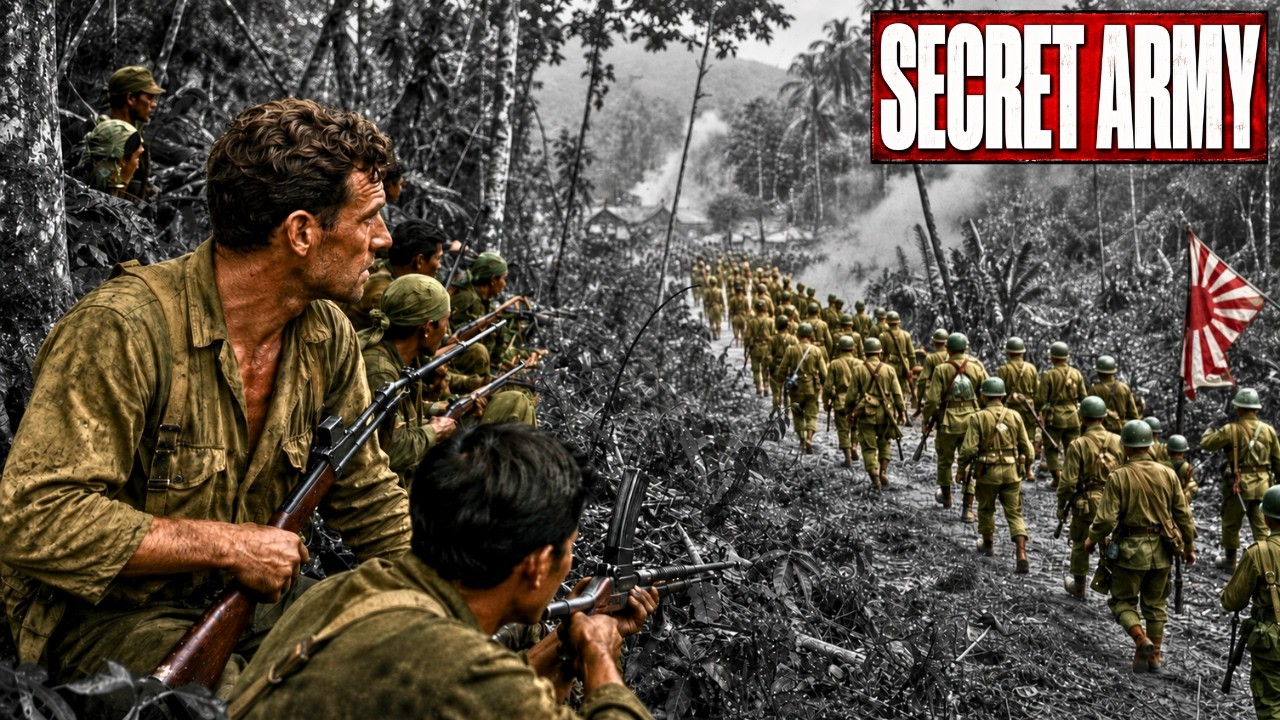
They would burn villages to draw him out, put a bounty on his head that tempted every hungry man in the mountains, and send patrols into the jungle again and again, only to watch them return with fewer men than had gone in. They never caught him. By the end of the war, that American engineer would command an army of 35,000 men, an army no president of the United States had ever authorized. This is the story of Wendell Willkie Fertig, and the country he built inside another country during the darkest years of the Pacific War.
The sun had not yet risen over the eastern hills that morning, and the mist along the highway moved like a living thing, coiling between the mango trees, flowing over the mud, blurring the shapes of the men marching below. From the edge of a clearing in the forest, Fertig watched the column pass. It stretched farther than his eyes could see. American soldiers, Filipino scouts, constabulary men, some still wearing the remnants of their uniforms, some barefoot, some already sick, dragging their feet through the wet mud of the road.
78,000 men on Mindanao, ordered to march toward the Japanese garrisons and lay down their arms. General William Frederick Sharp had signed the document the day before. On paper, the war on Mindanao was over. Fertig did not move.
He gripped the edge of the clearing the way a man grips the edge of a cliff. He watched the last of them disappear around the bend, then kept watching the empty road long after, because he understood that something of his own life was disappearing with them. He should have been down there among them. He was now a lieutenant colonel; his promotion had come through only weeks before.
General Edward P. King, in the desperate final weeks before the fall of Bataan, had sent Fertig south to Mindanao personally, not to fight, but to help General Sharp build airfields. That was the work Fertig was born for. Concrete and steel, runway levels, drainage calculations.
The army had given him a commission because it needed engineers, and dressed him in olive drab because it did not know what else to do with him. But the airfields he had helped design now belonged to the Empire of Japan. So did the highway he had helped survey between Dansalan and Iligan. The very road he was watching was the road down which his countrymen were walking into captivity.
There was a particular cruelty in that, a cruelty only Fertig understood, because the highway was not just a road. It was his road. He had studied its curves. He knew where the culverts ran beneath it.
He knew which bridges he had personally reinforced against the flood season. He knew all of this because, only a few weeks earlier, he had been the man ordered to destroy every part of it. In the frantic final days before the Japanese arrived, when American command in Manila realized Mindanao could not be held, the order came down: deny the enemy anything of use. The task fell to Fertig because he was the engineer, because he knew where every steel joint had been welded and every pier poured.
He had walked those bridges with dynamite in his hands. He had rigged the pier foundations at Iligan with explosives. He had watched the port infrastructure of Dansalan collapse into the waves by his own hand. Roads he had spent months surveying, warehouses he had helped raise from barren ground, all of it gone in a single afternoon of controlled detonations.
He had even driven his own car, a brand-new Dodge he had bought for his wife in another life, off the end of a pier into Manila Bay so that no Japanese officer would ever sit in its driver’s seat. He watched the water swallow the hood, then the roof, then the last gleam of chrome. He turned and went back to work. Six years he had spent building this country.
Six years learning its dialects, drinking its coffee, sitting on the porches of Filipino laborers who had become his friends. Six years of quiet, steady, useful work. He had destroyed all of it in six weeks. That was what echoed in his eyes as he watched the surrender column move down the highway on the morning of May 10.
He was not merely a man who had lost a war. He was a man who had helped destroy the country he had come to build. And now he was being asked to hand those ruins to the men who had forced him to destroy them. He turned and walked into the underbrush.
He had a choice, and he knew it fully. Behind him lay the surrender columns and the prison camps and the Bataan Death March, whose rumor had crossed the Sulu Sea the way terrible news crosses water, faster than any radio, carried by fishermen and priests and the whispers of frightened servants. Sixty miles of forced march. Men bayoneted for stumbling.
Men buried alive for stopping to drink from a puddle. Men beheaded at the roadside for reasons no one could explain. Everyone understood now that the Japanese were not taking prisoners in the way the Geneva Convention imagined. They were taking property.
And property could be disposed of. That was one road. The other led into the mountains of Mindanao, the second largest island in the Philippines, a landmass larger than the state of Indiana. Thirty-six thousand square miles of volcanic highlands and dense rainforest, a country of a thousand small worlds, and somewhere in those worlds, other Americans had also chosen that morning not to walk down that road.
Fertig had no weapon. He had no radio. He had no soldiers. He had almost no food.
In the moment he left the highway and entered the tree line, all he carried was the watch on his wrist, the boots on his feet, and the certainty that both roads would likely end in the same place, a shallow grave. But one road ended faster than the other. He chose the longer one. In the first few weeks, he was barely human.
Just a specter moving between the leaves. He drifted north, then west, then climbed high into the hills above Lake Lanao. Somewhere in that country he found the camp of an old man named Jacob Desha. Desha was a piece of the previous century, still walking upright.
He had come to the Philippines as a young American soldier during the war with Spain in 1898. When that war ended, he never left. He married there, raised children, and aged in the mountains until the mountains accepted him as one of their own. He knew every trail on the borders of Lanao and Bukidnon, and he knew how to disappear in a country that did not want to be put on maps.
Desha received Fertig without ceremony. He fed him rice and dried fish. He gave him a straw sleeping mat under the roof of a nipa hut. When malaria struck Fertig, as it struck every newcomer to that climate, Desha sat beside him through the nights of shaking, placed cool cloths on his forehead, and said little because there was nothing to say.
The fever came in waves. In its worst moments, Fertig dreamed of Colorado. He dreamed of the cold, dry air of La Junta in October, the smell of his mother’s kitchen, the copper light on the plains at sunset. He dreamed of his wife Marion standing at the door of a house he had not seen in years, and he could not remember whether the door opened outward or inward.
He woke soaked in sweat, unable to tell whether it was the fever or grief. From Desha’s yard, through gaps in the vegetation, he could see a thin ribbon of the coastal highway far below. On certain days he watched more columns of prisoners march along it. The Japanese liked to march the Americans in daylight so the Filipinos would see, so everyone would understand who now controlled the roads.
One day in July, Fertig watched a Filipino man on the side of that highway fail to bow low enough for a Japanese guard. Bowing was a ritual demanded of every civilian in occupied territory: head down, waist bent, eyes fixed on the dirt. The man’s bow was clearly an inch short of what was required. The guard stepped forward and struck the man’s face with the butt of his rifle.
The man fell. He did not get up again while Fertig watched. That was all. That was the entire event.
The cheekbone of a stranger shattered on a road Fertig himself had helped survey. And somewhere in the seconds that followed, the last part of the Colorado mining engineer quietly went out, and something else took its place. He decided that July that he would fight. He had no idea how.
He was not a combat commander. He had never led troops in battle, never trained infantry, never planned an ambush. He had spent his adult life calculating the load-bearing capacity of bridges. And yet the decision, once made, settled inside him with the kind of stillness an engineer understands.
It was not courage. Courage is loud. This was quieter than that. This was arithmetic.
Two roads. One ends faster. He had already chosen. He began to walk again.
Through the summer of 1942 he moved across the highlands south of Lake Lanao, from one hidden camp to another, meeting men who had made the same decision. Some were American soldiers who had slipped away from the surrender. Some were Filipino Scouts who had refused to obey the order. Some were farmers who had picked up guns because the Japanese had burned their village.
Some were simply bandits using the war as cover for the looting they would have done in peacetime. They did not trust one another. They did not trust him. They spoke different languages, followed different banners, and fought each other almost as much as they fought the Japanese.
In the mountains near Misamis, Fertig found the man who would show him how to unite them all. His name was Luis Morgan. He was in his early thirties, a captain in the Philippine Constabulary, the son of an American father and a Filipino mother, what the islanders called a mestizo. He had been fighting since the surrender with a small group of armed men, attacking Japanese patrols and vanishing into the folds of the mountains before retaliation could come.
Morgan was quick-witted, ambitious, and in his careful way, a genius. He understood the country in a way Fertig never could. Within an hour of their first conversation, Morgan explained the hardest problem facing the resistance. “Colonel,” Morgan said, and Fertig would remember his exact tone for years afterward.
In the Philippines, everyone is a colonel. He meant that the mountains were full of self-appointed officers. Every armed group on the island was led by someone calling himself major or colonel. Every warlord had his own rank.
Every faction had its own written mandate. If Fertig, a lieutenant colonel, appeared in a village and asked twenty other majors to obey him, they would smile politely and go right on doing what they were doing. There was only one American in the entire archipelago whose name still meant something to every Filipino, from the Christian farmer in the north to the Moro fisherman in the south. That name was MacArthur.
And MacArthur was gone. If the resistance on Mindanao was to unite, it needed a face. An American face. A face that could stand in the place MacArthur had vacated and speak for the promise of return.
And that face could not belong to a lieutenant colonel. It had to belong to a general. Fertig understood. He also understood that he was not a general, that no one in the United States Army had authorized him to be one, and that the penalty for impersonating a general officer under the laws of war was severe.
He thought about it for a long time. On September 16, 1942, he made his decision. He found a Moro blacksmith in a village whose name no official record preserved. The blacksmith worked in ornamental silver, the kind of quiet craftsman who had spent most of his life working in the same workshop and the same hut.
Fertig gave him a handful of silver coins and asked him to melt them down. He asked him to make two stars. The blacksmith did not ask what the stars were for. He heated the coins.
He shaped the silver with a small hammer on a small anvil. He made two five-pointed stars, rough by any West Point standard, so asymmetric they would have embarrassed any regular officer. Then he handed the stars to the American. Fertig pinned the stars to the collar of the shirt he was wearing.
He walked out of the blacksmith’s hut carrying the rank of brigadier general in the United States Army. Of course, he was not. He was a mining engineer from Colorado. In that quiet moment he had committed an act that a court-martial would have called fraud, deception, or worse.
He had assumed a rank he did not hold in an army that did not know he existed, in a country that had theoretically ceased to be a possession of the United States. If the Americans had caught him, his career would have been over. If the Japanese had caught him, he would have been beheaded. He wrote a proclamation that same day.
It was passed from village to village through the “bamboo telegraph,” that invisible network of runners and market gossip and priests that carried information across Mindanao faster than any wireless. The proclamation announced the founding of a new command. It was called the United States Forces in the Philippines, soon shortened by everyone to USFIP. The proclamation declared that this command now covered the entire island of Mindanao.
It declared that all guerrilla units in the area were, with immediate effect, under the command of the commanding general of these forces. Signed: W. W. Fertig, Brigadier General, United States Army.
The Filipinos in the villages read the proclamation, and something in that piece of paper touched them in a way that is hard to explain. It was not that they believed every word. It was the mere existence of the paper. Somewhere in these mountains, in the dark months after the great surrender, an American general had appeared.
He was issuing orders. He was making promises. He was signing his name. They began to call him by a particular name.
It was not a word from any training manual. It came from the everyday vocabulary of the family. A tender word, an intimate word, the word a child uses for his father. In Visayan and Tagalog households across the highlands, they began to speak of him as Tate, the old man.
He was a father, and he was 41 years old. He wore two silver stars on his collar that no army in the world had given him. He had no radio, no ammunition, no way to tell Douglas MacArthur, 2,500 miles away in Australia, that he existed. He had nearly 200 armed men, some loyal to him, some loyal to Luis Morgan, some loyal to no one at all.
He had 50,000 Japanese soldiers from the Mindanao garrison standing between him and the sea. And within weeks, a reward for his head would be announced in Japanese lettering on the walls of every town square from Zamboanga to Butuan. The most wanted American on an island of nearly four million people, the engineer who had refused the road. In the forest, in the wet, patient dark under the vegetation, the war he was about to build with his bare hands had not yet fired a single shot.
The proclamation was on paper. The war was not. In the weeks after he appointed himself, Wendell Fertig learned something no engineering textbook had ever taught him. Signing was easy.
Building a country was hard. Mindanao was not one island. It was dozens of islands packed inside a single coastline. In the north, along the coast facing the Sulu Sea, lived Christian Filipinos who had been educated in American schools, read English newspapers before the war, sang American hymns every Sunday morning, and wept at the sound of MacArthur’s name.
In the west, around Zamboanga, lived families whose ancestors had known Spanish priests. In the south, in the great river valleys of Cotabato and along the coasts of Lanao and Sulu, lived the Moro, the Muslim peoples of the Philippines who had fought foreign invaders for 400 years. First the Spanish, then the Americans themselves, now the Japanese. They trusted no one.
They did not trust the Christians of the north. They did not trust the American general in the mountains. They did not always trust each other. And in the volcanic highlands of the interior lived the Lumad, the pagan hill tribes, whose languages had never been written down, whose villages had never been counted in any census, who had watched for generations as wave after wave of outside powers tried to conquer them and failed.
Fertig, sitting in his first headquarters, a grass hut on a hillside above the Agusan Valley, understood that if he treated any of these worlds the way he treated the others, he would be dead within a month. And a dead general, self-appointed or not, could not liberate anything. So he began to walk. He walked for months through the rest of the rainy season, then through the dry months, then through the next rains.
He walked to villages washed by floods, where the trails were narrow enough for only one man and one water buffalo. He walked to where the Christian teachers served him coffee. He walked to where the Moro chieftains received him sitting on woven mats, their kris blades resting on their laps. He walked to pagan villages where children hid behind their mothers because they had never seen a white man before.
He made promises he had no authority to make. He told them MacArthur would return. He told them the United States would not forget. He told them that every peso they printed under his authority, every sack of rice they sacrificed to feed a wounded fighter, every son they gave to the resistance would one day be honored.
He signed papers to that effect. He signed hundreds of them, and in a way that seemed strange even to him, the tribal chiefs and the teachers and the village heads slowly began to believe him. Part of it was the two silver stars. Part of it was his Colorado calm, the plain talk of a man who never raised his voice.
Part of it was that he came alone, or nearly alone, without the arrogance of an occupying army, sat on the same mat, drank the same coffee, asked the same questions he would have asked before the war, when he was just an engineer. In that first year he was not so much a general as a traveling salesman for the idea that America had not forgotten. He was selling hope on credit, and the currency of that debt was his personal word. He was also selling something he did not possess.
He had no radio, and every night on the wooden porch of whatever hut sheltered him, he thought about the same problem. He could sign 100 proclamations. He could organize 100 villages. He could build the greatest guerrilla army the Pacific had ever seen.
None of it would change anything. Nothing would matter unless he could reach Australia, because the war would not be won on Mindanao. The war was to be decided by the men, ships, and planes gathering at that very moment somewhere south of the equator under Douglas MacArthur, waiting for the day of return. If Fertig could not put his hand on MacArthur’s shoulder across 2,500 miles of empty ocean, everything he was building in the mountains was just a private war.
One man’s war, a war that would end when a Japanese patrol caught him alone at last. He needed a transmitter. He did not have one. The Japanese had confiscated or destroyed every radio they could find.
All commercial sets were gone, all military sets were gone, even the ones fishermen had once used to check the weather. And Fertig, for all his engineering experience, was not a radio man. He understood concrete. He understood steel.
He knew nothing about vacuum tubes. But somewhere on Mindanao there were men who did. Filipino engineers who had worked before the war for mining companies, telephone exchanges, and the small commercial radio stations that carried Manila news to the outer islands. Some had fled when the Japanese came.
Some had hidden their tools. Some, on the day of the invasion, had dismantled their equipment piece by piece and buried it in boxes under the floors of their homes. Through the last months of 1942 and into the first months of 1943, Fertig’s men, who were already beginning to become his men, sent word through the bamboo telegraph. Anyone who knew radio, anyone who had ever soldered a wire, anyone who understood the difference between a receiver and a transmitter, come to the mountains.
They came. They came singly and in pairs, ragged and hungry, carrying reclaimed copper wire coiled around bamboo, carrying vacuum tubes they had walked three days to protect, carrying schematics drawn from memory on the backs of prayer cards. Filipino electrical engineers, mostly men who had worked for mining companies before the war, men who had run the telephone exchange in Cebu, men who had strung wire for coastal shipping stations. They set up their base in a clearing in the forest on a mountainside.
They stripped copper from wrecked trucks. They begged for spare parts from villagers who had hidden radio components under their floorboards for months. They hooked a generator to a small gasoline engine that had once run a rice mill. They strung an antenna between two giant forest trees and camouflaged it with vines specially grown to climb over the wire.
The entire station was designed to disappear. Every piece could be dismantled and carried on the backs of porters in under 30 minutes. If a Japanese patrol came within a mile, everything melted into the trees, leaving only the smell of hot solder. In February 1943, they switched it on.
The signal was weak. The frequency was uncertain. The men who had built the transmitter looked at Fertig, and Fertig looked at the sky, and they sent their message into the static: a small human voice thrown across the ocean, hoping that someone, somewhere, in the busy radio room at MacArthur’s headquarters in Brisbane, was tuned to the right frequency at the right hour on the right day. The first message was simple.
It gave a name. It gave a rank. It explained that an American officer was fighting on Mindanao. It requested confirmation.
Then they waited. They waited for three weeks. Twenty-one days of silence. Twenty-one nights Fertig lay on his mat, listening to the rain on the nipa roof, wondering whether the signal had reached anywhere at all, whether Australia had heard him and decided he was not worth answering.
The reply, when it came, was worse than silence. The men at MacArthur’s headquarters had heard him. They had heard him clearly, but they did not believe him. They had good reason.
The Japanese ran fake radio stations. They had already used one elsewhere in the archipelago to lure an American submarine into an ambush. The idea that a self-appointed brigadier general, a mining engineer by trade, was leading a growing army in the mountains of Mindanao seemed, from the mahogany desks of Brisbane, more like a trap than a miracle. They sent questions.
Personal questions, the kind only the real Wendell Fertig could answer. What was his wife’s name? Where did he study? What was the name of the street where he grew up?
Fertig sat at the transmitter. He answered them. Colorado School of Mines. Luna, Colorado.
The answers clicked across the ether. He waited again, and when Brisbane finally accepted that he was who he claimed to be, the reply wounded him deeper than any Japanese bullet could. There would be no promotions to general officer rank for guerrilla leaders in the Philippines. His self-appointed rank was unrecognized.
He would revert immediately to the rank he actually held under American law. Colonel. He read the message twice. He read it a third time.
He accepted it on paper. In his reply to Brisbane, he acknowledged the lower rank in dry, proper military language. He signed as Colonel, not General. The archive of correspondence then went out of the radio hut, and he adjusted his collar, and he kept wearing the two silver stars because he understood something MacArthur did not: if he took them off in front of the Filipinos, the resistance would collapse within a week.
He would spend the rest of the war living inside that contradiction. On American paper, he was Colonel Fertig. In the barrios of Mindanao, he was General Fertig. Two men in one uniform.
He never fully reconciled them. In March 1943, a United States Navy submarine surfaced off the north coast of Mindanao in the dark hours before dawn. From its conning tower came a single passenger. His name was Charles Parsons.
He was in his early forties, a lieutenant commander in the United States Navy, and one of the strangest and most useful men the Pacific War produced. He had first come to Manila as a five-year-old child. He had grown up between the Philippines and the United States, worked as a stevedore, as private secretary to an American governor-general, and as manager of shipping companies. He spoke Tagalog fluently.
He spoke the coastal dialects. He knew Manila the way a Manila taxi driver knows Manila. When war came, he had escaped the Japanese with his family, posing as a neutral Panamanian diplomat, a cover made possible by the fact that before the war he had actually served as Panama’s honorary consul in Manila. After months, he had ended up in a small office in Brisbane working for MacArthur’s intelligence staff.
He now came on MacArthur’s personal orders to answer a single question. Was this Fertig real, or was he insane? Parsons walked into the mountains with a small escort group. He watched.
He listened. He interviewed Filipino officers. He examined Fertig’s records, his rosters, his proclamations, his radio logs. He saw the small government beginning to take shape: a primitive judicial system, a primitive postal system, a set of resistance peso notes Fertig’s men printed on whatever paper they could find, which Filipino merchants had surprisingly begun to accept.
Parsons returned to Brisbane. He wrote his report and told MacArthur in the clearest possible language that Wendell Fertig was not insane. Fertig was building something MacArthur would need. That report changed the course of the war on Mindanao.
From Parsons’s assessment grew the operation that would later be known as Spyrron. It was a secret submarine supply service, an invisible, terrifying, scheduled lifeline running from the coasts of Australia to the hidden shores of the Philippines, carrying guns, ammunition, medicine, and radio equipment to a resistance that had until that moment been fighting with homemade hunting rifles and captured Japanese weapons. Over the course of the war, Parsons himself rode Spyrron submarines to the islands eight times. The service delivered more than 1,300 tons of cargo.
It carried more than 330 American and Filipino personnel into occupied territory and brought out more than 470 evacuees, women, children, and escaping prisoners of war. The first large supply ship to reach Fertig’s country was the USS Narwhal, one of the largest submarines in the Pacific fleet, so long and slow that her captain sometimes called her “a warehouse with a periscope. ” On a November night in 1943, she surfaced off the north coast of Mindanao, exchanged recognition signals, and took Colonel Fertig himself aboard for the run to port, slipping through the dark into Nasipit harbor. As she tied up at the dock, a Filipino brass band, assembled in the dark hours of the morning by men who had no reason to assemble a brass band anywhere in occupied territory, began to play “Anchors Aweigh.
” Forty-six tons of supplies came off the Narwhal that night. Rifles, ammunition, radios, medicine. When she slipped away before dawn, she carried 32 evacuees, including three American Marine officers who had escaped from a Japanese internment camp at Davao. For the first time since May 1942, Wendell Fertig was no longer alone.
But he was no longer innocent either. The larger the USFIP grew, the clearer became the problem no submarine could solve for Fertig. His deputy, the man who had been at his side almost from the beginning, was Luis Morgan. And Morgan, brilliant and ambitious and with a following of Filipino officers, had begun to want more than the deputy’s post.
Disputes arose over the distribution of supplies. Arguments broke out over which guerrilla leaders were favored and which were starved. There were rumors, and rumors in a war fought through the bamboo telegraph were themselves a kind of weapon, that Morgan intended to break away and form his own command responsible to no one. Fertig, who owed Morgan more than he wanted to admit, watched it all with growing silent dread.
In the end, Fertig moved first. He removed Morgan from his command position in the USFIP. The order was done with corporate coldness, the papers carefully kept. It was the kind of act for which Fertig would be praised by his admirers and condemned by his critics in the memoirs and after-action reports written after the war.
Some Filipino officers who loved Morgan never forgave Fertig. Some Americans who witnessed it would write decades later that Fertig began to take too much credit for what was in fact a collective effort. Fertig himself said little about any of it. He was never a man for public regret, but those who lived closely with him in those months noticed that he slept less, and that when he stood alone at the edge of the forest at dusk, his hand would sometimes go to the silver stars on his collar and stay there a long time.
Meanwhile, the Japanese had begun to realize what was growing in their mountains. They launched their first major offensive against the Visayan and southern Philippine forces in May 1943. Three columns of Japanese infantry drove up toward the highlands from three directions. Aircraft bombed villages suspected of sympathizing.
Naval vessels intensified their coastal patrols to prevent American submarines from landing. Fertig had prepared for this with precision. His forces did not stand and fight. They melted.
Guerrilla units split into small groups and vanished into the jungle. The radio station was dismantled in 28 minutes and moved to a secondary site five miles away. Fertig himself moved constantly, guided by Filipino scouts along trails no Japanese map had ever recorded, sleeping in a different hut every night. The Japanese columns pushed deeper.
They found only empty camps, cold ash, broken pots. They found nothing they could kill. Their sentries were silently killed at night by men who came out of the trees and returned to them without leaving a trace. Their pack mules were shot on the trails.
Their patrols returned to base with fewer men than had left. When they could not find the guerrillas, they vented their fury on the villages. They burned villages suspected of sheltering the resistance, or simply because burning them was convenient. They executed civilians to make examples.
In one village near the north coast, they lined up an entire family, a grandfather, two parents, four children, in front of the surviving neighbors, and killed them one by one. That was the cost of Fertig’s war. It was not paid in the mountains. It was paid in the villages.
Paid by farmers who had never carried a rifle. Paid by mothers who had offered, at best, a bowl of rice to a passing resistance fighter. Fertig understood the arithmetic. Every atrocity the Japanese committed pushed more Filipinos to his banner.
Every burned village produced twenty new recruits. Every executed family created a village that preferred death to informing. Strategically, in cold logic, the Japanese were building his army for him. He never wrote down the personal price of knowing that.
By mid-1944, the paper strength of the USFIP in official records reached between 32,000 and 38,000 men. Only half of them were actually armed. The honest numbers, in postwar US Army reports, put the armed strength closer to 16,500. It was still the largest resistance army in the Pacific.
He was still, on paper, a colonel. He was still, in the mouths of villagers, Tate. And in October 1944, in the black waters off the coast of Morotai, in a tragedy no one on Mindanao learned of in full until months later, the American submarine USS Seawolf, one of the boats that had brought supplies to Fertig, was mistakenly identified by the escort destroyer USS Richard M. Rowell and sunk by depth charges dropped by its own side.
Every man aboard was lost. In a war that had already killed so many, it was just another appalling small number. But it meant, in the quietest way, that the men who brought him ammunition were safe from neither the enemy nor their own side. The news of the Seawolf did not reach Wendell Fertig in a single moment.
It reached him the way most terrible news of that war reached the mountains: in fragments over weeks, carried by radio messages he did not always fully understand, by the silence of a boat that did not arrive on schedule, by a message from Brisbane that no longer mentioned a particular hull number. He was not told at the time the worst part, which would emerge later, after the war, in the precise language of a naval board of inquiry: that the Seawolf had been almost certainly sunk by an American escort destroyer; that the men who died carrying rifles to his mountains had watched, in the final minutes of their lives, depth charges falling from a friendly ship. Fertig did not learn those details until he came home, sitting in a kitchen in Colorado, reading them in print. But in October 1944 on Mindanao, all he knew was that a boat had disappeared, and in a war fought on this scale, disappearing meant disappearing, and there was no time to mourn it properly.
Because on October 20, 1944, on the other side of the Mindanao Sea, an old man in sunglasses and a soft cap waded through the surf onto a beach on the island of Leyte, and the war on Mindanao changed forever. MacArthur had returned. The moment reached Fertig by radio, as everything reached him. He was at his headquarters, a cluster of huts in the Agusan Valley, when confirmation came from Brisbane.
American forces on Leyte. The Sixth Army on the beach. MacArthur in the surf. The photograph that would appear on the front page of every American newspaper had not yet been developed, but its truth was crossing the Pacific in Morse code.
Fertig read the message. He folded it. He looked out the door of the hut toward the trees. He had been living inside a single sentence for two and a half years.
I shall return. He had built an army on that sentence. He had signed proclamations on its strength. He had spent guerrilla pesos backed only by that sentence.
Filipino farmers had died believing it. And now, on a beach 300 kilometers to the north, that sentence had ended. Orders came from Brisbane soon after. They were no longer suggestions.
No longer requests. MacArthur’s staff wanted the Japanese garrison on Mindanao isolated. They wanted roads cut. They wanted bridges destroyed.
They wanted every Japanese battalion on the island pinned in place, unable to move, unable to reinforce, unable to know what the Americans were doing. Fertig had spent two and a half years building the organization that could do this. Now it was time to use it. Through the winter of 1944 and into the first months of 1945, Fertig’s forces waged war on Mindanao’s nervous system.
Telephone cables running between Davao and the smaller garrisons were cut, and the repair crews sent to fix them were ambushed. Bridges that had survived, out of strange caution, three years of guerrilla harassment were now destroyed with American-supplied explosives. Roads were closed with felled trees, with disabled Japanese trucks, with the wreckage of carabao carts sacrificed by Filipino farmers to the cause. Japanese convoys that had once moved between towns in a day now took a week.
A Japanese battalion commander who wanted to send a message to another Japanese battalion commander could no longer trust the wires, could no longer trust the roads, and in most cases could no longer trust the radio, because Fertig’s direction-finding teams, now trained on equipment that had arrived by submarine, were locating enemy transmitters and passing coordinates to American aircraft. In the first months of 1945, Japanese radio stations on Mindanao went silent one by one, destroyed by planes flying from American bases in New Guinea and the central Philippines. The intelligence flowing in the opposite direction, from Fertig’s mountains to MacArthur’s headquarters, reached a volume no one in Brisbane had expected. Dozens of coast-watching stations reported every movement of Japanese shipping in the waters around Mindanao.
Filipino agents inside Davao City counted the troops in the barracks, identified unit insignia, mapped defensive positions. When American planners sat down in early 1945 to plan the invasion of Mindanao, they were working, for the first time in the Pacific War, with maps that were essentially accurate. The Japanese command in the Philippines had realized by then exactly what had been done to them. Their captured postwar reports used the phrase “strategic paralysis.
” Holding Mindanao required troops. Withdrawing troops from Mindanao meant leaving the guerrillas free to roam. Keeping troops there meant reducing the men available to defend Luzon, where the main American blow was heading. Every choice was the wrong choice.
Every choice lost them the war a little faster. In desperation, the Japanese launched a final offensive against Fertig’s strongholds in the early spring of 1945. They found what they always found. Empty camps, cold fires, trails leading to ambushes, a landscape of ghosts.
The offensive was still stumbling through the highlands when the Americans hit the beach. On April 17, 1945, in the first light of dawn, elements of the 24th Infantry Division of the United States Eighth Army under General Robert Eichelberger waded toward the beaches of Malabang and Parang on the western coast of Mindanao. This was the American invasion. This was the campaign Brisbane planners had expected to take months of savage fighting.
On the operation maps, it was called Victor V. What they found stunned them. The beaches were quiet. The Japanese defensive positions that were supposed to oppose the landing were empty, or occupied by the dead, or under the control of already broken units.
Fertig’s guerrillas, coordinated by radio and following orders issued weeks before, had done the job in advance. They had eliminated the beach garrisons in the nights before the invasion. They had ambushed the reinforcements moving toward the coast. They had cut the roads the Japanese could have used to mass for a counterattack.
In the early hours, American soldiers moving inland from the beaches met Filipinos in USFIP uniforms who had been fighting for three years. Guides who knew every trail. Intelligence officers who could place every Japanese position on a map from Malabang to Davao. Veterans who had already fought most of the hardest battles, now falling into line beside their American counterparts and marching inland, back toward the mountains they had never really left.
The liberation of Mindanao, for which the Eighth Army had budgeted a long and brutal campaign, collapsed into a pursuit. Japanese units that had once terrorized villages were now being hunted through the same jungle in which they had once hunted Fertig. Some fought ferociously. Some broke and ran.
Some retreated deep into the interior and were still holding out in small desperate pockets when the Emperor’s voice came over the radio in August of that year to tell them, in the polite and terrible language of surrender, that the war was over. By the end of that summer, organized Japanese resistance on Mindanao was finished. The garrison that had once numbered 50,000 had dissolved. The island that was supposed to stall the American advance for months had been delivered to MacArthur, in effect, by Fertig’s forces.
There is a story veterans told in later years, though it appears in no official record, that in one newly liberated coastal town, a column of American infantry found a small, thin man with white hair in a rough uniform standing at a crossroads, directing traffic with the calm authority of a construction foreman. A young American soldier who did not know who he was asked him what unit he was with. The white-haired man looked up. He touched the two silver stars on his collar, which had lost most of their polish by then.
In his usual Colorado voice, he said he was with Fertig’s forces. Then he went back to directing traffic. He was 44 years old. His hair had gone white in the mountains.
His body was worn down by five bouts of malaria, by a dysentery that had never really left him, by three years of rice cooked in water that would have killed a healthier man. He was, for all practical purposes, the man who had taken the island. He remained, in the paper records of the United States Army, a colonel. That never changed.
When MacArthur summoned Fertig to his headquarters after the fighting, the meeting was cordial and the praise public, and its language survives in the citations later read into the record. The Distinguished Service Cross for extraordinary heroism. The Distinguished Service Medal for organizing a disciplined and highly effective fighting force. The Legion of Merit.
The Bronze Star. Decorations from the Philippine government, which treated Fertig in the years that followed as a liberating hero. But the stars on his collar remained silver and remained what they were. He was never promoted to brigadier general.
The United States Army discharged him at the same rank he had actually held on the day the Japanese landed. Colonel, Engineers, United States Army Reserve. There were men who thought this unjust and said so. Some wrote letters.
Decades later, some said in interviews that Fertig’s lack of promotion was a small black mark on MacArthur’s personnel record. Others thought it proper that a self-promotion remained a self-promotion, however brilliantly the man had performed in the rank. And there were, in the years that followed, other quieter criticisms. They were not the criticisms of enemies.
They were the criticisms of men who had served beside him. Robert V. Bowler, an American colonel who had led guerrillas in northeast Mindanao and was ultimately subordinate to Fertig, later wrote with considerable bitterness about how supplies were distributed, about how credit was claimed, about the way Fertig dealt, or failed to deal, with rival guerrilla leaders he did not personally trust. Frank D.
McGee, another American officer who had lived through those years in the mountains, echoed similar complaints. These men were not lying. They had been there. They were also proud, tired, and wounded in the way men are wounded when a shared struggle becomes, in the telling, one man’s story.
Fertig himself said little about any of it. He was never a man to write memoirs. He gave a few interviews. He answered a few letters.
In late life, he allowed a writer named Keats to sit with him for long hours and record his account of the war, published in 1963 under the title They Fought Alone. The title, looked at coldly, is not entirely accurate. They did not fight alone. They fought together, three armies in one.
Fertig’s Americans, the Filipino guerrillas, and the villages that fed them all. But it was perhaps as close as a book title could come to expressing the feeling of aloneness that hung over those years from the inside. He went home to Colorado in 1945. He was 44 years old that December.
He had been away from his wife for years. He walked through his front door in Golden, Colorado, and Marion, who had spent those years not knowing, most of the time, whether he was alive, embraced him without a word. There is no photograph of that moment. There is no record of what was said.
It was, like most of the important moments of Fertig’s life, a private moment belonging to two people, and neither of them ever described it to a journalist. He tried, for a time, to become a civilian again. He returned to mining engineering. He kept his commission in the Army Reserve.
In the late 1940s he accepted a modest post as the officer in charge of the military training unit at his old university, the Colorado School of Mines. It was a strange post for a man who had done what he had done, the kind of assignment given to an ordinary lieutenant colonel, not to the man who had built the largest resistance army of the Pacific War. Some of his old friends thought it was another small injustice in the record. Fertig said nothing publicly.
Then came the Korean War, and in Washington, in a cluster of offices in the Pentagon that were still being organized, a group of quiet men began to realize that the next kind of war the United States would fight might not resemble the last one. It might, in fact, look rather like what an American engineer had done in the mountains of Mindanao between 1942 and 1945. The ability to enter an occupied country, sit on the mats of village elders, sign proclamations no army had authorized, and build from the wounded, the angry, and the willing an army capable of paralyzing a modern occupation force. That, they realized, would matter.
They sent for him. From July 1951 to June 1952, Colonel Wendell Fertig served as plans officer for special forces in the Office of the Chief of Psychological Warfare in the Department of the Army in Washington. From June 1952 to August 1953, he served as deputy chief of psychological warfare. In those two years, he was one of the few men who wrote the founding documents of what would become the United States Army Special Forces.
He helped design the training. He helped shape the combat doctrine. He helped translate the lessons he had learned, walking into Moro villages with two silver stars on his collar and asking to sit with them, into the plain, spare language of Army manuals. The center they built was at Fort Bragg, North Carolina.
It was first called the Psychological Warfare Center. It would later be named the John F. Kennedy Special Warfare Center and School. And the soldiers who would eventually train there, the Green Berets, would carry into every insurgency and every unconventional war over the next seventy years the quiet, specific lessons of a mining engineer from Colorado who had understood, before the doctrine was written, that guerrilla warfare is not really about killing the enemy.
It is about giving the population a reason to believe. He retired from active duty in the mid-1950s. He was himself in his mid-fifties by then. He returned to his home in Colorado for the last time.
He ran a small mining company. He kept to himself and held his secrets. He never sought fame. He never wrote his memoirs, and he never allowed his name to be attached to the films that were occasionally discussed and occasionally optioned about his life.
On March 24, 1975, in Lutheran Hospital in Wheat Ridge, Colorado, Wendell Willkie Fertig died. He was 74 years old. He lived long enough to see the Green Berets fight in Vietnam using a doctrine he had helped write. He lived long enough to see most of his old comrades on Mindanao grow old, and some of them visited him in Colorado in his final years.
The obituaries were respectful and brief. He was buried in Colorado. The Filipinos never forgot him. In the years after the war, whenever he returned to Mindanao, and he returned several times at the invitation of the government and veterans’ associations, people in the villages came out to the roads to greet him.
Some wept. Some sang. Some brought children born after the war who had lived through none of it, to tell them in Visayan and Tagalog that this old white-haired American was the man who had promised, in the darkest years, that America would return. He had made that promise on the strength of two silver stars struck from melted coins in a Moro blacksmith’s hut in September 1942.
He had made it in a country he had helped build and then helped destroy. He had made it when there was, in the coldest reading of reality, no rational reason to believe him. And it had turned out to be true. Some men are remembered for the battles they won.
Some for the medals they were given. Some for the ranks they held. Wendell Fertig wore a rank the army never gave him. He built an army the army never officially recognized.
He liberated an island the army had already surrendered. He was called Tate by a people who were not his own. And when it was over, he came home quietly and lived out his days as a mining engineer in Colorado, and never, as far as anyone remembers, told a stranger in a bar what he had done in the war. The stars were made of coins.
The country was made of promises. The army was made of hope. And the man was made, in the end, of the same quiet Colorado silence with which he had entered the forest on the morning of May 10, 1942, when the last of the surrender columns disappeared around the bend of the highway, and Wendell Willkie Fertig turned and walked the other way.






