Someone, somewhere, the guns were waiting. He passed them the map reference, and the reference was the ground he was lying on. Somewhere to the rear, the New Zealand crews laid their guns, and the shells came down on the hill with him still on it. Brian Cooper was nineteen years old, a sergeant in the Australian Army, and he was asking gunners to fire on his own head because the alternative was worse.
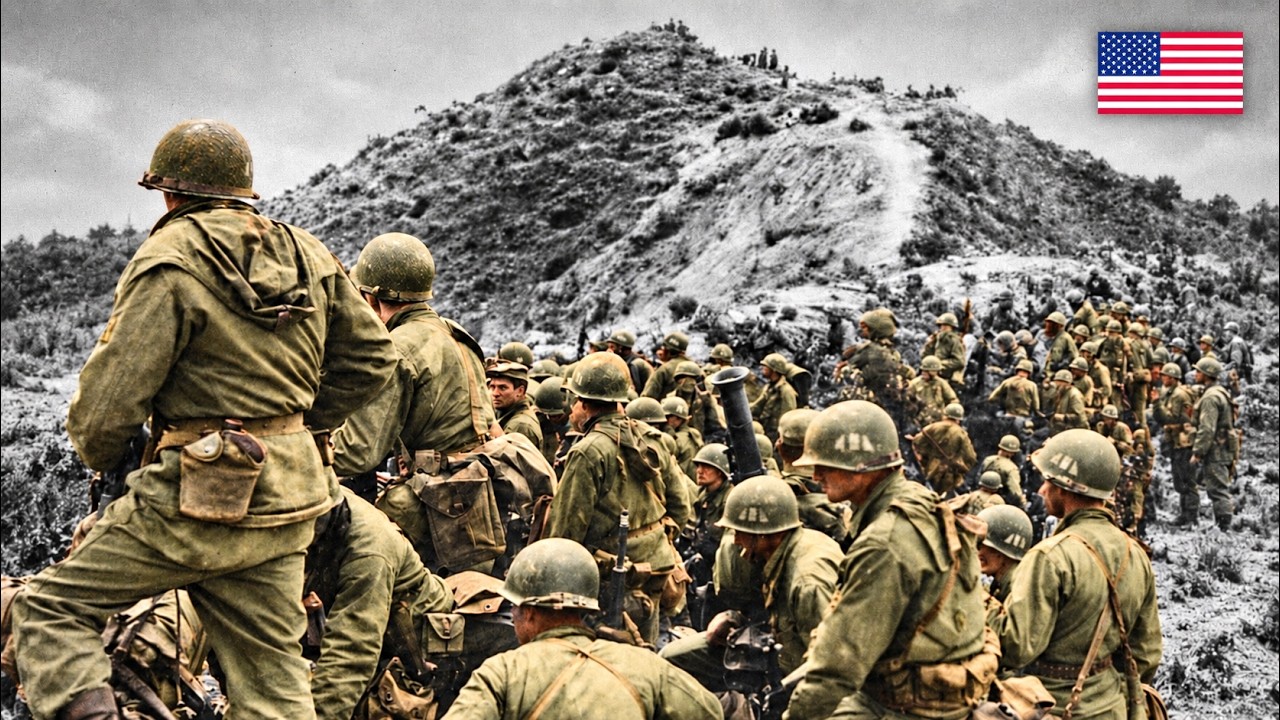
The war had roughly sixty hours left to run. The delegations at Panmunjom had settled nearly everything. The line that would divide Korea was already drawn. The hill he was holding would be abandoned within days of the shooting stopping, and then left empty.
He knew this. His officers knew it. The men climbing toward him knew it. This is not a story about a pointless last battle in a war that was already over—that framing is most of the reason you have probably never heard of it.
It is a story about what Australians saw when they were placed inside an American Marine perimeter for two nights, and about the thing neither army had a form to record. The familiar version of the Korean War’s ending is short. Stalemate. Two years of static fighting over hills known by their height in meters, then a signature, a ceasefire clock, everyone home.
None of that is false. It is incomplete in one specific place. Between half past seven on the evening of the 24th of July 1953 and three in the morning on the 26th, the Chinese People’s Volunteer Army put a divisional attack into a stretch of front held on the right by an Australian battalion, and on the left by the United States Marine Corps. The 7th Marine Regiment lost forty-three men killed and three hundred sixteen wounded.
The Australians of the 2nd Battalion, Royal Australian Regiment, lost five killed and twenty-four wounded. Chinese losses are counted in thousands by one side and in hundreds by the other, and the size of that gap is itself part of the story. The American record of those nights is thorough. The Marine Corps keeps its own history and keeps it carefully.
The witnesses worth listening to here are the other ones—allies, not adversaries, which makes them a peculiar sort of outsider. Close enough to watch the machinery work, foreign enough to find it strange. What the Australians said afterwards is not what you would expect from an ally. It is not admiration.
It is not complaint. It reads more like a man describing a piece of equipment he was handed without instructions. To understand how a nineteen-year-old from East Perth came to be calling artillery onto his own head on a hill held by another nation’s Marines, you have to go back, not to the week of the armistice, but to the ground itself and to what had already been done to it. On the 9th of July, 1953, the 28th British Commonwealth Brigade took over a position called The Hook.
The Hook was a spur of high ground west of the Sami Chon River inside the sector held by the United States I Corps. On the map, it curved, and the name followed the shape. From the Chinese side, it was something more useful than a shape. It was a bulge that overlooked the approaches toward the Imjin River, and it sat on the hinge between two Allied formations.
It had been attacked repeatedly since the autumn of 1952. By that summer, it was the most threatened sector on the divisional front, and it looked the part. The forward slopes had been shelled down to bare earth. Trenches were dug, collapsed, and dug again.
Bunkers were roofed with timber and sandbag and then buried, because anything standing above ground did not remain standing. The 1st Commonwealth Division held it. That division was commanded by Major General Michael West of the British Army and built from British, Australian, New Zealand, Canadian, and Indian units, all of it operating inside an American corps. Across the gully to the left stood the 1st Marine Division under Major General Randolph Pate, holding the ground the Americans called the Nevada complex.
Stay with that arrangement for a moment. It is the engineering problem of the whole battle. Two armies, two artillery systems, two signals procedures, two doctrines of defense, two vocabularies for the same objects, two chains of command that met nowhere below the level of a corps headquarters, and between them a gully. Staff officers call that a boundary.
Infantrymen call it a seam. It is the place where responsibility thins out, where each side assumes the other is watching, and where a commander who has studied the ground for months will choose to put his weight. The Chinese chose it. Their attack on the night of the 24th was aimed at the gully between the Hook and Hill 111—not at the strongest position on the front, but at the join between two nations.
The Commonwealth answer to that problem was unglamorous, and in its way remarkable. Hill 111 was American ground. It also happened to look straight down the western approaches to the Australian position. Guns sighted on it could fire along the length of those approaches rather than into them.
The technical word is enfilade—fire that travels down a line instead of at it. A man advancing on the Hook could be cut at by weapons he was not even facing. So Australian machine guns were sent to sit on an American hill. Not a liaison officer, not an attachment on paper.
A ten-man section with medium machine guns dug in on the extreme right flank of a rifle company of the 3rd Battalion, 7th Marines—How Company, in one detailed account of the action. There was no doctrine for that. Allied cooperation was written down at the level of divisions and corps, in liaison officers and fire plans and boundary lines drawn in grease pencil. Nothing in either army’s paperwork described what happens when ten Australians and an American rifle company share one hill under divisional bombardment.
Whose ammunition? Whose casualty chain? Whose orders at three in the morning when the telephone line has been cut and nobody can hear anything anyway? They had no box for it.
They built it out of whatever was on the hill. Behind them stood the Commonwealth Divisional Artillery, including the New Zealand gunners of the 16th Field Regiment, Royal New Zealand Artillery, and the Centurion tanks of C Squadron, 1st Royal Tank Regiment, sited to fire across the valley. Opposite them, the 137th Division of the Chinese 46th Army had been holding that stretch of line since February—five months to learn the ground. Five months also to watch exactly where one army stopped and another began.
The Australian Brigade was commanded by Brigadier John Wilton, born in Sydney in 1910. He was a gunner by training, decorated with the Distinguished Service Order in the Second World War, and he had spent 1951 and 1952 at the Imperial Defence College in London studying strategy at the highest level of abstraction available to an officer of his generation. In March 1953, he was given a composite brigade of Australian, British, Indian, and New Zealand troops holding a hill in a war nobody expected to win. The gap between those two assignments is the man.
He would later describe the ground in front of his own positions in language a staff college would not have taught him. The Australian battalion on the Hook, 2 RAR, was commanded by Lieutenant Colonel George Larkin. Its sister battalion, 3 RAR, under Lieutenant Colonel Arthur McDonald, held Hill 46 to the flank. Then there is the sergeant.
Brian Charles Cooper was born in East Perth, Western Australia, in August 1933. He joined the Australian Army in 1951 at eighteen, after a year in the Citizens Force. He sailed for Korea aboard the *New Australia* and arrived in March 1953, four months before the shooting stopped. He commanded one of the four sections of the battalion’s medium machine gun platoon.
He was nineteen years old on Hill 111. He would still be answering questions about those two nights sixty years later, in a recorded interview, in the flat voice of a man who has decided which parts he will say out loud. In C Company’s position on the Hook itself, there was a corporal named Kenneth Crockford holding a bunker forward of the main line. Accounts differ on his rank—some list him as corporal, others as lance corporal.
They agree on what he did. On the American side, Major General Randolph Pate had been ordered to Korea in June 1953 and had commanded the 1st Marine Division for only weeks. He was fifty-five, born at Port Royal, South Carolina, and had come through Guadalcanal and Iwo Jima. His 7th Marine Regiment, holding the forward positions beside the Australians, was commanded by Colonel Blen C.
Funk. And on the other side of the valley was Cheng Dengzhi, commanding the 137th Division. He deserves to be taken seriously because his plan was good. His artillery preparation was heavy, accurate, and correctly timed.
His reconnaissance had identified the seam between two Allied divisions and aimed the assault at it. His infantry attacked at night in successive waves against positions his men had watched for five months. Every one of those judgments was sound. One factor did not fit, and it was not courage, and it was not numbers.
It was the volume of shellfire that a Commonwealth division could put onto a valley floor in a single night, from guns crewed by New Zealanders directed by observers who were not going to move. Private Harry Cammerman of 2 RAR described the mood in the battalion before it started, in an account preserved in the unit’s history. “The memories of bad times in the line were beginning to fade, and everyone was getting impatient for action. ” Read that again.
Impatient for action, written by a man in a battalion that had lost seventeen killed and thirty-one wounded on that hill in the preceding fortnight, in a war that everyone knew was ending. It is not bravado. It is the specific boredom of static warfare, which is one of the things the record of this campaign consistently underplays. Half past seven in the evening, the 24th of July: Chinese artillery and mortar fire comes down on Boulder City, the American position on Hill 119.
Half past eight: probing attacks against the 3rd Battalion, 7th Marines. Ten minutes to nine: waves of Chinese infantry hit the forward positions of 2 RAR. Nine o’clock: the bombardment of Hill 111 becomes general. At ten past nine, Wilton orders a company of the 1st Battalion, Durham Light Infantry, into a reserve position.
At quarter past nine, the Chinese strike the right flank of the 5th Marines. This attack is not a raid—it is a division moving. At twenty past nine, the Chinese begin pulling back off Hill 111. That is where Cooper’s section is.
The second assault against the Australians comes in and is broken by twenty-five past eleven. Behind all of it, through the night, the British and New Zealand gunners fire approximately thirteen thousand rounds. Thirteen thousand rounds is not a percentage. It is that many shells from that many barrels into one valley in one night.
At quarter past midnight, Company I of the 3rd Battalion, 1st Marines, is ordered up to reinforce Boulder City. At half past one, two Marine companies counterattack. By half past three, the American perimeter is reestablished. At four in the morning, the fighting moves back to Hill 111.
And Hill 111 is not secure again until half past five. Twenty minutes to seven, the Marines report Outpost Esther secure. First light is up. Both sides can see the ground.
The Chinese come again in daylight—a company-strength assault on Hill 119 at twenty past eight in the morning, a heavy barrage onto Hill 111 at eleven. It takes until twenty-five minutes to two in the afternoon to force the last of them off the forward slopes of Boulder City. Then the second night. Nine o’clock on the 25th: an Australian standing patrol out in front of the wire runs into roughly twenty Chinese soldiers and fights them off.
Twenty past nine: the incoming fire thickens. Half past nine: Chinese companies go in against the Marines on Hill 119. Eleven o’clock: the shelling on Hill 121, held by C Company of 2 RAR, reaches more than thirty rounds a minute. That is a shell landing every two seconds on a hilltop, for as long as the guns can be fed.
Quarter past eleven: the main charge goes in against Hill 111 and Boulder City together. Twenty minutes to midnight: the Chinese reach the bunker held by Crockford’s section. He fights them at the entrance, and the record of his Military Medal notes that he repeatedly exposed himself to enemy fire. That flattened institutional phrasing means a man kept standing up in a place where standing up was fatal.
Between half past one and three in the morning, the fighting on Hills 111 and 119 becomes continuous. At 2:18, Wilton places a Durham Light Infantry company on five minutes’ notice to move. That is a brigade commander telling himself the line might not hold. The line held.
At three in the morning on the 26th, the small arms fire dies away, and the Chinese senior command calls off the offensive. Somewhere inside those hours, Cooper called the guns onto his own hill. The accounts I have read do not fix which night or the minute, and I am not going to invent one. What they agree on is that the position on Hill 111 was saved by an Australian sergeant asking New Zealand artillery to fire on the ground he was standing on.
His section had ten men. Two were wounded on the first night. One more took a grenade wound the following morning. Five Australians were killed in the battalion over those two nights.
Twenty-four were wounded. Their names are on the Roll of Honour in Canberra. The accounts I have read do not tell me which of them died on which hill, and I would rather say so than guess. The 7th Marines lost forty-three killed and three hundred sixteen wounded.
Forty-three men in fifty-four hours, for a hill that would be given up within the week. The Chinese dead lay in the valley in numbers that nobody has ever fixed. United Nations estimates for the battle run between two and three thousand killed, with wounded believed to exceed ten thousand. More than three hundred bodies were counted around Hill 111 alone.
Chinese official figures give a total of 886 casualties for the entire 46th Army across a period of more than a month. Those two accounts cannot both be right. What every source agrees on is that the valley floor had bodies on it that had to be counted rather than estimated, and that the Chinese division did not take the ground. Brigadier Wilton walked the approaches to his own positions afterwards.
His recollection is the plainest sentence any officer produced about that morning. “The bodies,” he said, “literally carpeted the ground sometimes two deep. ” Carpeted. Two deep.
A brigadier reaching for a domestic word—the thing on a floor in a house—because the military vocabulary he had been trained in for twenty years contained no unit of measurement for what he was looking at. That is not rhetoric. It is a category failing in real time. Sergeant Cooper’s testimony, recorded in interview decades later, does the same thing from the opposite end of the rank structure.
He describes bargaining out loud in the pit. “I had words with the great godfather up above, I said to him, ‘Well, if it’s going to be me, I’d like it to be quick. ’” *If it’s going to be me*—not *whether*, *when*. He had already moved the question from survival to method.
Then, of the shelling itself: “It was terrifying, I can tell you that. ” Six words from a man decorated for what he did during it. The Military Medal citation and the sentence do not contradict each other. They are simply two different filing systems for the same night, and only one of them is honest about the temperature.
Elsewhere in the same interview, he says of the whole business: “I reckon my luck’s been used up. ” And this, near the end: “They are lifetime experiences I don’t think anyone would forget. ” Experiences—not battle, not glory, not sacrifice. The blandest available noun doing the heaviest available work.
Ask most veterans of this fight what they made of the Marines beside them, and you will not get a verdict. You will get logistics, because that is the shape the Australian testimony actually takes. The Marines, Cooper noted, were grateful for the illuminating mortar rounds his section put up over the wire, which turned the black hillside into something a rifleman could shoot at. At one point, a Marine sergeant borrowed his 3.
5-inch rocket launcher—an American anti-tank weapon held by an Australian section on an American hill—and used it to clear bunkers the Chinese had taken. One weapon, two nationalities, passed hand to hand in the dark without a signature, without a form, without a single line of doctrine authorizing it. That is the whole alliance compressed into an object you could carry. Neither army had a category for that either.
Interoperability—the word staff colleges would later spend decades on—was invented that night by a Marine sergeant and an Australian sergeant who could not have been more than a few years apart in age, and who left almost no record of the conversation. The armistice was signed at Panmunjom at ten in the morning on the 27th of July. It came into force at ten that night. The Chinese guns fired until close to the end.
A Chinese platoon was still moving on the wire at Hill 111 at half past nine in the evening. The Commonwealth artillery fired approximately thirteen hundred rounds during that final day. Both sides then had seventy-two hours to withdraw two kilometres. The Hook, Hill 111, Boulder City, the gully—all of it went into the four-kilometre strip that became the Korean Demilitarized Zone.
Through August and September, sappers went back to lift the mines and demolish the bunkers they had spent a year building. Under Operation Big Switch, 12,773 United Nations prisoners were repatriated. Twenty-one of them were Australians, and one was a New Zealander. Brian Cooper received the Military Medal.
He returned to Australia in April 1954, served eighteen years in the army, and was still giving interviews about Hill 111 in his eighties. Kenneth Crockford received the Military Medal for the bunker. So did Corporal Maguire, Private Kent, and Private McAuliffe. Lieutenant Forbes received the Military Cross, as did Major James Spence of the New Zealand Gunners, who had put himself forward on the ground to direct the fire.
The Royal Australian Regiment was granted the battle honour “The Samichon. ”
John Wilton came home, commanded the Royal Military College at Duntroon from 1957 to 1960, ran the SEATO Military Planning Office in Bangkok, became Chief of the General Staff in 1963, and Chairman of the Chiefs of Staff Committee from 1966 to 1970. He directed Australia’s strategy in another Asian war, and died in Canberra in 1981. Randolph Pate commanded the 1st Marine Division until May 1954, and became Commandant of the Marine Corps in 1956.
He died in 1961. Cheng Dengzhi’s division held its line until the ceasefire. The English-language record I could read follows him no further, and I will not pretend otherwise. The battle itself went into the archives quietly.
In Australia, it is remembered mainly by the battalion that fought it. In the United States, the last days of July 1953 sit inside a much larger Marine Corps story, and it is not clear that a ten-man Australian section on Hill 111 was ever formally anybody’s to remember. This is not a story about brotherhood between armies. That word does most of its work by preventing you from looking closely.
It is a story about what happens at a seam. Two forces, two systems, a gully between them, and a commander opposite who had spent five months studying exactly where the responsibility of one ended and the other began. Everything institutional about that arrangement was a weakness. What closed it was not doctrine.
It was ten men with machine guns sitting in the wrong army’s position, and a borrowed rocket launcher, and a nineteen-year-old giving his own map reference to the gunners. The ground they held was worth dying for on the 25th of July, and worth abandoning on the 28th. Both of those are true, and no amount of retelling makes them agree. Cooper, asked long afterwards what he got out of it, gave an answer that reads at first like modesty and is not.
“I got my prize from my action in Korea in that I’m still here talking to you. ” Still here talking. The hill is still there too, inside the strip nobody enters. The forward slope grown back over the bare earth.
The guns that once swept the length of those approaches are gone, and the approaches are simply a valley again, running quietly between two lines that stopped where the shooting stopped.






