By late August 1944, there was a man in East Prussia who was laughing. His name was Alfred Jodl, a 54-year-old general and the chief of operations staff at the German High Command. He had just finished a set of calculations that told him, with the certainty of a professional soldier who had studied logistics for thirty years, exactly when the American army would stop. Not if, but when: in hours, perhaps days, and certainly no more than a week.
In a special assessment for the Führer, he wrote that George Patton’s tanks could not continue their advance. The mathematics said so. Thirty years of German experience said so. Every professional soldier in Europe would have agreed.
Armies simply did not outrun their supply lines and keep moving. That was not how wars worked. It had never been how wars worked. The mathematics were correct.
But the Germans were wrong. This is the story of 23,000 men, most of them Black, most of them denied the right to fight in the war they were winning, who broke Alfred Jodl’s calculations at forty miles an hour. It is the story of 83 days that decided the fate of the Western Front. Your father may have known some of these men.
Your uncle may have driven one of these trucks. Their names are not in most history books. This is the Red Ball Express. And this is the story of why the German generals stopped laughing.
To understand what these men accomplished, one must first understand what the German generals believed. Because the story of the Red Ball Express is, at its core, a story about a laugh. A laugh that started in Berlin in August and faded from every Wehrmacht headquarters by December. By mid-July 1944, the Allied armies in Normandy had been stuck for six weeks.
Not defeated, but stuck. More than a million soldiers had come ashore, yet they remained wedged into a narrow strip of French coast, throttled by the hedgerow country, bleeding slowly against German defenders who fought for every field. Then came Operation Cobra. On July 25, the American First Army under Lieutenant General Omar Bradley, cautious, quiet, with a face like a schoolteacher’s, broke through the German lines west of Saint-Lô with the heaviest tactical bombardment in history.
1,250 American bombers dropped 4,000 tons of explosives on a rectangle of French farmland five miles long. The German panzer division commanded by General Fritz Bayerlein ceased to exist as a fighting force by dusk. Through that gap poured Patton and the Third United States Army, activated on August 1. Patton did what only Patton did.
He drove. He drove at forty miles a day. He outran his own supply lines. He drove through Avranches, Rennes, Le Mans.
He ran until his flanks were exposed and his fuel was low, and his staff officers begged him to slow down. He refused, because Patton understood something some of his fellow generals did not. In war, momentum is a weapon, and a weapon must be used before it rusts. On August 21, the pocket around Falaise closed.
50,000 German soldiers were captured. Another 10,000 were killed. Two German armies were utterly destroyed. Field Marshal Walter Model, the 53-year-old commander known as the Führer’s fireman, arrived from the Eastern Front to inherit a corpse.
In his first report he wrote that the German army in the West was no longer an army. It was, in his exact words, a mob of fugitives. By August 25, Paris was liberated. By August 31, Patton was at the Meuse River, 200 miles east of the D-Day beaches and still advancing.
This was, on paper, the greatest tactical victory of the war in the West. It was also, on paper, impossible to supply. Now consider the men on the other side of the line. In the summer of 1944, the German High Command was headquartered in an East Prussian complex called the Wolfsschanze, the Wolf’s Lair.
There, Alfred Jodl reviewed intelligence reports with the quiet certainty of a man who had studied the mathematics of war since before the last one. Jodl was no fool. None of the German generals were fools. They had invented modern armored warfare.
They had crossed the Meuse in 1940 in three days when the French said it would take three weeks. They had driven 1,500 miles into Russia in 1941. They knew, in their bones, what a supply line could and could not do. They knew an armored division consumed about 25,000 gallons of fuel in a full day of movement.
An infantry division on the march required 700 tons of supplies a day. Ammunition, rations, water, medical supplies, spare parts, replacement tires, winter clothing, boots. Patton was driving twelve divisions. The German arithmetic said he needed 12,000 tons of supplies moved every 24 hours over broken roads, through a country whose rail network had been systematically destroyed, from beaches 400 miles behind him.
The calculation they believed in was inevitable. Patton would stop. Patton would starve. Patton would give the enemy time to reorganize behind the Seine, perhaps behind the Moselle, perhaps behind the West Wall itself.
Time to bring in fresh troops from Norway and Italy. Time to make the winter itself a wall. General Siegfried Westphal, forty years old, sharp-featured, precise, was soon to become chief of staff to Field Marshal Gerd von Rundstedt on the Western Front. Westphal knew a great deal about logistics; he wrote in his private notes that even if the Americans had unlimited trucks, which they did not, and perfect roads, which they did not, and suffered no mechanical breakdowns, which no army ever avoids, they could not have sustained Patton’s advance for more than another 48 hours.
Westphal wrote that the laws of physics could not be violated, not even by American industry. And in that belief, that precise and mathematical faith, the German generals were right. But they were right about the wrong war. That is the first thing nobody told you in school.
That is the first silent joke history plays on men who thought they understood war. In August 1944, the Wehrmacht, the army that invented blitzkrieg, the army that conquered Poland in a month and France in six weeks and seemed to embody modernity itself, still moved 80% of its supplies by horse. 2. 7 million horses served in the German army by the end of the war.
They pulled artillery. They pulled ammunition carts. They pulled field kitchens. They carried the wounded to aid stations.
In every propaganda newsreel, every carefully staged photograph, the panzer divisions advanced on their tracks. And in the fields behind those cameras, six horses per ammunition cart, six carts per battery, ten batteries per division, old Germany dragged new Germany forward, one tired step at a time. The German officers who now mocked American logistics had nearly frozen to death in Russia three winters earlier because their horses died faster than they could be replaced. They had watched their own supply lines collapse.
They had watched their own armored spearheads stall and stop 100 miles from Moscow because trucks could not keep up with tanks, and horses could not keep up with trucks. They had learned, at the cost of half a million dead, exactly what happens when an army outruns its ability to feed itself. And now they looked at Patton and saw themselves in 1941, and they laughed, because it was the only thing they could do. Historians have a term for what the German generals were doing.
It is not a military word. It is a psychological one. Projection. When a man fails at something terribly, he expects others to fail at it in exactly the same way.
His experience becomes his prophecy. His scars become his crystal ball. The German army was not laughing at American weakness. The army was laughing at its own memories.
The calculations were real. The contempt was real. But the certainty, that deep confidence that no army could sustain what Patton was doing, came from a German officer looking into a mirror and seeing a Russian winter behind his eyes. They were about to learn that the Americans looked into a different mirror and saw something they had never seen before.
But the Germans were not the only ones staring at Patton’s advance with growing alarm. Turn now to the American side. To a stone farmhouse near the town of Valognes in the Cotentin Peninsula. To a lieutenant general named John Clifford Hodges Lee.
Fifty-seven years old, silver-haired, erect, deeply religious, known as one of the most disliked senior officers in the American army. Lee commanded no fighting troops. Lee commanded the Communications Zone, the vast rear organization known by its acronym COMZ. Lee’s job was to make sure everything Patton fired, ate, wore, or burned reached him from the beaches.
His initials, J. C. H. , earned him a nickname among the men who served under him.
They called him Jesus Christ Himself. He did not discourage the joke. He did not appreciate it either. Lee had a problem.
In fact, Lee had several problems, each one worsened by Patton’s success. The first problem was Cherbourg. The great deep-water port on the Normandy coast had been captured on June 27, but the retreating German engineers had so thoroughly destroyed it that Allied planners called it the most complete demolition of any port in history. Cranes had been dynamited and dropped into the water.
The inner harbor was mined and choked with sunken ships. American engineers were working around the clock to bring it back into service. But by mid-August, Cherbourg was still handling only a fraction of the tonnage the Allied armies needed. The second problem was the railroads.
Beginning in the spring of 1944, Allied bombers had systematically destroyed the French rail network as part of a strategy called the Transportation Plan. It had worked brilliantly. German reinforcements could not move to Normandy on schedule. But now, in August, those cratered marshalling yards and broken bridges belonged to Bradley and Patton.
The tools of victory had become obstacles to its exploitation. There were no trains because the Allies had made sure there were no trains. The third problem was Antwerp. The great port, the second largest in Europe, would eventually solve everything.
The British Second Army captured the port facilities largely intact on September 4. But Antwerp lies sixty miles inland up a choked estuary, and both banks of that estuary were held by German forces who could, and would, shoot at any Allied ship trying to reach the docks. Antwerp did not open to Allied shipping until November 28. Nearly three months of waiting.
Nearly three months of trucks doing what ships should have done. So in the last week of August 1944, John C. H. Lee sat in his stone farmhouse and stared at his maps.
He saw the beaches on the left-hand side. He saw Patton on the right-hand side. Between them, a widening gap that no railroad and no port could yet bridge. And behind Lee, there was a small group of men working on the calculations, people history has largely forgotten.
Major General Frank A. Ross, chief of transportation for the European Theater of Operations. Brigadier General Ewart G. Plank, commander of the Advanced Section of the Communications Zone, a small, stern man who would soon issue the order that started everything.
And under them, a colonel from the Motor Transport Brigade named Loren Ayers, an officer whose job was to turn calculations into wheels. These men understood something the Germans did not. The crisis was not caused by the enemy. The crisis was caused by Patton.
This is the second joke history plays. This is the shift no German intelligence officer could have imagined because it required an American perspective to see it. The great supply crisis of August 1944 was not the fault of any failure. It was the direct result of an overwhelming victory.
Every Allied logistics plan made before D-Day assumed the ground campaign in France would unfold according to a timeline known as the Overlord schedule. That timeline was cautious. It was pessimistic. It was made by planners who remembered the First World War and assumed the German army would fight the way German armies had always fought: stubbornly, slowly, giving up ground by yards, not miles.
According to the Overlord schedule, Allied forces were supposed to reach the Seine, the river that runs through Paris, around day ninety after D-Day. That is, September 4, 1944. Every supply depot, every railroad repair project, every truck company allocation, every fuel tanker schedule for the ninety days after the June 6 landings was based on that assumption. Patton crossed the Seine on August 25.
He was ten days ahead of schedule. And ten days at forty miles a day meant four hundred miles. Four hundred miles no supply plan had ever imagined. Think about what that meant.
Every ton of ammunition scheduled to move east was destined for a depot Patton had already passed. Every fuel dump was calculated for a position his tanks had already burned through. Every mile of French railroad the American army planned to repair was still shattered, waiting for engineers who had assumed they had two extra weeks. The Third Army had outrun its logistics, not because the logistics failed, but because the operation succeeded beyond anything any plan could have predicted.
At his headquarters in England, the Supreme Allied Commander, General Dwight D. Eisenhower, 54 years old, bald, plain-featured, gifted at holding fifteen different personalities together in one alliance, understood this before most of his staff. He wrote in a private letter that success was proving to be just as heavy a burden as failure. Because when an army moves faster than its plan, the plan itself becomes the enemy.
That is the paradox that shaped everything that followed. Patton was winning too much. The Germans were retreating too fast. Every mile that brought Patton closer to Berlin also carried him farther from the ships that fed him.
Every day of victory was a day of growing hunger. Every hour of triumph was an hour closer to the moment when his tanks would stand in a French field with empty fuel gauges and open turret hatches, waiting, as it happened, for a solution that had not yet been invented. That solution was invented on the afternoon of August 23, 1944, in a requisitioned French château near the town of Liermont. Colonel Loren Ayers walked into a room full of officers he did not know well and gave them a briefing that contradicted most of what those officers had learned in war colleges.
He had spent the previous two days doing arithmetic on the backs of ration cards. He had calculated fuel consumption rates and truck duty cycles and driver endurance and bridge capacities and road conditions and the average speed of a GMC two-and-a-half-ton truck loaded with seven tons of artillery ammunition through the heavy August rains of Normandy. His numbers said something no American logistics manual had ever said. His numbers said it was feasible.
Not according to the book, not according to regulations, not according to anything anyone had learned in any military school in either army. Ayers said, according to the recollection of one officer in the room: Gentlemen, we are going to build a highway. Not just a road, a highway. A lane going, a lane coming, two parallel loops, with every truck we can find and every man we can put behind a wheel.
For 20 hours out of 24. With bright headlights. No blackout, no dispersion, no convoy discipline as you understand it. We are going to move 12,500 tons of supplies every 24 hours.
Someone in the back of the room, an infantry officer attached to the transportation section, is said to have laughed out loud. Then he stopped laughing, because Ayers was not smiling. And because the man who had brought everyone into that room, Brigadier General Ewart Plank, was not smiling either. The operation name had already been chosen.
It came from the world Ayers understood best, the world he had grown up in before he put on the uniform. It came from the world of railroads. In American shipping terms, a red ball meant a shipment with absolute priority. It moved before everything else.
It carried perishable goods, urgent goods, goods that could not wait. Every switchyard cleared its tracks when a red ball shipment came through. Every schedule shifted to accommodate it. In the railroad world, a red ball was not a request.
It was an order. They would call this operation the Red Ball Express. It would begin at dawn on August 25, 1944, the same day Free French tanks entered Paris. The same day Patton crossed the Seine and became, in strict logistical terms, unreachable.
The same day the Wehrmacht received its first fragmentary reports of a phenomenon its intelligence officers could not yet name, and would not believe for some time. Continuous columns of vehicles, headlights visible for kilometers, no intervals between them, no discipline. An estimated 1,000 vehicles an hour. The German officers who read those reports set them aside.
They told themselves: impossible. Propaganda. No army moves that way. No army in history had ever moved that way.
They were right. No army in history had ever moved that way, because no army in history had ever been asked to. 6,000 trucks were about to become the most powerful weapon in the Western war. And 75% of the men behind the wheels of those trucks were Black.
They would drive through exhaustion. They would drive on amphetamines. They would drive without sleep. They would drive over roads their engineers were still repairing.
They would drive with bright headlights through nights that military doctrine said would get them slaughtered from the air. They were not slaughtered from the air, because the Luftwaffe that would have slaughtered them had been slaughtered first. They would deliver, in 83 days, 412,000 tons of supplies. They would keep Patton fed.
They would keep the First Army fed. They would keep the war moving east while the Wehrmacht discovered, slowly at first and then with dawning horror, that the calculations they had trusted for thirty years no longer applied. They would do it in a segregated army, in a country where most of them could not eat in most restaurants, in a uniform whose oath they took more seriously than the state that issued it. But that story belongs to the next hour.
For now, on the last afternoon of August 1944, somewhere on the highway east, Lieutenant General George S. Patton was staring at a road that led toward Germany and doing the only thing he could do. He was waiting. A phrase often attributed to him, though historians argue about its exact wording, captured what he was thinking.
My men can eat their belts, but my tanks must have gas. He did not know that ninety miles behind him, the first painted red circles were already being stenciled onto the doors of two-and-a-half-ton trucks. He did not know that Ayers had written the plan. He did not know that Plank had signed the order.
He did not know that in the segregated barracks tents of the supply companies, drivers were being woken from sleep and told they would start in six hours something that nobody had yet given a name. He knew only what he could see. Empty tanks, an open road, and a war that could be ended if only he could move. The German generals had mocked American logistics.
They had studied their calculations. They had trusted their experience. They had bet the Reich on the belief that no nation could do what they themselves had failed to do. They were about to lose that bet, at forty miles an hour, for 83 days without stopping.
August 25, 1944. 5:30 in the morning. A field outside Saint-Lô, France. The rain had stopped an hour before dawn.
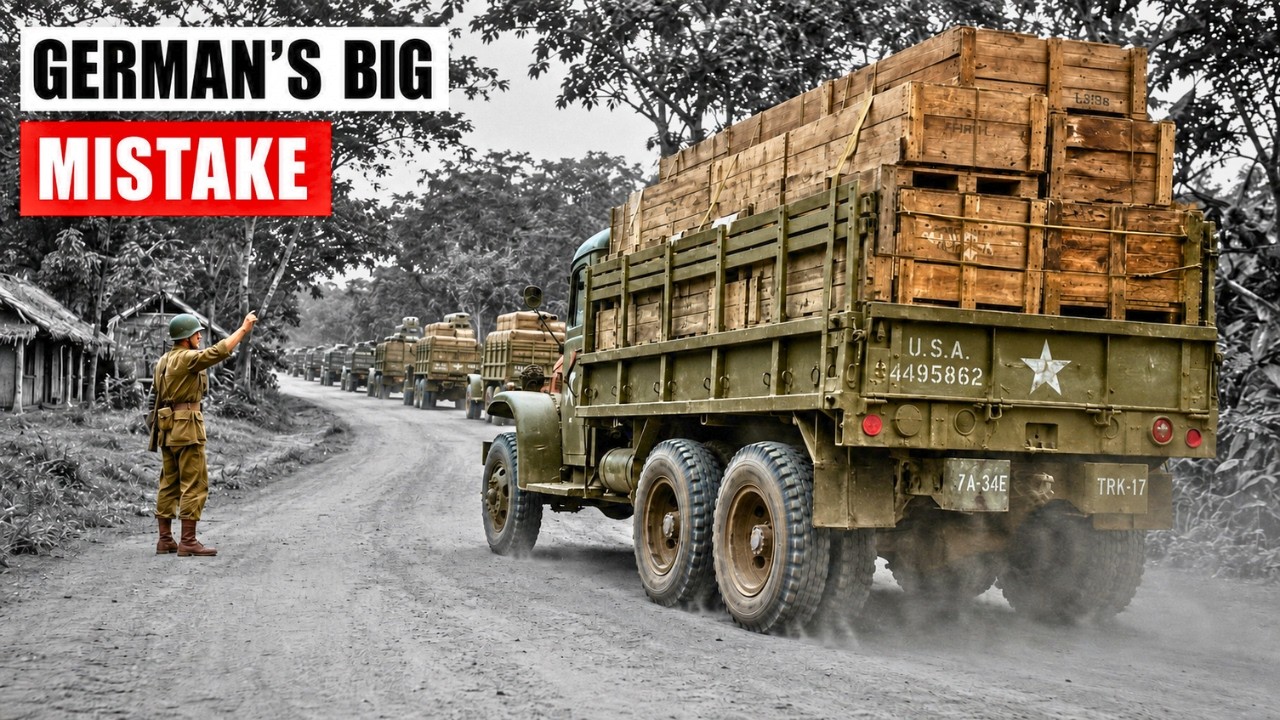
The remaining mud was the color of tobacco. In the gray pre-dawn light, 67 GMC two-and-a-half-ton cargo trucks lined up in a column so long the last truck could not see the first. On the door of each truck, still wet from the stencil, a red circle the size of a dinner plate had been painted the night before. The paint was army-issue, and it was not quite dry.
In the cab of the first truck sat a driver from the 3916th Transportation Battalion. His name was not preserved in the official records, but through the oral histories collected by the Army Historical Division in the years after the war, we know what kind of man he was. A young man of about 22, most likely from the American South, Black, in an army that had not yet learned to see him as a comrade. He had been in France seven weeks.
He had never driven a truck for more than four hours straight before the war. That morning he received orders he did not fully understand, but orders that would make history before the day was over. Head east. Stop only for fuel.
Do not turn off your headlights. If your truck breaks down, push it off the road and get out. Another truck will pick you up. Keep moving until you are ordered to stop.
At 5:35, an officer waved a green flag. The first driver released the clutch. There was no truck in front of him yet, so he simply drove off. Behind him, 66 engines fired up one after another like a string of small explosions along the line.
The convoy began to move, not slowly, not cautiously, but with the deliberate, unstoppable mechanical rhythm of a machine built to do one thing forever. The Red Ball Express had begun. That same morning, 180 miles to the east, tanks of the French 2nd Armored Division entered Paris. Church bells rang from Notre-Dame to Sacré-Cœur.
Women wept and threw flowers. American war correspondents wrote their opening paragraphs about liberation and champagne and history. None of them mentioned the trucks. None of them knew about the trucks.
But the trucks were the reason the tanks could advance. And the trucks had only just begun. The route was selected in less than 72 hours. It was a great loop from Saint-Lô in the west, east through Alençon, then Chartres, then Dreux, to a series of forward supply depots that moved east with Patton’s advance.
A round trip of 686 miles. On the outbound leg, every vehicle carried a load. On the return leg, every vehicle ran empty, as fast as possible, to come back and load again. Two parallel one-way routes, no cross traffic, military police at every intersection.
Any French civilian vehicle that wandered onto the route was pulled over and detained until the convoy passed. Any American truck that could not maintain 25 miles an hour was deemed an obstruction and pushed off the road. Bulldozers followed the convoys to shove broken vehicles into ditches. Mobile maintenance units were established every 50 miles.
Fuel depots were established every 25 miles. At its peak, the Red Ball Express put 5,958 trucks on those roads at once. In its busiest week, it operated 7,000 trucks. The number of men who drove for the line reached 23,000.
Of those 23,000, between 70 and 75% were African American soldiers. Serving in a United States Army that was still strictly segregated. This is a fact most Americans were not told then, and most are not told now. So let us state it plainly.
The men who fueled Patton were the men America would not allow to sit in its restaurants. The men who saved the Third Army were the men whose fathers had come home from the previous war to be lynched in their uniforms. The men who drove 20 hours a day through the rain of France and the artillery of the Germans were the men their country had assigned to supply and quartermaster battalions because it did not trust them to fight. And yet they drove.
They drove because they were given the trucks and asked to drive. They drove because they understood, in a way their commanders often did not, that every gallon of gasoline they delivered was an answer to everyone who had ever told them what they could not do. They painted slogans on their truck bumpers. Hitler, here we come.
The Detroit to Berlin Express. One truck in the 14th Quartermaster Regiment carried a hand-lettered placard on its windshield that read simply: We Deliver. They were not thinking about desegregation orders. They were not thinking about executive orders that had not yet been written.
They were thinking about the load in the back of the truck, and the road ahead, and the driver in the truck ahead of them. But history was watching them anyway. History was taking notes. It would take four more years for someone to read them aloud.
At that time, in the last week of August 1944, the truck they drove was the GMC CCKW, a 2. 5-ton truck. Six wheels, standard four-wheel drive, a canvas cover over a wooden bed. The soldiers called it the Deuce and a Half.
General Motors had built more than 500,000 of them by 1944. The entire German army owned fewer trucks of all types combined than the American army had of this one model alone. It was not an elegant vehicle. It was a simple vehicle.
It looked exactly like what it was: a piece of Midwestern industrial pragmatism painted dull olive and dedicated to a single purpose. The engine was a six-cylinder that ran on almost any grade of gasoline. The transmission was slow. The cab was cold in winter and hot in summer.
The seat was a sheet of steel with a cushion no thicker than a magazine, but it started every morning. It carried loads no factory had ever approved. It forded rivers thirty inches deep. It kept running even when its engine oil was black, its filters clogged, its tires patched more times than anyone could count.
It was designed to be built in Michigan, repaired in Missouri, and driven in France by a young man who had never sat behind a wheel until the army taught him how. It was, in a real sense, the weapon that won the Western war. The Germans built precise trucks in dozens of incompatible models. The Americans built one truck half a million times.
That difference seems simple. It was the size of an ocean. By the end of the first week, the Red Ball Express was delivering more than 12,000 tons of supplies a day. By the end of the second week, it had moved 89,000 tons over 686 miles of roads that had not been a supply route ten days earlier.
The German staff officers who intercepted these figures dismissed them as propaganda. American forces could not possibly be moving that much materiel. It violated the mathematics. It violated experience.
It violated everything the German army knew about war. And here we arrive at a truth that must be told carefully. The Red Ball Express violated German military doctrine. It did not violate German doctrine by accident.
It violated German doctrine deliberately, by design, after deep thought. Consider what the Americans did. They ran their trucks with headlights on all night. German doctrine said this invited air attack.
The Americans ran their convoys bumper-to-bumper with no intervals between vehicles. German doctrine said these were perfect targets for artillery and aircraft. The Americans wasted vehicles profligately, abandoning trucks with minor mechanical problems instead of repairing them. German doctrine said this was unforgivable waste.
The Americans burned 300,000 gallons of gasoline a day just to run the trucks that were delivering the gasoline. German doctrine said this was mathematical absurdity. By every measure of European military science, the Red Ball Express should have been a catastrophe. It was not a catastrophe because the Americans understood something the Germans did not.
The Americans understood that they owned the sky. The Luftwaffe of August 1944 was not the Luftwaffe of 1940. The great German air force that had once darkened the skies over Poland and France had been ground to dust over the previous two years. Its best pilots were dead.
Its factories were being bombed to rubble by Allied heavy bombers night and day. Its fuel was rationed. By late August 1944, the entire Luftwaffe could put perhaps 300 aircraft over the Western Front in a day. The American Ninth Air Force alone regularly flew more than 2,000 sorties a day.
When the American drivers drove with their headlights on, they were not being reckless. They were making a bet. They were betting that no German night fighter would find them. They were betting that no German artillery observer could direct fire before they passed the position.
They were betting that air supremacy, purchased at terrible cost over the previous two years by the bomber crews of the Eighth Air Force and the fighters of the Ninth, would now pay dividends on the ground, convoy after convoy. They won the bet. They won it every night. The trucks kept moving and the Luftwaffe did not come.
This was the great second secret of the Red Ball Express, and no German general ever fully seemed to understand it. The Red Ball did not succeed because it was well designed. It succeeded because it was designed for conditions only the Allies had created. Remove Allied air supremacy and the Red Ball becomes a slaughter.
Give the Americans that supremacy and the operation itself becomes an unstoppable river of steel. The Germans had built an air force to protect their own lines of communication. They had failed to keep that air force alive. Their own logic had been turned against them.
Now the Americans were driving with their lights on in the dark, mocking rules the Germans had written for a world that no longer existed. But there was another cost. A cost that did not appear in German intelligence reports. A cost paid in bodies, not vehicles.
The Red Ball drivers were asked to do something no army in history had ever asked of its transport troops. They were asked to stay awake for 20 hours a day, sometimes 30, sometimes more. The army knew this was medically impossible without help. So the army provided help.
The help came in the form of a small white pill, Benzedrine, an amphetamine. The army officially issued it to Red Ball drivers to keep them alert. The pills were distributed at fuel stops, three or four at a time, no prescription required. The drivers swallowed them or washed them down with lukewarm coffee and got back behind the wheel.
The pills worked for hours at a stretch. The pills were effective. Then they began to wear off. A driver on Benzedrine could stay awake for two days.
But he could not hold his mind together for two days. His reflexes slowed, his judgment blurred. He began to see things at the edge of the road that were not there. Some drivers reported hallucinations of children standing in the middle of the road.
Some reported entire villages that did not exist. Some drivers simply blacked out behind the wheel with their eyes open and crashed into the vehicle ahead. The accidents killed about 300 Red Ball drivers during the operation’s 83 days. Some burned to death inside the cabs of trucks that overturned into ditches.
Others were crushed when their overloaded trucks veered off wet roads. Some were shot by their own guards at forward checkpoints because they did not answer a challenge they never heard through the fog of exhaustion. Their names are recorded, but the full count of Black soldiers among the dead was never compiled. That was not the kind of thing the army was careful to count.
There were other costs the reports did not mention. A good deal of the gasoline being delivered to Patton simply disappeared en route. Some of it evaporated from leaky jerrycans; that was known and expected. Some of it was siphoned off by drivers and sold to French civilians on the black market for money, for cognac, for the company of women in the villages the route passed at night.
This too was known, and not expected, but there was little to be done about it. Colonel Ayers established mobile military police patrols. He tried sealing the jerrycans. He tried matching odometer readings to fuel records.
The thefts continued anyway. Men who were asked to drive until they dropped were not going to be deterred by courts-martial. They took what they took. None of this made them villains.
It made them human. They were doing the hardest job on the battlefield, in an army that still refused to seat them next to white soldiers in mess halls. History will need to be careful in its judgments. Meanwhile, a second truth about the Red Ball Express was becoming clear to the men running it.
A truth so uncomfortable it is rarely spoken aloud. The operation was consuming its own product. Every day, the Red Ball trucks burned between 200,000 and 300,000 gallons of gasoline just to run themselves. That gasoline had been unloaded from ships at Cherbourg.
It had been stored in depots. It had been pumped into the tanks of trucks whose job was to deliver other gasoline forward, to feed Patton his 12,000 tons a day. The Red Ball was consuming, in its own operations, roughly 7 to 9% of the fuel it was carrying. By the standards of any European army, this was madness.
By the standards of the German High Command, it was proof of everything Alfred Jodl believed. Only a civilization drunk on its own industrial abundance would burn a barrel of oil to move ten barrels. Only such a civilization. Exactly.
Such a civilization. That was precisely the point. The Red Ball Express was the first true expression of a military doctrine Europe had never seen before. The doctrine of profligate abundance.
The doctrine that says we can afford to burn seven barrels to deliver 93, because we own every barrel in the world. The doctrine that says we can afford to abandon a truck for a broken axle, because the shipyards at home are launching new trucks every week. The doctrine that says we can afford to exhaust our drivers, feed them stimulants, lose 300 of them in accidents, and keep going, because behind us stands a nation of 140 million people who have chosen to make this war their cause. The Germans could not process this because they never possessed it.
The Wehrmacht was built for a war of caution. The American army was built for a war of abundance. And in 1944 in France, the war of abundance was winning. But even a war of abundance has limits.
Even the Red Ball Express, at the height of its performance, could not keep up with the pattern forever. In early September 1944, those limits began to show. By September 4, Patton had reached the Meuse. By September 5, he was at the Moselle.
Every mile he advanced added to the distance the Red Ball trucks had to travel. The loop grew from 686 miles to over 700, then to 800, and in some cases to 900. At those distances, the mathematics began to fail. A truck that takes 36 hours to complete a round trip cannot keep a driver for more than two cycles before he collapses.
Vehicles began breaking down faster than mechanics could repair them. The daily tonnage delivered began to drop for the first time. Then, at the worst possible moment, the men in London made a decision that would stop Patton’s advance. On September 10, 1944, at a conference at Supreme Headquarters Allied Expeditionary Force, General Dwight Eisenhower met Field Marshal Bernard Law Montgomery, 56 years old, thin, sharp-featured, wearing his usual black beret.
Montgomery had proposed a bold plan: a single thrust north through Holland. Airborne forces to seize the key bridges, ground forces to race up and link with them. A leap across the lower Rhine, and perhaps an open door to the industrial heart of Germany. The plan had a code name: Market Garden.
To execute it, Montgomery needed fuel. Not some fuel, most of it. He needed priority on the tonnage that had until that day been allocated to the Third Army. Eisenhower approved the plan.
He approved the priority. He gave Montgomery his fuel, and in doing so left Patton with nothing. Three hundred miles south, at his headquarters in Nancy, Lieutenant General George S. Patton read the order and said nothing that could be printed.
His diary that night contains language his official biographers chose to summarize rather than quote. His tanks, which had been advancing steadily east for six weeks, slowed and then stopped, not because the Germans stopped them, not because the Red Ball failed, but because a decision made in London had sent his fuel north instead of east. Operation Market Garden began on September 17, 1944. It failed on September 25, at the Dutch town of Arnhem.
It failed catastrophically, with more than 17,000 Allied casualties. It failed with an entire British airborne division destroyed as a fighting force. It failed without establishing a bridgehead across the Rhine, without shortening the war, without any strategic gain worth the fuel that was consumed. The fuel Eisenhower took from Patton went, in the end, to nothing.
Worse than nothing: to a corpse. While the paratroopers were dying at Arnhem, Patton sat outside Metz. His tanks were draining fuel from wherever they could find it. His men captured German supply dumps and burned enemy fuel in their engines.
But the great, sweeping advance was over. The moment when the Third Army could have reached the Rhine before winter was gone, and the road to Germany that was open on the last day of August was closing. The Red Ball Express did not fail. Its decision was simply overruled.
That is the irony that the history of American logistics has not fully absorbed. It is not comfortable. It does not fit the story of victory. But it is true.
The greatest supply operation in the history of warfare could not save Patton in September 1944, because the enemy of the Third Army that month was not the Wehrmacht. The enemy was a decision made 300 miles behind the front by men who chose a different bet and lost it. The trucks kept moving. The Black drivers kept driving.
The GMC trucks kept consuming their tires and engines and oil. 12,000 tons a day, then 13,000, and on the best days more. But the war they were feeding was no longer a war of movement. It had become a war of attrition, measured in meters, not miles, in steps, not distances.
The Red Ball Express kept operating for two more months. It moved more than 400,000 tons before it was done. It proved wrong every German staff officer who calculated American logistics. It left a mark on the roads of France that was still visible a decade after the war.
But the moment when the war could have been decided before Christmas was gone. And somewhere east of Verdun, the tanks that had once been empty of fuel stood, this time full and motionless, waiting for orders that no supply convoy, however massive, could provide. The last hour of this story was approaching. The winter.
The Battle of the Bulge. The reckoning. And the quiet verdict history rendered years later on those men who had once been laughing. November 16, 1944.
A forward supply depot outside Soissons, France. The rain had returned. The cold, steady rain of a European November, which did not fall so much as settle, soaking into wool coats and canvas truck covers and the mud that had not really dried since August. A driver from the 3418th Truck Company climbed down from the cab of his GMC for what he was told would be the last time.
He was tired in a way no amount of sleep could cure. His hands, when he took off his gloves, trembled slightly. He was 23 years old, but he had aged more than that in 83 days. An officer walked along the line of trucks carrying a clipboard.
He was making a final count. 5,958 vehicles, the average used during the operation. 23,000 men. 412,000 tons of supplies delivered.
686 miles of highway round trip. 83 days of continuous movement. The Red Ball mission was over. The port of Antwerp had been opened to Allied shipping twelve days earlier.
Canadian and British forces had spent October and early November clearing the Scheldt estuary, suffering losses history has not adequately mourned, so that the great Belgian docks could finally receive the ships that had been waiting off Normandy for months. With Antwerp operating, trucking supplies 600 miles from the beaches was no longer necessary. The railroads were partially repaired. Fuel was arriving by pipeline and ship instead of convoy.
The trucks would keep working, but the Red Ball, the one-way highway operation with its painted circles and its 24-hour days and its army of exhausted drivers, that operation was ending. The men were reassigned. Some would drive trucks for smaller supply lines. Others would return to their original quartermaster units.
Some would be sent home. The driver from the 3418th folded his gloves and put them in his pocket. He walked toward the mess tent. He had not had a hot meal in three days.
He did not yet know that the war he had helped make possible was not over. In four weeks and four days, everything he had accomplished would be tested again. And the men who had once mocked American logistics were about to make one final, desperate attempt to change history. They were about to lose.
And the reason they would lose was the same reason they had been defeated since August. But they did not know that yet. On December 16, the counterattack came at dawn. 200,000 German soldiers, 600 tanks, a concentration of armor and infantry the thinly stretched Allied lines across the Ardennes forest did not expect at that place and time.
It was planned by Field Marshal Walter Model. The orders were signed by Field Marshal Gerd von Rundstedt. Hitler himself insisted on the objective. Antwerp.
The great port that had finally opened, the port that had made the Red Ball Express obsolete. If the Germans could reach Antwerp, if they could split the American and British armies, if they captured the Allied fuel dumps in the Ardennes along the way, they might turn the war around. Everything depended on gasoline. The German tanks that led the attack did not have enough of it.
Not nearly enough. The plan assumed, from the first meeting in October, that fuel would be captured from the Americans along the way. Specifically, the plan assumed that a fast-moving armored spearhead would seize the American supply dumps near Stavelot and Spa within 72 hours of the start of the attack. Without that fuel, the attack could not reach Antwerp.
With that fuel, it might. The spearhead was named Kampfgruppe Peiper. It was led by a Waffen-SS officer, Joachim Peiper, 29 years old, a decorated veteran of the Eastern Front. Cold-eyed, ambitious, utterly without mercy.
His unit contained the best tanks the Wehrmacht had left. King Tiger tanks from the 501st Heavy Tank Battalion, Panthers and Panzer IVs, the heaviest armor Germany had ever built. Peiper knew what he had been given, and he knew what he had been ordered to do. He also knew, though he did not say it aloud, that his tanks had enough fuel for perhaps 100 miles, maybe less, if he did not capture American gasoline before it ran out.
His armored fist would become a collection of expensive metal statues in the forests of Belgium. For three days, Peiper drove his force west through the Ardennes. He killed American prisoners of war at Malmedy, where more than 80 were machine-gunned in a field, a crime his men would answer for at Nuremberg. He pushed his crews past every limit without rest.
He achieved the deepest penetration of any German unit in the entire attack. And on the morning of December 18, 1944, he reached the outskirts of the town of Stavelot. The big American fuel dump lay only a few miles to the north, at Francorchamps. More than two million gallons of gasoline, stored in stacked containers, enough to run every tank in his battle group to Antwerp and beyond.
He never reached it. American engineers rushed through the night to pour gasoline across the road in front of his advancing tanks and set it alight. A wall of flame rose into the December air. Peiper’s tanks stopped, waited for the fire to burn out, and then discovered that the Americans had blown the bridges leading west.
He turned north; the road was blocked. He turned south; the road was blocked. The fuel gauges in his tanks dropped. His crews began abandoning vehicles along the roadside, taking their small arms and radios and walking east through the snow toward German lines that were also collapsing.
By December 24, Kampfgruppe Peiper no longer existed as a fighting force. Peiper himself escaped on foot with fewer than a thousand men out of the roughly 4,800 he had led into the Ardennes. His tanks, the greatest concentration of armored power Germany could put into the field, were left to rust in the Belgian ditches. Their engines had run dry.
History rarely says this aloud. It is the hidden turning point of this story, the one the German generals themselves could not fully admit after the war. The Battle of the Bulge was not lost because American soldiers were braver than German soldiers, though many were. It was not lost because American commanders were smarter than German commanders, though some were.
It was lost because the German logistics system, the same system whose officers had mocked American logistics in August, had completely collapsed by December. Albert Speer, Hitler’s armaments minister, had spent the autumn watching Allied bombers destroy the synthetic fuel plants of central Germany. Leuna, Böhlen, Merseburg: facilities that provided more than 90% of the Reich’s aviation gasoline and most of its vehicle fuel. By December 1944, German fuel production had fallen to less than a quarter of its spring level.
There was no strategic reserve left. There was no way to fill the tanks of a major armored attack except the hope of stealing fuel from the enemy. The men who had mocked American waste in August found themselves by December facing the desperate arithmetic of a starving man. They had built the best tanks in the world.
They could not fuel them. They had trained the best crews in the world. They could not move them. Their entire theory of war had collapsed.
The neat war of machines imagined by Guderian, Rommel, and Manstein had been defeated by the raw, wasteful, overwhelming American ability to produce and deliver quantities beyond anything German factories could destroy. The Red Ball Express ended on November 16, but its lesson remained present in every abandoned Panther and Tiger in the Ardennes forest. In modern industrial war, the side with more trucks defeats the side with better tanks. The side that can waste fuel defeats the side that must ration it.
The side that has won the battle of its factories has already won its war. By January 1945, the Bulge was closed. The German attack had failed. 200,000 German casualties.
800 tanks and assault guns lost. And the Wehrmacht had consumed, in six weeks, more fuel than Speer’s factories produced in three months. There was no room for a third offensive. Only retreat, defeat, and the long, cold death march toward Berlin remained.
The men of the Red Ball Express did not know all of this. Some of them were still in Europe, driving on different roads under different names. Some had been transferred to combat units. Finally, after years of being told they were not qualified to fight, some were sent home.
Those who returned home discovered something bitter. The uniform they wore did not protect them at bus stations in Georgia or on trains in Mississippi. Sergeant Isaac Woodard, beaten and blinded by a police chief in Batesburg, South Carolina, on February 12, 1946, only hours after his discharge from the army, had not been a Red Ball driver. But his story was the story of thousands of Black veterans who returned from a war for freedom to a country that had not yet decided to give them theirs.
Some Red Ball drivers were beaten in their uniforms. At least one was killed. The exact number is unknown. That was not the kind of thing the country was careful to count.
But something had changed. Not visibly. Not yet. Beneath the surface of American life, pressure was building.
In late 1945, the War Department commissioned a study of African American performance in the European Theater. It was headed by Lieutenant General Alvan C. Gillem Jr. , a professional officer from Tennessee who had commanded the XIII Corps in Europe.
The Gillem board listened to testimony from officers who had served with Black units. It examined operational records and reviewed after-action reports. In its final document, issued in early 1946, it concluded, in the cautious language of institutional reform, that segregation in the American army was inefficient, that it wasted manpower, and that it did not actually deliver the results its designers promised. The Gillem report did not end segregation by itself.
It recommended reform, not integration. Its language was careful. Its recommendations were slow. But it entered the official record.
It could not be erased. And in its discussion of the evidence, it pointed to the performance of transportation units in the European Theater. The Red Ball Express was not mentioned by name in most of the document, but the figures the Gillem report drew upon included the figures the Red Ball had achieved. 12,000 tons a day.
412,000 tons in total. 83 days of continuous operation, performed 75% by soldiers the army had assumed would not be capable of complex mechanical work. The Gillem report was not the only one of its kind. It joined a growing pile of evidence that could not be ignored.
The Tuskegee Airmen had flown more than 15,000 combat sorties over Europe with a record the Army Air Forces could not explain away. The 761st Tank Battalion, an all-Black armored unit, fought under Patton himself in Lorraine and the Battle of the Bulge and received a Presidential Unit Citation. The 92nd Infantry Division fought in Italy. The 93rd fought in the Pacific.
And in the corridors of Washington, a Black labor leader named A. Philip Randolph, dignified and uncompromising, threatened President Harry Truman with a peacetime civil disobedience campaign against the draft unless the army was integrated. Randolph had made a similar threat to President Franklin Roosevelt in 1941, and Roosevelt had signed Executive Order 8802 ending segregation in defense industries. Randolph knew how to apply pressure.
He was applying it now. Truman was not a man given to easy steps on racial matters. He had grown up in Missouri. In private letters as a young man, he had used words to describe Black Americans that cannot be printed here.
But he had also watched the war. He had also read the reports. And he had seen, as an artillery officer in the last war, what men could do when they were given equipment and a mission and allowed to become soldiers. On July 26, 1948, President Harry S.
Truman signed Executive Order 9981. Its language was direct. It stated that there shall be equality of treatment and opportunity for all persons in the armed forces without regard to race, color, religion, or national origin. The army was not integrated overnight.
Full integration took years, and was not really completed until the Korean War forced its final acceleration. But the order had been signed. It could not be undone. Historians debate the precise weight of each factor that pushed Truman to that step.
Cold War competition with the Soviet Union, which made American segregation a global embarrassment. The growing power of Black voices in northern cities. The political calculations of a president facing a difficult reelection. Randolph’s threat of civil disobedience.
The Gillem report. The Tuskegee record. The 761st, the 92nd, and the trucks of the Red Ball. To say that the Red Ball Express alone produced Executive Order 9981 would be an exaggeration.
That is not what history did. That is not how history moves. But to leave the Red Ball out of the picture would be a lie by omission. The men who drove those trucks were part of the mountain of evidence that made the old lies about Black soldiers untenable.
Their 83 days on the highways of France were one of the supporting stones of an argument that could no longer be denied. They did not drive the trucks for a civil rights order. They drove them for duty, and for their own dignity, and because the load in the back of the truck was heavy and the road ahead was long. But the country was watching them anyway.
And what the country saw could not be forgotten. This is what history does sometimes. It rewards men who did not know they were fighting a second war while they were fighting the first. There is one last thing to be said.
It should be said in the voices of the men on the other side. After the war, the German generals wrote their memoirs. They wrote them in cells at Nuremberg, in comfortable studies in Bavaria, and in the offices of the U. S.
Army Historical Division, where former Wehrmacht officers were paid to help American planners prepare for a possible war against the Soviet Union. Almost all of them touched, sooner or later, on the American logistical achievement of 1944. Field Marshal Albert Kesselring, one of Germany’s most capable commanders of the war, was asked while imprisoned what had astonished him most about the American army. He did not mention the tanks.
He did not mention the aircraft. He did not mention tactics. He answered, in words his interrogators recorded: the trucks. The trucks were what stunned him.
It was the way the Americans had turned the routine business of moving goods into a strategic weapon of overwhelming power. General Fritz Bayerlein, whose panzer division had been shattered on the first day of Operation Cobra, wrote after the war that the German general staff had fundamentally misunderstood American logistics from the start. He said they assumed the Americans would fight the way Europeans fought. They assumed supplies would follow the same rules they had followed in the Great War, in the Russian campaign, in every European conflict for 100 years.
The Americans violated those rules, and by violating them, rewrote the definition of what a modern army could do. General Hasso von Manteuffel, the lean commander of the Fifth Panzer Army during the Battle of the Bulge, was more direct. He told American interrogators, and later wrote in his memoirs, that the war had been decided long before the shooting stopped. He believed it was decided in the summer of 1944 on the highways of France, by trucks whose drivers he never saw.
In one interview, he said he had come to understand something the German officer corps had refused to accept for four years: that amateurs in modern war talk about strategy, while professionals talk about logistics. He was quoting an old aphorism. He did not know who had said it first. No one else did either.
It has been attributed to Napoleon, to Rommel, and to General Omar Bradley himself. Its origin does not matter. What matters is that a German general who led panzer armies at Kursk and in the Ardennes chose those words to describe the war he lost. There is a museum in New Orleans.
It stands on Magazine Street, near the Mississippi River. It is the National World War II Museum. In one of its main halls, on a raised platform, stands a GMC CCKW 2. 5-ton truck, restored to its original faded olive drab.
A Deuce and a Half. On its door, painted the way the drivers of the 3916th, the 514th, and the 418th would have painted it, is a red circle the size of a dinner plate. Visitors walk past it every day. Some stop, some read the placard, most do not.
But every now and then, an old man stops in front of that truck and stands there for a long time. Perhaps he was born in 1922, or 1924, or 1926. Perhaps he drove a truck like that through France once, when he was young enough that he was not yet anyone’s father. Perhaps he swallowed the amphetamines and took the wheel and stared for hours at an endless road.
Perhaps he watched a friend die in a burning cab outside Chartres. Perhaps he delivered ammunition to men who never knew his name. He will stand there. He will not always speak.
And when he walks away, the museum will never know what just happened in front of that truck. Because this is how this story ends. Quietly. Without medals.
Without parades. With the drivers growing old and dying in every state of the Union, some honored late in life, most not. With the units they served in deactivated, renamed, or forgotten. With the roads they built now buried under French highways and Belgian roundabouts and the ordinary traffic of a continent at peace for 80 years because they helped win it.
Berlin fell in May 1945 to the guns of the Red Army and the armies of the West. The guns got the credit. The shells, the tanks, the bombs, the men who fired them. That is how credit is always assigned.
That is how the story is always told. But the road to Berlin was paved with tires. 180,000 tires worn bare on the roads of France. 5,000 engines run until they failed.
23,000 pairs of hands on 23,000 wheels, hour after hour, day after day, night after night, for 83 days that changed the shape of the twentieth century. The German generals had laughed. They laughed in August. They had studied their calculations.
They had believed in the mathematics of European war. They had trusted a hundred years of continental logistics experience. They had bet everything on the certainty that no army could sustain what Patton was doing. They stopped laughing sometime in September.
They surrendered in May. Some lived to write their memoirs. Some did not. The men who drove the trucks lived, for the most part, quietly.
They went home. They started their businesses. They raised their children. They joined American Legion posts that still accepted them.
Some Red Ball drivers founded their own trucking companies in the years after the war. They built the American commercial trucking industry, the industry that today moves 70% of all freight in the United States, because they had learned in France what no one else in America had yet learned: that volume beats efficiency, that speed beats perfection, and that if you can keep the wheels turning 24 hours a day, you can move the world. They were Black men and white men. They were old men and young men.
They were farm boys from Iowa, city boys from Detroit, sharecroppers’ sons from Alabama. They were the last generation of Americans to agree in such numbers to such a task for such a purpose. 83 days. 412,000 tons.
6,000 trucks. 23,000 men. The war they made possible ended eight decades ago. The road they built still runs, invisibly, beneath everything that came after.
And somewhere in a French field, the tanks that once stood with empty tanks have rusted into the soil long since. But the men who filled them, the men whose names history books rarely mention, deserve to be remembered by those of us who inherited what they delivered. They fought a war. They gave us a future.
They delivered, at forty miles an hour for 83 days without stopping, the world we live in now. They were the Red Ball Express. And the German generals stopped laughing a long time ago.






