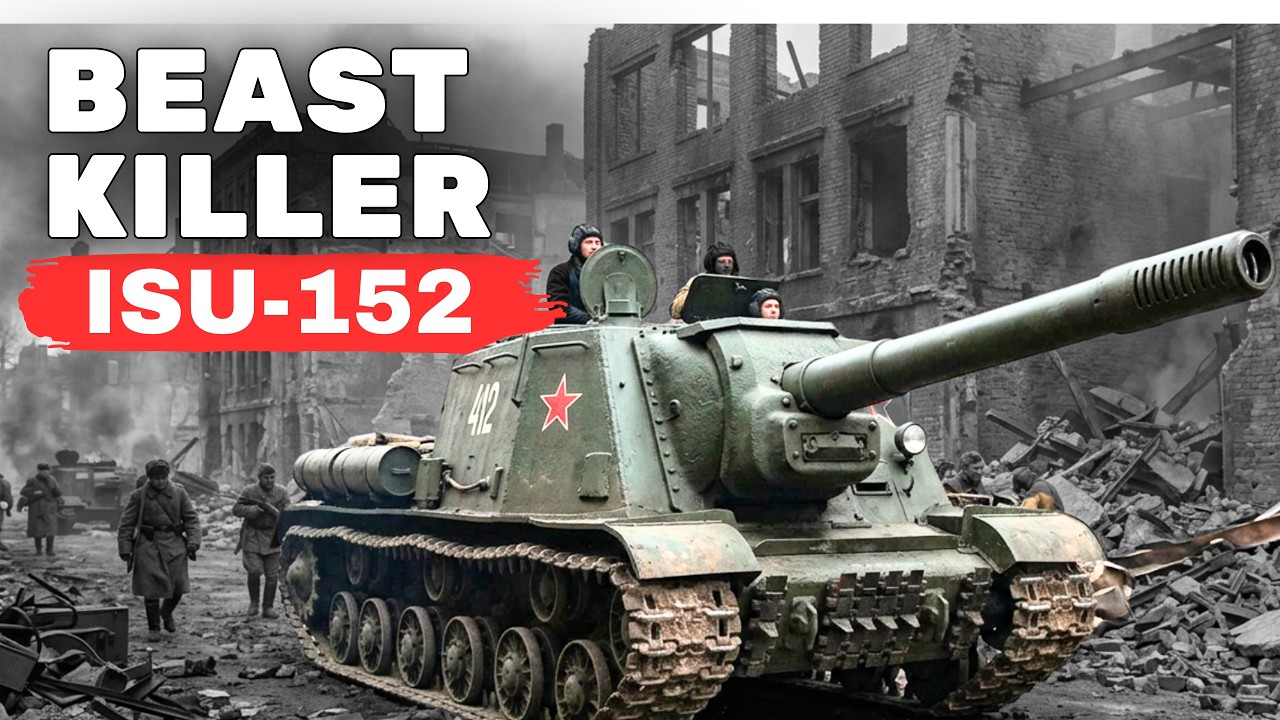
On April 16, 1945, approximately 2,650 ISU-152 heavy assault guns spearheaded the final Soviet assault on Berlin. Their 152-mm gun-howitzers systematically demolished the fortified positions where Hitler’s last Tiger tanks made their stand during the city’s final twelve days. The weapon, nicknamed Zveroboy, or beast killer, had emerged from catastrophe. In the opening six months of Operation Barbarossa, the Red Army lost 20,000 armored vehicles.
Existing anti-tank guns proved helplessly inadequate against German heavy armor, and crews died at horrific rates when their vehicles caught fire. The primary Soviet anti-tank weapon in 1941, the 45-mm model 1937 gun, faced a fundamental ballistic deficiency against German armor. Its armor-piercing shells could penetrate 60 mm of rolled homogeneous armor at 100 meters, sufficient against early Panzer III variants with 30 mm frontal plates, but ineffective against the up-armored Panzer III Ausf H entering service in late 1941 with 50 mm frontal protection. At Kursk in July 1943, Soviet 76-mm guns struggled against Tiger frontal armor, achieving limited penetrations despite firing numerous rounds.
The mechanical arithmetic was devastating. Soviet gunners found their weapons transformed overnight from tank killers to liabilities, capable only of flanking shots against the most numerous German medium tanks. The crisis deepened during fighting along the Mius River in February 1943, where Soviet heavy tank units suffered severe losses to Tiger 1 88-mm fire. Tigers achieved multiple kills per engagement, with KV-1 crews suffering heavy casualties in vehicles lost to fire.
The T-34-85 medium tanks with 85-mm guns struggled against Tiger frontal armor during the Vistula-Oder Offensive in January 1945, achieving limited frontal penetrations at 500 meters despite firing numerous rounds. The Red Army faced a penetration gap that conventional divisional weapons could not close. The rushed SU-152 heavy assault gun, deployed on the obsolete KV-1S chassis in April 1943, provided temporary relief but suffered catastrophic vulnerabilities that killed crews faster than Tigers. During the Battle of Kursk in July 1943, multiple SU-152s from heavy self-propelled artillery regiments were lost in single engagements around Prokhorovka, with many attributed to rear penetrations causing immediate fuel tank detonations.
The 400-liter fuel tank positioned directly in the fighting compartment ignited from sparks after rear armor penetration by 75-mm Pak 40 rounds or Panzer 4 75-mm shells. Crew survival rates for SU-152s lost to fire were extremely low. Post-battle inspection revealed the 45-mm rear armor plate breached with fuel vapors igniting from sparks generated by spalling. The weapon that was supposed to kill Tigers was killing Soviet crews at alarming rates.
Yosif Yakovlevich Kotin, chief designer of heavy tanks at the Chelyabinsk Kirov Plant, received the design brief to solve the fuel fire crisis in late 1943. In December 1943, Kotin submitted the initial ISU-152 design proposal, factory designation Object 241, titled Technical Project for 152-mm self-propelled gun on IS chassis. The proposal addressed SU-152 flaws identified in Kursk after-action reports: relocate fuel tanks to eliminate fire risk, lower the silhouette for urban combat, and integrate the proven ML-20S gun-howitzer onto the new IS-1 heavy tank chassis. People’s Commissar of Tank Industry Vasily Alexeyevich Malyshev issued formal production orders in December 1943, commissioning serial production of the ISU-152.
The order specified use of the IS-1 heavy tank chassis with critical constraints: maximum combat weight not exceeding 46. 5 metric tons to match rail transport limits, armor thickness limited to 90 mm frontal plate at a 60-degree slope to avoid exceeding chassis suspension capacity, and integration of the existing ML-20S 152. 4-mm gun-howitzer without modifications to its 4. 72-meter barrel length or 1,050-mm recoil travel.
The Main Directorate of Armored Forces Technical Department evaluated competing proposals in January 1944. The SU-152M upgrade retained the KV-1S chassis with incremental improvements: relocating the 400-liter fuel tank from the fighting compartment to the engine bay, adding a 160-mm mantlet shield, and up-armoring the roof to 30 mm. This variant projected 45. 5 metric tons combat weight and 2,500 units by mid-1944 using existing KV-1S hull stocks.
The ISU-152 proposal required a complete redesign on the IS-1 chassis with a lower hull profile at 2. 4 meters height, frontal armor increased to 90 to 120 mm sloped at 60 degrees, and fuel tanks fully isolated in sponson bays. Prototype evaluation in January 1944 revealed the SU-152M suffered stability issues on steep slopes due to its high center of gravity. The ISU-152 demonstrated superior armor protection and fired ten rounds in eight minutes without mantlet failure.
Factory reports from Chelyabinsk provided the decision rationale. The SU-152M perpetuated KV-1S undercarriage vulnerabilities, while the ISU-152, aligned with IS-2 serial production, shared 80 percent of components and closed the gap against projected Tiger II armor via high-explosive overmatch. The ISU-152’s ML-20S 152. 4-mm gun-howitzer fired the OF-530 high-explosive cartridge with devastating effect.
The projectile weighed approximately 48. 78 kg, achieving 600 m/s muzzle velocity from the 4,720-mm barrel. The armor-piercing BR-540 round weighed approximately 49 kg with no explosive filler, achieving approximately 130 mm of rolled homogeneous armor penetration at 100 meters and 110 mm at 500 meters, sufficient to defeat Tiger frontal armor. The blunt-nosed projectile delivered 6.
2 megajoules of kinetic energy at the muzzle, exceeding the spalling threshold on 150-mm plate at 100 meters through internal ricochet that shredded crews. The complete ISU-152 weighed 46. 5 metric tons fully loaded with twenty rounds of main gun ammunition and 600 liters of diesel fuel. Overall dimensions measured approximately 9.
2 meters in length with gun forward, 3. 3 meters in width, and 2. 5 meters in height, achieving a lower silhouette than the SU-152’s 2. 95 meters through the IS chassis redesign.
The five-man crew consisted of commander, gunner, loader, driver, and radio operator, though operational doctrine expanded to six personnel with a dedicated breech assistant during sustained urban combat per April 1945 amendments. Rate of fire reached two to three rounds per minute sustained, limited by the vertical sliding wedge breech mechanism requiring hand ramming of 48. 9-kg shells. Each projectile required a two-man lift from hull sponson storage, with a mandatory five-minute ventilation cool-down after firing more than three rounds per minute to prevent powder fouling and crew carbon monoxide poisoning.
The ISU-152 entered its crucial test during the Berlin Strategic Offensive Operation in April 1945. Guards heavy self-propelled artillery regiments received ISU-152s for urban combat operations with the 8th Guards Army and 5th Shock Army. Soviet front orders established ISU-152 urban combat doctrine: deployment in pairs with forty-to-sixty-man infantry assault groups, positioning the vehicles 150 to 200 meters from target buildings. The tactical sequence proceeded with infantry establishing a base of fire at 100 meters, followed by ISU-152 advance to covered firing positions behind rubble or damaged vehicles.
Single 48-kg high-explosive rounds detonated against building facades or penetrated through windows, producing a 30-meter blast radius that destroyed interior structure and forced German defender evacuation. Throughout Berlin’s final battles, ISU-152s engaged German defensive positions centered on fortified buildings. Tiger II tanks from heavy panzer battalions positioned in hull-down positions covered main approaches with their 88-mm guns. During typical engagements, ISU-152s fired high-explosive rounds at building ground floors, penetrating through reinforced windows and detonating inside.
The blast effects collapsed upper floors and killed German defenders, forcing evacuation. However, Tiger IIs opened fire, striking 88-mm rounds that penetrated side armor and detonated ammunition, destroying vehicles and killing crews. German gunners achieved flank shots by maneuvering to expose the Soviet vehicles’ thinner side armor. ISU-152s maneuvered to engage Tiger IIs and fired high-explosive rounds at German tank positions.
The rounds struck nearby structures, creating devastating blast effects that forced crews to abandon vehicles. The engagements lasted hours, with Soviet forces capturing strong points throughout the city. German responses to the ISU-152 threat revealed the weapon’s strategic impact beyond direct combat effectiveness. German unit reports identified the ISU-152 as a significant threat during Berlin’s defense, describing encounters with Soviet heavy self-propelled guns armed with 152-mm howitzers and noting their ability to demolish fortified positions and disable Tiger IIs without direct penetration through catastrophic overpressure effects.
German countermeasures imposed massive tactical costs. SS units issued tactical bulletins adapting Panzerfaust ambushes specifically to the ISU-152’s low silhouette, recommending elevated firing positions to achieve top-down hits on open roof hatches. German forces concentrated existing anti-tank weapons against ISU-152s, reducing defensive flexibility in April 1945. The tactical arithmetic exposed the leverage.
Germany concentrated critical personnel and equipment to defend against a weapon the Soviets manufactured at substantial cost at Chelyabinsk. Each ISU-152 forced German forces to adapt existing tactics and divert resources from offensive weapons to defensive countermeasures. The 2,650 ISU-152s produced represented a fraction of Soviet steel output, yet forced systematic German adaptation across the entire Eastern Front. Production concentrated at Ural Mountain factories to leverage evacuated Soviet heavy industry.
The Chelyabinsk Kirov Plant handled the majority of output from December 1943 through May 1945, producing approximately 1,300 units out of total production. The plant integrated ISU-152 assembly into existing IS-2 heavy tank production lines, sharing hulls, engines, and transmission components, with final assembly in dedicated halls repurposed from KV-1S lines. Secondary sites, including Uralmashzavod in Sverdlovsk, produced additional ISU-152s, primarily in 1944, focusing on hull fabrication and gun mounting while sourcing ML-20S gun-howitzers from artillery production facilities. Production peaked in early 1945.
Total production reached approximately 2,650 units by war’s end. The ISU-152’s service extended well beyond World War II, remaining with Soviet heavy breakthrough artillery brigades through the early Cold War. Soviet directives ordered withdrawal of ISU-152s from active front-line units by the mid-1950s, citing obsolescence against NATO tanks and the need to reallocate resources to newer systems. The vehicles remained in reserve storage through the 1950s, maintained for potential deployment during Cold War tensions.
Polish heavy self-propelled artillery units operated ISU-152s from 1945 until the late 1950s, participating in internal security operations and Cold War maneuvers. ISU-122 derivatives were produced with the D-25S 122-mm gun, achieving higher velocity and penetration, extending the chassis design through December 1945 production. The weapon that emerged from the catastrophic tank losses of 1941 had proven its doctrine through Berlin’s final twelve days. Simple enough to manufacture under siege conditions, effective enough to justify front-line distribution, durable enough to outlast the regime that commissioned it.
The systematic destruction of German defensive positions that the ISU-152 enabled during Berlin’s final assault traced directly back to the penetration gap that had made Barbarossa’s opening hemorrhage possible. Twenty thousand Soviet tanks lost in six months had forced the creation of a weapon so fundamental it required no improvement, only replication.






