Look closely at any photograph of a German soldier from World War II. Whether it is an elite paratrooper dropping onto Crete in 1941, a mud-caked infantryman freezing in a trench outside Moscow in 1942, or a frightened teenager fighting among the ruins of Berlin in 1945, one piece of equipment is always there with him. It is a rigid, corrugated metal cylinder, hung from his chest or back by canvas straps. Officially, the container was called the Tragbüchse, and inside it sat a gas mask.
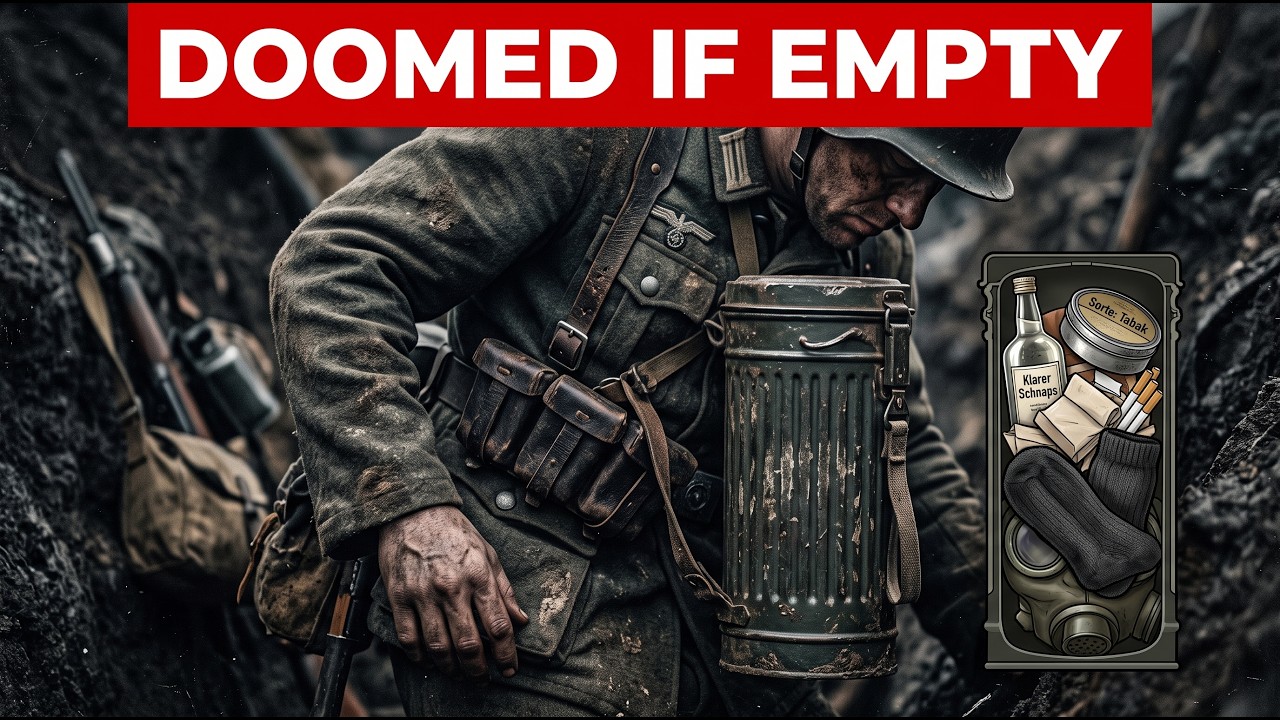
But this is where a huge historical puzzle hides, one that still confuses people today. Poison gas was never used on the battlefields of World War II in Europe. Unlike the muddy trenches of the previous generation, this war was defined by tanks, aircraft, and rapid movement. So why, when millions of soldiers were desperate to strip unnecessary weight from their heavy packs, did the German Army make carrying this heavy metal container mandatory from the first day of the war to the last?
Why did soldiers not simply toss them into the nearest ditch? And why did the military industry waste thousands of tons of precious steel producing millions of these containers, while factories were starving for raw materials? Today, we are going to break down the five main reasons why this iconic piece of equipment never left the German soldier’s side. We will look at the deep psychological wounds of the past, the intelligence of its engineering, its secret tactical uses on the front line, and finally, the terrifying reality of military discipline that will completely change how you think about the Wehrmacht.
Number one: the long shadow of the First World War. To understand the German military mindset in 1939, you have to look back twenty years to the tragedy of the First World War. That war was defined by the horror of chemical warfare. From 1915 onward, the battlefield became a terrifying laboratory for chemical weapons.
The yellow clouds of chlorine gas, the suffocating grip of phosgene, and the burning terror of mustard gas claimed more than a million lives. It was a slow and agonizing death that left deep mental scars on an entire generation of European men. Among those scarred men was Adolf Hitler himself. In October 1918, while serving as a corporal in the German Army, Hitler was caught in a British mustard gas attack.
He was temporarily blinded and hospitalized, an experience that profoundly shaped his worldview. When the German Army began its massive secret rearmament program in the 1930s, the High Command operated on a strict and unshakable belief. The next war would see chemical weapons used on an even larger and more destructive scale. They were not just being paranoid.
They knew exactly what was being developed in the scientific laboratories. In fact, German scientists had invented an entirely new and terrifying class of chemical weapon. Nerve agents like Tabun in 1936 and Sarin in 1938. Because these gases were colorless, odorless, and rapidly lethal, the German High Command assumed that Britain, France, and the Soviet Union had discovered similar weapons of their own.
As a result, the German military did not view the gas mask as some extra accessory or a last resort. They saw it as an essential piece of survival equipment. Every branch of the army, from front-line infantry to rear-area truck drivers, was issued a mask from day one. Abandoning it was considered the same as going into battle without a helmet or ammunition.
Number two: the logistics of full protection. A gas mask is a highly sensitive piece of life-saving equipment, but it only works if it functions perfectly at the exact moment a gas shell lands. In the case of chemical weapons, there can be absolutely no room for air to leak in. If the rubber parts crack, if the glass lenses break, or if the charcoal filter gets damp, the mask becomes just a useless burden.
This is where the brilliant and well-thought-out design of the canister comes into play. The corrugated metal cylinder was not just a carrying box. It was an advanced piece of protective armor, designed to withstand the worst conditions of modern warfare. If you take a close look at the container, you will see deep vertical grooves.
This corrugated design was not an aesthetic choice. It gave an immense amount of structural strength to very thin sheets of metal. When a soldier jumped into a trench, climbed over a concrete wall, or was slammed to the ground by an artillery blast, these grooves prevented the canister from being crushed or bent against the mask inside. Furthermore, the engineering inside the lid was extremely sophisticated.
The lid had a spring-loaded latch that could be opened with a single flick of the wrist, even while wearing heavy winter gloves. On the inside edge of the lid was a soft rubber gasket. When the latch was closed, it pressed the gasket tight, creating a completely airtight and watertight seal. This seal protected the moisture-sensitive filter unit from heavy rain, river crossings, and the terrible mud of the Eastern Front.
Inside the lid was a small spring-loaded compartment for spare lenses and an anti-fogging cloth to keep the mask clean in cold weather. If a soldier lost or damaged his canister, his mask would be ruined or useless within a few weeks in the harsh field conditions. The canister was the armor that kept the life-saving mask alive. Number three: the invisible gas war.
Although it is true that toxic nerve gas was never fired from artillery shells or dropped from bombers, German soldiers faced constantly toxic and suffocating environments throughout the entire war. They faced a different kind of gas war, one that was an industrial byproduct of modern warfare. World War II was a highly mechanized and industrial conflict that largely took place in urban areas, massive factory complexes, and fortified bunker installations. When armies fought inside major industrial cities like Stalingrad or Warsaw, artillery shells and bombs would rupture chemical plants, oil refineries, and gas mains.
Thick, toxic black smoke from fuel depots and chemical storage tanks would often blanket the battlefield, creating air so poisonous that soldiers would choke without protection. More importantly, the German Army’s own tactics relied heavily on creating dangerous atmospheres. The German combat engineers, known as Pioniere, specialized in clearing enemy fortifications using flamethrowers and heavy smoke agents. When a flamethrower was fired through the narrow opening of a concrete bunker, or when smoke grenades were tossed into a sealed basement, the fire quickly consumed all the oxygen and created a deadly layer of carbon monoxide and blinding toxic smoke.
In these intense close-quarters combat situations, the standard-issue gas mask worked as a highly effective respirator. German soldiers regularly put on their masks before entering smoke-filled buildings or clearing tunnels. It allowed them to breathe, see, and fight effectively in confined spaces where enemy soldiers were choking and incapacitated. So, apart from chemical warfare, the gas mask remained a very real and practical tool for urban assault and survival.
Number four: the ultimate tactical storage box. Now, let us step away from official military doctrine and look at the daily reality of the ordinary front-line soldier. Ask any veteran of any war from any army in history, and they will all tell you the same thing. Soldiers absolutely hate carrying unnecessary weight.
By 1943 and 1944, it became clear to the average German infantryman that neither the Allies nor the Soviet Union would use chemical weapons. With each passing month, the threat of a gas attack diminished. Naturally, soldiers took it upon themselves to make their miserable lives a little easier. Since the metal canister was completely waterproof, sturdy, and easy to carry at the waist or lower back, it quickly became the ultimate tactical storage box.
Soldiers began secretly modifying their equipment. Many would discard the heavy rubber mask in the woods and keep only the sturdy metal container. Others, afraid of surprise inspections, would cut the rubber facepiece completely off with a knife, leaving the round metal filter at the bottom of the tin so it looked like the mask was still inside. In this newly freed space, the canister became a treasure box for survival and comfort.
Soldiers used it to store valuable personal items that absolutely had to be kept dry and safe. They filled it with spare rifle ammunition, wool socks to prevent trench foot, chocolate and biscuit rations, letters from home, matches, and cigarettes. Even if a soldier’s main canvas backpack was completely soaked through by the endless Russian snow or the torrential rains of France, the items inside his metal gas mask canister stayed dry and intact. It was one of the few pieces of issued equipment that offered a small sense of comfort and security in a brutal and merciless environment.
Number five: the iron fist of Wehrmacht discipline. This brings us to a major question. If ordinary soldiers were secretly removing their gas masks to store food and dry socks, and if the German High Command knew by the late stages of the war that a gas attack was highly unlikely, then why did the military not officially withdraw the canisters? Why did they continue forcing factories to produce millions of them using precious steel that could have been used for tanks and artillery shells?
The answer lies in the terrifying and inflexible nature of German military discipline and the army’s psychological control. To the Wehrmacht High Command, a soldier discarding or modifying his equipment on his own initiative was not a minor offense. It was seen as a completely unacceptable degradation of military discipline, professionalism, and readiness. The German Army operated on the principle of total uniformity.
To put an end to the widespread practice of soldiers using the canister as a lunchbox, the military High Command instituted strict and sudden equipment inspections. The Feldgendarmerie, the military police units, and stern officers regularly stopped soldiers heading to the front and forced each one to open his canister on the spot. If a soldier was caught with a canister full of ammunition, tobacco, or food instead of a properly maintained gas mask, the punishment was immediate and severe. In the early victorious years of the war, this meant harsh disciplinary duty or confinement.
But in the final years of the war, as Germany faced total collapse, this discipline became fanatical and bloodthirsty. Being caught without a functional gas mask was often treated as sabotage of the war effort, damaging military readiness, or outright cowardice in front of the enemy. Under fanatical commanders, the punishment for such an offense was demotion and transfer to a penal battalion, where soldiers were sent on suicide missions like clearing mines by hand. In the chaos of 1945, in extreme cases, soldiers were summarily hanged or executed by firing squad as a warning to others.
So, even if a soldier hated that heavy metal container, even if he secretly cut his mask to pieces, he still had to strap that corrugated cylinder to his body every single day. Carrying the canister was no longer just about surviving a theoretical gas attack. It was about surviving the brutal rule of his own officers. It was a visible proof of loyalty.
In the end, the German gas mask canister is a small reflection of the grim and complex history of World War II. It was born out of the memory and lingering fear of the First World War as a protective shield. It survived and excelled as a unique piece of industrial design and safety engineering. On the muddy battlefields, it transformed into a survival tool and a personal locker for the common suffering soldier.
And finally, in the last days of the war, it became a heavy metal symbol of the harsh and merciless rule of a collapsing totalitarian empire. It is a powerful historical reminder that the heavy equipment a soldier carries onto the battlefield is shaped not only by the reality of flying bullets, but also by the fears of the past and the iron hand of military command.






