VERDUN, FRANCE — December 19, 1944 — The room at the 19th-century French barracks fell into a silence so profound that the distant rumble of artillery could be heard through the thick stone walls. General Dwight D. Eisenhower, Supreme Commander of the Allied Expeditionary Force, stared across the map table at the man who had just uttered a timeline that defied all military logic.
General George S. Patton, commander of the U. S.
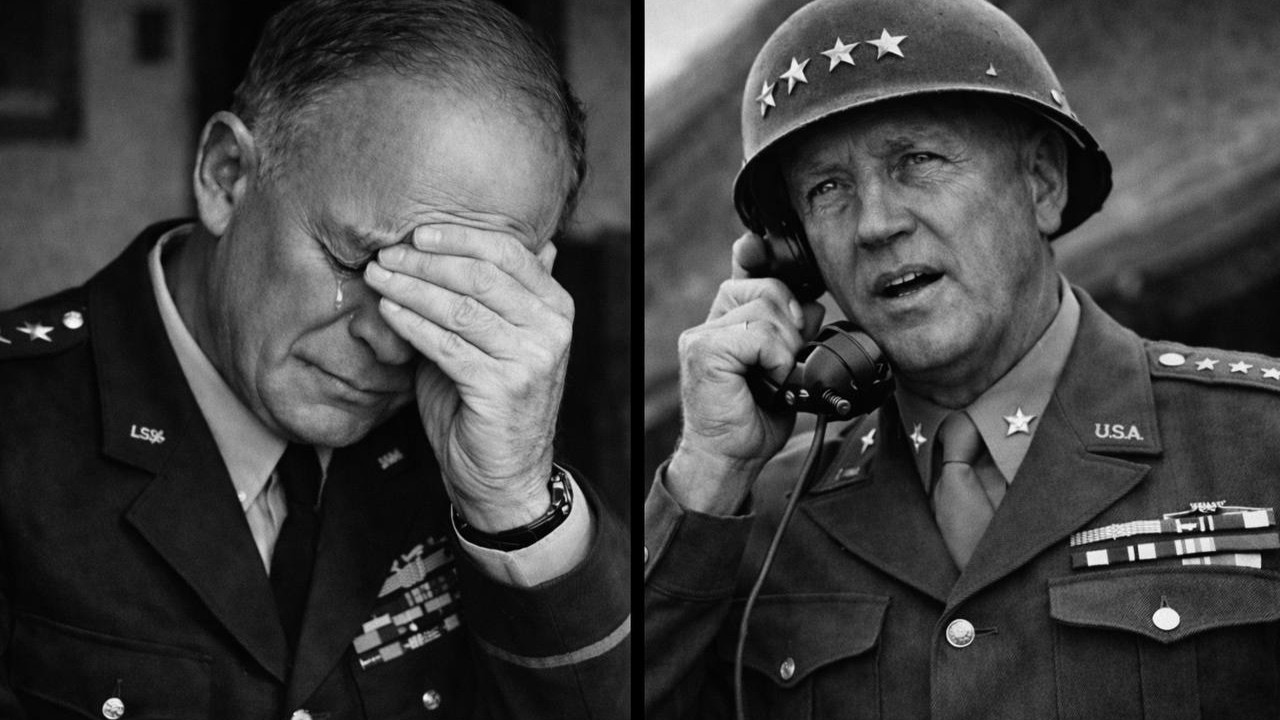 Third Army, had been asked how long it would take to pivot his entire force—nearly 150 kilometers to the south—and strike north into the heart of the German offensive in the Ardennes.
Patton did not blink. He did not consult a subordinate. He looked Eisenhower in the eye and said, “48 hours.”
The assembled commanders—men who had planned the Normandy invasion, who had orchestrated the liberation of Paris—shifted uncomfortably. They had expected a week. Perhaps ten days.
The Third Army was currently engaged in a grinding offensive toward the Saar. Its supply lines stretched across France. Its divisions were oriented east, not north.
To turn 90 degrees in the middle of a winter campaign, with temperatures plummeting to minus 15 degrees Celsius and roads glazed with ice, was not a maneuver. It was a fantasy.
Yet within 48 hours, Patton would not only begin the movement. He would complete it. And before that, he would make a phone call that would bring the Supreme Commander to the brink of tears, a call that hinged on four words that would alter the trajectory of the war in Western Europe.
The crisis began on December 16, 1944, when the German Wehrmacht launched its last major offensive on the Western Front. Codenamed Operation Watch on the Rhine, the assault deployed over 250,000 soldiers, nearly 600 tanks, and thousands of artillery pieces through the densely forested Ardennes region of Belgium and Luxembourg. The objective was audacious: split the Allied armies, capture the vital port of Antwerp, and force a negotiated peace that would leave Germany free to concentrate its remaining forces against the Soviet Union in the East.
The attack achieved complete tactical surprise. The Allies had considered the Ardennes a “quiet sector,” a rest area for exhausted divisions. The Germans exploited this complacency with brutal efficiency.
By December 19, the spearheads of the 5th Panzer Army, commanded by General Hasso von Manteuffel, had encircled the strategic crossroads town of Bastogne. Inside the perimeter were the 101st Airborne Division, elements of the 10th Armored Division, and a handful of tank destroyer and artillery units—approximately 20,000 American soldiers. They were cut off, low on ammunition, and facing an enemy that demanded their surrender.
The weather was a weapon in itself. A thick, unbroken cloud ceiling grounded all Allied aircraft. Fighter-bombers that could have decimated German columns were useless.
Supply planes could not drop food, fuel, or ammunition. The temperature hovered near zero degrees Fahrenheit. Men froze in their foxholes.
The wounded died of exposure before they could be evacuated. Bastogne was not just surrounded; it was suffocating.
At the Verdun headquarters, Eisenhower faced the grim arithmetic. The 101st Airborne had enough ammunition for perhaps two days of sustained combat. The German ring around the town was tightening, with elite armored divisions that had cut their teeth on the Eastern Front pressing from three directions.
If Bastogne fell, the road to the Meuse River would lie open. Beyond the Meuse lay Antwerp, the port through which nearly 70 percent of Allied supplies flowed. Losing Antwerp would not be a setback.
It would be a catastrophe—a logistical paralysis that could split the British and American armies and prolong the war by months, perhaps years, at a cost of tens of thousands of additional casualties.
The question posed to Patton was not academic. It was existential. Eisenhower needed a counterattack, and he needed it fast.
But the Third Army was engaged in its own offensive, pushing toward the German border. To disengage, reorient, and march north would require a logistical miracle. The commanders in the room knew this.
They had seen the maps. They had counted the trucks. They had calculated the fuel consumption.
The consensus was grim: a week at best, more likely ten days. By then, Bastogne would be gone.
Patton’s response—”48 hours”—was met with disbelief. Some officers assumed he was grandstanding. Others thought he had lost his mind.
But Patton was not improvising. For days, he had been watching the German buildup in the Ardennes with growing alarm. While other commanders focused on their own sectors, Patton had ordered his intelligence officers to track the movement of German reserves.
He had anticipated the offensive. And in the early hours of December 19, before the Verdun meeting, he had already issued preliminary orders to his staff: begin planning a 90-degree turn to the north.
The audacity of the plan was staggering. The Third Army consisted of over 100,000 men, hundreds of tanks, thousands of vehicles. To execute the pivot, Patton would need to reroute entire supply columns, establish new fuel depots, and coordinate the movement of three infantry divisions and an armored division across a road network that was largely unpaved and frozen solid.
 Bridges had been destroyed by German saboteurs. Traffic jams were inevitable. The risk of the entire army becoming a stationary target for German aircraft—if the weather ever cleared—was acute.
Yet Patton had already made his decision. He would not wait for permission. He would not wait for perfect conditions.
He would move, and he would move now.
That evening, after the Verdun meeting concluded, Patton returned to his command post in Luxembourg. He did not sleep. Maps were spread across every available surface.
His staff worked through the night, recalculating routes, redirecting fuel convoys, and issuing movement orders to division commanders. The Third Army began to turn north before Eisenhower had even signed the formal attack order.
Then came the phone call.
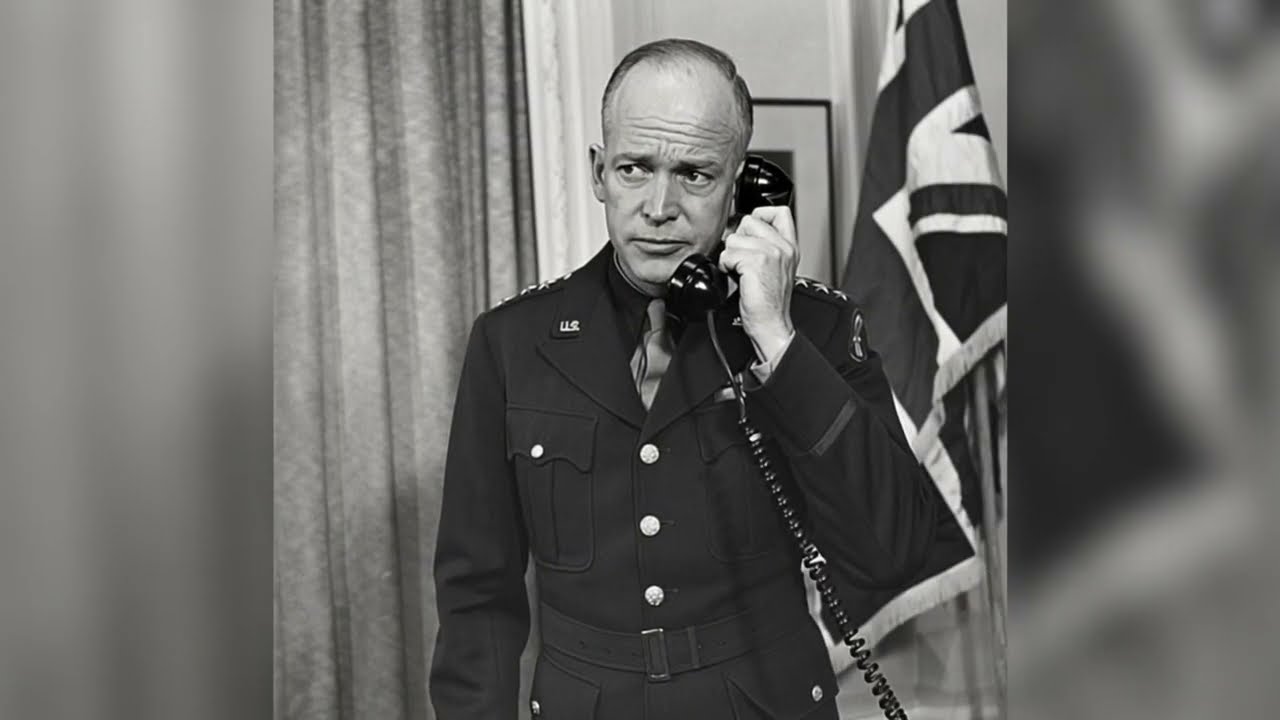
It was late on the night of December 19, or perhaps early on December 20—accounts vary, but the substance is consistent. Patton picked up the field telephone and asked to be connected to Eisenhower’s headquarters. The Supreme Commander, exhausted and burdened by the weight of the entire Allied war effort, came to the line.
The conversation was brief. Patton’s voice was calm, devoid of the theatrical bluster that often characterized his public persona. He did not ask for more time.
He did not request additional resources. He simply said four words:
“I can attack now.”
According to officers present in Eisenhower’s headquarters, the Supreme Commander paused. The silence stretched. Eisenhower understood the stakes.
If Patton moved too quickly and his forces were caught in disarray, the Third Army could be cut off and destroyed. The loss of 100,000 men would be a blow from which the Allies might not recover. But if Patton hesitated, Bastogne would fall, and the strategic consequences would be equally dire.
In that moment, Eisenhower made his decision. He approved the attack.
The movement that followed has been described by military historians as one of the most remarkable operational maneuvers in the history of warfare. The Fourth Armored Division, under General Hugh Gaffey, took the lead. Behind them came the 26th Infantry Division and the 80th Infantry Division.
The columns stretched for miles, a river of steel and men flowing north through the frozen Ardennes.
The conditions were brutal. The roads were narrow, slick with ice, and clogged with military traffic moving in both directions. Trucks skidded off embankments.
Tanks threw tracks on frozen grades. Fuel convoys were delayed by German ambushes. The men marched in freezing wind, their breath crystallizing on their wool coats.
Sleep was a luxury no one could afford. The drivers pushed on, their eyes burning from exhaustion, their hands frozen to the steering wheels.
Between December 21 and December 23, the lead elements of the Third Army advanced nearly 150 kilometers. It was a pace that defied the terrain and the weather. But the pressure on Bastogne was intensifying.
The German commander, General von Manteuffel, had sent a formal surrender demand to the acting commander of the 101st Airborne, Brigadier General Anthony McAuliffe. The response—one word, “NUTS!” —became legendary, but it did not change the tactical reality.
The garrison was running out of everything. Medical supplies were exhausted. The wounded were dying in makeshift aid stations.
The ammunition was so low that artillery crews were rationing shells to a handful per day.
 Then, on December 23, the weather broke. For the first time in over a week, the skies cleared. Allied aircraft poured into the gap.
C-47 transport planes dropped supplies into Bastogne—food, ammunition, medical kits, blankets. Fighter-bombers, including P-47 Thunderbolts and P-51 Mustangs, swooped down on German columns, strafing tanks and trucks with devastating effect. The German supply lines, already stretched thin, began to fracture.
On December 26, 1944, the Fourth Armored Division, under the command of Lieutenant Colonel Creighton Abrams, broke through the German lines at the southern edge of Bastogne. The encirclement was shattered. The 20,000 soldiers of the 101st Airborne were no longer alone.
The relief was not just a military victory; it was a psychological turning point. The German offensive had been blunted. The road to Antwerp remained closed.
The Wehrmacht’s last gamble in the West had failed.
The strategic implications were profound. The German High Command had committed its last strategic reserves to the Ardennes offensive. When it failed, the Wehrmacht had nothing left to stop the Allied advance into Germany.
The war in the West would continue for another five months, but the outcome was no longer in doubt. The Battle of the Bulge, as it would come to be known, was the largest and bloodiest battle fought by the United States in World War II. American casualties exceeded 80,000, including nearly 20,000 killed.
German losses were even higher—over 100,000 casualties, along with thousands of tanks and aircraft that could never be replaced.
But the battle might have ended differently. If Patton had not made that phone call, if he had not spoken those four words, the 101st Airborne would have been forced to surrender. Bastogne would have fallen.
The German armor would have rolled toward the Meuse, and the Allied supply lines through Antwerp would have been severed. The war in Europe could have been prolonged by months, with catastrophic consequences for both sides.
Patton’s decision was not without controversy. He was a commander who thrived on aggression, who often clashed with his superiors, and who was criticized for his harsh discipline and his willingness to take risks. But in December 1944, risk was exactly what the situation demanded.
Caution would have meant delay. Delay would have meant death. Patton understood that momentum is the currency of modern warfare.
He who hesitates loses not just the initiative, but the lives of his men.
The phone call itself has become the stuff of legend. Some accounts suggest that Eisenhower, upon hearing Patton’s four words, was moved to tears—not from sadness, but from relief. The Supreme Commander had been carrying the weight of the entire Allied war effort on his shoulders.
He had faced the possibility of a catastrophic defeat. And then, in a single moment, a subordinate had offered him a way out. The emotion of that moment, the release of tension, was overwhelming.
In the years since, historians have debated whether Patton’s pivot was a stroke of genius or a reckless gamble. The evidence suggests it was both. Patton had been preparing for the move for days, but he had also been willing to risk everything on a single throw of the dice.
He had staked his reputation, his command, and the lives of his men on the belief that speed could overcome the chaos of winter warfare. He was right.
The legacy of that decision extends far beyond the battlefield. The relief of Bastogne demonstrated that the Allied command structure, despite its internal rivalries and disagreements, could respond to a crisis with speed and decisiveness. It also cemented Patton’s reputation as one of the most audacious commanders in American military history.
His name would become synonymous with aggressive, mobile warfare—a doctrine that would influence military thinking for decades.
But the human cost must not be forgotten. The men who fought at Bastogne, who endured the freezing cold, the relentless shelling, and the constant threat of death, were not abstractions. They were fathers, sons, brothers.
They were young men from farms in Iowa, factories in Detroit, and offices in New York. They fought not for glory, but for each other. And they were saved by a commander who refused to accept the impossible.
If you have family members who lived through that winter of 1944, who fought in the Ardennes or waited at home for news, their stories are part of this history. The memory of that battle is not confined to books and archives. It lives in the recollections of veterans, in the letters they wrote home, in the photographs they kept in their wallets.
 It is a reminder that history is not made by abstract forces, but by individual decisions—by a man picking up a phone and saying four words that changed everything.
The war would continue for many more months. The Allies would cross the Rhine, encircle the Ruhr, and push deep into Germany. The Soviet Union would capture Berlin.
The Nazi regime would collapse in a final orgy of destruction. But the road to that victory ran through Bastogne, and it was paved by the Third Army’s impossible march through the snow.
Patton himself would not live to see the end of the war. He died in December 1945, just months after the German surrender, from injuries sustained in a car accident in occupied Germany. He was 60 years old.
His death was met with an outpouring of grief from the men who had served under him. They remembered not just his profanity-laced speeches and his ivory-handled pistols, but the fact that he had brought them home.
The phone call that made Eisenhower cry has been retold countless times, in books, documentaries, and films. It has become a symbol of what leadership means in times of crisis. It is a reminder that the difference between victory and defeat is often measured not in months or weeks, but in hours.
And it is a testament to the power of a single individual to alter the course of history through sheer force of will.
As the years pass, the veterans of the Battle of the Bulge are fading away. The generation that fought the Second World War is nearly gone. But their stories remain.
They are preserved in the archives of the National World War II Museum, in the memorials that dot the Ardennes countryside, and in the memories of the families who inherited their legacy. The snow that fell on Bastogne in December 1944 has long since melted, but the courage of the men who fought there endures.
In the end, the story of the phone call is not just about Patton. It is about the thousands of men who moved at his command, who drove their tanks through the ice and snow, who fought their way through German lines, who died so that others might live. It is about the 101st Airborne, who refused to surrender even when surrender seemed inevitable.
And it is about Eisenhower, who had the wisdom to trust a subordinate who was willing to take a risk.
History often remembers battles by numbers—by divisions, by tank columns, by kilometers on a map. But sometimes history turns on something much smaller: a decision, a risk, a moment when one man says, “I will move.” In December 1944, that man was George S.
Patton. And his four words—”I can attack now”—became part of the fabric of American history.
The question of whether another commander could have made the same decision is one that historians will continue to debate. But the evidence suggests that Patton was uniquely suited to the moment. He was a man who had spent his entire career preparing for the kind of mobile, aggressive warfare that the relief of Bastogne required.
He had studied the campaigns of Napoleon and Sherman. He had trained his troops relentlessly. And he had the instinct to act when others hesitated.
In the decades since, military academies around the world have studied the Third Army’s pivot as a case study in operational art. The ability to rapidly reorient a large force in the face of an unexpected threat is a skill that remains relevant today. The principles that Patton applied—speed, surprise, and concentration of force—are as valid in the 21st century as they were in 1944.
But the true lesson of the phone call is simpler. It is about the importance of courage—not just the courage to fight, but the courage to make a decision when the outcome is uncertain. Patton did not know for certain that his gamble would succeed.
He only knew that inaction was worse. He chose to move, and his movement saved an army.
As we remember the Battle of the Bulge, we should also remember the men who made the difference. We should remember the tank crews who broke through the German lines, the infantrymen who held the perimeter at Bastogne, the pilots who flew through the clearing skies to drop supplies, and the commanders who had the vision to see what was possible. And we should remember the phone call—a moment of human connection between two men, burdened by the weight of history, who found in each other the resolve to continue.
The war ended in May 1945. The world emerged from the darkness of conflict into the uncertain light of peace. But the memory of that winter, of the snow and the blood and the sacrifice, remains.
It is a reminder of what can be achieved when ordinary people do extraordinary things. And it is a testament to the enduring power of the human spirit.
If you have stories from that time, share them. Keep the memory alive. Because history is not only written in books; it lives in the hearts of those who remember.
And as long as we remember, the sacrifices of that generation will never be in vain.






