On November 23, 1944, Thanksgiving Day at Camp Clinton, Mississippi, the mess hall doors swung open and forty-three female German prisoners filed inside with the mechanical precision that months of military service had drilled into them. They moved in orderly lines, eyes forward, backs straight despite the uncertainty that had been their constant companion since capture. But when they reached the serving counter, everyone stopped. Some gasped.
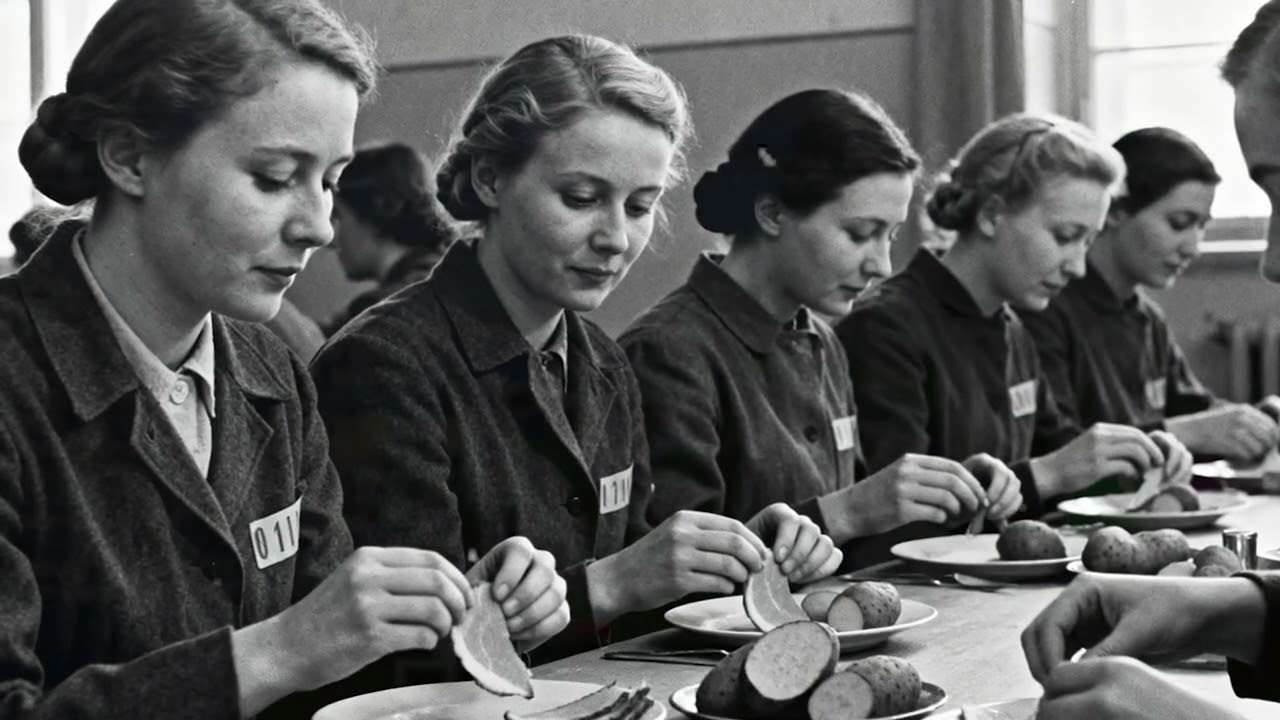
Others stood frozen, unable to process what lay before them on the metal trays being handed across by smiling American kitchen staff. Glazed ham, thick slices glistening with a caramelized coating that caught the overhead lights like amber. Sweet potatoes cut into perfect cubes and coated in something that made them shine with an almost unnatural orange brilliance. There was butter, real butter, pooled in small lakes across the potatoes.
Brown sugar crystals sparkled on the surface. Steam rose from the plates in fragrant clouds that carried scents the women had nearly forgotten existed in the world. Waltraud Kemper, twenty-six years old and accustomed to decoding enemy radio transmissions with cold analytical precision, found herself unable to move. Her hands trembled as she accepted the plate from Corporal Ruth Anderson, who wore the same warm smile she showed every prisoner regardless of the uniform they had once worn.
Traudy stared at the food, her mind racing through calculations that made no sense. This was November, not April. Not Easter. The ham alone represented more meat than her family in Berlin had seen in six months.
Behind her, nineteen-year-old Irmgard Fischer whispered a single word in German, her Bavarian accent thick with confusion and something approaching fear. Ostern. Easter. The word rippled through the line of prisoners like a wave.
Others picked it up, repeating it with the same bewildered inflection. Several women crossed themselves, their Catholic upbringing surfacing in the face of something they could not explain through any other framework they possessed. Elfrieda Bachmann, thirty-one and the most senior among them, maintained her composure better than the younger women, but even she could not entirely hide the shock that tightened her features as she studied the plate in her hands. She had coordinated supply logistics in Hamburg, had seen the careful rationing of every gram of food, had signed requisition forms that allocated precise portions to maintain fighting readiness.
She understood scarcity at an institutional level. This abundance defied every principle of wartime resource management she had ever learned. Three weeks earlier, the transport truck had rumbled through the gates of Camp Clinton carrying forty-three exhausted women who had spent the previous month crossing an ocean and half a continent. They had been captured in North Africa during the final chaotic months of the Africa Corps collapse, processed through facilities in Algeria, shipped across the Atlantic in the hold of a Liberty ship, and finally transported by rail and truck to this remote corner of Mississippi that none of them had ever heard of before.
Waltraud Kemper had expected a prison. She had prepared herself mentally for deprivation, for the kind of conditions she imagined enemy captors would inflict. The propaganda she had absorbed during her years serving the Reich had painted clear pictures of American brutality, of a society collapsing under the weight of its own decadence. She expected to find confirmation of everything she had been taught.
Instead, the barracks were heated, actually warm. Each bunk had a real mattress, wool blankets in better condition than what she had used in Berlin, and glass in every window. The first meal arrived within an hour of their processing. Irmgard Fischer expected thin soup, perhaps some bread if they were fortunate.
What arrived on the metal trays made her question whether this was some kind of elaborate psychological operation. Fresh white bread, soft and still warm from the oven. Real butter, not the synthetic spreads that had become standard across Germany. A thick stew with actual pieces of beef among the vegetables.
Coffee, recognizably coffee, not the grain-based substitutes that had replaced real coffee in the Reich two years earlier. Elfrieda Bachmann ate slowly, methodically, her administrative mind cataloging every item and trying to calculate what this meal represented in terms of resource allocation. The bread alone would have been a luxury in Hamburg. The butter was something she had not tasted in eighteen months.
The beef represented protein that German civilians were allocated perhaps once per month if they were fortunate and well-connected. She had managed supply chains. She understood logistics. This was not scarcity.
This was not even adequate provision. This was abundance, casual and apparently unlimited, served to prisoners of war on their first day of captivity in enemy territory. The waste bins appeared three days after their arrival, and Irmgard Fischer could not stop staring at them. She had volunteered for kitchen duty, partly because her nursing background made her comfortable with food preparation and sanitation, partly because she needed something to occupy her hands and mind.
The American staff had accepted her offer with the casual friendliness that still felt strange to women trained to expect cruelty from their captors. She was scraping plates into the large metal garbage containers when she realized what she was seeing. Half-eaten slices of bread, whole rolls barely touched, pieces of meat with significant portions remaining. In one shift, she watched more food thrown away than her entire village in Bavaria would have consumed in a week.
Corporal Ruth Anderson noticed the young German woman’s frozen posture and approached. “This is normal,” she said. “Every day, not special. This is how we always eat.
” Irmgard shook her head, not in disagreement, but in incomprehension. She had calculated rations in field hospitals where every gram of food was precious. The waste before her represented either criminal incompetence or resources so abundant that careful management became unnecessary. That evening, the women gathered in their barracks and discussed what they had witnessed.
The possibility that the camp was a demonstration facility designed to impress prisoners with false abundance occurred to them, but Traudy dismissed it. They were not high-value prisoners. They held no critical intelligence, commanded no troops, controlled no resources. “They would not waste resources on such an elaborate deception for forty-three women,” she said quietly.
“We are not important enough for that kind of effort. ” No one would design an elaborate psychological operation specifically for them, which meant that what they were witnessing was simply reality. American reality, so different from what they had been taught that it called into question everything else they had learned from official sources. The cold snap arrived in early November, and Elfrieda Bachmann woke on the third morning of cold weather with her joints aching, experiencing the early signs of arthritis that ran in her family.
Corporal Anderson noticed how she favored her left side, how she took longer than usual to stand fully upright after sitting. That afternoon, Anderson appeared at Elfrieda’s bunk carrying two extra wool blankets. “For the cold,” she said. “No need to request them through channels.
Just take them. ” Elfrieda stared at the blankets, searching for the angle, the hidden cost, the manipulation that must underlie this gesture. In her experience, nothing came without strings attached. Anderson seemed to read her thoughts.
“No trade required. You’re cold. We have extra blankets, simple as that. ” Meanwhile, Private Sarah Jenkins, a black woman from rural Georgia who had joined the Women’s Army Corps as one of the first waves of African-American women accepted into military service, noticed Irmgard’s persistent cough and appeared the next morning with a small bottle of cough syrup and a jar of honey.
Major Helen Crawford convened her staff meeting on November 15th to discuss the upcoming Thanksgiving holiday. As camp commander, she was responsible for maintaining both security and morale. She had been thinking about the holiday for weeks. “I want to include the German prisoners in the Thanksgiving meal,” she announced.
“The same food we serve our own people. No separate rations, no reduced portions, full participation in the holiday. ” Lieutenant Robert Morrison raised objections based on regulation and precedent. Thanksgiving was an American holiday with no equivalent in German culture.
Corporal Anderson supported the commander’s proposal. “Ma’am, these women are already struggling with what they’re seeing here. The food, the conditions, everything contradicts what they were taught to expect. Maybe showing them an American tradition, including them in it, might help them understand what they were actually fighting against.
”
The kitchen staff received their orders and began preparations. The menu would be traditional Southern Thanksgiving: roasted ham glazed with brown sugar and cloves, sweet potatoes prepared three different ways, collard greens cooked with ham hocks, cornbread dressing, green beans, cranberry sauce, and pecan pie for dessert. The quantities were calculated to feed two hundred people, including guards, administrative staff, and prisoners. The morning of November 23rd arrived with clear skies and unseasonably warm temperatures.
The German prisoners woke to the smell of roasting ham drifting through the barracks, a scent so rich and unexpected that several women initially thought they were dreaming. By noon, the mess hall had been transformed. Long tables were arranged in rows with prisoners and guards assigned to mixed seating, a departure from the usual separation that characterized daily meals. When the doors opened at one o’clock, the German women filed in with their usual discipline, but their eyes widened as they approached the serving line.
Irmgard Fischer was the first to lift her fork. The taste of real meat, properly prepared, hit her like a physical blow, and she felt tears slip down her cheeks. Around her, other women began to eat. Some cried openly, others ate in silence.
Waltraud Kemper tried the sweet potatoes and discovered a topping on them that Corporal Anderson identified as marshmallows. Traudy had never heard the word. Her sister’s last letter had described children in Berlin fainting from hunger in school. Her mother had written about trading family jewelry for a kilogram of potatoes.
And here she sat, a prisoner of war eating food topped with confections that served no purpose except to make an already sweet dish sweeter. The afternoon following Thanksgiving found the mess hall unusually full. The meal had broken something open in the prisoners. Waltraud Kemper sought out Corporal Anderson.
“This food yesterday, this is normal? Every Thanksgiving everyone in America eats this way? ” Anderson nodded. “Yes.
Most families have similar meals, some with turkey instead of ham, but the abundance is standard. It’s our tradition. ” Irmgard Fischer approached Private Jenkins. “In Germany we are told Americans are starving, that your people have no food because of the war.
” Jenkins smiled sadly. “I’ve known hunger. During the depression my family went days with almost nothing, but that was before the war, and it was because we were poor, not because America lacked food. The country has always had plenty.
It’s just not always shared fairly. ”
The Red Cross mail delivery arrived on December 1st. Waltraud Kemper tore open the envelope from her sister Gisela, written two and a half months earlier from Berlin. “We have had no meat since July.
Mother managed to obtain half a kilogram last week through connections with her old supervisor, but it was mostly gristle and bone. We made soup that lasted three days. What they call bread now is barely recognizable. It’s gray and heavy and tastes of sawdust.
Frau Werner from downstairs says they mix in wood pulp to stretch the flour. The children are hungry all the time. Little Klaus has stopped asking for treats because he understands there are none to give. ” Traudy read the words again, trying to reconcile them with the memory of marshmallow-topped sweet potatoes.
Irmgard Fischer’s letter came from her mother’s neighbor. Her mother had died in October, not from bombing or violence, but from malnutrition complicated by pneumonia. Her mother had starved to death while she, a prisoner of war in enemy territory, had eaten fresh bread with real butter every single day. Private Sarah Jenkins found Irmgard sitting alone in the corner of the barracks three days after the mail delivery.
She sat down beside the young German woman and began talking about her own past. “I grew up in rural Georgia during the depression. My family were sharecroppers working land we’d never owned for wages that barely kept us alive. There were eight children.
I was the oldest girl. I remember going to bed hungry most nights. My little brother died when he was four years old. Pneumonia, the doctor said, but really it was because he was too weak from not eating enough to fight off any sickness.
” She paused. “America has abundance, but that doesn’t mean every American has always had access to it. The plenty you see here, it’s real, but it’s not the whole story of America anymore than the hunger in Germany is the whole story of your country. ” Irmgard asked through her grief, “My mother starved while I ate ham and sweet potatoes.
How do I live with knowing that? ” Jenkins was quiet for a moment. “You live with it by understanding that you didn’t cause it. The people who started this war, who built the system that led to your mother’s death, they caused it.
The question isn’t what you believed when you didn’t know the truth. The question is what you do now that you understand. ”
December brought news of the Battle of the Bulge, the massive German offensive in the Ardennes Forest. The mood in Camp Clinton shifted immediately.
Guards who had been relaxed and friendly became watchful and tense. Major Crawford called an assembly and explained what was happening in Europe. Elfrieda Bachmann’s administrative mind began calculating logistics, and the numbers made her deeply uneasy. Germany had concentrated its remaining resources into one massive gamble.
Where had those resources come from? What had been stripped from civilian populations to feed this military operation? She thought about the letters from Hamburg describing starvation and wondered how many people had gone without food so that tanks could have fuel for this desperate attack. Irmgard felt the news as a physical blow.
Young German soldiers were dying for a cause that she increasingly understood to be built on lies. On Christmas Eve, the German prisoners cooked a traditional dinner with American supervision and shared it with guards and staff. The food was good, but the women could not help comparing this meal, which would have been considered generous by German standards, to the Thanksgiving abundance that had shocked them weeks earlier. In January, newspapers from Europe began describing what Allied armies were discovering as they advanced into Germany.
Reports came from camps in Poland with names the German women had never heard. The accounts spoke of facilities designed for mass killing, of industrial-scale death conducted with bureaucratic efficiency. Elfrieda Bachmann read the articles with mounting horror. She had worked in logistics, had processed shipping manifests and transportation schedules.
She brought her question to Major Crawford directly. “Did I help this? In my work, did I contribute to what these articles describe? ” Crawford’s response was measured and honest.
“I don’t know, maybe indirectly. But you didn’t know what you were supporting, and you weren’t in a position where refusing would have been possible. The guilt belongs to the people who designed these systems and gave the orders. ”
May 8th, 1945.
Victory in Europe Day. The war that had consumed the continent for six years ended with Germany’s unconditional surrender. Major Crawford received orders regarding repatriation procedures within days. German prisoners would be processed for return to their homeland according to Geneva Convention protocols.
Most would begin the journey home within two months. She called an assembly to announce the procedures, and Waltraud Kemper stood up before she finished speaking. “Major Crawford, may I ask a question? Is return to Germany mandatory, or can prisoners request to remain in American custody longer?
” Crawford was momentarily surprised. “Why would you want to remain in custody? ” Traudy looked around at her fellow prisoners. “We have learned things here.
About what we served, about what our country became, about the lies we believed. Going back immediately means facing a Germany that no longer exists. Also, we are afraid. We will be seen as failures, as soldiers who were captured and corrupted by enemy influence.
The Germany we return to will be broken and starving, and we will be returning well-fed and healthy from enemy captivity. How will our own people receive us? ”
Twenty years later, Waltraud Kemper Morrison stood in her kitchen in rural Mississippi preparing Thanksgiving dinner for her American family. Her husband Tom, a former Army sergeant she had met during her extended stay at Camp Clinton after the war, was in the living room with their three children watching the parade on television.
The house smelled of roasting turkey and the sweet potatoes that had changed her life two decades earlier. Her oldest daughter, Margaret, fourteen years old and named for Major Crawford, who had facilitated Traudy’s eventual immigration, wandered into the kitchen and asked the question she asked every Thanksgiving. “Tell me again about the Easter ham, Mama. ” Traudy smiled and began the story her children had heard many times but never tired of requesting.
“We thought it was a special meal, something rare and precious that Americans were sharing with us as prisoners because it was a holy day. We could not imagine that this was normal, that this was just how Americans ate when they celebrated together. The meal showed us that everything we believed was wrong, not just slightly incorrect, but fundamentally inverted. We had starved ourselves and our people for lies while truth existed in abundance elsewhere.
” Margaret asked, “Did you ever feel guilty for eating well while people in Germany were starving? ” Traudy nodded slowly. “Every day for years. But Private Jenkins helped me understand that guilt without action is just another form of selfishness.
The question was not whether I felt bad about the past, but what I did with what I learned. ” After her immigration was approved in 1946, she had worked with refugee assistance organizations helping other displaced Germans navigate American culture and language.






