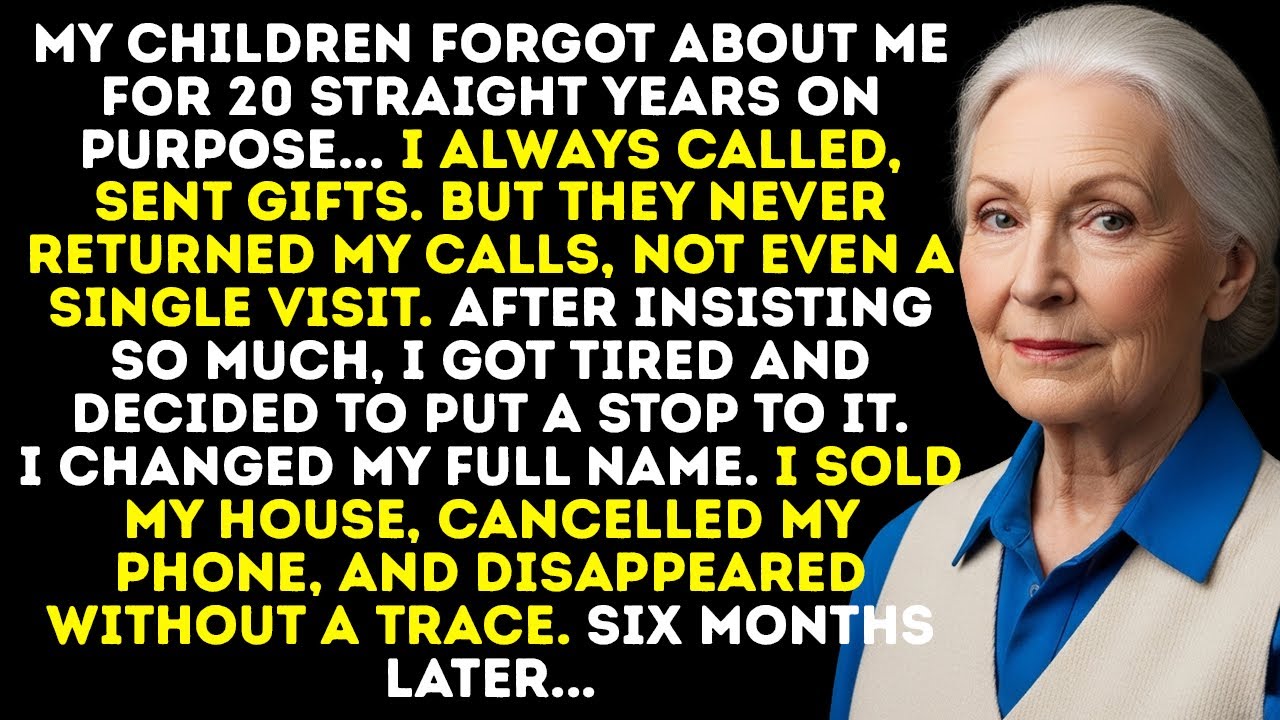
Margaret Ross had waited twenty years for a phone call that never came. Twenty years of sending gifts that vanished without a trace. Twenty years of dialing numbers that rang until a robotic voice asked her to leave a message. And she left messages, hundreds of them over two decades.
Birthday greetings for Jennifer. Miss you, Christopher, it’s Mom. I just wanted to know how you were doing. I thought about you both all day.
I hope you’re well. A big hug. I love you. In twenty years, she never received a single reply.
No return call, no text, not even a cold email. Silence became her only companion. She woke each morning in her small two-room apartment, the same place she had lived alone since her husband died twenty-three years earlier. The walls were covered with photographs of Jennifer and Christopher as children.
Jennifer in her pink elementary school graduation dress. Christopher in his baseball uniform, smiling that smile that lit up her entire world. Photos of birthdays, Christmases, trips to the Jersey Shore back when they had little money but plenty of love, or so she had believed. Every morning she looked at those photos and wondered at what point she had stopped existing for them.
One ordinary Wednesday, she shuffled through her usual routine: coffee, staring out the window, checking her phone out of habit. Zero missed calls. Zero messages, as always. She opened her photo gallery and looked at pictures of gifts she had sent over the years.
She always photographed them before mailing, as if needing proof that she had tried. Last year she sent Jennifer a cashmere scarf that cost two hundred and fifty dollars. She never knew if it arrived. Six months ago she sent Christopher a Montblanc pen for his office, three hundred dollars from her small pension.
He never acknowledged it. She went for her morning walk in the park, watching other women her age strolling with grandchildren, laughing, taking photos, eating ice cream together. She had never met her grandchildren. She knew Jennifer had two, a boy and a girl.
She discovered that four years ago on Facebook before her daughter blocked her. Christopher had a daughter, learned through crumbs of social media before that door also closed. Three grandchildren who did not know her name, who did not know she existed. Around noon she returned home and found an envelope in her mailbox.
An elegant invitation printed on thick ivory cardstock with gold lettering. It was from Jennifer, a formal invitation to her forty-fifth birthday party Saturday at her home from six to ten in the evening. Dress code formal. Something stirred in Margaret’s chest, something that had been dormant for so long she had almost forgotten it existed.
Hope. After twenty years of silence, her daughter had invited her. She spent the next three days preparing as if it were the most important event of her life. She bought a wine-colored dress for two hundred dollars, nearly a quarter of her monthly pension.
She bought a sterling silver cutlery set engraved with Jennifer’s and her husband’s initials, six hundred dollars, all the money she had saved for months for emergencies. But this was an emergency of another order. It was her chance to exist again for her children, to remind them she was still there, that she had always been there. Waiting.
Saturday arrived. She dressed carefully, applied light makeup, put on the pearl necklace her mother had given her more than forty years ago. She took a taxi because her eyesight was no longer good enough to drive. During the ride she rehearsed what she would say.
Hello, Jennifer. Happy birthday, sweetheart. Christopher, so good to see you. I have missed you both so much.
Simple sentences a mother should be able to say without practicing, but she needed preparation because she no longer knew how to talk to her own children. The taxi stopped before an enormous villa in one of the most exclusive suburbs in the city. Jennifer had become wealthy. Her husband, Robert Stone, was a successful businessman, and she had become a society woman.
Margaret knew this because when loneliness became unbearable, she searched her daughter’s name online and read articles about charity galas, country club memberships, a perfect life of which she was not a part. She walked to the front door, and before she could ring, a housekeeper opened it and pointed her to the garden at the back. Margaret walked through a long hallway furnished with modern art and furniture that probably cost more than everything she owned. She reached the garden and froze.
At least fifty guests, elegant tables with white linen and fresh flower centerpieces, uniformed staff carrying trays of champagne, a full bar with a professional bartender, live jazz music. It was a party from a magazine, expensive and spectacular, and she with her two-hundred-dollar dress and gift that had cost her life savings felt like an imposter. She spotted Jennifer laughing with a group of women in designer clothes, radiating the wealth and success Margaret never had. She approached slowly, each step requiring more courage than she possessed.
Jennifer saw her and stopped laughing abruptly. For a second, only a second, Margaret saw something in her eyes she could not identify. Then Jennifer smiled, that perfect social smile learned at country clubs. “Mom, you said you would come,” she said, kissing the air near Margaret’s cheek.
The women looked at her curiously. “This is my mother, Margaret,” Jennifer announced in a tone that sounded more like an apology than an introduction. They nodded politely, but no one made an effort to speak with her. Jennifer excused herself, saying she had to greet other guests, and left Margaret alone in a crowd of strangers who clearly belonged to a world she would never join.
Margaret found an empty table in a corner of the garden, far from the center of the party, where she could observe without being in the way, which seemed to be exactly what was expected of her. She saw Christopher come out of the house. Her son, forty-two years old, a successful corporate lawyer in a suit that probably cost over two thousand dollars. He entered laughing with a group of men, moving through the guests with the confidence only money and success provide.
He saw her. She knew he saw her because their eyes met for a fraction of a second, and then he simply turned his head away and continued his conversation as if she were garden furniture, invisible, nonexistent. A waiter offered her champagne. She took it only to have something in her hands.
She looked around and saw whole families talking, laughing, embracing. She saw an older woman, probably her age, surrounded by what appeared to be her children and grandchildren, all attentive to every word she said. Margaret felt a stab of pain so intense she had to close her eyes. That was what she had dreamed of.
That was what she thought she would have when she raised her children, sacrificed everything for them, worked two jobs so they could attend good schools, stayed up all night caring for them when they were sick. The memories flooded over her. Jennifer was eight when she had pneumonia, three nights in the hospital with Margaret never leaving her side. When they finally left, Jennifer hugged her and said she was the best mother in the world.
Christopher was twelve when his father died of a sudden heart attack. He cried for weeks, coming into her room every night, afraid she would leave too. She hugged him and promised she would never leave him. She kept that promise.
They were the ones who left her. The estrangement had been gradual, like a silent disease. When Jennifer married eighteen years ago, Margaret was still part of her life. But after the wedding, the calls became rarer.
Once a week became once every two weeks, then once a month, then nothing. Christopher married fifteen years ago. He did not even invite her. She found out three months later when a distant cousin mentioned it casually.
When she called him crying, demanding an explanation, his answer was cold and mechanical. It was a small, intimate wedding. They valued their privacy. How could she not take it personally?
He was her son, and it was his wedding, and he never even thought she should be there. Birthdays were the worst. Every year without exception she sent gifts, spending money she did not have, wrapping each present with care, writing long cards about how much she loved them and missed them. She never received a thank you, never any acknowledgment the packages had arrived.
Five years ago she sent Jennifer an Italian wool coat that cost four hundred dollars from her savings, money meant to fix a leak in her bathroom. She never knew if her daughter received it. Three years ago she bought Christopher a collector’s edition of his favorite childhood book, three hundred and fifty dollars, searched for in three different bookstores. She never knew if it reached his hands or ended up unopened in the trash.
Christmas had always been particularly painful. She spent the holidays alone watching Christmas movies, trying not to think about Jennifer and Christopher celebrating with their own families without sending her even a message. Four Christmases ago she dared to show up unannounced at Jennifer’s door. Her daughter opened it, surprise quickly turning into barely concealed annoyance.
“Mom, what are you doing here? ” she asked without inviting her in. Behind her Margaret saw a huge Christmas tree, heard children laughing. Her grandchildren were there, just a few feet away, and she did not even know their names.
She said she just wanted to say hello, give them a present, holding out a bag of toys. Jennifer took the bag without looking inside. “Thanks, Mom, but we’re in the middle of a family dinner. We’ll talk another day, okay,” and she closed the door.
Margaret stood on the porch listening to the laughter inside. Family dinner. She was her family, and she stood outside. She tried once, two years ago, to have a conversation about it.
She managed to reach Christopher by calling from an unknown number. “Son, I need to talk to you. I need to understand what happened. Why have you shut me out of your lives?
” There was a long silence on the other end. Then a sigh of irritation. “Mom, don’t be so dramatic. We haven’t shut you out.
We’re just busy. We have our own lives, our own families. We can’t call you all the time. ” She said she was only asking to hear from them occasionally, to see her grandchildren, to be part of their lives even a little.
“Look, Mom,” he interrupted, “we’re not children anymore. We don’t need you constantly hovering. You did your job raising us, and we appreciated that. But now you need to understand we have our own paths.
It’s not personal. It’s just life. ” Not personal. Those words echoed in her head for days.
How could it not be personal when your own children erase you from their lives? That was their last exchange until the party. Sitting at that garden table with her untouched champagne, Margaret understood with brutal clarity. She had not been invited because Jennifer suddenly remembered she had a mother.
She had not been invited out of love or a genuine desire to see her. Something else lay behind this invitation. The music continued and the conversations flowed around her. She watched Jennifer surrounded by elegant friends, laughing at something someone said.
She remembered the nights Margaret worked as a supermarket cashier and then cleaned offices to pay for the private school Jennifer wanted to attend. She remembered her hands turning red and swollen from scrubbing floors. She remembered taking a third job on weekends selling cosmetics door to door to pay for Christopher’s math tutor. Her feet hurt so much some nights she could not sleep.
But she did it because they were her children, because she wanted them to succeed. They had succeeded. Jennifer with her mansion, her wealthy husband, her elegant parties. Christopher with his law firm, his two-thousand-dollar suit, his perfect life.
They had succeeded so thoroughly they left her behind like roadkill, something that had served its purpose and was no longer needed. Then Robert, Jennifer’s husband, walked to a small podium in the center of the garden and tapped a spoon against his crystal glass. The conversations died. He announced they had acquired beautiful coastal property with ocean views to build a beach house for the whole family.
“A house where we can gather, create memories, strengthen our family bonds. ” Christopher took the microphone and spoke about the legal aspects he had coordinated, an inheritance for their children and grandchildren, a place where the Stone family would gather for generations. The Stone family. Margaret was Margaret Ross.
She had given them that surname. Clearly she was not part of this inheritance. Then Jennifer searched the crowd with her eyes until they met Margaret’s. Her smile widened, but something in it made Margaret’s skin crawl.
“Mom,” she said, pointing at her, “will you come stand with us? ” Fifty pairs of eyes turned to her. She walked to the podium on shaking legs. Jennifer put an arm around her shoulders in a gesture that appeared affectionate to anyone who did not know their past.
“This is my mother, Margaret,” she told the guests. “After all these years, she’s finally here with us. ”
Robert continued. “As I said, we want this house to be a family investment, and for that, all family members need to contribute their share.
” Christopher looked directly at her. “Mom, I know Dad left you the house you lived in with him, the one you sold a few years ago. ” Margaret felt the ground move beneath her. How did he know?
She had sold that house five years ago when maintenance became too expensive. Jennifer squeezed her shoulder harder than necessary. “It would be wonderful if you could contribute with that savings to this family investment. That way you would also have a part of the beach house.
You could visit us there and spend time with your grandchildren. ”
Everything fell into place like a macabre puzzle. That was why they had invited her. Not because they missed her, not because they finally realized they had a mother.
Because they needed her money. Christopher produced a folder with documents already prepared. “I have the papers ready. We just need you to sign here and here and arrange the transfer.
We’re looking at two hundred thousand dollars, right, Mom? That’s about what you had left from the house sale after buying your apartment. ”
Two hundred thousand dollars. Exactly what she had.
How did they know? Christopher was a lawyer. He had connections. They had planned all of this meticulously.
The invitation after twenty years, the elegant party, the public announcement, all designed to pressure her, to make her feel she would finally have a place in the family if she handed over her money. “Come on, Mom,” Jennifer said with barely concealed impatience. “It’s not that complicated. It’s a good investment.
Property values will rise. And besides, you could finally build a bond with your grandchildren in a family setting. Isn’t that what you always wanted? ”
Yes, it was what she had always wanted.
But not bought with her savings. Not as part of a calculated plan where she was merely an ATM they finally wanted access to after ignoring her for twenty years. “Mom,” Robert asked, breaking the silence that had lasted too long, “what do you say? Do you want to be part of this family project?
”
All eyes were on her. Jennifer, Christopher, Robert, and the fifty guests waited for her answer. Something that had been cracking for years finally broke inside her, but it did not break painfully. It broke in a liberating way, like chains falling away, like waking from a long nightmare.
“I need to think about it,” she said in a voice that surprised her with its steadiness. “It’s a lot of money and a big decision. ” Jennifer’s face tightened. “Mom, there’s not much to think about.
The property will be sold soon. We have to close the deal this week. ” Christopher took a pen from his pocket. “If you sign the papers now, I can process everything tomorrow morning.
I just need access to your account to make the transfer. ”
Access to her account. The only security she had left after a lifetime of work and sacrifice. “No,” she said simply.
The word left her mouth before she could think about it. The silence that followed was heavy and uncomfortable. Robert let out a nervous laugh. “What do you mean, no, Margaret?
Don’t you understand this is for your own good? ” “For my own good? ” she repeated, feeling the cold anger settle inside her. “For my own good would have been if you had called me even once in twenty years.
For my own good would have been meeting my grandchildren. For my own good would have been being invited into your lives instead of only to this party when you need my money. ”
Jennifer and Christopher’s faces went rigid. Some guests began whispering.
“Mom, don’t do this here,” Jennifer said through her teeth. “Don’t make a scene. ” A scene? Margaret had not organized this public ambush.
She had not planned to humiliate anyone before fifty strangers. She had not investigated anyone’s finances behind their backs. “Keep your voices down, please,” Robert said, glancing uncomfortably at the guests. “We can discuss this privately.
” “There is nothing to discuss,” Margaret answered. “I’m not signing anything. I’m not giving away my money, and now I’m leaving. ” She stepped off the podium without waiting for a response.
Her legs trembled but kept moving. She heard Jennifer call after her, but she did not look back. She reached her table, grabbed her bag with the present she would never give, and walked toward the exit. Christopher caught up with her before she reached the house, grabbing her arm firmly.
“You can’t just leave, Mom. ” “Let me go. ” “You need to understand something. That beach house is a smart investment.
If you don’t participate, don’t expect to ever have access to it. Don’t expect to visit us there. Don’t expect to be part of our family vacations. ” “I expect nothing from you,” she said, looking him directly in the eye.
“I have expected nothing for twenty years. And you know what? I finally understand. You didn’t forget me.
You chose to forget me. And I chose to keep begging like a fool, but that’s over. ” Something in her tone must have surprised him because he finally released her arm. “Don’t call me Mom.
Mothers get phone calls from their children. Mothers know their grandchildren. Mothers are part of their family’s lives. I am not your mother.
I’m just someone with money you’re suddenly interested in. ”
She turned and walked away. No one stopped her. She left that house, that perfect garden, that farce of a family party.
She called a taxi from the street and gave the driver her address. As they drove away from that illuminated mansion, with a clarity she had never possessed, she knew exactly what she was going to do. She would no longer beg. She would no longer wait.
She would no longer be that invisible mother who existed only when they needed her. She would truly disappear, completely. And when she did, it would be in such a way that they could never find her or reach her money. She arrived home after midnight.
She took off the wine-colored dress and folded it carefully, knowing she would never wear it again. She sat at the kitchen table with a cup of tea she did not intend to drink. She felt no pain, no sadness. She felt pure, cold determination.
She picked up a notepad and began writing a list, not emotional but practical, methodical, definitive. First, legally change my name. Second, sell the apartment. Third, close all bank accounts and open new ones at a different bank.
Fourth, cancel my phone number. Fifth, delete all social media. Sixth, contact a lawyer to revise my will. Every item was a step toward her complete disappearance.
She stayed up all night planning every detail. When Monday arrived, her first stop was the office of a lawyer she found online, someone with no connections to Christopher or his professional circle. A woman in her fifties named Sarah Parker. Margaret explained her situation without excessive emotional detail, just the facts.
“I want to change my full name, in a way that is difficult to trace. ” Sarah looked at her with eyes that had seen many stories. She did not judge, did not ask if she was sure. She simply nodded and explained the process.
It would take about three months, a petition to the court, publication in the official newspaper, a legal waiting period. Margaret could wait three months. She had waited twenty years for love that never came. She could wait three months for her freedom.
“And the will? I need to change that too. I want my two children completely removed. I want everything I have to go to a charity if I die.
” Sarah wrote it down without comment. “I also need to be removed from any document where they might appear as emergency contacts, powers of attorney, or insurance beneficiaries. I want them removed from everything. ” Sarah looked up.
“That is very definitive, Ms. Ross. Are you absolutely sure? ” Margaret looked her straight in the eye.
“I have not existed for them for twenty years. It is time they do not exist for me either. Only this time it will be legal and permanent. ”
Her next stop was the bank, where she closed all accounts and took bank checks for the total: two hundred fifteen thousand dollars.
She went directly to another bank across town and opened new accounts, depositing all the money. In the weeks that followed she executed her plan with surgical precision. She listed her apartment for sale, willing to lower the price for speed. Within two weeks she accepted an offer for one hundred eighty thousand dollars.
She found a one-bedroom apartment in a coastal town four hours away, quiet, with an ocean view, costing much less than what she had been paying. She began packing slowly. The hardest part was deciding what to do with the photographs, those cursed photographs on her walls. She took each frame apart and looked at every picture, allowing herself to feel the pain one last time.
Then she put them all in a box and stored it at the back of a closet. She canceled her phone number, the one she had kept for fifteen years, the number Jennifer and Christopher had saved but never called. She deleted her Facebook account, years of posts no one responded to, photos no one liked, messages that were never answered. She changed her email address and closed the old one.
Weeks passed. One day she received a call on her old phone just before canceling it. It was Christopher. Her heart jumped, not with hope but with anger.
She answered without speaking. “Mom,” his voice said, “we need to talk. I know things got out of hand at Jennifer’s party. Maybe we didn’t present it in the best way.
” Maybe? “The offer still stands. We got a better price on the beach house. We only need one hundred fifty thousand from your side now instead of two hundred thousand.
” “How generous,” she said flatly. “Come on, Mom. Don’t be like that. It’s a good investment.
And besides, it would be nice for everyone to have a place to gather. You could see the grandchildren more often. ” “I have no interest, Christopher. That’s final.
” “But Mom—” “Don’t call me again. I want nothing to do with your beach house, your investments, or your life. ” A surprised silence. “You’re being very dramatic, Mom.
” “You think I’m dramatic? Twenty years without a single phone call from you, and I’m the dramatic one. Twenty years of begging for your attention, and I’m the dramatic one. ” “Oh, Mom, there you go again.
Always exaggerating. We didn’t call because we’re busy. We have lives, responsibilities. We can’t be at your beck and call.
” “I didn’t ask you to be at my beck and call. I asked you to call me even once a year. I asked to meet my grandchildren. I asked to be part of your lives in some way, and you deliberately decided I didn’t matter.
And now that you need money, suddenly I matter. That’s not how it works. ” “You’re being ridiculous. Do what you want, but don’t expect us to keep begging to be part of your life.
” “You never begged for anything. I was the one who begged. But that’s over. ” She hung up.
Immediately she turned off the phone, removed the SIM card, and cut it into pieces with scissors. That number ceased to exist. With it died the last connection Jennifer and Christopher had to find her. Three months later her transformation was complete.
The court approved her name change. She was no longer Margaret Ross. She was now Selina Owens. Her apartment was sold.
She had moved to the coastal town where no one knew her. Her new apartment had a balcony facing the sea where she drank her coffee every morning watching the sunrise. It was peace. It was silence.
It was freedom. She had transferred all her money to new accounts under her new name, three hundred ninety-five thousand dollars total. Sarah Parker completed all legal changes. Jennifer and Christopher were truly removed from everything.
Her will now left everything to a foundation that helps elderly women abandoned by their families. Her life insurance had the same beneficiary. On her medical documents, Sarah was listed as her emergency contact. Six months passed without word from Jennifer or Christopher.
Six months of absolute silence, which honestly was not much different from the previous twenty years, except that now the silence was her choice, not theirs. She had made friends in her new neighborhood. Betty, a woman of seventy-two who lived downstairs, came for coffee twice a week and talked about her children who lived in another city but called every Sunday without fail. Margaret smiled and nodded without telling her story.
To Betty she was simply Selina, a widow who had decided to retire by the sea. One afternoon in October, six months after Jennifer’s party, her new phone rang. It was a number she did not recognize but had the area code of her old city. She hesitated before answering.
“Ms. Margaret Ross? ” a male voice asked. “I don’t use that name anymore.
Who is speaking? ” “I am attorney Daniel Rivers. I represent your son, Christopher Ross. I need to locate you urgently.
” Her heart pounded, but she kept her voice steady. “How did you get this number? ” “We’ve been trying to find you for months. Your previous number was canceled.
Your apartment was sold. You don’t appear in any public records. Your son is very worried. ” “My son has not worried about me in twenty years.
What does he want? ” The lawyer cleared his throat uncomfortably. “It concerns an important family matter. We need you to come sign some documents.
” “I’m not signing anything, and I’m not coming back. But how did you get this number? ” The lawyer hesitated. “Your former attorney, Ms.
Parker, gave us this contact. ” Margaret felt a twinge of betrayal but understood Sarah had legal obligations. “What kind of documents? ” “I have to discuss that with you in person.
It’s of a delicate nature. ” “No. Whatever you have to tell me, you can say over the phone or not at all. ” A long silence.
“Very well. It concerns your deceased husband. ” “What about him? My husband died twenty-three years ago.
” “Yes, ma’am. But it was recently discovered that he had a bank account no one knew about. An account with substantial funds. As his widow, you are entitled to that money.
But we need your signature to settle the estate. ” “How much money? ” The lawyer hesitated. “Approximately one hundred fifty thousand dollars with accumulated interest.
” One hundred fifty thousand. Exactly the amount they had wanted her to contribute to the beach house. How convenient that this lost account suddenly appeared. “Listen, Mr.
Rivers. Let me be very clear. I have no interest in that money. If it’s part of my husband’s estate and my children are also heirs, they can have all of it.
I’m not interested. ” “But ma’am—” “And one more thing. Do not look for me again. Do not call me again.
Do not send more lawyers or investigators. I chose to disappear from your lives, just as you let me disappear from yours for twenty years. The difference is that for me, it’s permanent. ” “Ms.
Ross, please—” “I am no longer Margaret Ross. That name legally no longer exists, and neither does the person I was. Goodbye, Mr. Rivers.
” She hung up and blocked the number immediately. Her heart pounded, not from fear or sadness but pure adrenaline. They had tried to find her. They had hired lawyers.
They had invented a story about a lost bank account. Everything to track her down. Everything because they finally realized they could no longer reach her or her money. A week later she received a certified letter from a court.
It was a summons. Christopher was suing her for neglecting family obligations. She read the document in disbelief. It claimed that as a mother she had a moral and financial obligation to support her family, that she had made verbal promises to contribute to family investments, that her sudden disappearance had caused emotional damage to grandchildren who barely knew her.
It was absurd, and it was real. She called Sarah immediately. “Can they really sue me for this? ” Sarah sighed.
“They can try, but they have no case. You have no legal obligation to give them money. Verbal promises are impossible to prove. Family obligation neglect usually applies to parents of minors or dependents, not the other way around.
” “Why are they doing this then? ” “Pressure. They want to scare you into showing up. Into negotiating.
They want the legal process to exhaust you until you give them what they want. ” “What should I do? ” “Show up at the hearing. Unfortunately you can’t ignore a summons.
But I’ll be with you. And we will make very clear they have no right to your money or your life. ”
The hearing was scheduled in a month. A month in which she would have to return to the city she had left behind, face the children who had abandoned her, and defend her right to disappear from their lives just as they had disappeared from hers.
She was not afraid. She was angry, with a cold and righteous anger that gave her strength. She spent that month preparing mentally. She organized all the documents that proved her story: receipts for gifts sent over the years, screenshots of unanswered messages, lists of calls never returned.
If they wanted to play dirty, she would show them exactly how dirty their own behavior had been for twenty years. On the day of the hearing she arrived at the courthouse with Sarah at her side. She wore a simple gray suit, her hair pulled back. As she entered the courtroom, she saw Christopher with his lawyer.
Jennifer was there too, elegantly dressed as always, with Robert behind them. They looked at her as she entered, and Margaret saw something in their eyes that deeply satisfied her: surprise. They had not expected her to appear with such confidence. The judge, a man in his sixties with a serious expression, reviewed the documents with a furrowed brow.
“We are here for a lawsuit filed by Mr. Christopher Ross against his mother, Ms. Margaret Ross, for neglect of family obligations and breaking verbal commitments. Before we begin, I need to clarify something.
” He looked directly at Margaret. “Ma’am, I have documents here showing your legal name was changed six months ago. You are no longer Margaret Ross but Selina Owens. Is that correct?
” “Yes, Your Honor. That is correct. ” She saw Christopher and Jennifer exchange looks of confusion and anger. “We will proceed with your current legal name.
Mr. Rivers, continue with your argument. ”
Christopher’s lawyer stood. “Your Honor, my client and his sister have suffered emotional and financial neglect from their mother.
Ms. Owens disappeared six months ago without notice and cut all contact with her family. This has caused significant emotional damage, especially to the minor grandchildren who miss their grandmother. ” Margaret had to bite her lip to keep from laughing bitterly.
The grandchildren who had never known her missed her. The lawyer continued. “Furthermore, the lady verbally committed to financially contributing to a family project, a real estate investment my clients had planned, counting on her participation. When she disappeared, my clients lost the opportunity to close that investment, causing them financial loss.
”
Sarah stood. “Objection, Your Honor. There is no written evidence of these alleged verbal commitments. And regarding the alleged emotional neglect, we have extensive evidence proving exactly the opposite.
” The judge raised his hand. “We will get to that. Mr. Rivers, do you have any tangible evidence of these verbal commitments?
” The lawyer hesitated. “We have testimonies from those present at the birthday party where the matter was discussed. ” Testimonies from people present at that public ambush. The judge called Jennifer to testify.
She walked to the witness stand, looking perfect as always. Her lawyer began. “Ms. Stone, can you describe the relationship you have had with your mother over the years?
” Jennifer took a deep breath and put on her victim face. “My mother has always been a very difficult person. After my father died, she became demanding and constantly needed attention. I tried to keep in touch, but it was exhausting.
Every conversation ended with her complaining that we didn’t visit often enough, didn’t call often enough. It was a very heavy emotional burden. ” Margaret clenched her fists under the table but kept her face neutral. “And regarding the real estate investment?
” Jennifer answered that they had thought it would be a great opportunity to finally have a place to gather as a family, where her mother could spend time with her grandchildren. “We explained it all at my birthday party. She seemed interested, said she would think about it, but then disappeared without explanation. She sold her house, changed her name, and left without telling anyone where she was going.
She left us in uncertainty, not knowing if she was alive or dead. ” Her eyes filled with perfectly timed tears. “My children are always asking about their grandmother. I don’t know what to tell them.
”
Sarah stood for cross-examination. “Ms. Stone, when was the last time you called your mother before the birthday party? ” Jennifer blinked.
“I don’t remember exactly. ” Sarah produced a document. “I have here the phone records of Ms. Owens for the last five years.
There is not a single incoming call from your number or your brother’s. Not one in five years. ” Jennifer shifted uncomfortably. “Well, I was very busy.
” “So busy you couldn’t make a single phone call in five years? And what about the twenty years before that? We have testimonies from neighbors, acquaintances, and distant relatives confirming that you and your brother had no contact with your mother for over two decades. ” “That’s not true,” Jennifer protested.
“We sent messages. We had contact. ” Sarah produced more papers. “Here I have screenshots of all the messages your mother sent you over the years.
Hundreds of messages: birthday wishes, Christmas greetings, photos, questions about how you were doing. And do you know how many of those messages were answered? Not one. ” Jennifer went pale.
“Well… sometimes I didn’t see the messages. ” “For years? And the gifts?
Your mother has receipts for dozens of presents sent to your address. Expensive gifts bought with her pension money. A two-hundred-fifty-dollar cashmere scarf, a six-hundred-dollar silver cutlery set, a five-hundred-dollar bicycle for your son. Did you ever thank her for those gifts?
Did you ever let her know you received them? ” Jennifer did not answer. “And the grandchildren? Your mother went to your house when your first child was born.
You left her at the door for less than five minutes. You did not let her inside. You did not let her hold the baby. Is that how you treat a grandmother who is supposedly so important to your children?
” “That was… it was a bad time. The baby was sleeping. ” “Was it still a bad time three months after the birth?
Six months later, a year later? At what point exactly were you planning to let your mother meet your children? ” Jennifer was crying now, real tears. “I…
I don’t know. Things were complicated. ” “Complicated,” Sarah repeated. “Or you simply didn’t care.
You didn’t care for twenty years until you needed your mother’s money for your beach house. Then you remembered you had a mother. You invited her to a party not to celebrate but to pressure her publicly into giving you one hundred fifty thousand dollars. ” Jennifer protested weakly.
Sarah turned to the judge. “Your Honor, this is not a case of maternal neglect. It is a case of adult children who neglected their mother for two decades and are now upset because she finally took control of her own life and financial resources. They have no legal right to my client’s money.
They have no moral right either, given how they treated her. ”
Christopher testified next. His version was similar to his sister’s, speaking of how difficult and demanding Margaret had been. Sarah dismantled him just as she had Jennifer, with evidence after evidence of their years of silence and neglect.
Finally Margaret was called to testify. She walked to the witness stand with her head held high. Sarah asked why she had decided to change her name and move. Margaret looked directly at the judge.
“For twenty years I tried to maintain a relationship with my children. I called them, and they did not answer. I sent them messages, and they did not reply. I sent them gifts and never knew if they received them.
I went to their homes, and they slammed the door in my face. My grandchildren are eight, six, and four years old. I have never held them. I have never spent a birthday with them.
I barely know their names. Not because I didn’t want to, but because my children deliberately shut me out of their lives. For twenty years I begged for their love, their attention, a small place in their perfect lives. And for twenty years they ignored me completely.
Until they needed money. That’s when they invited me to a party. Not to repair our bond, but to pressure me before fifty strangers into giving them my savings. ” “And when did you realize this?
” Sarah asked. “The moment they asked me to sign documents they had already prepared. The moment my son Christopher told me exactly how much money I had, information he could only have obtained by investigating me behind my back. Then I understood that I was never their mother to them.
I was only a bank account they finally wanted access to. And I decided that if I did not exist for them, I would truly cease to exist. Legally, physically, completely. ”
The judge listened attentively.
“Ms. Owens, what do you want from this situation? ” “I want them to leave me alone, Your Honor. I want them to respect my decision to live my life without them, the same way they lived their lives without me for twenty years.
I owe them nothing. I owe them no money. I owe them no explanations. I owe them no presence.
They made their decision twenty years ago. I made mine six months ago. And my decision is final. ”
The judge asked them to leave the courtroom while he deliberated.
They waited outside for thirty minutes that felt like an eternity. Christopher and Jennifer stood on the other side of the hallway, speaking in low tones with their lawyer. They did not look at her once. Finally they were called back.
The judge had arranged the documents before him, his expression serious but clear. “I have reviewed all the evidence presented. And I must say, this is one of the clearest cases I have seen in a long time. ” He took off his glasses and looked directly at Christopher and Jennifer.
“Mr. Ross, Ms. Stone, you appear before this court claiming you were abandoned by your mother. The evidence presented shows exactly the opposite.
For over twenty years, your mother tried in every possible way to maintain contact with you. Unanswered calls, ignored messages, gifts sent without acknowledgment, visits rejected at your doorstep. ” He continued. “There is no law that forces a mother of adult children to maintain contact with them if she does not wish to do so.
Still less is there a law forcing her to financially contribute to her children’s investment projects. The alleged verbal commitments you claim are impossible to verify and, frankly, in the context described, appear more like a convenient invention than reality. ” Christopher’s lawyer tried to interrupt, but the judge raised his hand. “I am not finished.
What I find particularly disturbing in this case is the clear pattern of emotional neglect by the plaintiffs toward their mother, followed by a sudden interest when they discovered she had significant financial resources. That is not filial love. That is opportunism. ” He paused.
“Therefore, this court dismisses the lawsuit in its entirety. Ms. Selina Owens, formerly known as Margaret Ross, has no legal, moral, or ethical obligation to her adult children. Furthermore, I order the plaintiffs to cease all attempts to contact, locate, or harass Ms.
Owens. Any violation of this order will result in harassment charges. Case closed. ”
The gavel echoed through the room like a gunshot.
Margaret felt something release in her chest. It was official. It was legal. It was final.
Christopher stood abruptly. “This is ridiculous. She’s our mother. She has obligations to us.
” The judge looked at him sternly. “Mr. Ross, I suggest you sit down and accept the ruling. Otherwise I will fine you for contempt of court.
And let me add something personal, although it is not part of the official ruling. I am a father of three children and a grandfather of five grandchildren. I cannot imagine going twenty days without speaking to them, let alone twenty years. What you have done to your mother is unforgivable.
That you come here crying because she finally had enough is pathetic. Leave my courtroom. ”
Christopher stood nailed to the floor. Jennifer had started crying, real tears this time, tears of anger and humiliation.
Robert took her arm trying to lead her out. But Jennifer pulled away and walked to where Margaret stood. “Mom,” she began with a broken voice. “Please, don’t do this.
We can make it right. ” Margaret looked into her eyes, eyes that so resembled her own but looked at her like a stranger. “There is nothing to make right, Jennifer. You and your brother made your decision many years ago.
You chose your lives without me. And I respected that. Now I have chosen my life without you. And I want you to respect my decision.
” “But we’re your family. ” “I am myself. Family doesn’t disappear for twenty years. Family doesn’t slam the door in your face.
Family doesn’t ignore calls and messages for two decades. Family doesn’t appear only when they need money. You were not my family for twenty years. I’m not going to pretend you are now.
”
She turned to leave, but Christopher blocked her path. “You will regret this. When you’re old and sick and need help, we won’t be there. ” Margaret looked directly at him, and for the first time in years she smiled.
A sad but genuine smile. “Christopher, you were never there. Not when I was younger and needed you. Not when I was alone and begging for your company.
Why would I think you would be there in the future? I have already made arrangements for my old age. I have excellent health insurance. I have enough savings to hire care if I need it.
And most importantly, I have my dignity intact. Something you lost long ago. ” She stepped aside and walked past him. Sarah followed.
They left the courthouse into the daylight. The sun shone brightly and Margaret felt its warmth on her face. “Are you okay? ” Sarah asked.
“I feel wonderful,” Margaret answered, and she meant it. For the first time in twenty years, she felt wonderful. That same afternoon she returned to her apartment by the sea. During the bus ride she looked out the window and thought about everything that had happened, about the woman she had been six months ago begging for crumbs of love, and the woman she was now, free and at peace.
She arrived as the sun was setting. She unpacked, walked to the balcony, poured a glass of wine, and toasted alone. “To endings,” she said aloud. “And to new beginnings.
”
The days that followed were quiet. She resumed her morning beach walks. Betty came for coffee, and for the first time Margaret told her part of her story. Betty listened without judgment, and when she finished, she took Margaret’s hand and said, “You did the right thing, dear.
Sometimes we have to let go even of our own family to live. ”
Weeks passed, then months. Margaret heard nothing from Jennifer or Christopher. She assumed they had finally understood her decision was irrevocable.
Then one afternoon, four months after the trial, she received a package with no return address but a postmark from her old city. Inside was a small box and a letter. She recognized the handwriting immediately. It was from Jennifer.
Her hands trembled as she opened it. “Mom,” it began. “I knew you probably wouldn’t read this, but I have to try. I have been thinking a lot these months, in therapy, talking with my husband, reflecting on everything.
And you’re right. About everything. I was a terrible daughter. I abandoned you when you needed me most.
I ignored you for years, and when I finally reached out, it was for the wrong reasons. I don’t expect you to forgive me. I don’t expect you to ever want to see me again. I just want you to know I’m sorry.
I’m genuinely sorry. Sorry for every call I never answered. Sorry for every birthday I forgot. Sorry for every door I slammed in your face.
Sorry for denying my children the chance to know their grandmother. Sorry for being so selfish, so blind, so cruel. ”
The letter continued for two more pages. She wrote about starting therapy, about recognizing patterns of shutting down emotionally from fear of abandonment.
She wrote that Christopher still lived in denial but that she could not go on that way. She wrote about her children, how she had begun telling them about their grandmother, the grandmother they never knew because of her. The box, the letter said, contained something she found in the attic. “Something you kept for me when I was a child.
I thought you should have it back. I ask nothing of you, only that you know I know who failed here, and it was not you. With love and regret, Jennifer. ”
Margaret opened the box with tears in her eyes.
Inside was an old necklace, the kind you buy in souvenir shops, but she recognized it immediately. It was the first gift Jennifer ever gave her, when she was seven years old, bought with five dollars she had saved over months. She had given it to Margaret on Mother’s Day with a homemade card that read, “For the best mom in the world. ” Margaret had kept that necklace for years like a treasure.
She must have found it when she cleaned out the old house after the sale. Margaret held the necklace in her hands and cried. These were not tears of joy or reconciliation. They were tears of grief for what could have been and never was.
For the relationship they should have had and had lost. For the years they would never get back. She put the letter and the necklace in a box at the back of her closet. She did not answer.
She did not call. She did not seek out Jennifer. Because although she appreciated the apology, although she recognized the genuine regret, she also knew that some things are irreparably damaged. And she was at peace with that.
She had spent twenty years forcing a relationship her children did not want. She was not going to spend the rest of her life doing the same. Even if now it was one of them reaching out. Her life was now hers.
Her time was hers. Her peace was hers. She was not willing to risk it. Even for the possibility of getting back a daughter she had lost long ago.
Six months after receiving that letter, on a particularly beautiful morning, Margaret was drinking coffee on her balcony when Betty came by with a cake. “It’s your birthday,” she announced with a smile. “Seventy years deserves to be celebrated. ” Margaret had completely forgotten her birthday.
But Betty had remembered because Margaret had mentioned it casually months ago. They cut the cake and ate it while watching the sunrise. Betty told her stories about her seventy-two years, her regrets and joys, and Margaret shared her own reflections. “I have reached this age and I finally feel free,” she said.
“Free from expectations that were never met. Free from a family that saw me as a burden. Free from begging for love that wasn’t reciprocated. And you know what, Betty?
It feels wonderful. ” Betty raised her coffee mug in a toast. “To freedom. To dignity.
To women who finally said: enough. ”
They toasted as the sun rose fully over the ocean. At that moment Margaret understood something fundamental. She had not lost her children.
Her children had lost her. And that was their loss, not hers. Because she had spent seventy years learning to love unconditionally, to give without expecting anything back, to be strong even when everything collapsed. She had raised two children alone.
She had worked until exhaustion. She had sacrificed everything for them. And when she finally decided to stop sacrificing herself, when she finally chose her own peace over their comfort, she became the villain in their story. But she did not mind being the villain if it meant she was finally free.
Three years after the birthday party that changed everything, Margaret still lives in her apartment by the sea. She is seventy-two. Her hair is entirely white and she no longer bothers to dye it. She has deep wrinkles that tell the story of a full life, with its pains and victories.
She walks on the beach every morning without exception. She has made friends here, women her age who understand what it is to reinvent yourself in the final stage of life. They take yoga classes together. They organize dinners.
They celebrate birthdays. They are the family she chose, not the one she was given. Sometimes Margaret thinks about Jennifer and Christopher. She wonders how they are.
Whether they continue their perfect lives. Whether they bought their beach house with someone else’s money. But those thoughts grow less frequent and less painful. She does not hate them.
Perhaps she should, but she does not. She simply lets them go, the way you release everything that hurts you. And in that release she found something she never expected to find. She found herself.
Selina Owens, a seventy-two-year-old woman who lives alone but is not lonely, who has little money but enough, who has no family but has a community, who lost her children but won her freedom. Her story has no happy ending in the traditional sense. There is no reconciliation. There is no final hug.
There is no mutual forgiveness and fresh start. But it has something better. It has peace. It has dignity.
It has a woman who finally understood that her worth does not depend on the recognition of others. And that, she discovered, is more than enough. She drinks her coffee as the sun fully appears on the horizon. A new day, a new chance to live on her own terms.
She smiles and goes inside to get ready for her morning walk. Life goes on. Her life goes on.
And for the first time in decades, that fills her with joy instead of sorrow.






