The order came down from the highest level of the German war machine, and it was brutally simple. For every German soldier killed, one hundred civilian hostages would be executed. For every soldier wounded, fifty more would be shot.
The directive, issued by Field Marshal Wilhelm Keitel on the 16th of September 1941, was Hitler’s answer to a problem that was growing worse by the day: the resistance in occupied Serbia. The guerrillas were not going to stop, and the occupation authorities decided that the Serbian people would pay the price.
The Second World War had begun on the 1st of September 1939, when Nazi Germany invaded Poland. By early 1941, Adolf Hitler was already preparing for the planned invasion of the Soviet Union, and before launching that campaign in the East, the German leadership sought to secure its southern flank in the Balkans. Political instability in the Kingdom of Yugoslavia and the presence of British forces in Greece made the region a strategic concern for Berlin.
On the 6th of April, 1941, German aircraft bombed Belgrade, the Yugoslav capital, in a massive air raid that killed many civilians and destroyed large parts of the city. Within days, German, Italian, Hungarian, and Bulgarian troops advanced from all sides. The Yugoslav army, poorly prepared and ethnically divided, could not resist the large-scale and coordinated assault.
After only eleven days of fighting, on the 17th of April 1941, the government signed an unconditional capitulation. The state of Yugoslavia ceased to exist, and its territory was divided among the Axis powers and their local allies.
Serbia, one of the most important parts of the occupied kingdom, came under direct Nazi military rule. In the months that followed, guerrilla attacks against German forces increased, and Serbia soon became a war zone. The resistance was not a single movement.
Two different organizations operated in the region. One was the Chetniks, a Serbian nationalist guerrilla force loyal to the Yugoslav government in exile and the Serbian monarchy. The other was the Partisans, a communist-led resistance movement organized under Josip Broz Tito that sought to wage a broader revolutionary war against the Axis occupation.
Both were active, and both were making life difficult for the occupiers.
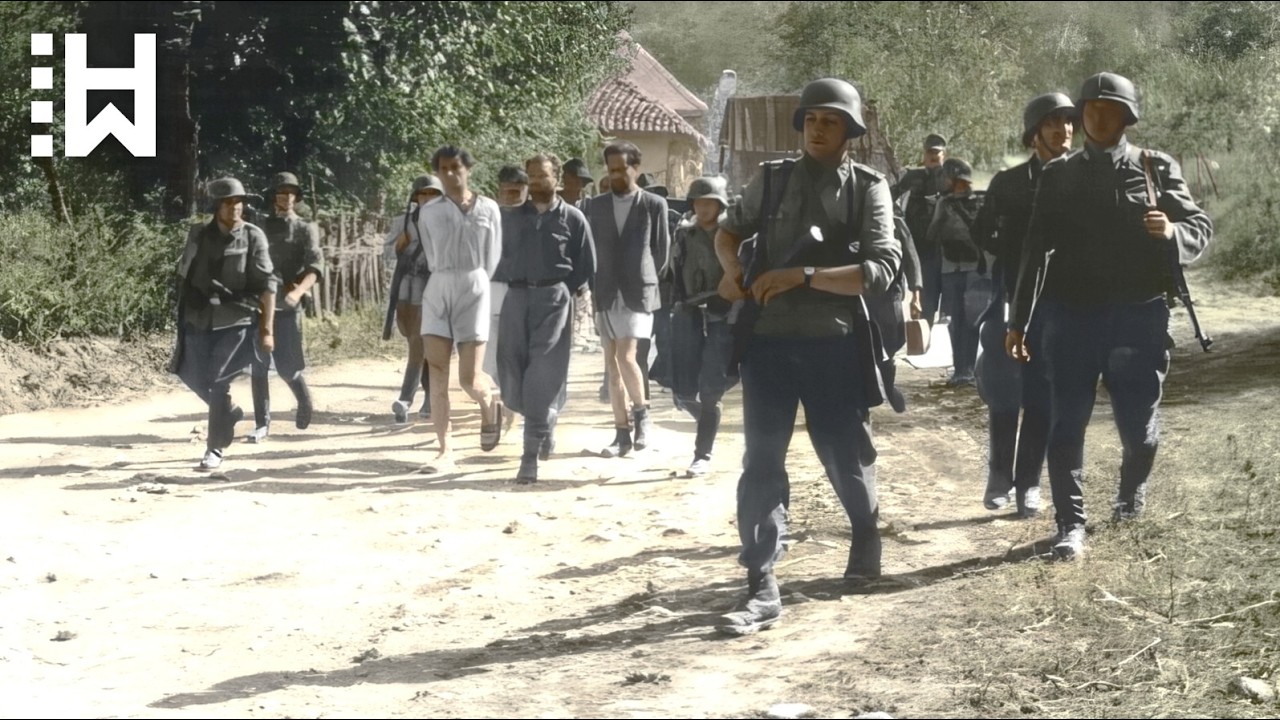
Three days after Keitel issued the hostage order, on the 19th of September 1941, Hitler appointed the Austrian General of the Infantry, Franz Böhme, as the chief commander in Serbia, giving him direct authority to suppress the attacks against the German forces in the occupied territory. Böhme arrived with a staff of the 18th Mountain Corps and took control of the German occupation forces already stationed there. Among the main formations operating under his authority were the 704th, the 714th, and the 717th infantry divisions, units tasked with carrying out security operations and brutal reprisals across German-occupied Serbia.
Böhme openly encouraged vengeance against the Serbian population and reminded his soldiers of the defeats Austria-Hungary had suffered during the First World War. Addressing his troops, many of whom were Austrian-born, he declared, “Your objective is to be achieved in a land where, in 1914, streams of German blood flowed because of the treachery of the Serbs, men and women. You are the avengers of those dead.”
The consequences of those orders soon became visible in the town of Gornji Milanovac in central Serbia. By late September 1941, the town had effectively been cut off from the rest of German-occupied Serbia as guerrilla fighters repeatedly disrupted road and rail transport in the surrounding area. On the 29th of September 1941, fighters from Chetnik and Partisan resistance groups attacked the German garrison there.
The town was defended by German troops stationed in a local school building. The insurgents did not expect to capture the garrison. Instead, the attack was intended to demonstrate resistance and attract new recruits from the surrounding villages.
The assault began in the morning. The guerrillas quickly overran the German sentry posts, but heavy machine gun fire from inside the school halted their advance. After ninety minutes of fighting, ten German soldiers had been killed and twenty-six had been wounded.
Under German occupation policy, these casualties carried devastating consequences for the civilian population. The standing orders demanded the execution of one hundred Serbian civilians for every German soldier killed and fifty for every soldier wounded. The fighting in Gornji Milanovac therefore triggered a massive reprisal operation.
German authorities began searching for hostages in the area around the nearby industrial city of Kragujevac, which soon became the focal point of the retaliation. Located about one hundred kilometers, or sixty-two miles, south of Belgrade, Kragujevac had a population of more than forty thousand in 1941 and served as the headquarters of a German military district. In October 1941, German commanders decided that this city and its surrounding communities would supply the hostages needed to fulfill the brutal reprisal quota.
The first arrests began on the evening of the 18th of October 1941. German authorities ordered the detention of all male Jews in Kragujevac, together with individuals suspected of communist activity. In total, only seventy men were taken into custody, but because this number was far too small to satisfy the reprisal quota demanded by German command, the following day German troops turned to nearby villages.

Soldiers from German occupation units entered the villages of Mečkovac, Maršić, Grošnica, and Milatovac. Men were rounded up and executed on the spot. In these four villages alone, 422 civilians were shot, even though no German soldiers had been killed there.
Despite these killings, the Germans still had not reached the number of hostages they required. German commanders therefore ordered large-scale arrests inside Kragujevac itself. Soldiers moved through the city arresting men and boys between the ages of sixteen and sixty.
People were seized in fields, factories, markets, on the streets, and in their homes. Some three hundred school children and teachers were arrested in their classrooms. Roma children, mostly shoe shiners who had refused to polish German soldiers’ boots, were rounded up as well.
The detainees were taken to army barracks on the outskirts of the city, where each hostage was registered and his belongings recorded. By the evening, several thousand men and boys had been rounded up and placed under armed guard, waiting through the night for the decision that would determine their fate. Members of the Serbian fascist movement Zbor were allowed to inspect the prisoners, after which a large number of detainees were removed from the execution lists.
More than three thousand individuals identified as supporters of the movement and described as reliable patriots or genuine nationalists were released and excluded from the execution lists. Those who remained were labeled by the Nazis as communists, and for the German authorities, such accusations were enough to justify their execution. The remaining prisoners spent the night under heavy guard, uncertain whether they would survive the coming day.
On the morning of the 21st of October 1941, the prisoners were marched from the city toward open fields on the outskirts of Kragujevac. Groups of between fifty and one hundred twenty men and boys were lined up before German firing squads from the 717th Infantry Division. Heavy machine guns were positioned in front of the prisoners, and the executions began.
The shootings continued for about seven hours.
Witnesses later recalled scenes of extraordinary courage among the condemned. One elderly teacher reportedly addressed the soldiers before the shooting began, declaring, “Go ahead and shoot. I am conducting my class.”

He was executed together with his students. As they faced the firing squads, many prisoners sang the patriotic song “Hey, Slavs.”
It is estimated that between 2,778 and 2,794 people were murdered during the massacre in Kragujevac. Of the total killed, 144 were high school students, and fifteen of the victims were twelve years old. Victims of the mass executions included Serbs, Jews, Romani people, Muslims, Macedonians, Slovenes, and members of other nationalities.
Roughly two hundred of the remaining prisoners were forced to bury the dead, an act that took days. The rest were sent home, and following the massacre, the Wehrmacht, the German armed forces, held a military parade through the city center.
The crime would not remain unpunished, though the reckoning took years to arrive. After the war ended in May 1945, those responsible for the Kragujevac massacre eventually faced justice. The soldiers of the 717th Infantry Division, directly responsible for the massacre, continued anti-partisan operations across the Balkans for the remainder of the war.
In 1943, the division was reorganized as the 117th Jäger Division, and hundreds of those once deployed in Serbia were killed during the Second World War.
The Serbian Volunteer Corps, the paramilitary branch of the fascist political organization Zbor, which collaborated with the Nazis and was involved in the Kragujevac massacre, retreated into Austria toward the end of the war. There, they surrendered to British forces, but after the war, most were returned to Yugoslavia, where they were executed on charges of treason.
Franz Böhme, the commanding general in Serbia with direct responsibility for crushing the resistance, was captured in Norway. He was then brought before the Hostages Trial, a division of the subsequent Nuremberg Trials, and charged with war crimes committed in Serbia. When his extradition to Yugoslavia seemed imminent, Böhme committed suicide.
Wilhelm Keitel, who issued Hitler’s order regarding the ratio of hostages to be shot, was indicted by the International Military Tribunal in Nuremberg as one of the major war criminals. He was found guilty on all counts and executed by American Army Sergeant John C. Woods, who is believed to have been deliberately bad at his job, causing the ten Nazi war criminals from the Nuremberg Trials whom he executed on the 16th of October 1946 to suffer as they died long, agonizing deaths.
With Wilhelm Keitel, however, it was even worse. The sixty-four-year-old Keitel was hanged, but because the trapdoor was too small, it caused him painful head injuries, and as he fell from the gallows with insufficient force to snap his neck, his horrible convulsing and trembling lasted twenty-eight long minutes before he died.
The Kragujevac massacre remains one of the most brutal examples of Nazi reprisal policy during the Second World War. It stands as a reminder of how radical ideology in power and blind obedience to orders can lead to unimaginable crimes.






