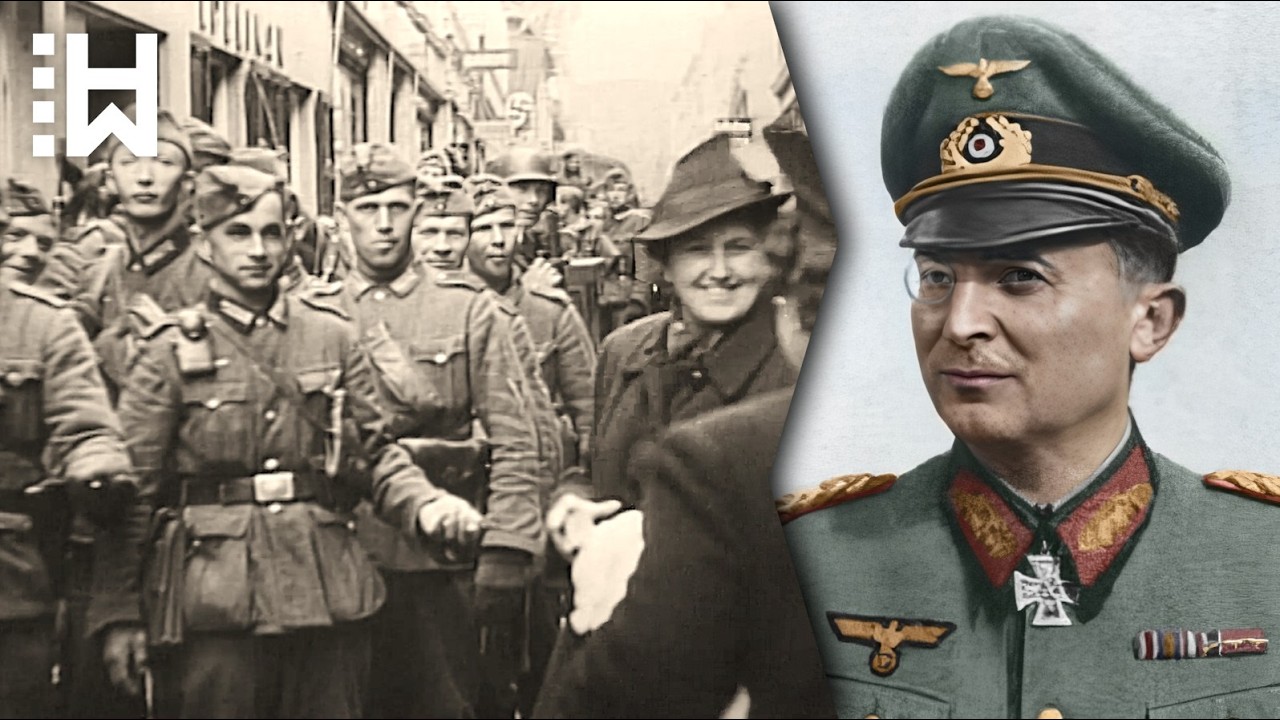
On the 5th of June 1945, in the city of Ljubljana, a partisan firing squad raised its rifles and took aim at a group of captured German officers. Among them stood Gustav Fehn, a general who had served the Nazi regime faithfully for more than a decade, a man who had commanded armored divisions, fought in the Soviet Union, and directed a brutal anti-partisan campaign in Yugoslavia. There was no formal trial, no written sentence.
The execution was swift and carried out without ceremony, part of the violent reckoning that swept through the Balkans as the Second World War came to its end. Fehn was 53 years old.
How did a career officer of the old Imperial Army come to stand before that firing squad? The answer reaches back more than three decades, to a young man who entered military service in the twilight of the German Empire and rose through the ranks of every army that followed, each time swearing loyalty to a new master, each time obeying orders without question.
Gustav Fehn was born on the 21st of February 1892 in the city of Nuremberg, then part of the German Empire. Like many young men of his generation, he was drawn early to the army, the most respected institution in Imperial Germany. In July 1911, at the age of 19, he entered military service as a cadet.
Two years later, he became an officer. The German Empire in Europe was still at peace, and for ambitious young officers like Fehn, the army offered both a career and a sense of belonging.
When the First World War began in the summer of 1914, Fehn was sent to the Western Front. The German army, confident of a quick victory, advanced through Belgium and France, but the campaign soon turned into a bloody stalemate of trench warfare. During the war, Fehn received promotions and various military awards, including both classes of the Iron Cross, the wound badge, the Hanseatic Cross of Hamburg, and the Friedrich August Cross.
These distinctions marked him as a capable and loyal officer, one of those who survived the destruction of the old Imperial Army and formed the backbone of the next army in peacetime.
After the armistice in November 1918, Germany descended into turmoil. Soldiers returned home to a country in revolution and despair. Fehn, like many officers unwilling to lay down their arms, joined one of the Freikorps paramilitary groups fighting communists and separatists in the ruins of postwar Germany.
The Freikorps were violent and chaotic, but for men like Fehn, they were also a refuge, a way to preserve military discipline in a world that seemed to have lost it. He served with a Freikorps group named the Deutsche Schutz Division, which operated in Berlin and various regions of Germany.
In 1919, Fehn was accepted into the new Reichswehr, the professional army of the newly founded Weimar Republic. The army was strictly limited in size by the Treaty of Versailles to 100,000 men, but its officers were carefully selected for competence and reliability. Fehn began a long period of steady service, moving through various infantry and cavalry assignments.
He completed an elite officer training course and proved to be an able administrator and instructor. The interwar years focused on modernization within the tight restrictions imposed by Versailles, studying mobile tactics and technology that would later become central to Blitzkrieg, the lightning war. Fehn fit neatly into this professional and formally apolitical core.
When Adolf Hitler came to power as German chancellor in January 1933, Fehn was soon promoted to major and assigned to the infantry school in Dresden as an instructor. At Dresden, Fehn taught infantry tactics to young officers and witnessed the growing militarization of Germany. The army, long proud of its independence from politics, was now tied to the Nazi regime.
Many officers welcomed the expansion of the military but ignored the regime's ideology. When the army swore an oath of loyalty to Hitler personally in 1934, Fehn, like most of his colleagues, complied without protest and swore his allegiance to the Nazi dictator.
By 1938, Fehn had risen to the rank of Oberst, equivalent to colonel. A year later, he assumed command of one of the motorized regiments intended to spearhead Germany's future conquests. When the Wehrmacht invaded Poland and started the Second World War on the 1st of September 1939, Fehn led his regiment in the campaign and distinguished himself as a calm and efficient commander.
The swift German victory brought him once again promotion and military awards.
At dawn on that first day of September, without a declaration of war, German artillery opened fire across the Polish border. Stukas dove from the clouds, their sirens screaming as Polish towns erupted in flames. Columns of the Wehrmacht rolled forward in tight formation, armored spearheads breaking through with motorized infantry following fast behind.

On the 28th of September, Warsaw officially surrendered. Fehn had commanded his regiment through the entire campaign, and his superiors took note.
Fehn again commanded his unit during the western campaign of 1940, leading troops through France and the Low Countries. For his leadership, he was awarded the Knight's Cross of the Iron Cross, one of the highest awards in the military and paramilitary forces of Nazi Germany during World War II. Soon after the victory over France, in November 1940, Fehn assumed command of the 5th Panzer Division, one of Germany's elite armored units.
In the spring of 1941, Fehn's division took part in the invasion of Yugoslavia and Greece, campaigns that secured the Balkans for Germany and its allies just a few weeks before the German invasion of the Soviet Union. Parts of Fehn's division were also engaged in the Battle of Crete, a costly airborne assault that brought that important island under German control. Fehn's reports showed a commander focused on mobility and discipline rather than glory.
His superiors regarded him as a competent professional rather than a visionary, a man who obeyed orders faithfully and kept his formation effective.
Later that year, Fehn's division was transferred east to join Army Group Center in the invasion of the Soviet Union. His men took part in the offensive against Moscow and were part of that brutal and exhausting campaign, connected also with the murdering of the civilian population. Disease, mud, and partisan attacks took a heavy toll on the soldiers.
Fehn's leadership and willingness to serve the Nazis earned him the German Cross in Gold on the 7th of July 1942, an award that recognized personal bravery and effective command.
In 1942, Fehn became General der Panzertruppe, and he briefly commanded the 40th Panzer Corps, part of the 1st Panzer Army, before being placed in the Führer Reserve, the pool of senior officers awaiting new assignments. His next appointment came unexpectedly. After a few days, on the 16th of November 1942, he was sent to North Africa to serve as commander of the Afrika Korps, where he tried to hold the collapsing front.
But on the 15th of January 1943, he was severely wounded and evacuated to Germany. The North African campaign ended soon after in total defeat for Nazi Germany and fascist Italy.

After his recovery, Fehn returned to duty, but never regained the prominent position he once held. He ended up commanding the 21st Mountain Army Corps in the Balkans. In October 1943, he was transferred to Yugoslavia, where he directed anti-partisan operations against the forces of Communist Partisan leader Josip Broz Tito.
The campaign was bitter and merciless, with civilians often caught between reprisals and guerrilla warfare. Fehn's corps was part of the 2nd Panzer Army, charged with maintaining German control over a region already descending into chaos.
On the 20th of July 1944, the very day of the failed assassination attempt on Hitler, Fehn took command of the 15th Mountain Army Corps, a position he held until the end of the Second World War. His forces fought retreating battles as the Red Army advanced from the east and partisans led by Tito grew stronger in the mountains of the Balkans. To the very end, Fehn followed orders, maintaining discipline even as Germany disintegrated around him.
While he projected the image of a disciplined career officer, the reality of his leadership during these final months was far darker. Under Fehn's authority, the retreat of the 15th Mountain Corps across the Balkan regions became inseparable from a campaign of systematic violence against civilians. Entire villages were burned in punitive operations.
Thousands of hostages, men, women, and children were executed in retaliation for partisan attacks. Collective punishments were imposed on communities accused of aiding the resistance. Rather than uphold the rules of war, Fehn implemented and enforced Hitler's brutal directives for bandit fighting, which treated civilians and partisans as one and the same.
In doing so, he transformed the German withdrawal from the Balkans into a scorched earth campaign that left behind a trail of destruction, death, and lasting trauma.
In May 1945, with the German surrender, Fehn was taken prisoner by the British. Like many captured officers, he expected to face interrogation and internment, perhaps even a formal war crimes trial. Instead, on the 4th of June 1945, the British handed him over to the Yugoslav partisans, who accused him of responsibility for the atrocities committed by the German troops in the Balkans.
There was no formal trial, no written sentence. On the 5th of June 1945, in Ljubljana, Gustav Fehn was executed by a partisan firing squad along with other high-ranking German officers, among them General Edmundsorf, Friedrich Stefan, and Heinz Kärtner. The executions were swift and carried out without ceremony, part of the violent reckoning that swept through the Balkans at the war's end.
When the partisans shot him for crimes committed by units under his command, he was 53 years old.






