“We believe that our spiritual convictions and moral strength could balance your material and scientific advantages. ”
Lieutenant General Torashiro Kawabe, Deputy Chief of the Imperial Japanese Army General Staff, spoke those words to American interrogators in Tokyo on the 30th of November, 1945. He was answering a question about the Kamikaze. It was not a boast.
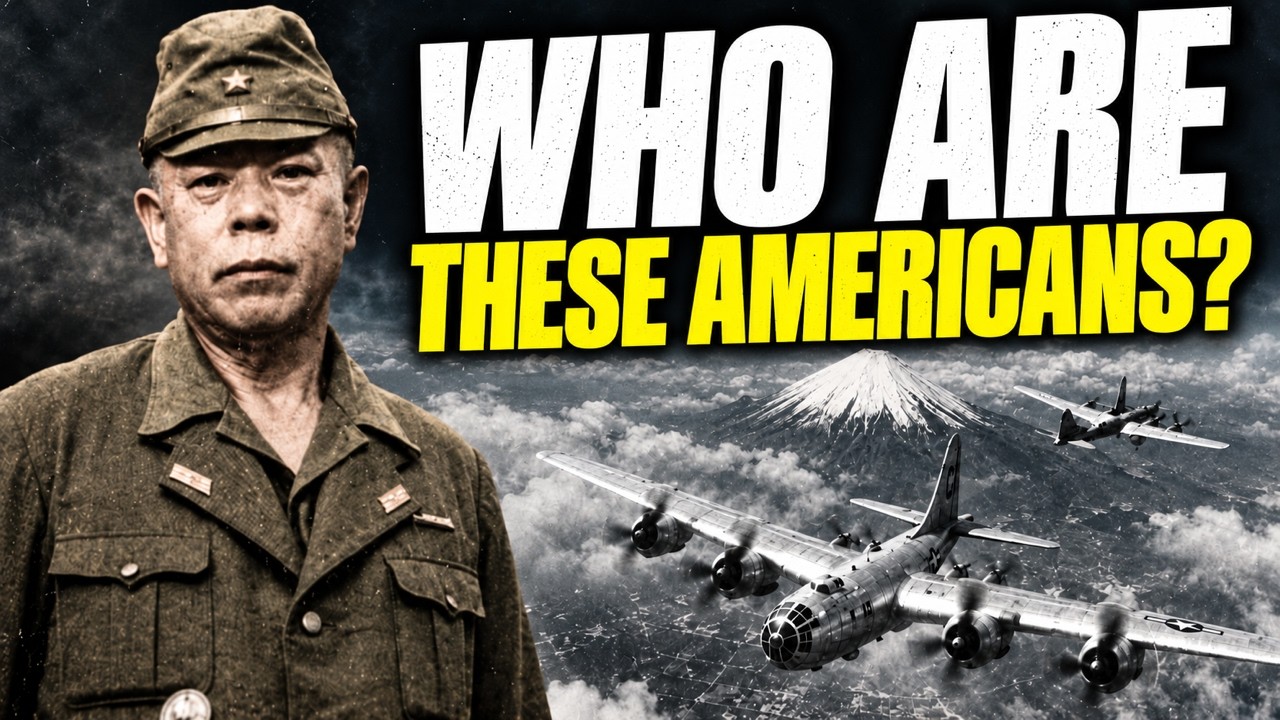
It was a confession, spoken by a man who had spent the last months of the war inside the headquarters where Japan’s army planned its battles. We believed, past tense. Three months before that interview, Kawabe had flown south in an aircraft painted entirely white, marked with green crosses, surrounded by American warplanes. What waited for him at the end of that flight belongs at the end of this story.
Other Japanese commanders had reached his conclusion long before him. He was one of the last. Some reached it before the first bomb fell on Pearl Harbor. One reached it in the oil fields of the United States and Mexico.
One reached it in Detroit behind the wheel of an American car. One reached it at a desk in Tokyo in a study he presented to two senior admirals. Their words survive in letters to a wife, in a prime minister’s memoirs, in radio messages sent from caves, and in interrogation transcripts typed by the United States Strategic Bombing Survey and filed in archives that very few people open. The survey’s naval officers questioned Japan’s commanders in Tokyo through October, November, and December of 1945.
Their transcripts are almost never read side by side with the letters and the memoirs. Read together, they raise a question that the usual story of the Pacific War walks past. If Japan’s sharpest commanders understood American power, some of them years before the war began, why did the war run on until the cities burned? And why were the men who understood it best sent to face it in the worst places?
The answer is in their own words. It arrives slowly, the way it arrived for them. Start with a school teacher’s son. He was born in 1884, the seventh son of a poor teacher in a fishing village on the northwest coast of Japan.
His name at birth was Isoroku Takano. He placed second out of 300 candidates in the entrance examination for the Naval Academy at Etajima and graduated in 1904. A year later, in the war against Russia, he was wounded in battle. He lost two fingers of his left hand.
In 1913, after the death of his parents, he was adopted into the Yamamoto family and took their name. Six years later, the Navy sent Isoroku Yamamoto to the United States. From 1919 to 1921, he studied at Harvard University. He did not choose literature or law.
He studied economics, and he studied oil. He toured the oil fields of the United States and Mexico. He watched the derricks and the storage tanks of a country that had more fuel than it could use. He also became an accomplished poker player.
A poker player learns to count what the other man has on the table. From 1926 to 1928, he returned to Washington as naval attaché. What he took home was a conviction his biographers described plainly. Naval power depended on oil and on industrial capacity.
And on both counts, Japan had little hope against the United States. The second man was a cavalry officer. Tadamichi Kuribayashi was born on the 7th of July, 1891, in Matsushiro, in Nagano Prefecture, into a family whose samurai line ran back to the age of civil wars. In March 1928, at 36, Captain Kuribayashi left Japan for America.
He lodged in Buffalo, New York. He took courses at Harvard in English, in American history, in American politics. He audited classes at the University of Michigan. He visited Washington and Boston.
He spent time with the cavalry at Fort Bliss in Texas and at Fort Riley in Kansas. And he bought a Chevrolet. American officers taught him to drive it. He drove it in many directions across the country, as his son later remembered.
To that son, Taro, back in Japan, he sent letters filled with his own sketches: Harvard, walks through Buffalo, a Japanese officer playing with American children. Later, Kuribayashi described what those roads had shown him. “I was in the United States for 3 years. I knew the close connections between the military and industry.
I saw the plant area of Detroit, too. The plant area of Detroit. ” A man who has driven past those factories in a car built by them does not need a staff report to understand what they can produce. According to his grandson, Yoshitaka Shindo, Kuribayashi’s reluctance to fight America slowed his rise through the ranks.
Some officers on the Imperial Staff came to call him a defeatist. He kept saying it anyway, to his family, again and again. “The United States is the last country in the world Japan should fight. ”
The third man’s career had looked elsewhere.
Torashiro Kawabe was born on the 25th of September, 1890, in Toyama Prefecture. He graduated from the Army Academy in 1912 and chose the field artillery. His postings pointed toward Europe and the Soviet Union: Riga, in Latvia, from 1926 to 1928, studying Soviet affairs; Moscow, as military attaché, from 1931 to 1934; then Berlin and Budapest. His files were Russian and German.
When the Pacific War began, he was a lieutenant general working in army aviation. In May 1943, he took command of an air army in Manchuria, on the Soviet frontier, far from any American front. Three men. One measured the oil.
One drove past the factories. One kept his eyes on Moscow. And a fourth figure, who appears here only as a document, a rear admiral in Tokyo, would spend five months of the war adding up the numbers that the others had seen with their own eyes. The conclusion he reached matters less than the date on which he reached it.
That date has to wait until the battles have done their work, because only then does its weight become clear. The first warning was spoken aloud. Sources disagree on the year. Some place the conversation in September 1940, others in 1941.
Prince Fumimaro Konoe, Prime Minister of Japan, asked the commander of the Combined Fleet what would happen in a war with the United States. Konoe recorded the answer in his memoirs. “I shall run wild considerably for the first 6 months or a year, but I have utterly no confidence for the second and third years. ” Utterly no confidence, from the man who would plan the attack.
On the 7th of December, 1941, Yamamoto’s carriers struck Pearl Harbor. Among those who wrote to him afterward was Taketora Ogata, a senior newspaper editor. Yamamoto answered on the 9th of January, 1942. His reply, as given in the biography by Hiroyuki Agawa, is a strange thing to read in the first month of a victorious war.
A military man can scarcely pride himself on having smitten a sleeping enemy. It is more a matter of shame, simply, for the one smitten. “I would rather you made your appraisal after seeing what the enemy does, since it is certain that, angered and outraged, he will soon launch a determined counterattack. ” Certain, not possible, not likely.
Certain. The six months ran almost to the day. On the 4th of June, 1942, off Midway, American carrier aircraft found the Japanese strike force. By nightfall, four Japanese fleet carriers were burning or sinking.
The running wild was over. Two months later, the Americans landed on Guadalcanal, and the arithmetic began to show on Japan’s own supply lines. General Miyazaki later testified to the survey that only 20% of the supplies dispatched from Rabaul to Guadalcanal ever reached there. Twenty percent.
Four loads out of five lost on the way. Then the Americans came for the admiral himself. On the 14th of April, 1943, American code breakers intercepted the itinerary of an inspection tour Yamamoto was about to make in the Solomon Islands. Times, aircraft, destination.
On the 18th of April, sixteen Lockheed P-38 Lightnings flew a long route low over the sea and arrived where the decoded message said he would be. Over Bougainville, they intercepted two Mitsubishi G4M bombers carrying Yamamoto and his staff. First Lieutenant Rex Barber engaged the Admiral’s aircraft. It went down into the jungle.
A postmortem found two . 50 caliber bullet wounds. The man who had studied American oil at Harvard was killed by American intelligence reading his own schedule. The machine he had measured found him over a jungle at an hour it had chosen in advance.
The second wave of understanding came from the sky. According to the bombing survey, news of a new American bomber, the B-29, and of what it could do, reached Japan in 1943. On the 15th of June, 1944, the first B-29 raid struck Japan from bases in China. Four days later, on the 19th of June, Lieutenant General Kuribayashi arrived on a small volcanic island south of Tokyo, Iwo Jima.
Eight square miles of black ash and sulfur. Then Saipan fell in early July. The survey’s analysts were blunt about what that meant in Tokyo. From bases in the Marianas, the home islands could now be brought under an intensive shattering assault from the air.
Many leaders, the survey found, became wholly convinced of Japan’s eventual defeat. By mid-1944, the survey wrote, those Japanese in possession of the basic information saw with reasonable clarity the economic disaster which was inevitably descending on Japan. On the 18th of July, 1944, ten days after Saipan, the cabinet of General Hideki Tojo fell. The war did not stop.
On Iwo Jima, Kuribayashi turned against the old doctrine. He refused to defend the beaches. Positions on the shore would be exposed to American naval guns and aircraft. So he put his garrison underground.
They dug through volcanic rock in heat and sulfur fumes. Eighteen kilometers of tunnels by the usual count. Around 5,000 caves and positions. Pillboxes buried until only their firing slits showed.
He also banned the banzai charge. He considered it a waste of men who could keep killing from cover. His chief of staff later recalled what Kuribayashi told him on the island. “America’s productive powers are beyond our imagination.
Japan has started a war with a formidable enemy. ” He wrote to his wife, “Yoshi, do not plan for my return. ” And in another letter, “You must not expect my survival. ” He told her something else, something only a man who had lived among Americans would think to write.
“Americans have always taken casualties very seriously. ” That sentence is the design of Iwo Jima. His letters show he expected no victory. What he could do was make the price high enough that the Americans might hesitate before the next island.
Meanwhile, Kawabe’s command in Manchuria ended in August 1944. In October 1944, off Leyte, Japan launched the first organized suicide attacks against the American fleet. On the 25th of October, kamikaze aircraft struck the American escort carriers, and the USS St. Lo went down.
This was the doctrine Kawabe would later describe to his interrogators. “The pilot did not start his mission with the intention of committing suicide. He thought of himself as a human bomb which would destroy part of the enemy fleet. ” And Kawabe added, “He died happy in the conviction that his death was a step towards final victory.
” Spiritual conviction set against material advantage. One aircraft, one man, against a ship. Through the winter, the island waited. Below ground, the garrison worked in the heat of the rock.
Above, American aircraft and warships pounded the surface in the weeks before the landing. The tunnels held. The third wave struck from two directions at once. On the 19th of February, 1945, the Marines landed on Iwo Jima.
The American planners had expected to take it in about five days. It took 36. Ash that swallowed boots to the ankle. Mortars from positions no one could see.
Machine guns that fell silent, then fired again from a different cave. Flamethrowers. Demolition charges. One opening at a time.
Day after day, the Marines took ground measured in yards. And in the middle of that battle, the same machine turned toward the heart of Japan. On the night of the 9th of March, 1945, B-29s flying from the Marianas came over Tokyo at low altitude with incendiaries. 1,667 tons of bombs.
Fifteen square miles of the city destroyed in a single raid. Over the following ten days, through the 19th of March, 9,373 tons fell on four cities. Thirty-one square miles burned. The survey would later record those figures as tonnage and area.
For the people beneath the bombers, they were neighborhoods of wood and paper. On Iwo Jima, the arithmetic ran the other way. On the 17th of March, Kuribayashi sent his farewell to Tokyo with three death poems in the classical waka form. The same day, he was promoted to full general.
On the 22nd of March, his radio reported, “We are still fighting. The strength under my command is now about 400. ” Four hundred out of a garrison of more than 20,000. On the 23rd of March came his last message.
“All officers and men of Chichi Jima, goodbye from Iwo. ” Around the 26th of March, he died in a final night assault. By some accounts, he had removed his insignia so that he could fight as an ordinary soldier. His body was never identified.
Now, the date. The rear admiral was Suekichi Takagi. The bombing survey’s report spells his first name Sueichi. Between the 20th of September, 1943, and February, 1944, he studied the lessons of every battle Japan had fought so far.
Shipping, raw materials, aircraft, the reach of American bombers. He concluded that Japan could not win. The survey summarized his reasoning. Japan could not import the essential materials it needed.
The home islands lay open to long-range air attack. Japan, he concluded, should seek a compromise peace. In March 1944, he presented his findings to Admiral Mitsumasa Yonai and to Vice Admiral Shigeyoshi Inoue. March 1944.
Before Saipan. Before the first B-29 raid from China. Before Kuribayashi ever set foot on Iwo Jima. Before the first Kamikaze.
Before Tokyo burned. Every death in the second and third waves of this story came after a Japanese admiral had written down, from Japan’s own data, that the war was lost. Understanding had arrived on paper in Tokyo. It had not arrived in the decision.
The fourth wave reached the palace. In February 1945, according to the survey, the emperor on his own initiative met a series of senior statesmen. Their consensus was that Japan faced certain defeat and should seek peace at once. On the 7th of April, 1945, Admiral Kantaro Suzuki became prime minister.
He later told the survey that it was the emperor’s desire to bring the war to a conclusion as quickly as possible. “And that was my purpose. ”
That same April, Torashiro Kawabe became deputy chief of the army general staff. The man whose career had faced Moscow was now the second officer of an army preparing to defend the home islands against America.
Off Okinawa, the suicide offensives grew into ten massed operations under the name Kikusui. By one count, 1,840 suicide sorties were flown there, and 960 aircraft were lost. At sea, the blockade was finishing what the fleets had begun. By the survey’s figures, 8.
9 million tons of Japanese merchant shipping went to the bottom during the war, 88% of everything Japan had. American submarines alone accounted for 54. 7% of the sinkings. The factories Kuribayashi had driven past in his Chevrolet were turning out ships and aircraft faster than Japan could sink them.
In August came the atomic bombs on Hiroshima and Nagasaki and the Soviet declaration of war. The weight each of those blows carried in Tokyo is still argued over by historians. The bombing survey itself concluded that the bombs shortened the war rather than caused the surrender. Others have read the same evidence differently.
The debate remains open. On the 15th of August, the emperor’s voice announced the end on the radio. Then someone had to fly to the enemy. General Yoshijiro Umezu, chief of the army general staff, refused to go.
The task fell to his deputy. The 19th of August, 1945, Kisarazu airfield near Chiba. Two converted Mitsubishi bombers on the strip, disarmed, painted pure white. On the wings, on the fuselage, on the rudder, green crosses where the red rising sun used to be.
MacArthur’s headquarters had ordered the paint scheme so that no American gunner could mistake them. The Americans gave them call signs, Bataan 1, Bataan 2. Japanese hardliners were feared to be planning sabotage or a suicide attack on the flight. The escort was heavy because of that fear.
Eighteen minutes past 7:00 in the morning, Japanese time, wheels up. Sixteen envoys, military and civilian. At their head, Lieutenant General Torashiro Kawabe. Over the sea, the escort formed up around them.
P-38 Lightnings, the same type of aircraft that had killed Yamamoto over Bougainville. B-25 bombers. American airplanes on every side. The white bombers landed at Ie Shima, a small island off Okinawa, ground the Americans had taken that spring.
There, the delegation left the Japanese aircraft behind. They climbed into an American C-54 transport, four engines, American crew. Its call letters spelled the same word: Bataan. The flight carried them to Nichols Field near Manila.
Major General Charles Willoughby met them. There were no negotiations. The Japanese envoys received instructions: how to prepare for the formal surrender, how to prepare for the occupation of their country. According to the American record, the atmosphere was one of firmness but fairness, and it favorably impressed the envoys.
A man who had studied armies all his life sat in a room in Manila and was told, courteously, what would happen next. No argument. No bargaining. Instructions.
On the 2nd of September, 1945, in Tokyo Bay, aboard the battleship Missouri, Japan signed the instrument of surrender. The survey later put numbers on the air war. 160,800 tons of bombs dropped on the home islands, 147,000 of them by B-29s. Civilian casualties from the bombing, about 806,000, the survey estimated, of whom about 330,000 were killed.
On Iwo Jima, the figures change with the source. American casualties, 26,309 killed and wounded by one tally, about 26,000 by others. The Japanese garrison, around 21,000 men in one count, 22,786 in another. The number taken alive is just as divided.
Some sources give 216 prisoners, others count 1,833 survivors. The gap depends on who was counted and when, and it cannot be settled here. Almost the entire garrison died in the caves Kuribayashi had ordered dug. The Marine General Holland Smith, who had fought across the Pacific, gave his own verdict.
Of all our adversaries in the Pacific, Kuribayashi was the most redoubtable. And in November 1945, American officers sat across a table from Torashiro Kawabe and asked him why young men had flown their aircraft into ships. He told them about spiritual conviction and about material and scientific advantage, and he used the past tense. Isoroku Yamamoto never saw the end.
He died over the jungle of Bougainville on the 18th of April, 1943, more than two years before the surrender he had foreseen with his utterly no confidence. Tadamichi Kuribayashi died around the 26th of March, 1945, on Iwo Jima. His son Taro, the boy who once received sketches of Harvard and Buffalo in the mail, believed his father was killed in an artillery barrage and buried near the village of Chidori. The body was never found.
Torashiro Kawabe survived. He answered the survey’s questions. He lived fifteen more years and died on the 25th of June, 1960, at the age of 69. The study of Rear Admiral Takagi survived as a few lines in an American report dated with precision.
Why are these words so rarely heard? Part of the answer is that a better line was invented. The most famous sentence ever attributed to Yamamoto, the one about awakening a sleeping giant, comes from the 1970 film Tora! Tora!
Tora! Its producers claimed a diary entry or a letter as the source. No such document has ever been produced. The invented line is quoted everywhere.
The real ones sit in Konoe’s memoirs, in Agawa’s biography, in letters to a wife on Iwo Jima, in the typewritten transcripts of the Strategic Bombing Survey. Kawabe’s is listed as interrogation number 98 in the naval series, filed under a dry heading, overall planning and policies. Another part of the answer is that the real words are harder to hear. They described men who saw clearly, said so, and were sent to fight anyway.
The admiral who had counted the oil planned the attack. The general who had driven past Detroit was handed Iwo Jima. The rear admiral who wrote down the truth in March 1944 watched seventeen more months of war. And the general whose career had faced Moscow was the one who had to fly in a white airplane with green crosses to receive America’s instructions.
“We believed that our spiritual convictions and moral strength could balance your material and scientific advantages. ”
When Kawabe spoke those words in November 1945, they were meant for his interrogators. Read now, after Detroit, after Takagi’s study, after Iwo Jima and Manila, they answer the question this story opened with. Japan’s commanders did understand American power.
Yamamoto understood it in the oil fields. Kuribayashi understood it on the road, in a Chevrolet. Takagi understood it in a column of figures in 1944. The clearest record of American power in the Pacific was kept by the men who stood against it.
Their eyesight was sound. The failure lay in a belief held above them and around them that conviction could cancel arithmetic. The men who could read the arithmetic were sent to the front to prove it wrong, and the war ended only when the arithmetic arrived over Tokyo in tons and square miles. Kawabe was the last of them to see it from a white airplane ringed by P-38s.
Some of them had seen it before the first shot. The enemy’s own words are the hardest witness to argue with.






