A damp field in eastern France, the morning of September 19, 1944. More than fifty German Panther tanks were about to die. They were better armored than the American tanks coming against them. They carried bigger guns.
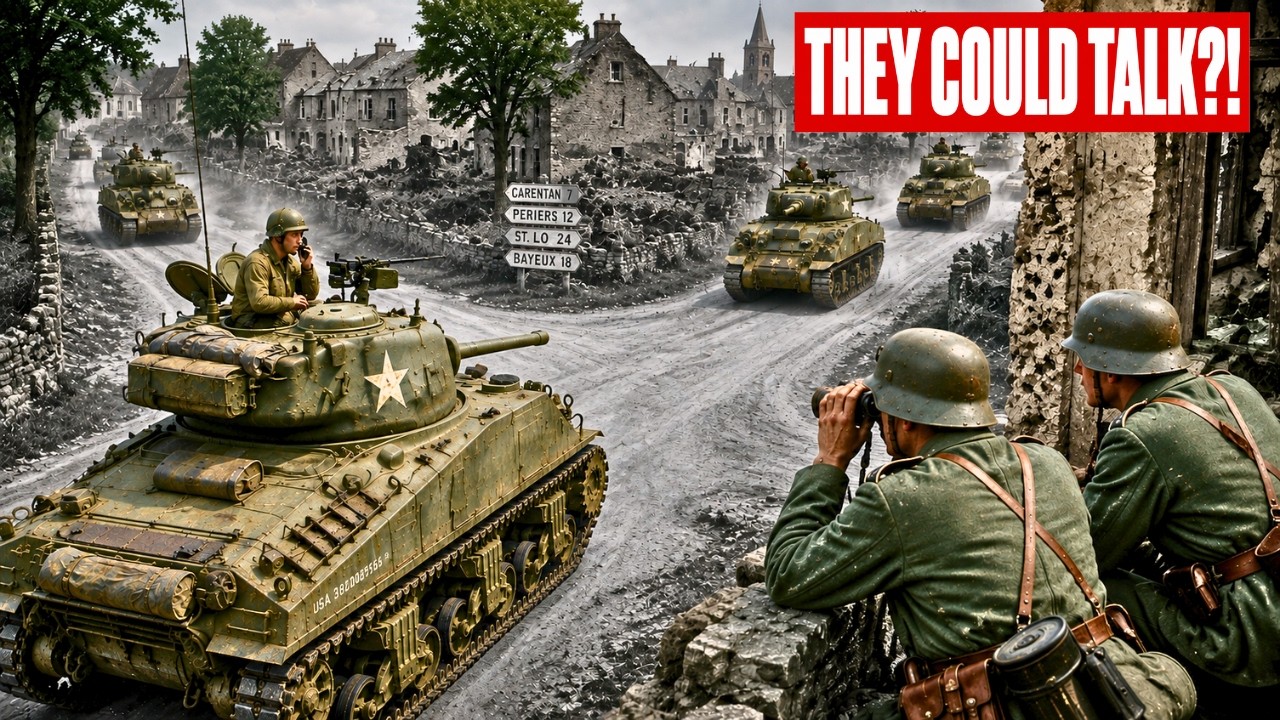
Their crews were veterans. Within ten days, most of them were burning in the mud outside a town called Arracourt. The Panther crews never understood what killed them. Eighty years later, most Americans have never heard the reason.
It was not the 75mm gun on the Sherman. It was not sloped armor. It was a small metal box weighing 181 pounds that the Germans did not know existed. This is the story of that box, and of the three men who put it in the turret of every American tank in Europe.
The story begins not on a battlefield but in a laboratory on the New Jersey coast, six years before the fog closed in over Arracourt. Fort Monmouth stood on the low bluffs above the Shrewsbury River, a cluster of red brick barracks and long wooden laboratory sheds. In 1938 it housed the Signal Corps Laboratories, the place where the United States Army thought about the future of its own voice. That future was uncertain.
The Army had radios in some of its trucks and some of its airplanes. It had almost nothing in its tanks. It was, by the quiet judgment of history, unprepared for the war that was already coming. The man responsible for thinking about the problem was a colonel named Roger B.
Colton. He was fifty-one that year, a career signal officer with a precise, careful mouth and the patience of a man who had seen many committees. He wore round, thin-rimmed glasses. He was not a public figure.
He was quiet by every measure. The choice before him was simple to describe and almost impossible to make. For an entire generation, the whole world had built its radios on amplitude modulation. AM was mature technology.
Every commercial broadcaster used it. Every industrial receiver used it. Every foreign army used it. There were spare parts, factories, textbooks, trained technicians.
AM was the safe road. It was the only road most engineers could see at all. Then there was the other road. Frequency modulation, FM, a newer way of encoding sound onto a radio wave, championed by a reclusive inventor named Edwin Armstrong.
FM promised something strange. It promised silence. The crackle of electrical noise, the hiss of engine spark, the racket of a battlefield—all of it would vanish. Only the human voice would remain.
Almost nobody wanted to hear about it. The most powerful man in American broadcasting, David Sarnoff of RCA, had built his empire on AM and had every reason to keep FM confined. The industry followed his lead. Manufacturers were fully equipped for AM.
Engineers were trained for AM. Choosing FM in 1938 was betting against the future that every serious man in the field believed was inevitable. Colton chose FM anyway. He did it in the quiet way he did most things.
He signed memoranda. He wrote specifications. He informed his subordinates. He told them that from that year on, the Signal Corps Laboratories would develop the next generation of tactical radios—not for amplitude modulation, but for frequency modulation.
There was no dramatic speech. No photograph was taken. No press release was issued. There was only a decision made by one man at his desk, which would shape the sound of every American armored battle for the next seven years.
Six years later, in a letter dated June 29, 1944, Edwin Armstrong wrote to Colton, describing his choice as the most difficult decision in the history of radio that anyone had ever been asked to make. Armstrong meant every word of it. He knew what it cost. To understand what it cost, one must understand Edwin Armstrong.
He was forty-seven in 1938. He grew up in Yonkers, north of New York City, in a house on Warburton Avenue with a wide porch and a view of the Hudson River. He climbed radio antennas as a boy. He served in the Signal Corps of the American Expeditionary Forces during World War I in France, working on receiver designs for the trenches.
He returned to Columbia University, where he taught engineering and thought about the sound of voices across the electromagnetic spectrum. In 1933 he filed the patents that would later become FM. He believed, rightly, that it would change the world. He also believed, rightly, that David Sarnoff would do everything in his power to stop it.
By 1938 Armstrong was already at war with RCA. It was a slow war, fought in courtrooms and in the pages of patent office files. It would consume the rest of his life. It would devour his money, his marriage, his mind.
But in 1938, when Colton made his quiet decision at Fort Monmouth, Armstrong did something history rarely records with the weight it deserves. He gave his patents to the Army for free. He signed no lucrative contract. He asked for no royalties.
He bargained for no price. He told the War Department that for the duration of the coming war, they could use FM without paying him a cent. The man locked in a mortal legal struggle with the largest broadcasting corporation in America over FM ownership turned and handed FM to the United States government as a gift. That gift would travel far.
It would ride through the desert of Tunisia inside a Sherman turret. It would land scattered on the beaches of Salerno. It would sit above an M4 transmission cutting through the hedgerows of Normandy. It would speak in clear, static-free tones through the fog at Arracourt on the morning this story opened.
Armstrong got almost nothing for it. When the war ended, RCA and the other broadcasters returned to their patent suits with renewed appetite. Armstrong spent the next nine years mired in litigation. He would die in 1954, alone, in a way this story will return to at its end.
Now the Army had to build it. The building happened in two places. The first was Chicago. On the north side of the city, in a red brick factory that had spent the thirties producing car radios for Ford and Chrysler, a company called Galvin Manufacturing was preparing to become something else.
Its founder, Paul Galvin, had a tendency to hire engineers who thought about things nobody else had thought of yet. In September 1940, he hired one. Daniel Noble was thirty-nine that fall. He was a professor of electrical engineering at the University of Connecticut.
He was tall, dark-haired, patient, and quietly obsessed with FM. He believed FM could be miniaturized until it was small and rugged enough for a soldier to carry on his back. Galvin gave him a team. The team included a young Polish immigrant named Henryk Magnuski, who had come to the United States in 1939 to represent a Polish radio company at the World’s Fair and could not return home because his country had been invaded and destroyed.
Magnuski was thirty-one. He wore a mustache. He was a brilliant radio frequency engineer, and he owned nothing in America but this new laboratory bench in Chicago and the memory of a country he might never see again. The team also included Marion Bond, Lloyd Morris, and Bill Vogel.
They worked long hours in a small room. What they built between the winter of 1940 and the spring of 1941 was not the tank radio. What they built was the SCR-300, the first true walkie-talkie, a frequency modulated transceiver weighing thirty-five pounds that a soldier could carry on his shoulders through European autumn mud and use to speak, with a clear voice, to another soldier five miles away. The SCR-300 was for infantry—strapped to the back of a runner in the Normandy hedgerows, or a company commander in the Ardennes forests, or a paratrooper on the eastern edge of a town full of rubble.
It was a masterpiece of miniaturization, and its story is unique. It is the story on which Motorola—the name Galvin gave his company after the war—would build a global empire. But the SCR-300 was not the tank radio. The tank radio was built on the East Coast, in the great research houses of the American telephone.
Design work was rooted at Link Radio, which had been experimenting with FM communications since the late thirties. The engineering was done by Bell Telephone Laboratories and Western Electric under a Signal Corps contract. The set was introduced in March 1942. Its official name was SCR-508.
Its heart was a transmitter called the BC-604 and a pair of receivers called the BC-603. The numbers are worth listening to. Twenty-five watts of transmission power. Eighty channels, each locked firmly in place by a small chip of vibrating crystal, spaced every 100 kilohertz across the band.
A frequency range from 20 megahertz to 27. 9 megahertz. Two receivers wired to work simultaneously so the tank commander could listen to his platoon net in one ear and his company command net in the other, without missing a moment he needed. An intercom, the BC-606, built into the same set, so that every man in the crew—from the loader jammed against the ammunition rack to the driver bent over the steering levers—could talk to the commander without screaming over the roar of the engine.
Every wire, every solder joint, every ceramic capacitor was tested against the vibration of a moving tank, the temperature swings of Tunisian nights, the noise of a Sherman’s electrical ignition system. The set had a dedicated power supply, a small motor-generator that filtered the sharp fluctuations of the vehicle’s electrical system into clean, stable current. It came with noise-isolating headsets and throat microphones. Small vibration discs strapped to either side of the neck, so a soldier could speak in a whisper and be heard over the noise of a 75mm gun firing three feet from his ear.
It weighed 181 pounds. It sat in the storage rack behind the turret. Its antenna rose eight feet into the air, a black whip that would become the silhouette by which every American tank was known at a distance. That was the SCR-508.
Bell Laboratories and Western Electric built it on a Link Radio design under Signal Corps supervision, using the FM patents Edwin Armstrong had relinquished for the duration of the war. Its relatives, the SCR-528 and SCR-538, equipped light tanks. Its larger relative, the SCR-608, went to the artillery. In Chicago, the Galvin team kept building the SCR-300 for the infantry.
Together these sets formed the first true tactical radio network of the modern battlefield. One family, one philosophy, one modulation, one voice. Fifty thousand tank sets came off the assembly lines. Every single one found its way into a tank hull.
When the last Sherman left the last factory in the final months of the war, it carried the same radio the first Sherman carried when it hit the beaches at Safi in November 1942. One hundred percent fit, one hundred percent coverage. Not one American tank went to war deaf. The Germans built a different world.
For thirty years, the German army had thought about radio in tanks more seriously than any army on earth. This was due to one man above all: Heinz Guderian. Born in 1888 in what was then East Prussia, he was fifty in 1938. He wore round spectacles and had the determined, tense look of a Prussian staff officer who had read a great deal and slept very little.
His book Achtung Panzer, published in 1937, laid out the doctrine that became the basis of German armored warfare. The doctrine had one central idea. The speed of a tank formation depended entirely on how well it was coordinated. Coordination required communication.
Communication required radios. Therefore every tank must carry a radio. The tank arm must be built around the radio as much as around the gun. Guderian argued this in the twenties when nobody wanted to listen.
He argued it in the thirties when German rearmament finally gave him a chance to build something. He built the first true panzer divisions on that principle. In 1940, on the plains of France, he proved it. The German tanks talked to each other.
The French tanks did not. The German tanks moved as a single formation. The French tanks fought as isolated islands. The panzers overran France in six weeks.
Guderian was, at that moment, the most successful living theorist of armored warfare. But the machine that made his doctrine possible was called the Fu 5, and it had limitations. It was an AM transceiver. It ran 10 watts of transmission power, less than half of what the American SCR-508—which did not yet exist—would put out.
Its frequency range was 27. 2 to 33. 3 megahertz. Its range could reach two or three kilometers when the tank was stationary and everything around it was quiet.
When the tank moved, when the engine roared and the tracks screamed and the spark plugs fired thirty times a second, the range dropped to between five hundred meters and a kilometer, and even that was not always clear. The set used variable capacitors for tuning, not crystals. That meant it drifted off frequency. In the cold of a Russian dawn, in the heat of a North African noon, the tuning shifted.
Crews had to check the dial, retune, listen, and retune again. In the middle of an exchange of fire, this was not always possible. There was a deeper problem, one more important than any technical specification. The Wehrmacht could not manufacture enough of them.
In 1943, at the peak of German armored production, about 5,700 medium tanks came out of the factories at Kassel, Nürnberg, and Magdeburg. In that same year, fewer than 2,000 Fu 5 transceivers were manufactured to equip them. The arithmetic is harsh. The numbers do not lie.
Even if every Fu 5 produced had gone into a tank, most tanks would still have had nothing but a receiver. Doctrine met industry, and industry won. The ordinary Panzer IIIs and Panzer IVs, and the newer tanks up through the Panthers of 1943 and 1944, were often equipped only with the Fu 2, a receiver pure and simple. Their crews could hear the platoon leader.
They could not answer him. They could not report an enemy tank spotted on their right flank. They could not warn a comrade whose turret was pointed in the wrong direction. They could receive the war.
They could not speak in it. Often the platoon leader and company commander alone had the full Fu 5 transceiver. Their tanks carried two antennas instead of one, a distinctive silhouette that made them easy to spot and, in time, easy to destroy. Every campaign of the war saw American gunners deliberately hunt the double-antenna tanks, on the assumption that if you cut off the head, the body went blind.
The assumption was correct. Guderian knew all this. In December 1944, after years of watching his doctrine slowly stripped of the tools it needed, he wrote a memorandum acknowledging that American coordination was counterbalancing Germany’s superiority in armor and firepower. He did not use the word radios.
He did not need to. The men who read the memorandum knew what he meant. There was something else Guderian could not have known in 1938, when he was writing his doctrine, while Colton was signing his memoranda and Armstrong was drafting his patent. The two systems, Fu 5 and SCR-508, would meet on the same electromagnetic band.
Their frequencies overlapped almost completely—20 to 27. 9 megahertz on the American side, 27. 2 to 33. 3 on the German, with a shared passage between them.
Theoretically, either side could hear the other. Practically, one side heard a clean, filtered human voice, and the other heard only noise and the ghosts of language it could not parse. The gap between those two experiences was the one the war would open and never close. By the middle of 1943, the machine was ready.
The first Shermans carried it ashore in North Africa. The first tank platoons trained on it at Fort Knox and Camp Bowie, Texas. The first American voices went out through it in combat, and other American voices, miles away, heard them clearly. On the other side of the world, in the ports of Bordeaux and Hamburg, German tanks kept coming out of the factories with the same Fu 5s they had used in France in 1940.
Or with no transceivers at all. Their crews were told, as they had always been told, to listen carefully to the platoon leader and trust that he would speak clearly. The war was heading for a small farming town in northeastern France. In September 1944, that town would lend its name to one of the strangest tank battles on the Western Front—a battle in which the technically weaker side won because it could speak, and the technically stronger side lost because it could not.
By early September 1944, the war was moving very fast. Patton’s Third Army had raced across France from the Cotentin Peninsula in early August to reach the Meuse River in the final days of the month. The men in the Sherman turrets were exhausted but buoyant. They had crossed most of the country in six weeks.
They had left the German armies shattered and reeling behind them. In early September they believed they might push into Germany itself before winter closed the roads. Then they ran out of fuel. The gas Patton needed to continue the advance was diverted, by decisions made at high command, to support Field Marshal Bernard Montgomery’s airborne operation in the Netherlands—Operation Market Garden.
Patton’s tanks stopped at the sides of roads in eastern France with empty fuel tanks and full ammunition racks, while the soldiers inside cursed and waited. That pause gave the Germans a chance to catch their breath. In Berlin, Adolf Hitler ordered a counterattack. He would strike and break the flank of Patton’s stalled Third Army.
The instrument of that strike was General Hasso von Manteuffel, a small, quick, tireless armored commander who had made his name on the Eastern Front and now commanded the Fifth Panzer Army with orders to attack. Von Manteuffel received two brand-new armored brigades for the operation. The 111th and 113th Panzer Brigades had been formed in the summer of 1944 from the wreckage of earlier units, equipped with new Panthers straight from the factories, and sent to the front with crews that had never fought together. The Panthers were magnificent machines—long 75mm guns, thick sloped armor, a design that, in an equal fight, would destroy anything the Americans could send against them.
But the crews were young and inexperienced. Von Manteuffel also had under his operational command the 11th Panzer Division, a veteran formation the brigades lacked. But the 11th Panzer Division had almost no tanks left. It had lost most of its armor in earlier battles.
It went into the coming fight with essentially infantry, half-tracks, and desperate optimism. On the American side, the 4th Armored Division was to defend the ground. Its commander was Brigadier General John S. Wood, a broad-shouldered West Point graduate who had built the division from nothing and whose men called him “Tiger Jack.
” His Combat Command A was under Colonel Bruce C. Clarke, a quiet engineer whose star had risen fast in the war, possessed of a gift for handling chaos calmly. Within Combat Command A was the 37th Tank Battalion, commanded by Lieutenant Colonel Creighton Abrams. Abrams was thirty that fall—a stocky, cigar-smoking cavalry officer with a rough face and a rougher voice, who fought every battle from the same Sherman, which had the word “Thunderbolt” painted on the barrel of its 75mm gun.
His company commanders were the men who would do the actual fighting. Captain William Spencer led Company A, Captain Charles Lamerson led Company C, Captain James Leach led Company B, and Captain William Dwight served as the liaison officer between the tank battalion and higher command—a job that in the coming week would depend more on his radio than on his legs. Attached to the command was a company from the 704th Tank Destroyer Battalion under Captain Thomas J. Evans, equipped with M18 Hellcats—the fastest tracked vehicle of the war, open-topped and thinly armored, but carrying a 76mm gun that could kill a Panther in the right conditions.
On the night of September 18, the 111th Panzer Brigade came out of the woods east of the town of Lunéville and attacked. The American units scattered in the area took the blow and gave it back. Reinforcements arrived from the 4th and 6th Armored Divisions. By nightfall the German brigade had lost about twenty Panthers without gaining anything significant.
At 4th Armored Division headquarters, the mood was calm. Generals Wood and Manton Eddy of the XII Corps read the reports and concluded the fighting at Lunéville was a local counterattack, nothing more. They planned to continue their own attack the next morning. Through the night, more reports arrived.
German activity was increasing. New armored units were advancing from the east. The planned American attack was postponed. In the fields around the small town of Arracourt, the Shermans of Combat Command A took up hasty defensive positions along the low ridges and wood lines, their commanders talking over the radio in the darkness, coordinating fields of fire and reserve positions.
The night was cold. A damp fog was already forming in the low ground. At German command headquarters, forty kilometers to the east, von Manteuffel drew his lines on the map. He would launch his attack toward Arracourt at dawn.
The 113th Panzer Brigade would push northwest from Barbonville. The 111th Panzer Brigade would come up from the south. They would meet in the American rear. They would isolate Combat Command A.
They would restore the German defensive line and give Hitler what he had asked for. The Panthers moved to their start lines in the last hours before sunrise. Their engines were loud. Their crews were tired.
Their radios were the Fu 5s that had served the German army since 1940. In many tanks the crew had only the Fu 2 receiver—they could listen, but they could not speak. Platoon leaders in the double-antenna command tanks issued orders, and the rest followed. Across the fields in the American lines, the crews of the 37th Tank Battalion were awake.
They drank coffee from steel canteen cups. They wiped condensation from their periscopes. They checked their intercoms. They pressed their microphones and heard, in the quiet of their headsets, the voices of the other tanks around them—clear, close, connected.
The fog kept getting thicker. Somewhere behind the trees, an engine of the first Panther began to turn over. The fog on the morning of September 19, 1944, was thick enough to touch. It hung in the low ground between Arracourt and Lunéville like a wet gray curtain, drifting in ribbons across the stubble fields, pooling in the ditches, wrapping around the trunks of the apple trees in the orchards.
Visibility was no more than fifty yards. A tank commander in an open turret could not see the tank behind him. For the Germans coming out of the woods from the east, the fog was a gift. It hid them from the sky.
The P-47 Thunderbolts of the XIX Tactical Air Command, which had hunted every German armored column in France for two months, were stuck at their bases near Nancy and Toul, waiting for the ceiling to lift. The fog also hid the Panthers themselves as they moved. A Panther with its long 75mm gun could destroy a Sherman at 1,500 yards. On the open plains east of Lunéville, that range alone could have decided the battle before it began.
The Germans knew this. It was why they had come. But the fog was a double-edged weapon, and the second edge was what killed them. A Panther could not use a 1,500-yard gun in fifty yards of visibility.
The pale great beast rolling across the field could not see any farther than a Sherman. Their range advantage vanished entirely, and when the firing started, the Panther crews found themselves in something like a knife fight in a dark closet—against an enemy who did not need to see them to know where they were, because the Americans could communicate. At 6:30 in the morning, elements of the 113th Panzer Brigade emerged from the fog south of the little village of Rechicourt. Twelve Panthers, moving in open column, picking their way carefully along a farm track toward the American positions.
The lead Panther commander, standing at his hatch, could barely see two tank lengths ahead. He could not see the low hill to his right, where the barrel of a 76mm tank destroyer was already aimed at the side of his second vehicle. That tank destroyer was an M18 Hellcat, attached to Captain Thomas J. Evans’s company of the 704th Tank Destroyer Battalion.
It had been sitting in that position for twenty minutes. It was sitting there because a Sherman commander, a mile to the east, had spoken over his radio at 6:12 and reported hearing German engines coming from Barbonville. The report reached Colonel Bruce Clarke at Combat Command headquarters within seconds. Clarke, sitting at a folding table in a stone house with maps spread before him and a radio operator beside him, made two decisions and issued two orders.
The orders reached the tank destroyer, and Company C of the 37th Tank Battalion, and a battery of the 94th Armored Field Artillery, in the time it took a young man to press his microphone button and speak. That was the thing the Germans could not do. Inside the German Panther column, the Fu 5s in the platoon leader tanks were transmitting. But most of the tanks behind them had only the Fu 2 receiver.
They could hear the platoon leader shouting through the static. They could not answer him. They could not report the shape they had just seen in the fog to their left. They could not warn the tank two hundred yards behind them that the hedgerow ahead was flashing with the muzzle flame of an American gun.
The war for them was a one-way conversation. The voice at the other end had already started speaking at 6:47, when the first Hellcat fired. A Panther in the middle of the German column burst into flame, an orange column rising through the wet air. A second Panther swung its turret toward the flash and was hit almost immediately from a different angle.
The crew of a third Panther, blind in the fog, tried to back away. The commander stood in his hatch and shouted into his microphone, hearing only his own voice, small and muffled, lost in nothing. Behind the American ridge line, Captain Charles Lamerson, commanding Company C of the 37th Tank Battalion, was moving. His Shermans advanced in a wide arc through the woods to the north.
He talked to his platoon leaders as he advanced. He talked to Captain Leach’s Company B, coming up from the west. He talked to Captain Evans in the Hellcat that had opened the fight. Their voices came through his headphones, dry and clear, cutting through the muffled roar of his engine.
He could not see them. He did not need to. He knew where every American vehicle in the sector was, where every burning Panther was, and where the surviving German tanks were trying to move. He knew because they told him.
He fought a battle he could not see, and fought it brilliantly, because the man who built his radio understood that the human voice is the only weapon that matters when the fog closes in. By eight o’clock that morning, seven Panthers were burning south of Réchicourt. Company C had lost three Shermans. The German brigade commander, somewhere inside the woods, was trying to understand what had happened to his advancing battalion.
His radio worked. His orders went out. But the tanks that received the orders could not tell him what they saw, and the tanks that could communicate could not hear each other through the roar of their own engines. The fog thickened.
The Americans kept talking. At 9:45, at a position further north, another column of German armor emerged from the trees near Bezange-la-Petite. This was the first attack of the 111th Panzer Brigade. Eleven, twelve, fourteen Panthers in a staggered formation, heading for the town of Ley.
They crossed almost open ground to reach their attack position, and succeeded only because the fog was still there. The fog began to lift at ten. At 10:15 the sun came out. The sky over Lorraine turned a watery pale blue.
Steam rose from the wet fields. At Toul and Nancy, the Thunderbolts began taking off, flying low in pairs, their radios chattering. Their pilots carried SCR-522 sets operating on very high frequencies, sets that let them talk directly to forward air controllers in modified Shermans on the ground. A pilot heard in his headset the voice of a tank soldier three miles below him, telling him which trees the enemy was under.
He could strafe with . 50 caliber guns, drop his 500-pound bombs, and deliver his load on a target he would never have found without the help. The Panthers of the 11th Panzer Brigade saw the P-47s coming and had no answer. By the end of September 19, the two German panzer brigades had lost more than fifty tanks and assault guns.
The 4th Armored Division had lost fewer than twelve tanks. Von Manteuffel read the reports at his headquarters to the east and at first did not believe them. Then he believed them, and ordered another attack the next morning. For ten more days the German counteroffensive continued.
The 113th Panzer Brigade was thrown back in, then the 11th Panzer Division and what was left of the 111th Panzer Brigade. Von Manteuffel changed his lines of attack. He tried from the south. He tried from the north.
He tried in the fog and he tried in clear weather. Every time the pattern repeated. The Panthers came out of the woods. The Americans on the ridges talked to each other in their clear, calm voices.
Sherman platoons that could not see the Panthers moved to strike their flanks. Hellcats waited in hull-down positions. Artillery batteries received target coordinates in minutes and poured 105mm and 155mm shells onto the German approach routes. The P-47s came down from above.
The Germans fought bravely. Some individual Panther kills at Arracourt required extraordinary courage from the German crews. But the coordination that had made the Wehrmacht the terror of Europe in 1940 was gone. It had died in the small Ruhr factories that could not build enough radios.
It had died in the doctrine that assumed the platoon leader could speak while the rest of the platoon listened. It had died, finally, in the Lorraine fog, where the platoon leader’s voice was lost in the wet air and nobody heard it. By September 29, the attack was over. The Fifth Panzer Army lost that month in that sector 118 Panthers, 101 Panzer IVs, and 122 tank destroyers and assault guns.
It was a catastrophe on a scale Germany, in the autumn of 1944, could not absorb any more of. Combat Command A of the 4th Armored Division lost forty-one medium Shermans, seven light Shermans, and seven tank destroyers. There were no Tiger tanks at Arracourt. Later accounts sometimes remembered them, and the error crept into books and articles, even into some official records, but the record is clear.
The armor of the Fifth Panzer Army in the Lorraine counteroffensive was Panthers, Panzer IVs, and assault guns. The Tiger, that great heavy tank still lodged in the memory of the war, fought other battles. Arracourt was a Panther battle alone. The men of the 37th Tank Battalion did not realize, in the days after the fighting stopped, that they had been in one of the most important tank battles of the Western Front.
All they knew was that they were tired. Lieutenant Colonel Abrams sat on the deck of his tank, Thunderbolt, drinking coffee and looking out over the fields where the Panthers had died. Captain Lamerson walked among his tanks, checking on his men. Captain Leach would lead his company into battle again in the days ahead, and then again, through the long winter.
Colonel Clarke wrote his after-action report. He was precise in his phrasing. He gave credit to his soldiers. He gave credit to the terrain.
He gave credit to the weather that had neutralized German gun superiority. He did not write at length about the radios, because for him and every man under his command they were as ordinary as the air they breathed. They had always been there. They had always worked.
It did not occur to any of them that this was exceptional in the world of 1944. The war went on. The Third Army fought through the winter. In December the Germans launched their last great offensive in the west through the Ardennes, and Abrams’s 37th Battalion turned north, driving 150 miles through snow and ice to relieve Bastogne.
Abrams’s Thunderbolt entered that shattered town on December 26, 1944, and the men inside the Sherman turrets talked to each other over their SCR-508s the whole way. On March 7, 1945, at Remagen, the 9th Armored Division found the Ludendorff Bridge over the Rhine still standing, and the report went over the radio to First Army headquarters within minutes. Divisions all along the Western Front began moving within the hour. In April, the First and Ninth Armies closed the Ruhr Pocket around 325,000 German soldiers, and the coordination that made that encirclement possible relied on the same FM voice network that had decided the fog battle at Arracourt seven months earlier.
Then the war ended, and the man who made it possible began to die. Edwin Armstrong spent the war years mostly in New York, at his Columbia University laboratory, working on radar and countermeasures for the Signal Corps. He received no royalties from the FM patents that rode into battle in every Sherman turret. He asked for nothing.
When the war was over, he expected that peacetime would bring respect for his patents. He expected manufacturers who had used FM technology under wartime exemption to negotiate fair licensing agreements. Instead, RCA returned to the courtroom. David Sarnoff and his lawyers took the position that Armstrong’s patents were, technically, invalid.
That FM was not actually Armstrong’s invention. That the variations introduced by RCA constituted a separate technology. The lawsuits multiplied. They eventually numbered more than twenty.
Armstrong fought them one by one. He spent his own money. He spent his wife’s money. He mortgaged his life to defend a claim that had been settled morally in the pages of Bell Labs specifications and Signal Corps memoranda a decade earlier.
He was a proud man, and a difficult man, and he did not know how to stop. Through the late forties and into the early fifties, the money ran out. Legal fees piled up. His health failed.
He suffered a stroke. His marriage to Marion MacInnis, his refuge for twenty-seven years, began to crack under the strain. After a bitter argument on Thanksgiving night, November 26, 1953, Marion left him and went to stay with her sister in Connecticut. On the last day of January 1954, Edwin Armstrong put on his hat, coat, and gloves.
He wrote a short note to Marion. He walked to the window of his thirteenth-floor apartment in River House on East 52nd Street, overlooking the East River in Manhattan. He opened the window. He jumped.
He was found the next day, February 1, 1954, on the third-floor extension of the building, still wearing his hat and coat. He was sixty-three years old. The man who invented FM, who gave it to the American army for free, who made possible the sound of the fighting in the fog at Arracourt, died on a small ledge above a river he loved, in a city he loved, on a cold winter morning no one thought to remember. Marion Armstrong, who had left him weeks before, came back to bury him.
Then she did something that surprised everyone who knew her. She carried on the lawsuits where her husband had stopped. For thirteen years, Marion Armstrong kept litigating. She was quiet where Edwin had been stormy.
She was patient where he had been relentless. She won. Between 1954 and 1967, she carried each of the suits through to resolution, and in nearly every case she prevailed. The FM patents that had fought the war in fifty thousand Sherman tank radios were confirmed, in court after court, as the invention of Edwin Armstrong.
He did not live to see it. He did not need to. Marion did it for him. The technology Edwin Armstrong had given away free in 1940 became the foundation of the entire modern communications industry.
Every FM broadcast station on the American dial owes him credit. Every police radio, every fire truck radio, every taxi dispatch radio in the country ran on his FM for the next fifty years. Every cellular phone, every wireless network, every digital voice channel carrying human speech through the modern world traces its roots to the patents Colonel Roger Colton bet the future of American armor on in 1938. Colton retired from the Army after the war.
He lived a quiet life. He died in 1986 at the age of ninety-eight, in a small house in Virginia. Almost nobody outside the Signal Corps ever knew his name. The men who fought at Arracourt went home to Ohio and Iowa and Brooklyn.
Bruce Clarke reached the rank of major general and served through the Korean War and into the early Cold War. Creighton Abrams commanded American forces in Vietnam and became Chief of Staff of the Army. The M1 main battle tank that entered service in 1980 was named after him. He died of cancer in 1974, and the tank that bore his name fought in every American war for the next forty years—carrying radios that were, in their essential design, a direct descendant of the SCR-508 he had carried in Thunderbolt across the foggy fields of Lorraine.
In West Germany, after 1955, the Bundeswehr made a choice that reversed everything the old Wehrmacht had believed. Every Leopard tank that came off the Krauss-Maffei assembly line was fitted with a full radio suite. Every crewman had an intercom. Every platoon had full transceivers in every vehicle.
The lesson of Arracourt had been learned, silently, by the losing side. Forty-seven years later, in the deserts of Kuwait and southern Iraq, American M1 Abrams fought Iraqi T-72s in the Battle of 73 Easting and the Battle of Medina Ridge. On paper the T-72 was a powerful tank. It had a big gun and adequate armor, but its Soviet communications system was in essence a distant cousin of the old Fu 5 problem.
Command tanks had radios. Ordinary tanks often did not. Coordination collapsed within minutes of contact. The Americans, in their network-linked M1s, broke the Iraqi armored formations with coordination that was almost surgical.
The pattern of Arracourt held. The connected side won, and the isolated side died. There is a Sherman tank at the Patton Museum of Cavalry and Armor at Fort Knox, Kentucky. It is an ordinary Sherman, a machine that was considered, in its time, just adequate for the job.
It stands under the sun, its long antenna reaching toward the Kentucky sky. Most visitors who pass it look at the gun. They look at the sloped armor. They look at the tracks.
They do not look at the antenna. The antenna was the thing that really mattered. The men who fought in tanks like this carried many weapons. They carried a 75mm gun that was, in most circumstances, unable to penetrate the frontal armor of a Panther.
They carried a hull that was not, by the standards of 1944, thick enough. They carried a tall silhouette that was, by the standards of stealth, enormous. Each of these shortcomings has been detailed at length by historians and armchair experts for eighty years, and all of them are true. But they also carried a voice.
They carried the voice of the man in the tank next to them, and the voice of the platoon leader half a mile away, and the voice of the artillery observer behind the hill, and the voice of the tank destroyer commander in the low, hidden Hellcat waiting for a target he could not yet see. They carried a voice that pierced the noise, beat the fog, and could not be silenced by the roar of their engines. They carried, in 181 pounds of radio equipment bolted into the turret, the future of every war the United States would fight in the next eighty years. The German soldiers killed at Arracourt never understood what killed them.
Some of them, in their final moments, may have looked through the fog and seen the shape of a Sherman moving ahead of them, and wondered how it had gotten there without their seeing it coming. They died believing they had been unlucky, or that the Americans were well trained, or that the fog had betrayed them. They died without knowing that a colonel behind a desk in New Jersey had chosen the harder road in 1938, that an inventor in New York had donated the work of a lifetime in 1941, and that a Polish immigrant, a Connecticut professor, and the engineers of Bell Laboratories had built a machine in 1942 capable of carrying a human voice through fog and static and gunfire. They died deaf on wet ground in France in September 1944, at the beginning of a war they did not know they had lost until it was over.
And the men who killed them in their Shermans returned to their assembly areas that evening, drank their coffee, and talked to each other in clear, quiet voices through their headsets, none of them thinking for a moment that they had done anything out of the ordinary at all.






