My Son Said I Didn’t Deserve My Own House—Then My Security Camera Revealed What He Was Doing Inside.
Part 1:
The phone rang just past 11.
I almost let it go to voicemail, but the name flashing on the screen stopped me.
Mrs.
Cortez, my neighbor across the street.
Her voice trembled.
“Mbel, I’m sorry to bother you so late, but there are people in your house.”
I sat up, heart thutting.
“What do you mean, people?”
“I see lights, movement, music.
They’ve been there at least an hour.”
For a moment, I couldn’t breathe.
My house, my sanctuary.
I’d locked it, checked it twice before leaving for the weekend.
I fumbled for my tablet, opened the security app, and pressed the feed.
The screen came alive, too vivid to deny.
In the living room, wine glasses clinked.
Laughter rolled through the speakers.
My son Adrien leaned back in my chair as if it had always been his.
His wife, Talia, twirled in the middle of the room, her heels clicking against my hardwood floor.
Around them, a half-dozen friends raised glasses, shouting over the music.
My stomach lurched.
This wasn’t strangers.
It wasn’t a break-in by chance.
This was my own family.
The same people who had told me I didn’t need a house, who insisted I should hand over anything I built to them because they had children.
And I did not.
I pressed the tablet closer as if my disbelief could change what I saw.
Talia disappeared into the kitchen.
A moment later, she returned, carrying my wine decanter, the one I had unwrapped carefully on my first night here, promising myself it would only be used for quiet evenings, never chaos.
The story isn’t over yet.
Part 2:
She poured, they cheered, and Adrienne raised his glass high.
My throat burned.
I wanted to shout through the screen, to demand what gave them the right.
But I sat, frozen, fingers trembling above the call button, the weight of years of sacrifice pressing down on me.
They had taken the one place in this world I thought was mine alone.
I lowered the tablet, staring at the silent walls of my hotel room, and knew that peace, the thing I had worked for all my life, was already under siege.
I didn’t come to this house by accident.
Every brick, every inch of it was paid for with years that no one but me remembers.
When Adrien was little, barely five, his father collapsed on a construction site and never came home.
There was no savings, no insurance big enough to soften the blow.
Just me and a boy who needed shoes, lunches, and someone strong enough not to cry in front of him.
I worked wherever I could.
Days at the school district office, nights at the grocery store, weekends typing reports for a real estate firm.
Three jobs, no vacations.
The walls of our apartments were thin, our neighbors loud.
Arguments, televisions, babies crying.
I learned to tune it out.
But at night, when Adrienne finally slept, I’d sit with a cup of coffee at the kitchen table and wonder if silence would ever be mine.
The years blurred together.
Birthdays with homemade cakes instead of bakery ones.
Hand-me-down clothes passed off as bargains I’d found on sale.
When Adrienne wanted a computer for high school, I sold my wedding ring to make it happen.
He never asked where the money came from, and I never told him.
Through it all, I saved a little from every paycheck, tucked away where no one could touch it.
At first, it was just for emergencies, but as the years stacked up, the dream of a house, a place with a yard, no shared walls, no footsteps overhead, kept me moving.
That dream became a lifeline.
By the time Adrienne left for college, I thought maybe I’d finally rest.
But even then, the calls for help came.
Tuition shortfalls, rent, car repairs.
I gave what I could, kept little for myself.
Quiet was always just out of reach.
When I finally signed the deed to this house, I thought I’d beaten the noise.
I thought I’d earned the right to wake with birdsong instead of sirens.
I never imagined the greatest battle for peace would be against my own blood, sitting in my chair, raising my glass, as if I had saved all those years for them.
I can still see that night as clearly as if it happened yesterday.
We were all gathered at my sister’s house, squeezed around the old oak table.
Janet had made a roast, and the smell clung to the curtains.
Adrienne sat across from me, Talia at his side, her hand resting possessively on his arm as if to remind me whose family mattered most now.
I waited for the right moment, thinking maybe, just maybe, they would be happy for me.
I cleared my throat, pushed my fork aside, and said, “I’ve been saving for years.
I’m finally ready to buy a house.”
The table went silent.
For a second, I thought they were stunned in a good way, but then Adrienne’s mouth curled into something that wasn’t quite a smile.
“You don’t need a house, Mom.
You’re barely there.
We have kids.
We need space.”
The words landed heavier than any bill collector’s letter ever had.
Before I could answer, Talia leaned forward, her voice light but edged.
“Honestly, it feels selfish not to think of us first.
You’ll just rattle around in some place by yourself while our children share a tiny room.
What sense does that make?”
I looked from one face to another, searching for someone to tell them how wrong they were.
Instead, my sister nodded like a judge handing down a verdict.
“They’re right, Marabel.
You’ve managed fine in that apartment.
You don’t need anything more.”
I forced a smile.
But inside, something broke.
I’d carried these people for years, and they couldn’t give me even one word of encouragement.
That night, as I gathered my purse and wrapped my scarf, I promised myself they would never know another detail of my plans.
The house would be mine.
But the dream of sharing it with family had already died before I signed a single page.
After that dinner, I stopped talking about my plans.
Not another word to Adrien, not a hint to my sister.
Silence was my only shield.
I called an old friend from the district office, Henry, who had left administration years earlier to sell real estate.
He still remembered me, still asked about my coffee habit.
And when I told him what I was looking for, he didn’t question why I needed it.
He just said he’d find it.
Two weeks later, he drove me out to a quiet street on the edge of town.
The moment I saw the red front door, my chest tightened.
It wasn’t grand or flashy.
White siding, wide yard, oak trees throwing shade over the lawn.
Inside, sunlight poured across wood floors.
The kitchen had granite counters.
The living room, a worn but welcoming sofa and chairs.
The bedroom smelled faintly of fresh paint, not mildew or old tenants.
Everything about it whispered calm.
Henry walked me through each room, but I barely heard him.
I ran my fingers over the banister, opened closet doors, touched the cool surface of the counters.
For the first time in decades, I could imagine waking to birds instead of sirens, sitting in a backyard without traffic rattling through thin walls.
The price was within reach, almost as if the house had been waiting for me.
I signed the papers alone in Henry’s office, my hands steady until the last signature, when the tears finally came.
They weren’t dramatic tears, just quiet ones that slipped down and darkened the corner of the page.
I didn’t bother to wipe them away.
That night, I walked through the house with my own keys.
I sat on the sofa, turned on no lights, and let the quiet wrap around me.
It was mine, not because anyone gave it to me, but because I had carried the weight alone long enough to deserve it.
I told no one.
The only person who knew was Mrs.
Cortez, the neighbor across the street, who promised to keep watch whenever I traveled, and that was enough.
I didn’t want a big celebration, just a few cousins who had never asked me for more than company, and some friends from work who had cheered me on through the years.
We grilled in the backyard, the scent of burgers drifting through the warm air, laughter rising over the hum of cicadas.
I thought for once I could relax without looking over my shoulder.
Then the front door opened without a knock.
Adrienne’s voice carried into the living room, bright and rehearsed.
“Surprise!”
Talia followed on his heels, smiling wide, as if the invitation had been misplaced and not deliberately withheld.
My guests looked at me uncertainly.
But before I could speak, Adrienne was shaking hands and clapping shoulders, introducing himself like a proud host.
Talia slipped into the kitchen, her heels clicking on the tile.
“Look at this place, Mom,” she said, kissing the air near my cheek. “You’ve done so well.”
Her eyes darted around, scanning every corner as though she were already redecorating it in her mind.
I stood frozen, watching the scene unfold.
Adrienne raised a glass of soda from the counter, toasting the room as if he had poured every ounce of sweat and sacrifice that bought these walls.
“Here’s to Mom.
Finally, out of that apartment,” he said, and everyone cheered politely.
But I saw the quick glance he exchanged with Talia, the one that said they believed it was only a matter of time before this house was theirs.
While guests moved between rooms, Talia lingered by the counter where my keys lay.
She picked them up, twirled them on her finger, laughed about how many locks I had.
It seemed harmless to the others, just a casual gesture, but I noticed how long she held them before setting them back down, her smile never faltering.
The party went on, but the chill in my chest didn’t leave.
I kept one eye on them as they wandered upstairs, opening doors, peeking into closets.
They left later with hugs and more smiles, but I knew something had shifted.
The house had been marked, and I felt it in my bones.
A month passed before I had to leave for a 3-day training in another city.
I locked every door, double-checked the windows, and handed Mrs.
Cortez my number again in case anything looked unusual.
It was routine by now, a habit of caution I never thought would be tested.
The second night, just after 10:00, my phone buzzed.
Mrs.
Cortez’s name lit the screen.
Her voice was steady but urgent.
“Marbel, I don’t want to alarm you, but I see lights in your house.
Music, too.
It’s faint, but I know what I’m hearing.”
I stood by the hotel window, gripping the phone tighter.
“Are you sure?
Maybe it’s a reflection.
Maybe you’re just catching something from the street.”
There was a pause.
“I’ve lived across from this house for 20 years.
I know when something isn’t right.”
Still, I couldn’t let myself believe it.
The thought of Adrien and Talia crossing my threshold without a word was too bitter.
“I appreciate you calling, but I’m sure it’s nothing.
I’ll check when I’m back.”
Her silence stung more than her words.
“All right, then,” she said flatly, and hung up.
Sleep never came that night.
Guilt gnawed at me, and by the time I returned home, I carried a pie from a bakery and knocked on her door with an apology.
“I should have listened,” I said, sliding the pie across her kitchen table.
She didn’t scold me.
Instead, she picked up her phone and pulled up a video.
Grainy, shaky, filmed through her window, but clear enough.
My house lit from inside.
Shadows moving across the curtains.
The faint outline of someone lifting a glass.
I felt cold all over.
“You caught this that night?”
She nodded.
The next morning, I called a security company.
By the end of the week, tiny cameras were tucked into corners inside and out, invisible unless you knew to look.
From then on, kindness gave way to vigilance.
I still waved at my neighbors, still kept flowers by the door.
But inside, every lock, every feed, every alert became part of my watchful silence.
It happened on the third night of my next trip.
I was in the hotel room finishing paperwork when the phone rang again.
Mrs.
Cortez calling just after 11:00.
Her voice was tight.
“Mary Bell, something’s happening at your house.”
Almost at the same time, my screen lit up with a notification: motion detected, living room camera.
At first, I told myself it might be a shadow or the heating system.
But when I opened the feed, my heart lurched.
The screen filled with music, laughter, movement.
Adrien was stretched out in my armchair, the same one I had bought for myself after decades of secondhand furniture.
Talia stood in the center of the room, clinking glasses with friends as though she were hosting a holiday party.
Strangers moved through my kitchen, my dining room, helping themselves to my dishes.
And running between them were children.
Feet pounding my floors, hands slapping my walls, squeals echoing through the house I had promised would stay quiet.
I gripped the phone so tightly my knuckles whitened.
My first instinct was to call Adrien, to scream at him, to demand he leave that second.
My thumb hovered over his number, trembling.
But then I remembered the dinner table, the smirk on his face when he said I didn’t need a house.
I remembered Talia twirling my keys on her finger, smiling as if she had already claimed what I worked for.
Slowly, I erased the number.
Yelling would change nothing.
They would only twist my anger into guilt.
Tell me again that I was selfish, that family should share.
My hand steadied.
I pressed three numbers instead.
The dispatcher answered, and I forced my voice into calm.
“There are intruders in my home,” I said. “I’m out of town on business, but I can see them on my security cameras right now.”
“Can you describe them?” the dispatcher asked.
“Yes,” I said.
My own voice sounded foreign in my ears.
“They’re my family.”
The words hung heavy, impossible to take back, even as I watched the party go on inside my stolen quiet.
I stayed on the line with the dispatcher, the phone pressed to my ear while the feed from my cameras showed every detail.
The laughter didn’t stop until the pounding at the front door rattled through the speakers.
The music cut off.
Faces turned toward the sound, startled.
Rob swaggered forward, half-drunk, shoulders squared like he owned the place.
He yanked the door open, and the two officers stood framed in the doorway.
I couldn’t hear their words, but I saw Rob’s arms spread wide, saw his lips moving fast, his gestures exaggerated.
The officers kept their stance calm but firm while the room behind him froze.
Then Rob’s posture shifted.
His head snapped back, his finger jabbing the air.
Even through the screen, I recognized the belligerence in his movements.
One officer stepped in, said something sharp, and Rob shoved back with his chest.
That was enough.
In seconds, his arms were twisted behind him, cuffs glinting under the porch light.
The camera angle caught Adrien rushing forward, his mouth open, his hands pleading.
Talia clutched her glass, still half full, her face pale now, not triumphant.
Voices rose, chairs scraped.
My own family shouting to the police that this was their house, their right, their space.
Neighbors had gathered outside, the glow of phone screens showing as they filmed from the sidewalk.
One by one, the officers guided them out.
Adrienne’s eyes darted toward the neighbors, his jaw tight with humiliation.
Talia tried to hold the children close, her words frantic, but the officers didn’t soften.
Everyone was led down my walkway and toward the squad cars waiting at the curb.
I sat on the hotel bed, my hands shaking around the phone.
The image of my living room empty again, quiet but ransacked by betrayal, stared back at me.
I thought I would feel victory, maybe even peace.
Instead, I felt hollow, as if every sacrifice that bought that house had been stripped bare under flashing lights.
And as the patrol cars pulled away, taking them into the night, I realized my reckoning with them had only just begun.
The station smelled of coffee gone cold and paper left too long in filing cabinets.
I sat in a stiff chair across from the officer who had handled the arrest.
A stack of forms lay between us, my name already written at the top.
The door opened, and in they came.
Adrien first, eyes bloodshot, hair uncombed.
Talia clung to his arm, mascara smudged, her voice rising before she even sat.
“Mom, please just tell them you gave us permission.
Say it was a misunderstanding.”
I didn’t move.
Adrienne’s voice cracked.
“You don’t know what they’ll do if you don’t.
They’ll charge us, Mom.
Please.
We’re family.”
I looked at him and saw not the boy I raised, but a man who had grown comfortable taking, expecting, demanding.
My hands stayed folded on the table.
“I never gave anyone keys,” I said quietly. “I never gave anyone permission to be in my home.”
The officer cleared his throat.
“Mrs.
Rivera,” he said, glancing at me, then at them. “We’ve investigated.
Your daughter-in-law used a soft plastic mold to copy your keys during that housewarming party.
She then had duplicates made, and based on what we’ve gathered, someone in your company’s HR department provided information about your travel schedule.
That’s how they knew when the house would be empty.”
Talia’s face blanched, then hardened, but she said nothing.
Adrien turned toward me, desperate.
“You don’t understand.
We needed space.
The kids needed—”
“The kids needed honesty,” I cut in. “Not lies.
Not stolen keys.
Not this.”
The officer pushed the papers toward me.
“We’ll need your signature to move forward.”
For a moment, my pen hovered above the line.
Adrienne’s eyes pleaded, wide and wet like he was 8 years old again, afraid of losing something he loved.
But I knew what was at stake.
I pressed the pen down, signed my name, and slid the papers back.
Adrienne’s face collapsed, his head falling into his hands.
The room was silent except for the scratch of the officer’s pen as he noted the time.
And I knew the next chapter of this fracture was already waiting.
The weeks that followed unfolded like an unraveling thread.
Adrien was fined heavily, his name stamped into public record for trespassing.
Rob lost his
Recommended Stories

My wife secretly agreed to buy her son a $1.1 million house with my savings, convinced i would pay without question—but when she thanked…
The $1.1 Million House My Wife Promised Without Asking Me My wife secretly agreed to buy her son a $1.1...
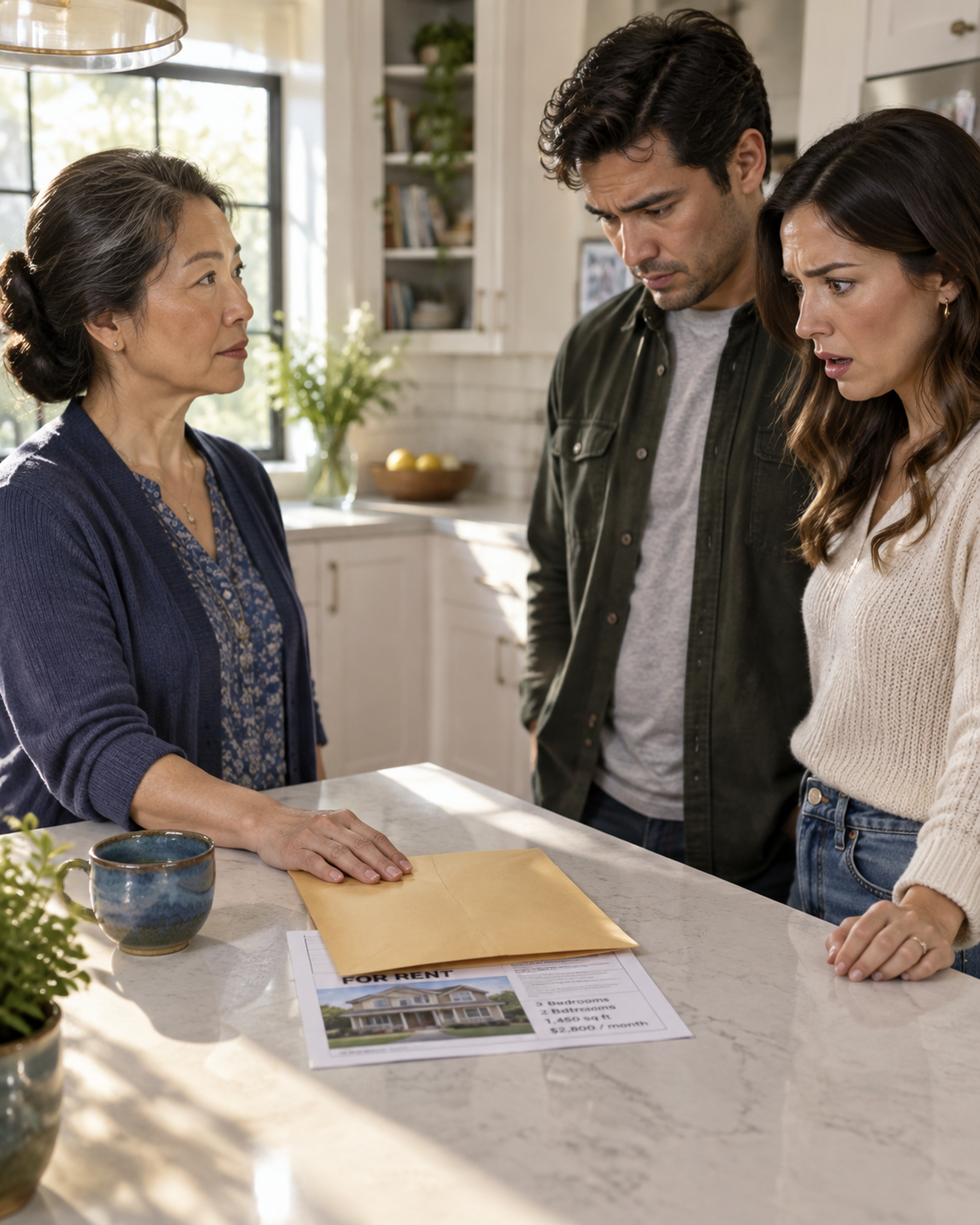
My daughter-in-law called my home “perfect for the nursery” and left a rental listing on my kitchen counter—as if I had already agreed to move out…
The Home They Wanted for Their Baby—And the Documents That Changed Their Plans My daughter-in-law called my home “perfect for...

Advertising – News
Reach the wife.trungtamhueicp.com audience. We offer a range of advertising and sponsorship opportunities across the site. For our media kit...